Skip to content
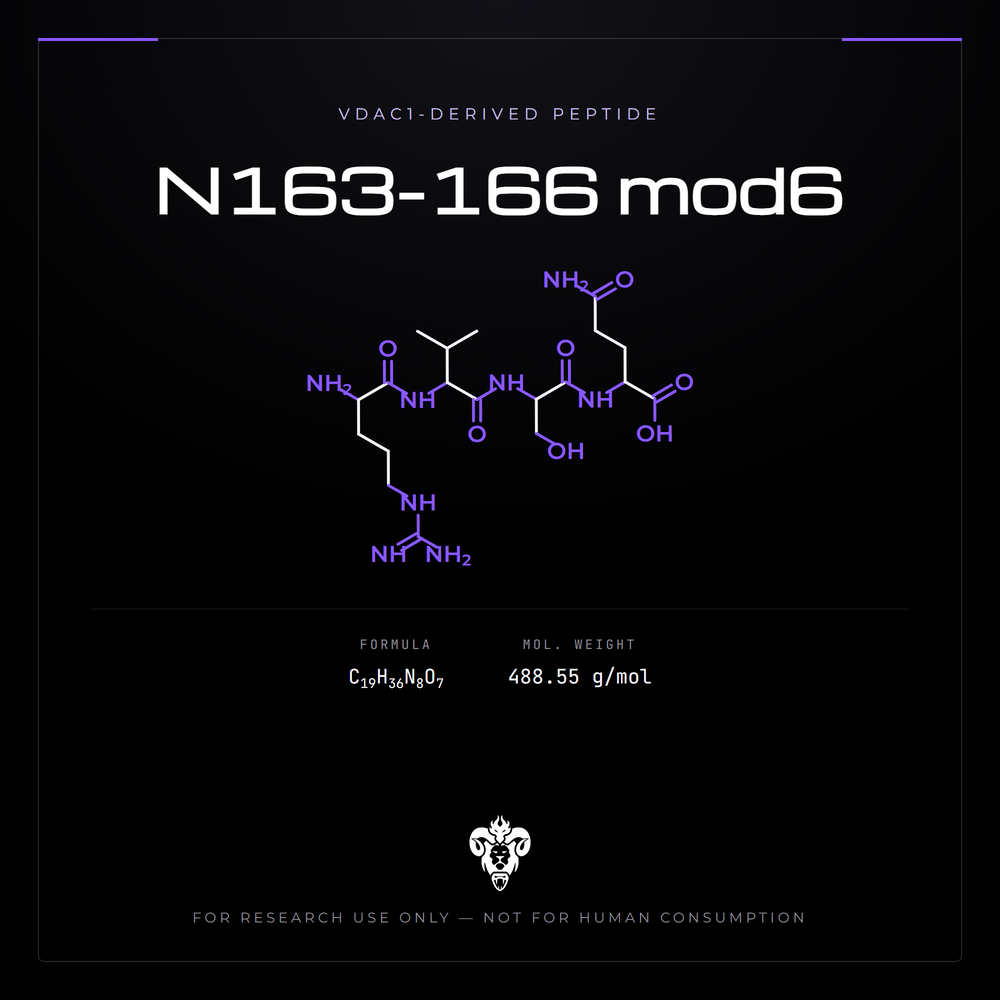

N163-166 mod6 (VDAC1-Derived Peptide) Research Standard
N163-166 mod6 is a specialized, synthetic VDAC1-derived tetrapeptide designed to modulate mitochondrial cholesterol transport. By targeting the interaction between the voltage-dependent anion channel 1 (VDAC1) and the steroidogenic transduceosome complex, this peptide serves as a research tool for studying the rate-limiting step of steroidogenesis. Specifically, N163-166 mod6 is utilized to investigate the selective enhancement of testosterone biosynthesis through increased mitochondrial cholesterol availability, while maintaining neutral activity regarding corticosterone production, offering a precise model for researching androgen-specific signaling.
Additional Properties
| Property | Specification |
|---|---|
| Origin | VDAC1 (Voltage-Dependent Anion Channel 1) |
| Sequence Modification | Arg-D-Val-Ser-Gln (R-D-V-S-Q) |
| Physical Appearance | Lyophilized powder |
Mechanism of Action (Pharmacological Context)
N163-166 mod6 functions by modulating the mitochondrial transduceosome, a multiprotein complex responsible for the translocation of cholesterol into the mitochondria—the rate-limiting step in steroidogenesis.
-
Cholesterol Transport: The peptide acts by interacting with VDAC1, which functions as a gatekeeper in the outer mitochondrial membrane. By disrupting inhibitory interactions (such as the 14-3-3epsilon binding to VDAC1), the peptide facilitates the recruitment of the Steroidogenic Acute Regulatory protein (StAR) and cholesterol import.
-
Testosterone Specificity: Research indicates that this mechanism specifically promotes androgen biosynthesis within Leydig cells. Notably, data suggests this enhancement occurs without stimulating a corresponding increase in corticosterone production, differentiating it from generalized steroidogenic stimulants.
-
D-Valine Modification: The inclusion of D-Valine in this specific “mod6” variant serves to increase proteolytic stability in in vitro and in vivo research models, preventing rapid degradation and allowing for more controlled kinetic analysis.
Research Applications
N163-166 mod6 is a pivotal tool for exploring mitochondrial dynamics and androgenic signaling.
Primary fields of in vitro and in vivo laboratory investigation include:
-
Steroidogenic Pathway Mapping: Studying the protein-protein interactions (PPIs) between VDAC1, TSPO, and StAR.
-
Mitochondrial Cholesterol Flux: Measuring the rate of cholesterol entry into the mitochondrial matrix under stimulated and basal conditions.
-
Androgen-Specific Signaling: Investigating why this peptide scaffold specifically upregulates testosterone biosynthesis while remaining selective relative to other steroid pathways (e.g., corticosterone).
-
Proteolytic Stability Research: Utilizing the D-Valine-modified tetrapeptide to benchmark how stereochemical variations improve the half-life of short-chain bioactive peptides.
Storage & Handling Guidelines
Store at controlled room temperature. Keep tightly closed.
Storage guidance is a house recommendation. Analytical documentation is per-lot release testing.
References
-
Martinez-Arguelles DJ, et al. (2023) Oral administration of VDAC1-derived small molecule peptides increases circulating testosterone levels in male rats. Frontiers in Endocrinology. 13:1003017. doi:10.3389/fendo.2022.1003017.
-
Aghazadeh Y, et al. (2014) Peptide Targeting of Mitochondria Elicits Testosterone Formation. Molecular Therapy. 22(8):1511-1520.
Related Research Compounds
Research Use Disclaimer
Research Use Only Disclaimer: This product is labeled and sold “For Research Use Only — NOT FOR HUMAN CONSUMPTION.” It is not a drug, dietary supplement, food, cosmetic, or medical device, and it is not approved by the FDA or any other regulator for human or veterinary use. It is supplied to approved account holders as a research chemical for laboratory use and must be handled in accordance with applicable law.