Skip to content
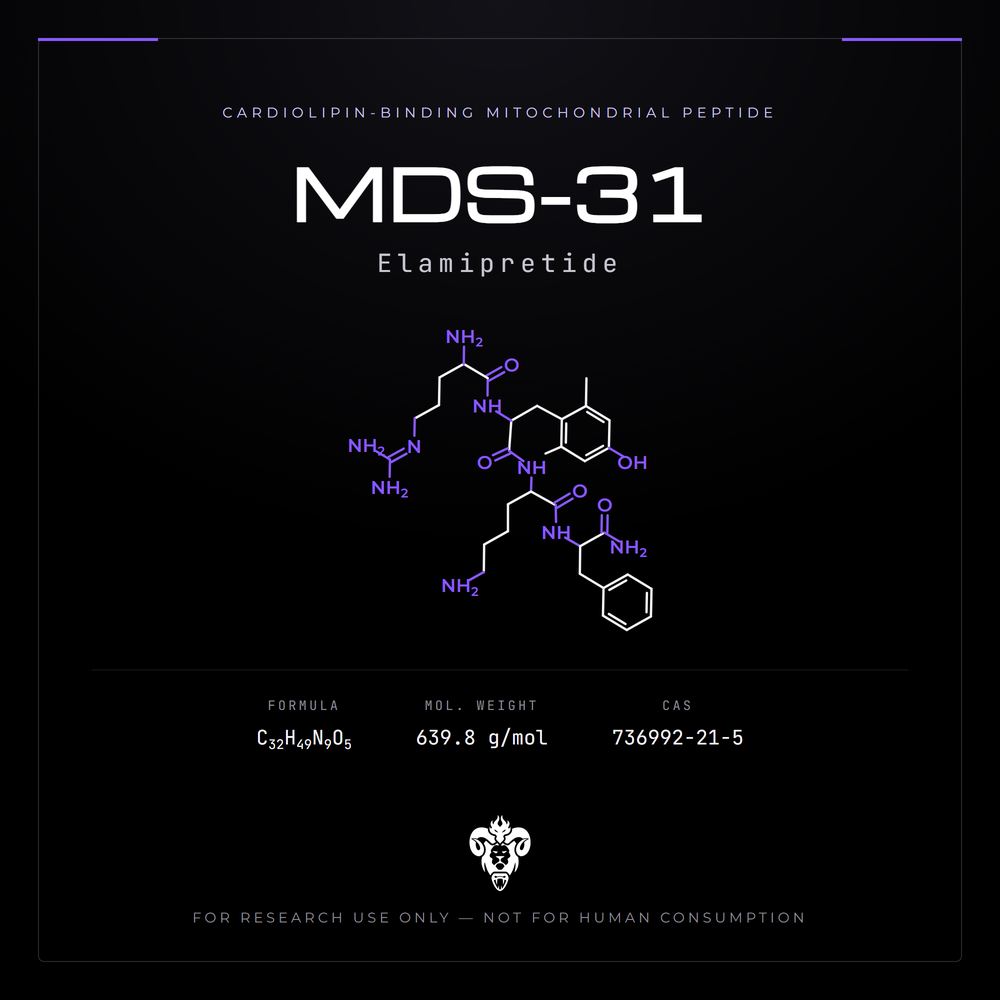

MDS-31 (Mitochondria-Targeted Peptide)
MDS-31 is a synthetic, cell-permeable tetrapeptide with the amino acid sequence D-Arg-Dmt-Lys-Phe-NH₂ (where Dmt represents 2′,6′-dimethyltyrosine). This compound is widely utilized in mitochondrial research for its specific targeting behavior within the inner mitochondrial membrane. By leveraging its unique structural motif of alternating aromatic and cationic residues, MDS-31 is frequently employed as a molecular probe to study cardiolipin interactions, cristae organization, and electron transport chain bioenergetics in isolated laboratory models.
Additional Properties
| Property | Specification |
|---|---|
| Sequence | D-Arg-Dmt-Lys-Phe-NH2 |
| Appearance | White to off-white lyophilized powder |
Mechanism of Action & Research Context
The primary utility of MDS-31 lies in its selective association with cardiolipin, a phospholipid concentrated on the inner mitochondrial membrane that is essential for maintaining cristae architecture and organizing respiratory supercomplexes.
-
Membrane Targeting: The tetrapeptide carries a net positive charge at physiological pH, driving its accumulation in mitochondrial compartments via the mitochondrial membrane potential.
-
Structural Role: Once localized, the peptide interacts with cardiolipin-rich membrane domains, which researchers study to understand its role in stabilizing electron transport chain (ETC) complexes and modulating cytochrome c interactions.
-
Bioenergetic Modulation: The Dmt (2′,6′-dimethyltyrosine) residue is a critical component of its SAR profile, distinguishing it from endogenous peptide sequences and influencing its membrane-targeting efficiency.
Research Applications
MDS-31 serves as a critical biochemical tool for investigating mitochondrial ultrastructure and bioenergetics in in vitro and ex vivo models.
Primary fields of laboratory investigation include:
-
Mitochondrial Bioenergetics: Assessing electron transport chain efficiency and ATP production pathways.
-
Cardiolipin-Protein Modeling: Studying the structural role of cardiolipin in membrane organization and ETC supercomplex stability.
-
Redox Biology: Investigating reactive oxygen species (ROS) generation dynamics at Complex I and Complex III.
-
Membrane Dynamics: Measuring membrane potential dynamics in isolated mitochondrial preparations.
-
Structural Ultrastructure Research: Utilizing the peptide as a probe for studying age-related changes in mitochondrial architecture.
Storage & Handling Guidelines
Store at controlled room temperature, sealed and protected from light.
Storage guidance is a house recommendation. Analytical documentation is per-lot release testing.
Related Research Compounds
Research Use Disclaimer
Research Use Only Disclaimer: This product is labeled and sold “For Research Use Only – NOT FOR HUMAN CONSUMPTION.” It is not a drug, dietary supplement, food, cosmetic, or medical device, and it is not approved by the FDA or any other regulator for human or veterinary use. It is supplied to approved account holders as a research chemical for laboratory use and must be handled in accordance with applicable law.