Skip to content
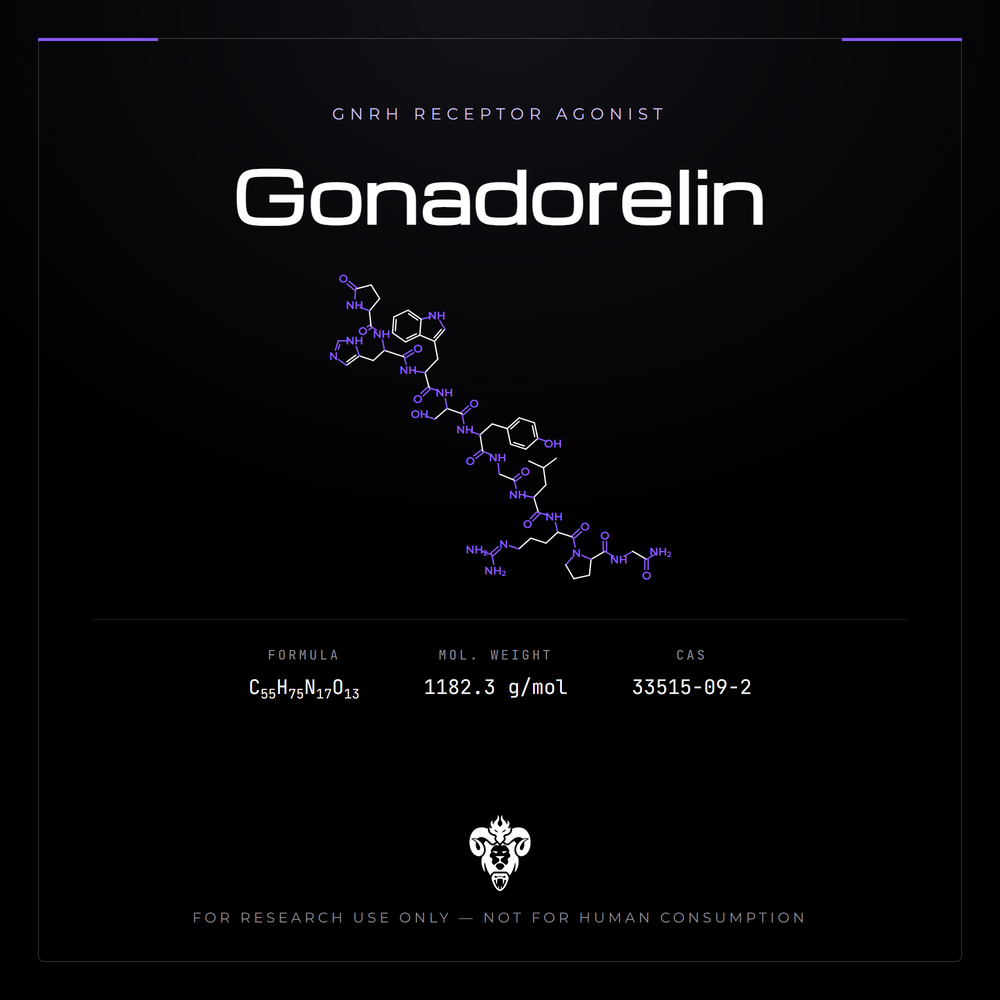

Gonadorelin Research Standard
Gonadorelin (CAS 33515-09-2) is gonadotropin-releasing hormone, the native hypothalamic decapeptide, supplied as a 2 mg lyophilized powder in a 3 mL vial. It is the unmodified endogenous sequence rather than an engineered analogue, which makes it the reference arm when characterising GnRH analogues.
Mechanism of Action & Research Context
The molecular target is the GnRH receptor on pituitary gonadotrophs — a minority cell population making up only 5–10% of pituitary cells.[1]
-
Pulsatility is part of the signal. GnRH is synthesised and secreted from the hypothalamus in a pulsatile manner. Continuous exposure and pulsatile exposure are not interchangeable at this receptor, which is the single most important design consideration when working with it.[1]
-
A branched signalling cascade. GnRH receptor activation drives phosphoinositide turnover, phospholipase D and phospholipase A2 activation, mobilisation and influx of Ca2+, and activation of protein kinase C and MAPK. Crosstalk between these messengers mediates the receptor’s diverse outputs, so a single readout captures only part of the response.[1]
-
A heterogeneous target population. Gonadotrophs are not uniform: roughly 60% are multihormonal (LH and FSH), about 18% contain LH only and about 22% FSH only. Population-level assays average across three cell types.[1]
-
Feedback is layered on top. Gonadal steroids and gonadal peptides exert positive and negative feedback that modifies GnRH action, so an isolated preparation and an intact axis give different answers.[1]
-
Upstream context. GnRH neurons receive an obligatory kisspeptin input via KISS1R, and they reach the hypothalamus by migrating from the olfactory placode during development.[2,3]
Research Applications
Primary fields of in vitro and preclinical laboratory investigation include:
-
Gonadotropin release assays in pituitary cell culture, with pulsatile and continuous exposure compared directly.[1]
-
Second-messenger profiling across phosphoinositide turnover, Ca2+ flux, PKC and MAPK.[1]
-
Gonadotropin subunit gene expression.[1]
-
Comparative pharmacology as the native reference against engineered GnRH analogues.[1]
-
Axis-level studies pairing GnRH with upstream kisspeptin manipulation.[2]
Analytical Documentation
Purity and identity vary by manufacturing lot. Kimera Chems does not publish a single fixed purity figure for this item; refer to the batch-specific Certificate of Analysis (COA) issued for the lot received, which reflects third-party analytical testing for that lot.
References
- Shacham S, Harris D, Ben-Shlomo H, et al. Mechanism of GnRH receptor signaling on gonadotropin release and gene expression in pituitary gonadotrophs. Vitam Horm. 2001;63:63–90. doi:10.1016/s0083-6729(01)63003-6
- Roseweir AK, Millar RP. Kisspeptin antagonists. Adv Exp Med Biol. 2013;784:159–186. doi:10.1007/978-1-4614-6199-9_8
- Schwarting GA, Wierman ME, Tobet SA. Gonadotropin-releasing hormone neuronal migration. Semin Reprod Med. 2007;25(5):305–312. doi:10.1055/s-2007-984736
Storage & Handling
Store at controlled room temperature, sealed and protected from light.
Storage guidance is a house recommendation. Analytical documentation is per-lot release testing.
Related Research Compounds
Research Use Only Disclaimer: This product is labeled and sold “For Research Use Only – NOT FOR HUMAN CONSUMPTION.” It is not a drug, dietary supplement, food, cosmetic, or medical device, and it is not approved by the FDA or any other regulator for human or veterinary use. It is supplied to approved account holders as a research chemical for laboratory use and must be handled in accordance with applicable law.