Skip to content
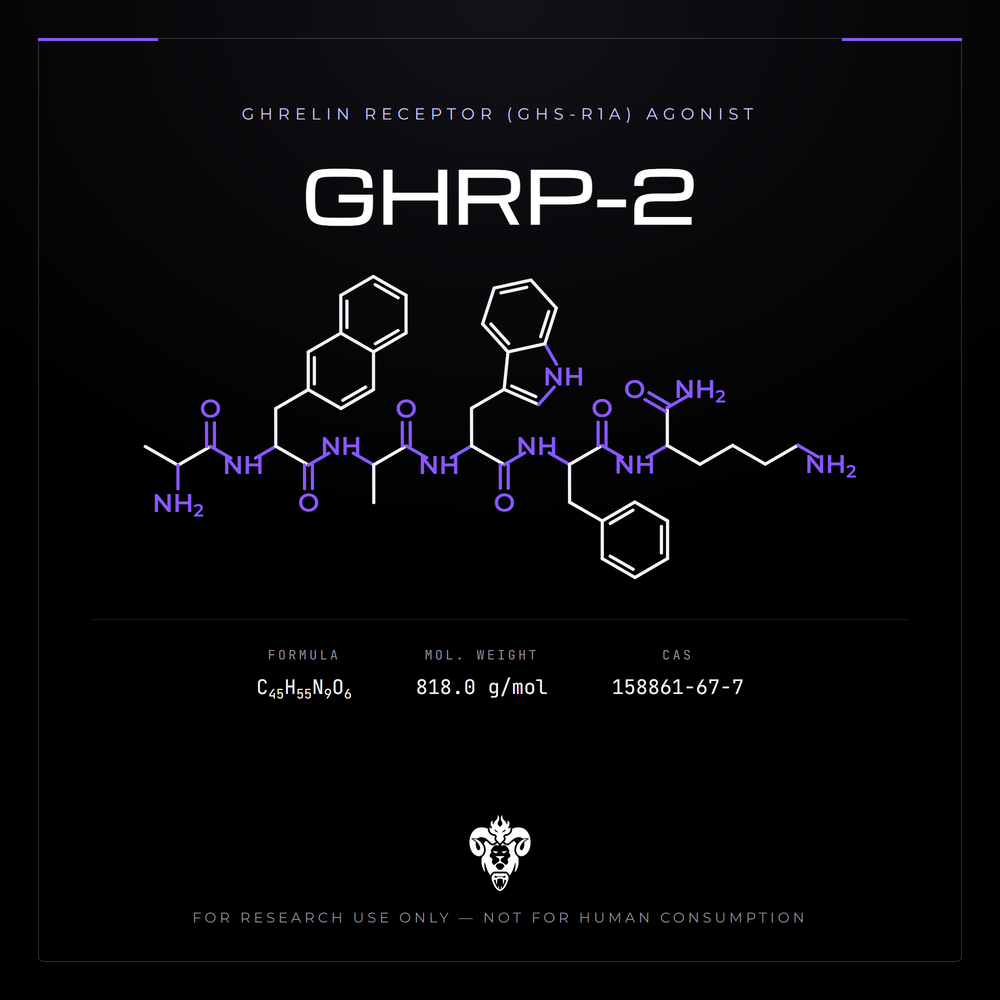

GHRP-2 Research Standard
GHRP-2 is a synthetic growth hormone-releasing peptide and GHS-R1a agonist, supplied as a 5 mg lyophilized powder in a 3 mL vial. Within this class it occupies a specific and useful position: higher potency than GHRP-6 but lower maximal efficacy, which makes potency and efficacy separable in a single experiment.[1]
Mechanism of Action & Research Context
The molecular target is the growth hormone secretagogue receptor GHS-R1a, a class A G-protein-coupled receptor whose endogenous ligand is ghrelin, a peptide produced predominantly by the stomach.
Potency and efficacy pull apart. In conscious swine, GHRP-2 gave ED50 = 0.6 nmol/kg against GHRP-6 at 3.9 ± 1.4 — roughly sixfold more potent — while reaching a lower maximum (Emax 56 ± 6 against 74 ± 7 ng GH/mL). A compound that is more potent and less efficacious than the reference is a good tool for separating the two properties, which dose-response work often conflates.[1]
Raises ACTH and cortisol. Like GHRP-6 and unlike ipamorelin, GHRP-2 increased plasma ACTH and cortisol. No effect on FSH, LH, PRL or TSH was seen for any secretagogue tested.[1]
A shared pharmacophore. The peptidic secretagogues converge on the core Ala-Trp-(D-Phe)-Lys. Radio-competitive assay against radiolabelled ghrelin at GHSR1a has mapped which substitutions at positions 1, 2, 3 and 7 preserve or destroy binding across GHRP-1, GHRP-2, GHRP-6, hexarelin and ipamorelin — and confirmed that active metabolites, not only intact parent, retain receptor binding.[2]
An unusually constitutively active receptor. GHS-R1a is notable among GPCRs for high ligand-independent signalling. The interaction between the ligand-binding transmembrane domains and extracellular loop 2 appears partly responsible. That basal activity drives PLC, PKC and CRE signalling, is reversed by the inverse agonist [D-Arg1, D-Phe5, D-Trp7,9, Leu11]-substance P, and the receptor also shows C-terminal-dependent constitutive internalisation. A nonsense mutation (Ala204Glu) that alters only the constitutive activity is associated with familial short stature, which is the strongest evidence that the basal signalling matters rather than being an artefact.[3]
Part of the response may be indirect. Radiolabelled GHRPs accumulate in the glandular stomach, the site of ghrelin synthesis. Resecting the gastrointestinal tract attenuated the GH response to GHRP-6 by 60–70% while leaving the GHRH response intact, which points to endogenous ghrelin mediating a substantial share of the effect rather than the peptide acting on the pituitary alone.[4]
Research Applications
Primary fields of in vitro and preclinical laboratory investigation include:
Radio-competitive receptor binding assays against radiolabelled ghrelin at GHSR1a.[2]
GH release assays in primary pituitary cell culture, with GHRP and GHRH antagonists to establish which receptor is carrying the response.[1]
Constitutive-activity and inverse-agonist work at GHS-R1a.[3]
Structure-activity studies across the shared Ala-Trp-(D-Phe)-Lys core.[2]
Metabolite and analytical method development, where active metabolites retain receptor binding.[2]
Analytical Documentation
Purity and identity vary by manufacturing lot. Kimera Chems does not publish a single fixed purity figure for this item; refer to the batch-specific Certificate of Analysis (COA) issued for the lot received, which reflects third-party analytical testing for that lot.
References
- Raun K, Hansen BS, Johansen NL, et al. Ipamorelin, the first selective growth hormone secretagogue. Eur J Endocrinol. 1998;139(5):552–561. doi:10.1530/eje.0.1390552
- Ferro P, Krotov G, Zvereva I, Rodchenkov G, Segura J. Structure-activity relationship for peptidic growth hormone secretagogues. Drug Test Anal. 2017;9(1):87–95. doi:10.1002/dta.1947
- Mear Y, Enjalbert A, Thirion S. GHS-R1a constitutive activity and its physiological relevance. Front Neurosci. 2013;7:87. doi:10.3389/fnins.2013.00087
- Ahnfelt-Rønne I, Nowak J, Olsen UB. Do growth hormone-releasing peptides act as ghrelin secretagogues? Endocrine. 2001;14(1):133–135. doi:10.1385/ENDO:14:1:133
- Locatelli V, Bresciani E, Bulgarelli I, et al. Ghrelin in gastroenteric pathophysiology. J Endocrinol Invest. 2005;28(9):843–848. doi:10.1007/BF03347579
Storage & Handling
Store at controlled room temperature, sealed and protected from light.
Storage guidance is a house recommendation. Analytical documentation is per-lot release testing.