
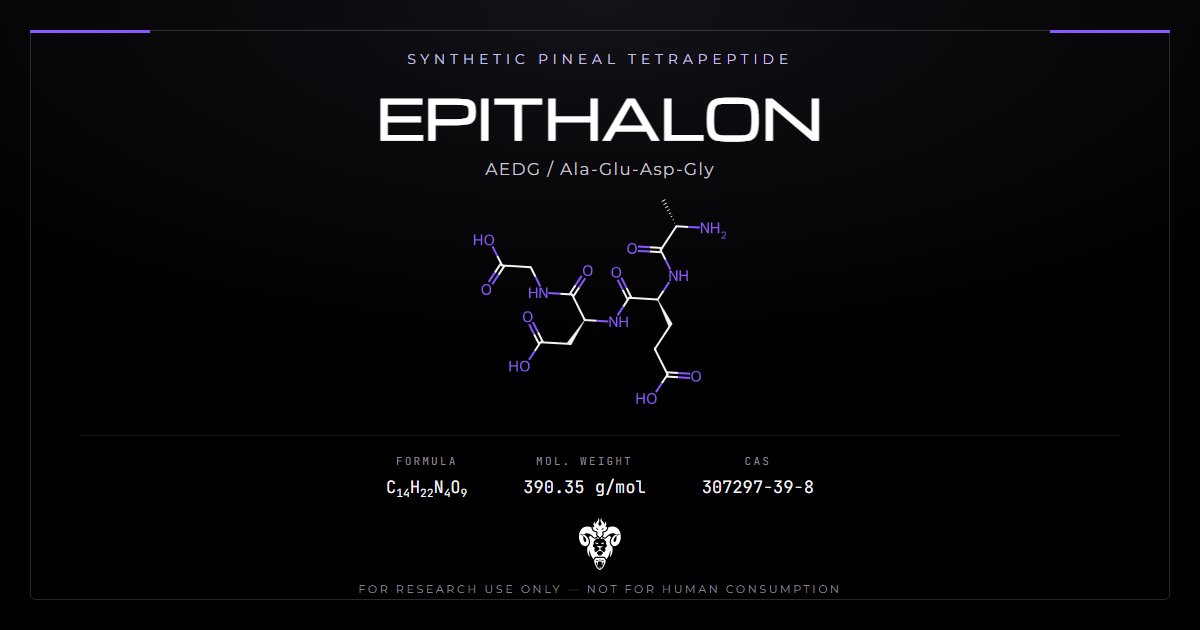
Four amino acids, in the order alanine, glutamate, aspartate, glycine. That is the whole molecule. Epithalon is one of the smallest peptides in any research catalogue, and it carries one of the largest claims attached to any of them.
The claim arrived in 2003. A St Petersburg group reported that the peptide induced telomerase activity and elongated telomeres in human somatic cells [1]. An independent group retested that in human cell lines twenty-two years later, in 2025 [3].
That gap of two decades is the most interesting fact about this compound’s literature, and it shapes how every other result in it should be read. Kimera supplies Epithalon as 10 mg of lyophilised powder for that kind of work.
Everything below reports findings from cells, animals and observational studies. This material is for research use only, not for human or veterinary use.
What Epithalon is
The compound is a synthetic tetrapeptide with free carboxyl groups on two of its four residues. Nothing about it is exotic chemically. Its interest comes entirely from what has been reported about it.
Identity and physical data
| Property | Value |
|---|---|
| Compound | Epithalon, also written Epitalon |
| Sequence | Ala-Glu-Asp-Gly, abbreviated AEDG |
| PubChem CID | 219042 |
| CAS number | 307297-39-8 |
| Molecular formula | C14H22N4O9 |
| Molecular weight | 390.35 g/mol |
| InChIKey | HGHOBRRUMWJWCU-FXQIFTODSA-N |
| Supplied form | 10 mg lyophilised powder in a 3 mL vial |
| Chemical class | Synthetic tetrapeptide |
An acidic peptide
Two of four residues carry side-chain carboxylates, glutamate and aspartate, and the C-terminal glycine adds a third free acid. That makes this an unusually acidic peptide for its size, which explains both its water solubility and its behaviour on ion exchange chromatography.
Where the sequence came from
The peptide was derived from Epithalamin, a bovine pineal extract studied by the same laboratory from the 1970s onward. Order matters here: the extract came first, and the tetrapeptide followed as a defined molecule meant to reproduce what the extract reportedly did.
From extract to defined peptide
That order of events matters when reading the older literature, since papers on the extract and papers on the peptide are often cited interchangeably.
The two are not the same material
Epithalamin is a peptide mixture from tissue. AEDG is a single synthesised sequence. A result from the extract does not transfer to the tetrapeptide without testing. Several frequently cited findings belong to the extract rather than to the defined molecule [16].
Four names, one search problem
The record spells this compound at least four ways. Epithalon and Epitalon are the common variants, AEDG is the sequence abbreviation, and Epithalamin names the extract rather than the peptide.
PubMed indexes those strings separately. A search for Epithalon alone misses papers filed under Epitalon, and both miss the AEDG papers. Search all four and read the methods to see which material each paper used, since the extract and the peptide share a literature but not a molecule.
The programme around them
Both sit inside a larger Russian research programme on short peptide bioregulators, which produced dozens of sequences aimed at different tissues. The catalogue carries that family as Bioregulators. Reading one member alone makes its claims look more isolated than they are. Reading the programme as a whole shows how consistent its methods and its journals have been.
The telomerase claim
The original reports
A 2003 paper reported telomerase activity induction and telomere elongation in human somatic cells [1]. A 2004 follow-up from the same group reported that treated cells passed their normal division limit [2]. Both appeared in Bulletin of Experimental Biology and Medicine.
What happened next, and did not
Those two papers became the citation backbone for everything written about the compound since. For two decades no independent laboratory published a quantitative retest, which is unusual for a claim of that size.
The 2025 retest
A 2025 study in Biogerontology measured telomere length, hTERT mRNA, telomerase enzyme activity and alternative lengthening of telomeres across human cell lines [3]. The authors framed their work explicitly against the thinness of prior quantitative data (PubMed). That paper carries a published correction [4], which is worth pulling alongside the original rather than citing the result blind.
The proposed mechanism
The mechanism offered by the originating group is direct interaction with DNA.
Peptide binding to the double helix
A 2003 paper reported effects of regulatory peptides on gene transcription [5]. A 2005 paper proposed that short peptides bind the DNA double helix in a manner comparable to transcription factors [6]. The model treats a four-residue peptide as a sequence-recognising element.
The epigenetic framing
A 2020 study in Molecules reported that AEDG stimulated gene expression and protein synthesis during neurogenesis, and proposed an epigenetic mechanism [7]. A 2020 Russian paper reported effects on circadian rhythm gene expression in a pineal ageing model [8].
What is missing from the model
No published structure shows the peptide bound to DNA. No binding constant is widely reported. A mechanism proposed in 2003 and still lacking structural confirmation in 2026 is a hypothesis, not an established route, and the compound’s own literature does not close that gap.
Melatonin and the pineal axis
The pineal origin of the parent extract set the direction for much of this work.
Reports in animals and people
A 2012 study examined melatonin and Epithalamin effects on peroxidation products in rat cortex and hippocampus under acute hypoxia [9]. A 2017 report described increased pineal melatonin synthesis in elderly participants given a peptide preparation marketed as Pineamin [10]. Both belong to their study populations and neither establishes a mechanism.
Why melatonin keeps appearing
If a compound derived from pineal tissue changes pineal output, the whole downstream circadian literature becomes relevant to it. That logic explains why melatonin measurements recur across the programme. It also explains why the results are hard to separate from the assumption behind them.
Rodent lifespan and carcinogenesis work
The SAM mouse study
A 2005 study compared epitalon and melatonin for effects on life span and spontaneous carcinogenesis in senescence-accelerated mice [11]. Senescence-accelerated strains reach endpoints faster than normal mice, which makes them practical and also makes them a specific model rather than a general one.
The human observational claim
A 2003 paper from the originating group reported that pineal and thymic peptide preparations prolonged human life in the cohorts it followed [12]. That is an observational claim from the laboratory that developed the compounds, published in a journal outside the mainstream gerontology literature. Weigh it accordingly, and do not treat it as trial evidence.
Recent work from other groups
The last four years have brought results from laboratories with no connection to the originating programme, and they are the most informative part of the current record.
Oocyte studies
A 2022 study reported protection against post-ovulatory ageing-related damage in mouse oocytes in vitro [13]. A 2025 study reported that Epithalon-activated telomerase improved bovine oocyte maturation rate and post-thaw embryo development [14]. Reproductive biology brings its own quantitative endpoints, which is why these papers report numbers the older literature does not.
A wound-healing model
A 2025 study in Stem Cell Reviews and Reports examined the peptide as an antioxidant in an in vitro model of diabetic retinopathy. It reported enhanced delayed wound healing [15].
Recent reviews
An overview published in 2025 collected the pharmacological claims [16]. A 2026 review placed therapeutic peptides in gerontology more broadly [17]. Reviews inherit the evidence base they summarise, so read them for orientation and go to the primary papers for anything load-bearing.
Reading a literature dominated by one lineage
Count the affiliations
Most primary work on this peptide traces to one institute and its collaborators [1][2][5][6][12]. That concentration is not misconduct and it is not evidence of error. It does mean the usual cross-checking that independent replication provides has been largely absent.
What independent means here
Independence is a spectrum rather than a switch. The 2022 and 2025 papers come from groups outside the originating institute, which is the meaningful line. Some still cite the founding papers as their rationale, so they inherit a hypothesis while testing it with their own hands.
That is normal and it is still progress. A result from a laboratory with no stake in Epithalon carries weight the internal literature cannot supply, whatever prompted the experiment.
Language is part of the barrier
Several key papers are Russian-language with English abstracts only. An abstract carries the claim and drops the method, so a reader outside those journals cannot check strain, schedule or statistics.
Treat those entries as pointers rather than as evidence you have examined. Where an English-language paper covers the same ground, cite that one instead.
Where the journals sit
Bulletin of Experimental Biology and Medicine, Advances in Gerontology and Neuroendocrinology Letters carry much of the record. Several papers are Russian-language with English abstracts, so methods detail often stays out of reach for readers outside those journals.
What that means in practice
Read pre-2022 results as internally consistent rather than independently confirmed. The 2022 and 2025 papers from other groups are the first meaningful outside tests. Four of them stand against two decades of prior work.
Designing a telomerase experiment
The founding claim is testable with standard reagents, and the 2025 paper shows what a modern version looks like [3].
Four measurements, not one
Telomere length, hTERT transcript level, telomerase enzyme activity and alternative lengthening of telomeres are four different endpoints. A compound can move one without moving the others. Reporting telomere length alone leaves the mechanism unresolved, which is what the 2025 authors set out to fix (PubMed).
Timescale is the hidden cost
Telomere work runs long. Length changes accumulate over population doublings, not over hours, so a meaningful experiment spans weeks of passaging with treatment maintained throughout.
Budget for that before starting. Peptide added once at day zero has degraded long before the readout, and a study that dosed once and measured at four weeks has measured the vehicle. Fresh addition at each medium change is the minimum, and recording the actual schedule matters more than the nominal concentration.
Cell line choice decides the answer
Immortalised lines already express telomerase. Primary fibroblasts do not, past a point. A result in one says little about the other, so state the line, the passage number and the baseline telomerase status before treatment.
Controls that make the result readable
Run a vehicle arm, a positive control that induces telomerase by a known route, and a scrambled-sequence peptide of the same composition. A scrambled control separates sequence-specific activity from any effect of four free amino acids, and it costs one extra synthesis.
Physicochemical properties and handling
| Property | Detail |
|---|---|
| Appearance | White lyophilised powder |
| Solubility | Water soluble; bacteriostatic water and saline both used |
| Reconstitution | Add diluent down the vial wall, swirl, do not shake |
| Storage, lyophilised | Minus 20 degrees Celsius, desiccated, protected from light |
| Storage, reconstituted | 2 to 8 degrees Celsius, short term only |
| Stability note | Aspartate-glycine sequences are prone to succinimide formation |
| Handling | Standard laboratory controls for a lyophilised peptide |
The Asp-Gly bond is the weak point
This sequence ends in aspartate followed by glycine. Asp-Gly is the classic motif for succinimide formation and subsequent isomerisation to iso-aspartate, which proceeds fastest at neutral to slightly alkaline pH. The rearrangement changes the backbone without changing the mass, so a routine mass check will not see it.
Two practical consequences follow. Keep reconstituted material cold and use it promptly. And when a stored solution gives a weaker result than a fresh one, consider isomerisation before blaming the assay.
Solubility and pH
Three carboxylates make the peptide soluble in water and in saline, and its isoelectric point sits low. Solutions near neutral pH carry net negative charge, which helps solubility and also drives the isomerisation described above.
Acidic diluents slow that rearrangement. They also change what the peptide meets in a cell assay, so match the diluent to the experiment rather than to the storage convenience.
Reconstitution discipline
Lyophilised peptide sits as a loose cake that can lift and stick to the stopper. Add diluent slowly against the glass, let it wet the cake, then swirl. Vortexing shears peptide and foams the solution, and foam carries material out of the working volume.
Analytical characterization
Mass confirmation
Electrospray gives a protonated ion at m/z 391.2 for the C14H22N4O9 formula, and a deprotonated ion at 389.1 in negative mode. The three free carboxylates make negative mode the more sensitive choice for this peptide, which is the opposite of the usual preference.
Confirming sequence, not just mass
Four residues can be permuted many ways at the same mass. Tandem mass spectrometry resolves the order through the fragment series, and amino acid analysis confirms composition. A mass alone confirms formula and says nothing about sequence, which matters for a compound whose identity is its sequence. Batch documentation for catalogue material sits in the certificate of analysis database.
Amino acid analysis still earns its place
Composition analysis is old technology and it answers a question nothing else answers cheaply: how much of the vial is peptide of the right composition. Hydrolysis followed by derivatisation gives molar ratios for alanine, glutamate, aspartate and glycine.
Ratios near one to one to one to one confirm composition. Ratios that drift indicate either a synthesis problem or a batch diluted with something that is not this peptide.
Separating the isomer
Iso-aspartate forms shift retention slightly on reversed-phase columns, and a shallow gradient resolves them from the parent. Running a fresh vial beside a stored solution on the same gradient shows whether the peak has split or shouldered.
That comparison is the practical test for this sequence. Mass spectrometry cannot see the rearrangement, so chromatography carries the whole burden.
What a peptide certificate should carry
Purity by reversed-phase HPLC with the gradient stated, net peptide content, and water content. Counterion content belongs there too, since lyophilised peptides carry acetate or trifluoroacetate from purification and that mass is not peptide. Ignoring net peptide content overstates every concentration prepared from the vial.
Where Epithalon sits among peptide research compounds
| Compound | Studied theme | Class |
|---|---|---|
| Epithalon | Telomerase, pineal signalling, circadian gene expression | Tetrapeptide |
| Bioregulators | Tissue-specific short peptide programme | Peptide family |
| MOTS-C | Mitochondrial-derived peptide, metabolic signalling | 16-residue peptide |
| FOXO4-DRI | Senescent cell targeting via FOXO4 and p53 | Retro-inverso peptide |
All four appear in ageing research and reach it by different routes. Further reading sits in the peptides research library.
What this literature does not establish
Independent confirmation of the founding claim
One independent quantitative retest exists, published in 2025 and carrying a correction [3][4]. That is thin ground under a claim that has been repeated for twenty years.
A confirmed mechanism
The DNA-binding model rests on papers from the originating group [5][6]. No structural work confirms it, and no widely reported binding constant supports it.
Human evidence of the usual kind
The human claims in this literature are observational and come from the developing laboratory [12]. No controlled trial evidence of the standard sort appears in the indexed record.
Exposure data
No pharmacokinetic dataset for Epithalon appears in the indexed record. A tetrapeptide with three free carboxylates faces both peptidase clearance and poor membrane permeability, so exposure is the obvious question, and nobody has published the answer.
That absence limits how far any in vivo result can be interpreted. It also means an in vitro concentration cannot be justified by reference to a measured plasma level, because none exists.
Where the extract ends and the peptide begins
Older results often belong to Epithalamin rather than to AEDG. Check which material a paper used before citing it for the tetrapeptide, because the two are separated by a purification step and thirty years of publication.
Frequently asked questions
What is the sequence?
Ala-Glu-Asp-Gly, abbreviated AEDG. Four residues, 390.35 g/mol.
Is the telomerase effect confirmed?
Partly examined. Papers from 2003 and 2004 reported it, both from the originating group [1][2]. A 2025 independent study then measured telomere length, hTERT mRNA and telomerase activity in human cell lines [3]. That paper has a published correction [4].
How does Epithalon differ from Epithalamin?
Epithalamin is a bovine pineal extract, a mixture. Epithalon is one synthesised tetrapeptide. Results from one do not transfer to the other without testing.
What degrades in storage?
The Asp-Gly bond, through succinimide formation and isomerisation to iso-aspartate. The mass does not change, so mass spectrometry alone will not detect it.
Does the peptide need a scrambled control?
For any sequence-specific claim, yes. Four free amino acids in random order test whether the effect depends on the sequence or on the composition.
Which ionisation mode suits it?
Negative mode, usually. Three free carboxylates ionise well as anions, and the peptide has only one basic site.
Is Epithalon the same as Epitalon?
Yes. The two spellings describe the same tetrapeptide, and both appear across the literature.
What is the largest gap in the evidence?
Independent replication of the founding telomerase claim, and any pharmacokinetic data at all. One 2025 study addresses the first [3]. Nothing addresses the second.
Why is net peptide content on the certificate?
Because lyophilised peptides carry counterion and water. The vial mass is not all peptide, and concentrations calculated from gross mass run high.
References
- Khavinson VKh, Bondarev IE, Butyugov AA. Epithalon peptide induces telomerase activity and telomere elongation in human somatic cells. Bull Exp Biol Med. 2003;135(6):590-2. PubMed DOI
- Khavinson VKh, Bondarev IE, Butyugov AA, et al. Peptide promotes overcoming of the division limit in human somatic cells. Bull Exp Biol Med. 2004;137(5):503-6. PubMed DOI
- Al-Dulaimi S, Thomas R, Matta S, et al. Epitalon increases telomere length in human cell lines through telomerase upregulation or ALT activity. Biogerontology. 2025;26(5):178. PubMed DOI
- Al-Dulaimi S, Thomas R, Matta S, et al. Correction: Epitalon increases telomere length in human cell lines through telomerase upregulation or ALT activity. Biogerontology. 2025;27(1):1. PubMed DOI
- Khavinson VKh, Shataeva LK, Chernova AA. Effect of regulatory peptides on gene transcription. Bull Exp Biol Med. 2003;136(3):288-90. PubMed DOI
- Khavinson V, Shataeva L, Chernova A. DNA double-helix binds regulatory peptides similarly to transcription factors. Neuro Endocrinol Lett. 2005;26(3):237-41. PubMed
- Khavinson V, Diomede F, Mironova E, et al. AEDG peptide (epitalon) stimulates gene expression and protein synthesis during neurogenesis: possible epigenetic mechanism. Molecules. 2020;25(3):609. PubMed DOI
- Ivko OM, Linkova NS, Ilina AR, et al. [AEDG peptide regulates human circadian rhythm gene expression during pineal gland accelerated aging]. Adv Gerontol. 2020;33(3):429-435. PubMed
- Zamorskii II, Sopova IY, Khavinson VKh. Effects of melatonin and epithalamin on the content of protein and lipid peroxidation products in rat cortex and hippocampus under conditions of acute hypoxia. Bull Exp Biol Med. 2012;154(1):51-3. PubMed DOI
- Trofimova SV, Linkova NS, Klimenko AA, et al. [Pineamin increased pineal melatonin synthesis in elderly people]. Adv Gerontol. 2017;30(3):422-426. PubMed
- Anisimov VN, Popovich IG, Zabezhinskii MA, et al. [Effect of epitalon and melatonin on life span and spontaneous carcinogenesis in senescence accelerated mice (SAM)]. Vopr Onkol. 2005;51(1):93-8. PubMed
- Khavinson VKh, Morozov VG. Peptides of pineal gland and thymus prolong human life. Neuro Endocrinol Lett. 2003;24(3-4):233-40. PubMed
- Yue X, Liu SL, Guo JN, et al. Epitalon protects against post-ovulatory aging-related damage of mouse oocytes in vitro. Aging (Albany NY). 2022;14(7):3191-3202. PubMed DOI
- Ullah S, Haider Z, Perera CD, et al. Epitalon-activated telomerase enhance bovine oocyte maturation rate and post-thawed embryo development. Life Sci. 2025;362:123381. PubMed DOI
- Gatta M, Dovizio M, Milillo C, et al. The antioxidant tetrapeptide epitalon enhances delayed wound healing in an in vitro model of diabetic retinopathy. Stem Cell Rev Rep. 2025;21(6):1822-1834. PubMed DOI
- Araj SK, Brzezik J, Madra-Gackowska K, et al. Overview of epitalon, a highly bioactive pineal tetrapeptide with promising properties. Int J Mol Sci. 2025;26(6):2691. PubMed DOI
- Mavrych V, Shypilova I, Bolgova O. Therapeutic peptides in gerontology: mechanisms and applications for healthy aging. Front Aging. 2026;7:1790247. PubMed DOI