Skip to content

FOXO4-DRI Research Standard
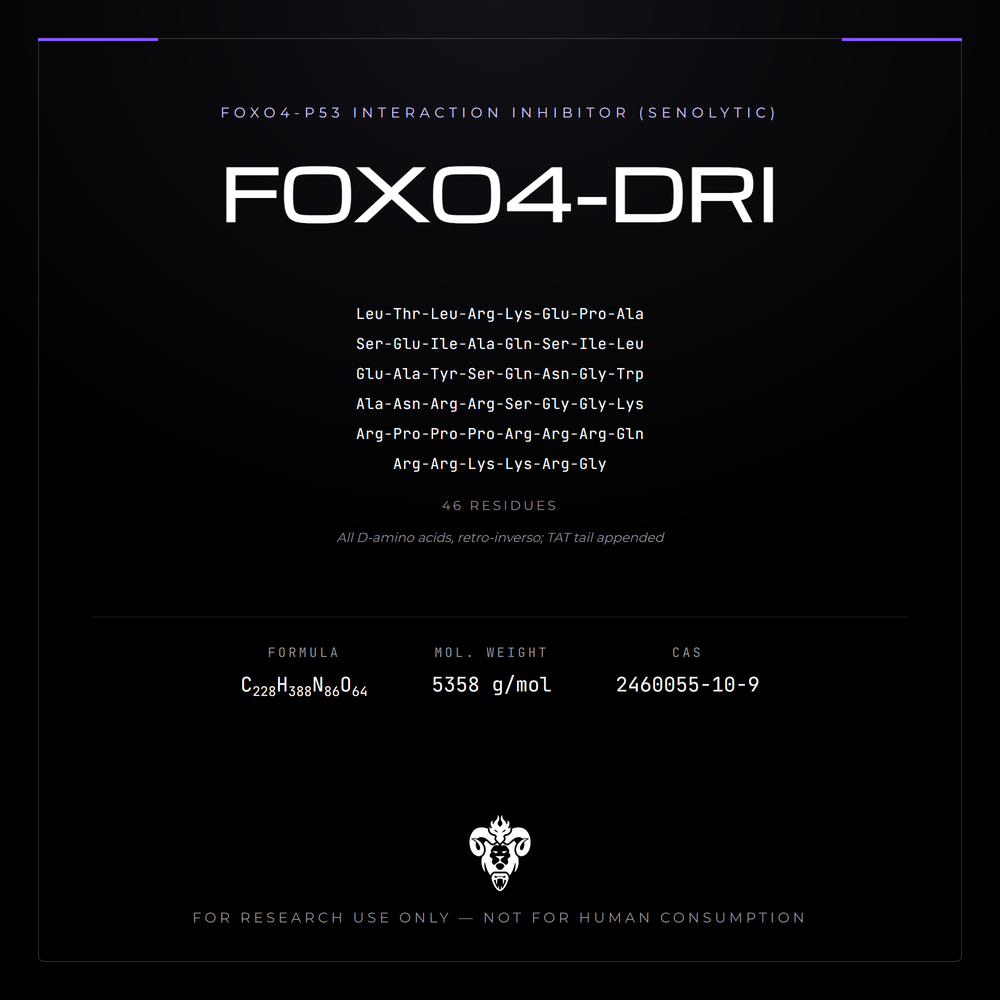
FOXO4-DRI (CAS 2460055-10-9), also indexed as proxofim, is supplied as a 10 mg lyophilized powder in a 3 mL vial. The DRI in its name is D-retro-inverso: the sequence is reversed and built from D-amino acids, a standard strategy for producing a peptide that presents a similar side-chain topology to the L-peptide while resisting proteolysis.
Mechanism of Action & Research Context
Its target is a protein-protein interaction rather than a receptor, which puts it in a different design category from most peptides sold for research.
It blocks the FOXO4-p53 interaction. FOXO4 is a forkhead box O transcription factor. In senescent cells it maintains viability and suppresses apoptosis. FOXO4-DRI, described as a specific FOXO4 blocker, disrupts the FOXO4-p53 interaction, which selectively induces p53 nuclear exclusion and apoptosis in senescent cells.[1]
Selectivity comes from the biology, not the molecule. The peptide is not cell-type selective by design — it works where the FOXO4-p53 interaction is doing the work of keeping a senescent cell alive. That is the whole senolytic premise, and it means a model without a genuine senescent population has nothing to demonstrate.[1]
Characterised in a defined senescence model. Hydrogen peroxide-induced senescent TM3 Leydig cells were used as the in vitro system, with FOXO4 nuclear translocation in aged human tissue as the observation motivating it. In naturally aged mice, FOXO4-DRI improved the testicular microenvironment.[1]
Nuclear localisation is the readout. The mechanism is expressed as p53 moving out of the nucleus, so imaging or fractionation beats a simple viability assay for demonstrating it.[1]
Research Applications
Primary fields of in vitro and preclinical laboratory investigation include:
Senescent cell models, such as H2O2-induced senescence, with non-senescent controls.[1]
FOXO4-p53 interaction assays by co-immunoprecipitation or proximity methods.[1]
p53 subcellular localisation by imaging or nuclear/cytoplasmic fractionation.[1]
Senescence marker panels paired with apoptosis readouts.[1]
Proteolytic stability comparison against the L-peptide equivalent.
Analytical Documentation
Purity and identity vary by manufacturing lot. Kimera Chems does not publish a single fixed purity figure for this item; refer to the batch-specific Certificate of Analysis (COA) issued for the lot received, which reflects third-party analytical testing for that lot.
References
- Zhang C, Xie Y, Chen H, et al. FOXO4-DRI alleviates age-related testosterone secretion insufficiency by targeting senescent Leydig cells in aged mice. Aging (Albany NY). 2020;12(2):1272–1284. doi:10.18632/aging.102682
Storage & Handling
Store at controlled room temperature, sealed and protected from light.
Storage guidance is a house recommendation. Analytical documentation is per-lot release testing.