Skip to content
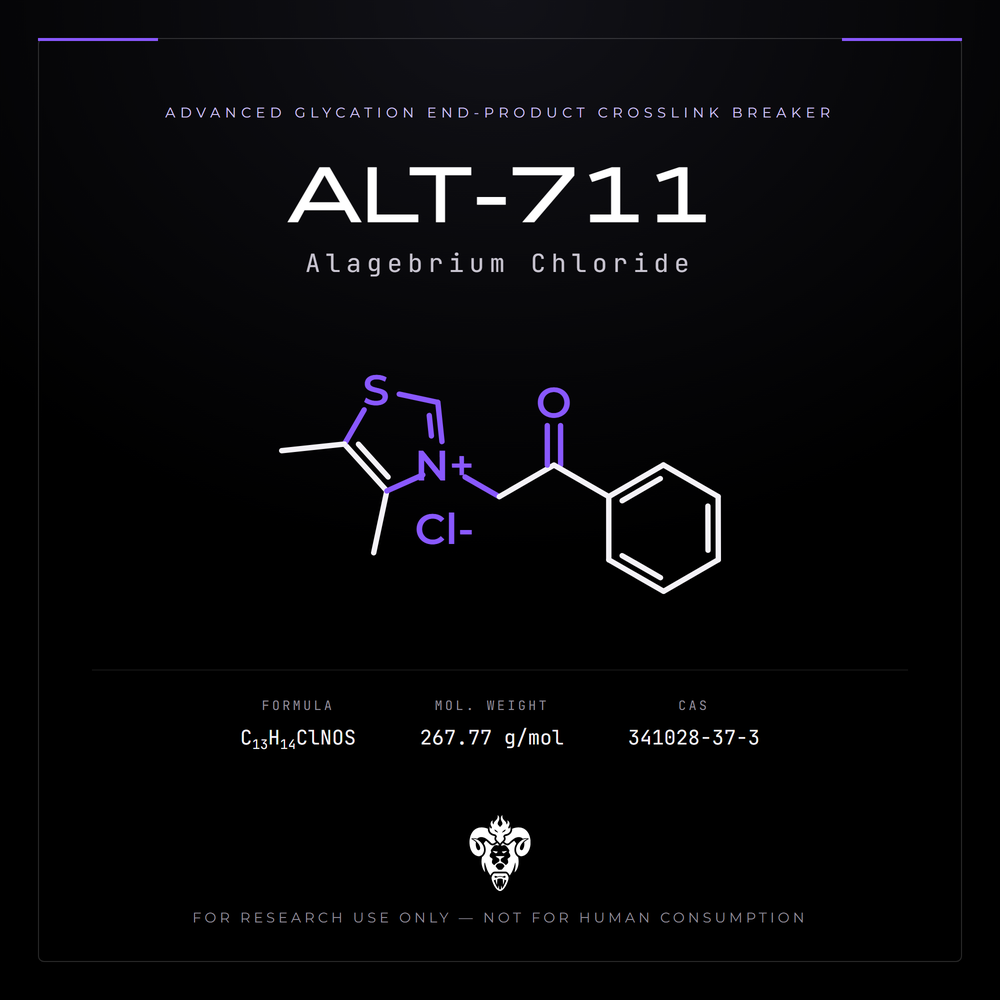

ALT-711 (Alagebrium Chloride)
ALT-711 is a thiazolium salt developed as an advanced glycation end-product crosslink breaker. Advanced glycation end-products form when reducing sugars react non-enzymatically with protein amino groups, and the late-stage products of that reaction can covalently bridge adjacent long-lived proteins. Collagen and elastin are the usual substrates, and because they turn over slowly the crosslinks accumulate. Most anti-glycation chemistry aims to prevent that reaction. This compound is interesting because it was designed to reverse it.
The proposed chemistry is cleavage of alpha-dicarbonyl crosslinks, and the compound is the standard positive control in that assay class. It is worth being precise about the evidence, though: the crosslink-breaking activity is best characterised in cell-free and in-vitro systems, and a second, separable activity has been reported at protein kinase C. Whether an observed effect in a tissue model reflects crosslink cleavage or kinase inhibition is a real experimental question rather than a settled one.
Physical & Handling Properties
| Property | Specification |
|---|---|
| Appearance | Off-white to pale crystalline solid |
| Solubility Profile | Soluble in water and DMSO; the quaternary thiazolium is hygroscopic |
| Solution Base | PEG400, Propylene Glycol, Distilled Water, PS80, Potassium Sorbate |
Research Applications & Mechanism of Action
The reactive centre is the thiazolium ring. Its C-2 position is nucleophilic, and the proposed mechanism has that carbon attacking the dicarbonyl bridge of an established crosslink, cleaving the linkage and releasing the two proteins. The practical consequence in a tissue model is a change in the mechanical properties of the extracellular matrix rather than a change in gene expression, which is why the readouts are so often physical.
Primary fields of in vitro and preclinical laboratory investigation include:
-
Crosslink Cleavage Assays: Cell-free systems using glycated model proteins, where the readout is recovered solubility or restored electrophoretic mobility.
-
Matrix Mechanics: Measuring tensile and compliance properties of collagen-rich tissue preparations after glycation and after treatment.
-
AGE Quantification: Tracking tissue pentosidine and other AGE markers as the direct chemical endpoint.
-
Mechanism Discrimination: Separating crosslink-breaking activity from reported protein kinase C isoform inhibition, which requires a kinase-activity arm rather than a matrix readout alone.
-
Analytical Reference Work: A defined thiazolium standard for chromatographic method development in glycation chemistry.
Selected Research Literature
Peer-reviewed literature indexed on PubMed, provided for scientific context only. Nothing here describes or implies a use for this material.
- Coughlan MT, Forbes JM, Cooper ME. Role of the AGE crosslink breaker, alagebrium, as a renoprotective agent in diabetes. Kidney Int Suppl. 2007;(106):S54-S60. doi:10.1038/sj.ki.5002387
Assay note. Coughlan et al. note that alongside reducing tissue AGE levels the compound appears to inhibit certain protein kinase C isoforms. An experiment that measures only a downstream tissue outcome cannot separate those two mechanisms; a direct crosslink or AGE-content endpoint is what makes the attribution.
Analytical Documentation
Purity, identity, and composition vary by manufacturing lot. Kimera Chems does not publish a single fixed purity figure for this item; refer to the batch-specific Certificate of Analysis (COA) issued for the lot received, which reflects third-party analytical testing for that lot. Contact us if a COA for your lot is required.
Storage & Handling
Store at controlled room temperature. Keep tightly closed. Liquid formats: do not refrigerate or freeze. Cold storage may cause the solution to cloud or precipitate. If this occurs, return to room temperature and mix until clear.
Storage guidance is a house recommendation. Analytical documentation is per-lot release testing.
Related Research Compounds
Research Use Disclaimer
Research Use Only Disclaimer: This product is labeled and sold “For Research Use Only — NOT FOR HUMAN CONSUMPTION.” It is not a drug, dietary supplement, food, cosmetic, or medical device, and it is not approved by the FDA or any other regulator for human or veterinary use. It is supplied to approved account holders as a research chemical for laboratory use and must be handled in accordance with applicable law.