
Fenbendazole is a veterinary anthelmintic that acquired a second reputation online, and the founding observation behind that reputation is worth reading carefully.
In 2008, a lymphoma xenograft at Johns Hopkins failed to grow. The mice had been fed a diet containing this compound to control pinworms. The investigators ran the controlled follow-up, and the result was specific: the compound alone changed nothing.
That study is cited constantly and its conclusion is quoted rarely. What follows sets out the chemistry, the mechanism, the split animal literature, the absorption problem that explains much of the split, and the human harm that has been documented.
Chemical identity
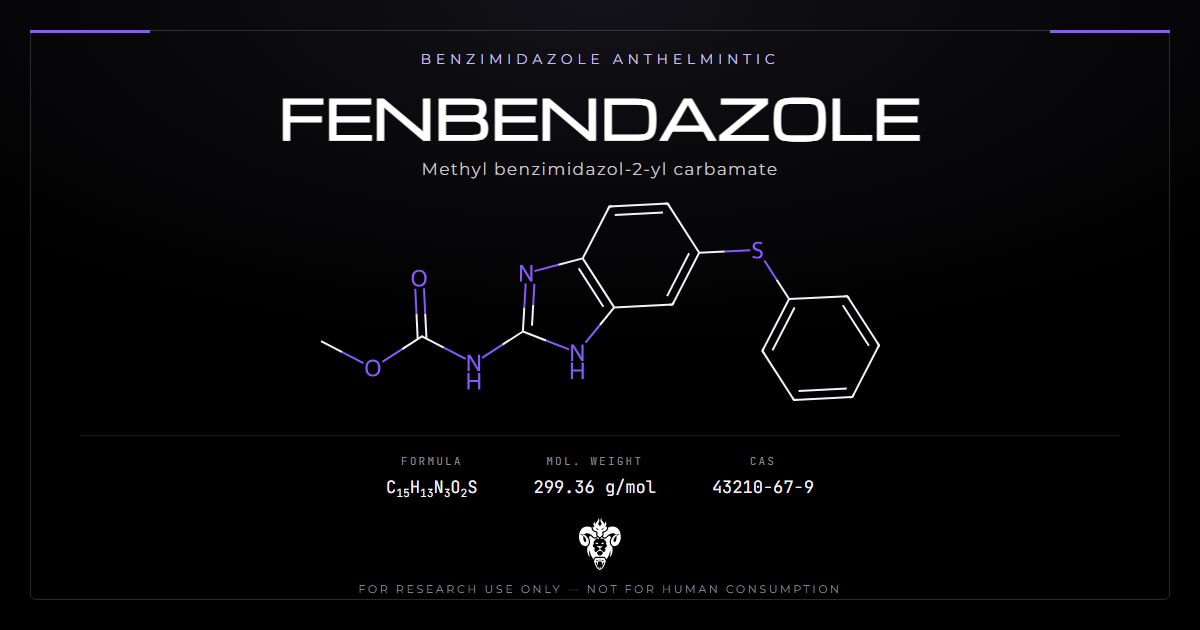
The compound is a benzimidazole carbamate with a phenylthio substituent.
| Property | Value |
|---|---|
| Systematic name | Methyl N-(6-phenylsulfanyl-1H-benzimidazol-2-yl)carbamate |
| Common names | Fenbendazole, FBZ, FZ |
| Molecular formula | C15H13N3O2S |
| Molecular weight | 299.35 g/mol |
| CAS number | 43210-67-9 |
| PubChem CID | 3334 |
| InChIKey | HDDSHPAODJUKPD-UHFFFAOYSA-N |
| Chemical class | Benzimidazole carbamate |
| Molecular target | Beta-tubulin |
| Active metabolite | Oxfendazole (fenbendazole sulfoxide) |
| Water solubility | Very low |
| Approval status | Veterinary only |
The sulfoxide metabolite has its own name
Oxidation at the sulfur gives fenbendazole sulfoxide, which is a licensed anthelmintic in its own right under the name oxfendazole. Further oxidation gives the sulfone.
The relationship runs both ways. Gonzalez and colleagues describe oxfendazole as having a long metabolic half-life in ruminants, with fenbendazole as a metabolite that also carries anthelmintic action [4].
This matters for reading the literature. Oxfendazole has first-in-human safety and pharmacokinetic data behind it [4]; fenbendazole does not. Papers on one are routinely cited as though they were papers on the other.
Solubility is the defining property
Very low water solubility is not a footnote here. It determines what dose reaches tissue, and it is the single variable that most often separates a positive result from a negative one in the studies below.
What the compound is licensed to do
Before the oncology literature, this molecule has a settled forty-year role, and that role explains most of its properties.
Broad-spectrum anthelmintic
Veterinary medicine uses it against gastrointestinal nematodes, lungworms and some cestodes across cattle, sheep, horses, dogs, cats and laboratory rodents. Laboratory animal facilities reach for it routinely to clear pinworm outbreaks, which is exactly how the Johns Hopkins observation happened [2].
The dosing regimens are long by drug standards, typically several consecutive days, because the mechanism depends on sustained contact rather than a peak concentration.
Why poor absorption is a feature
For a gut-dwelling parasite, staying in the lumen is the point. A compound that is absorbed efficiently leaves the compartment where the worms are.
Benzimidazole anthelmintics are therefore selected partly for the property that frustrates every attempt to use them systemically. Gokbulut and colleagues found the parent compound predominant in faeces while absent from plasma [5], which is a description of the drug working as designed.
This is the tension running through the whole repurposing literature. The property that makes it a good anthelmintic makes it a poor systemic agent.
Mechanism: beta-tubulin
Benzimidazoles bind beta-tubulin and interfere with microtubule polymerisation. In parasites this collapses the cytoskeleton and disrupts glucose uptake.
The binding site is well mapped. Resistance in target organisms arises through point mutations in the beta-tubulin gene, which is the standard evidence that an interaction is direct [9].
Selectivity comes from affinity differences between parasite and mammalian tubulin, and that selectivity is partial rather than absolute. Dogra and colleagues measured moderate affinity for mammalian tubulin and cytotoxicity to human cells at micromolar concentrations [6].
They also reported effects beyond the cytoskeleton: mitochondrial translocation of p53, inhibition of glucose uptake, and reduced expression of GLUT transporters and hexokinase II [6].
Doudican and colleagues found the class effect independently (PMID 18667591). Screening 2,000 compounds against chemoresistant melanoma lines, four of the ten hits were benzimidazoles, fenbendazole among them [1]. They prioritised mebendazole for further work on the basis of its more favourable pharmacokinetics, which is a telling choice.
The preclinical record
The cell work and the animal work do not agree, and the disagreement is the informative part.
| Study | Model | Route | Result |
|---|---|---|---|
| Gao 2008 [2] | Human lymphoma xenograft, SCID mice | Diet | No effect alone; inhibition only with added vitamins |
| Duan 2012 [3] | EMT6 mammary tumour, BALB/c | Diet, 150 ppm | No change in growth, invasion or metastasis |
| Duan 2013 [7] | EMT6, cells and tumours | Intensive regimens | Cytotoxic in culture; no antitumour effect in vivo |
| Dogra 2018 [6] | Human xenograft, nu/nu mice | Oral | Growth blocked |
| Chung 2021 [8] | Prostate metastasis models | Reformulated | Survival extended; albendazole outperformed fenbendazole |
| Chang 2023 [10] | Ovarian xenograft and PDX | Oral | No tumour reduction |
| Chang 2023 [10] | Same models | Nanoparticle, intravenous | Tumour weight significantly reduced |
| Wang 2024 [12] | Ovarian xenograft | Oral | Growth inhibited |
| Nguyen 2025 [13] | A549 lung xenograft | Oral, with DADA | 50% complete regression combined; 0% with fenbendazole alone |
The founding observation
Gao and colleagues investigated why their xenograft had stopped growing [2]. The diet had been supplemented with extra vitamins to compensate for autoclaving losses, then not autoclaved.
They ran four arms: standard diet, diet plus fenbendazole, diet plus vitamins, diet plus both. Neither the compound alone nor the vitamins alone altered tumour growth compared with controls. Only the combination inhibited growth.
They closed with a caution to other researchers. The compound may interact with other treatments and confound results.
The negative animal studies
Duan and colleagues at Yale tested a 150 ppm therapeutic diet against EMT6 mammary tumours [3]. No change in growth, invasion or metastasis, and no alteration of radiation-induced growth delay.
They followed up with maximally intensive regimens and combination testing [7]. Intensive exposure killed cells in culture, and toxicity rose under severe hypoxia. Tumours in mice did not respond, and the compound added nothing to radiation. Their conclusion was that the studies provided no evidence of value in cancer therapy, while suggesting the compound class merits further investigation.
Both papers make the same secondary point, which matters for anyone running animal work: a fenbendazole-containing chow used routinely for pinworm control can confound an experiment.
The formulation result that reframes the rest
Chang and colleagues tested the compound against epithelial ovarian cancer in cell lines, xenografts and patient-derived xenografts [10].
Cell proliferation fell in both chemosensitive and chemoresistant lines. Oral treatment produced no tumour reduction in the xenograft models. Intraperitoneal administration did not absorb at all. The compound aggregated in the peritoneal space.
They then encapsulated the compound in PLGA nanoparticles to make it water-dispersible and gave it intravenously. Tumour weight fell significantly against control, in both cell-line xenografts and the PDX model.
One molecule, one laboratory, one set of models, one paper: it failed by one route and worked by another. That is close to a controlled test of whether absorption is the limiting factor.
Chung and colleagues reached the same place from a different direction, improving bioavailability with micelles and nanoparticles, and finding albendazole outperforming both fenbendazole and paclitaxel on median survival [8].
Absorption is the bottleneck
The pharmacokinetic literature supports what the formulation studies imply.
Gokbulut and colleagues gave 10 mg/kg orally to donkeys and sampled plasma for 120 hours (PMID 16772142). Neither the parent molecule nor its sulfoxide and sulfone metabolites reached detectable concentrations in any plasma sample [5].
The compound was, however, the predominant species in faeces. It passed through.
Absorption varies by species. Ruminants take up benzimidazoles better than donkeys do, thanks to longer gut residence. The general pattern holds: this is a poorly absorbed molecule whose anthelmintic use depends on acting in the gut lumen rather than on reaching systemic concentrations.
Any claim about systemic effects has to explain how enough compound arrives.
What the formulation studies had to do
Two independent groups reached the same workaround. Chang and colleagues encapsulated the compound in PLGA nanoparticles [10]. Chung and colleagues used micelles and nanoparticles [8].
Both were solving solubility, and both then gave the product by injection rather than by mouth. Neither result transfers to unformulated material taken orally, which is the form in circulation.
That gap is the most important thing to hold onto when reading a positive headline about this compound. The version that worked in those papers is not the version anyone has.
Why cell results and animal results diverge
The pattern in the table is consistent enough to be worth naming. Cell work is positive across every tissue tested. Animal work splits, and the split tracks how the compound was delivered.
That is the expected shape when a molecule is active but poorly delivered. Cells in a dish receive whatever concentration the experimenter dissolves in DMSO. An animal receives whatever crosses its gut wall, and for this compound that is very little [5].
Two consequences follow for reading any new paper. The in vitro concentration should be stated and compared against a plausible plasma level, and the in vivo route and formulation matter more than the tumour type.
A positive cell result for this compound carries less information than usual, because delivery rather than potency is the constraint.
Documented liver injury
Two case reports describe severe hepatocellular injury following self-administration, and both are recent.
Thakurdesai and colleagues reported the first histologically confirmed case, in a 67-year-old woman presenting with two weeks of jaundice [11]. Liver function returned to normal over three months after she stopped.
Krishnan and colleagues reported a 47-year-old woman with metastatic colon cancer on immunotherapy who developed severe hepatocellular injury after raising her self-administered dose [14]. A Roussel Uclaf Causality Assessment Method score of 8 identified the compound as the probable cause, rated probable. Biochemistry improved rapidly on withdrawal, and she resumed immunotherapy without recurrence.
The second case makes a point beyond the hepatotoxicity itself. In a patient on checkpoint inhibitors, drug-induced liver injury from an unregulated compound mimics immune-mediated hepatitis. The two demand opposite management.
Both papers attribute the rise in human use to social media.
Combination work
The pattern that keeps recurring is that the compound performs better with something else than alone.
Nguyen and colleagues tested it against A549 lung cancer xenografts alongside diisopropylamine dichloroacetate [13]. Combined oral treatment at 100 mg/kg DADA and 40 mg/kg fenbendazole gave 50 percent complete tumour regression. The single-agent arms gave 11.1 percent and zero.
Zero for fenbendazole alone, in a study designed to show the combination working.
The authors selected the second compound partly for hepatoprotective properties, given the liver toxicity reported with the first. Whether that logic holds is untested in humans.
The albendazole comparison
One finding recurs and rarely gets quoted alongside the enthusiasm.
Doudican and colleagues screened four benzimidazoles out of 2,000 compounds and carried mebendazole forward, on pharmacokinetics [1]. Chung and colleagues tested both and found albendazole extending median survival further than fenbendazole, and further than paclitaxel [8].
Two independent groups, working a decade apart on different cancers, picked a different benzimidazole than the one that became popular.
Albendazole and mebendazole are also approved for human use, with established dosing and safety data. Fenbendazole is not. Whatever the class does, the member with the least human data is the one in widest unregulated circulation.
Verifying research material
Identity is straightforward and purity is where attention belongs.
The sulfoxide and sulfone oxidation products are the expected related substances, both as manufacturing impurities and as degradation products. A certificate reporting a single purity figure without naming them is not informative, since oxfendazole is a different licensed compound with different properties.
HPLC with UV detection separates the three readily. The parent absorbs around 290 nm.
Veterinary formulations complicate sourcing. Granules, pastes and suspensions sold for animal use contain excipients, flavourings and suspending agents, and the labelled percentage refers to the formulation rather than to compound purity. Material intended for analytical work should arrive as the neat solid with its own certificate.
Polymorphism is worth checking on a certificate too. Benzimidazole carbamates form multiple crystal forms with different dissolution rates, which matters more than usual for a compound whose limiting property is dissolution.
Solubility governs handling. The compound is close to insoluble in water and dissolves in DMSO for cell work. Verify the stock concentration rather than assuming it, and report the final DMSO concentration, since the vehicle itself affects many assays.
Handling and storage
The compound is a stable crystalline solid, and its problems in the laboratory are all about getting it into solution.
It is essentially insoluble in water and poorly soluble in ethanol. DMSO is the usual vehicle, and stock solutions above about 30 mM tend to precipitate on dilution into aqueous media. Precipitate that forms after dilution is easy to miss in a 96-well plate and will make a dose-response curve flatten at the top for reasons that have nothing to do with biology.
Warming and sonicating the stock helps. Checking the working dilution for haze under a microscope helps more.
The sulfur is the oxidisable site, so exposure to air and light over time favours the sulfoxide. Store the solid cold, dark and sealed, and prepare working solutions fresh rather than keeping diluted aqueous stocks.
Kimera publishes third-party certificates of analysis for every lot in its COA database. Laboratories source fenbendazole as a tubulin-binding reference compound, sometimes alongside DADA following the combination work above, or against metabolic tools such as methylene blue and BAM15. Related chemistry appears in the metabolic category.
Where the compound is genuinely useful in a laboratory
Setting the oncology question aside, this molecule has uses that are not contested.
It is the standard positive control for beta-tubulin-directed antiparasitic activity, and the reference compound against which benzimidazole resistance is measured in nematode and fungal isolates [9]. Resistance assays depend on a well-characterised binding interaction, and this one qualifies.
It is also, unavoidably, a confounder to control for. Any facility using medicated chow for pinworm management has animals with systemic exposure to a tubulin-binding compound, and two independent groups have published warnings about exactly that [2][3]. Recording whether a colony has been on medicated feed belongs in the methods section of any tumour study.
Those two roles are settled, documented and free of the interpretive difficulty that surrounds everything else here.
What the record does not establish
No clinical trial of this compound in humans for any oncology indication has been published. Trial registries list none completed, and the case reports describe people dosing themselves without medical supervision rather than participants in any study. The human data consists of veterinary pharmacology, the oxfendazole safety work on a different molecule [4], and two liver injury case reports [11][14].
Efficacy by the oral route is contested rather than established. Three animal studies found no effect [2][3][7], one found none until the compound was reformulated for intravenous delivery [10], and two reported oral efficacy [6][12]. That is not a consensus.
The founding observation was a combination effect. Gao and colleagues showed inhibition only when vitamins and the compound were given together, and explicitly not with the compound alone [2].
No study has characterised the dose that produces the reported cell-culture concentrations in a human. The micromolar concentrations used in vitro [6] have not been tied to any achievable systemic exposure.
Common questions about fenbendazole
What did the original mouse observation actually show? That a diet containing both extra vitamins and the compound suppressed a lymphoma xenograft. The controlled arms showed no effect from either alone [2].
Why do animal studies disagree? Absorption is the most likely reason. The compound is close to insoluble in water, and the one study that tested routes head to head found oral ineffective and an intravenous nanoparticle formulation effective in the same models [10].
Is oxfendazole the same thing? No. Oxfendazole is the sulfoxide, a separate licensed anthelmintic with its own human safety and pharmacokinetic data [4]. The two interconvert metabolically, which is not the same as being interchangeable.
Has liver injury been documented? Yes. Two published cases of severe hepatocellular injury from self-administration, one histologically confirmed [11], one with a formal causality score of probable [14].
Does it interfere with animal experiments? It can. Two independent groups warned that fenbendazole-containing chow used for pinworm control may confound tumour studies [2][3].
Why does DMSO concentration matter so much here? Because the compound only dissolves in it. A stock made too concentrated precipitates on dilution, capping the delivered dose without any visible sign in the plate.
Why did the melanoma screen pick mebendazole instead? Better pharmacokinetics. Four benzimidazoles came out of the screen; the authors carried forward the one most likely to reach tissue [1].
Summary of the evidence
Identity: methyl N-(6-phenylsulfanyl-1H-benzimidazol-2-yl)carbamate, C15H13N3O2S, 299.35 g/mol, CAS 43210-67-9. Veterinary approval only.
Mechanism: beta-tubulin binding and microtubule disruption, with resistance in target organisms arising by beta-tubulin mutation [9]. Moderate affinity for mammalian tubulin, micromolar cytotoxicity, plus effects on p53 localisation and glucose handling [6].
Cell work: consistently cytotoxic to tumour lines across melanoma, prostate, ovarian and lung models [1][6][8][10][12].
Animal work: split. No effect [2][3][7], no effect orally but effective as an intravenous nanoparticle [10], effective orally [6][12].
Absorption: parent and metabolites undetectable in plasma after 10 mg/kg orally in donkeys, with the parent predominant in faeces [5].
Human data: none for oncology. Two case reports of severe drug-induced liver injury from self-administration [11][14].
Combination: 50 percent complete regression with DADA against zero for fenbendazole alone in A549 xenografts [13]; inhibition only with vitamins in the founding study [2].
Status: supplied for laboratory research use only.
References
- Doudican N, Rodriguez A, Osman I, Orlow SJ. Mebendazole induces apoptosis via Bcl-2 inactivation in chemoresistant melanoma cells. Mol Cancer Res. 2008;6(8):1308-1315. PMID 18667591. DOI
- Gao P, Dang CV, Watson J. Unexpected antitumorigenic effect of fenbendazole when combined with supplementary vitamins. J Am Assoc Lab Anim Sci. 2008;47(6):37-40. PMID 19049251
- Duan Q, Liu Y, Booth CJ, Rockwell S. Use of fenbendazole-containing therapeutic diets for mice in experimental cancer therapy studies. J Am Assoc Lab Anim Sci. 2012;51(2):224-230. PMID 22776123
- Gonzalez AE, Codd EE, Horton J, Garcia HH, Gilman RH. Oxfendazole: a promising agent for the treatment and control of helminth infections in humans. Expert Rev Anti Infect Ther. 2019;17(1):51-56. PMID 30501436. DOI
- Gokbulut C, Akar F, McKellar QA. Plasma disposition and faecal excretion of oxfendazole, fenbendazole and albendazole following oral administration to donkeys. Vet J. 2006;172(1):166-172. PMID 16772142. DOI
- Dogra N, Kumar A, Mukhopadhyay T. Fenbendazole acts as a moderate microtubule destabilizing agent and causes cancer cell death by modulating multiple cellular pathways. Sci Rep. 2018;8(1):11926. PMID 30093705. DOI
- Duan Q, Liu Y, Rockwell S. Fenbendazole as a potential anticancer drug. Anticancer Res. 2013;33(2):355-362. PMID 23393324
- Chung I, Zhou K, Barrows C, et al. Unbiased phenotype-based screen identifies therapeutic agents selective for metastatic prostate cancer. Front Oncol. 2021;10:594141. PMID 33738243. DOI
- Tarafder M, Datta B. Deciphering beta-tubulin gene of carbendazim resistant Fusarium solani isolate and its comparison with other Fusarium species. Curr Genet. 2022;68(3-4):429-447. PMID 35419713. DOI
- Chang CS, Ryu JY, Choi JK, et al. Anti-cancer effect of fenbendazole-incorporated PLGA nanoparticles in ovarian cancer. J Gynecol Oncol. 2023;34(5):e58. PMID 37170725. DOI
- Thakurdesai A, Rivera-Matos L, Nagra N, Busch B, Mais DD, Cave MC. Severe drug-induced liver injury due to self-administration of the veterinary anthelmintic medication, fenbendazole. ACG Case Rep J. 2024;11(5):e01354. PMID 38706451. DOI
- Wang X, Tian W, Wang N, et al. Transcriptome analysis reveals the anticancer effects of fenbendazole on ovarian cancer: an in vitro and in vivo study. BMC Cancer. 2024;24(1):1593. PMID 39736624. DOI
- Nguyen TQ, Phan UTT, Can MV, Nguyen DH, Han B, Hoang BX. Synergistic anti-tumor effect of fenbendazole and diisopropylamine dichloroacetate in immunodeficient BALB/c nude mice transplanted with A549 lung cancer cells. Transl Lung Cancer Res. 2025;14(7):2509-2521. PMID 40799435. DOI
- Krishnan A, Lucas K, Maas L, Woreta TA. Differentiating fenbendazole-induced liver injury from immunotherapy hepatitis: the importance of structured causality assessment. A case report. World J Clin Cases. 2026;14(2):116700. PMID 41608149. DOI
Fenbendazole is sold for laboratory research use only. Not for human consumption, nor medical, veterinary, or household uses.
Literature retrieved from PubMed.