
Two articles in this catalogue describe compounds sold as prodrugs whose conversion nobody has ever measured. RAD-150 and OTR-AC are both esters, both assumed to release a parent, and both entirely untested on that point.
Fladrafinil is the same shape of claim with a different answer. It has exactly one indexed paper, and that paper gave 20 mg to six volunteers and watched what came out [1].
It converts. The measurement exists. That single fact separates this compound from most of the shelf, and it also produces the least flattering conclusion available: what fladrafinil delivers is flmodafinil, which this catalogue sells separately.
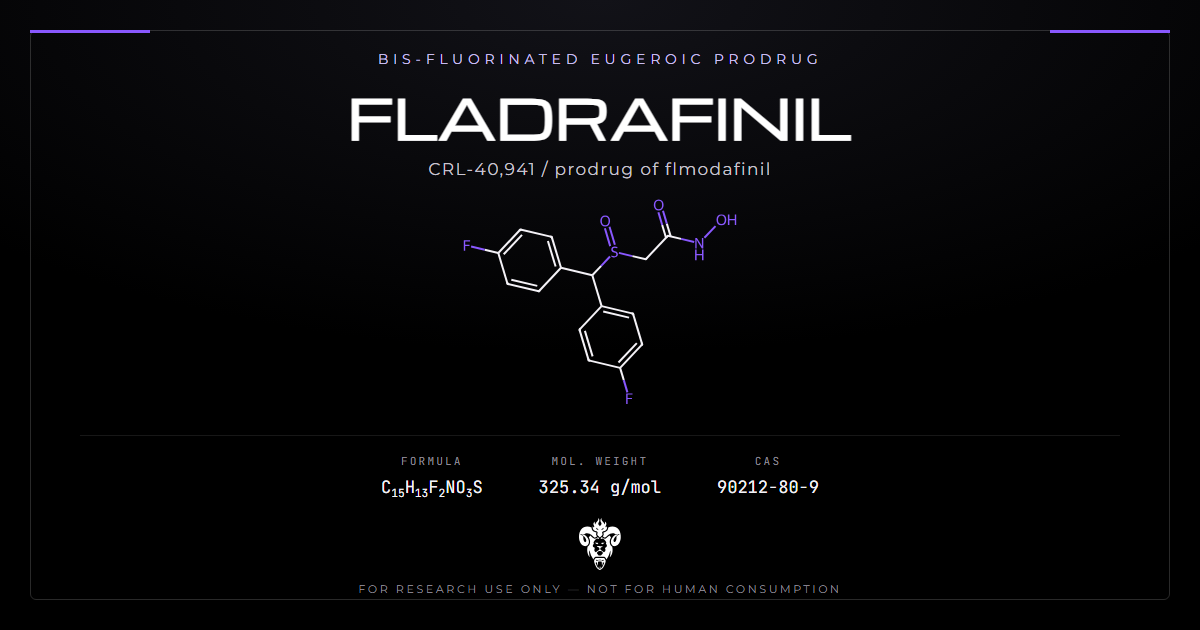
Chemical identity
| Property | Value |
|---|---|
| Common names | Fladrafinil, CRL-40,941 |
| Systematic | 2-[bis(4-fluorophenyl)methylsulfinyl]-N-hydroxyacetamide |
| Molecular formula | C15H13F2NO3S |
| Molecular weight | 325.33 g/mol |
| CAS | 90212-80-9 |
| PubChem CID | 13316557 |
| InChIKey | VKGUUSVYPXTWMA-UHFFFAOYSA-N |
| Class | Bis-fluorinated benzhydryl sulfinyl hydroxamic acid |
| Stereochemistry | Sulfoxide centre, undefined in the record |
The catalogue carries it as Fladrafinil.
The family is a two-by-two
Four compounds in this catalogue sit on one grid. Two variables: whether the amide carries an N-hydroxyl, and whether the two phenyl rings carry fluorines.
| Acetamide | N-hydroxyacetamide | |
|---|---|---|
| Unsubstituted phenyls | Modafinil, 273.35 | Adrafinil, 289.35 |
| 4,4′-difluoro | Flmodafinil (CRL-40,940), 309.33 | Fladrafinil (CRL-40,941), 325.33 |
Read the grid rather than the names. Adrafinil is modafinil plus a hydroxyl. Flmodafinil is modafinil plus two fluorines. Fladrafinil is both changes at once, which is why it sits in the corner and why its behaviour is predictable from the other three.
The two development codes differ by one digit. CRL-40,940 is the amide and CRL-40,941 is the hydroxamic acid, and there is no mnemonic linking the number to the structure.
Sixteen daltons from the compound beside it
Fladrafinil and flmodafinil differ by a single oxygen atom. 325.33 against 309.33.
That is the practical trap, because this catalogue sells both. A nominal-mass measurement separates them easily, and a name on a label does not. Anyone receiving material under either code should confirm which one arrived rather than assume the supplier’s grid matched their own.
The hydroxamic acid is also the reactive end of the molecule. It is the group that comes off, and the section below is about somebody measuring how fast.
The one paper, and it is the right one
Krug and colleagues at the German Sport University Cologne published the only indexed study of this compound [1]. It is a human administration study built for doping control.
Design
Six volunteers ingested 20 mg of either flmodafinil or fladrafinil. Urine and dried blood spots went to liquid chromatography with high-resolution mass spectrometry. Limits of detection ran between 0.2 and 4 ng/mL.
The design is the clever part. Running both compounds in the same study, with the same assay, is what makes the comparison meaningful. A prodrug study that measures only the prodrug cannot say what it delivered.
What the concentrations show
The authors state the relationship directly: fladrafinil acts as a prodrug for flmodafinil [1]. After a fladrafinil dose, they detected flmodafinil along with flmodafinil acid and flmodafinil sulfone, the same metabolites that follow a flmodafinil dose.
| Analyte | Urine Cmax | Blood Cmax |
|---|---|---|
| Flmodafinil | 191 to 891 ng/mL | 45 to 98 ng/mL |
| Fladrafinil | 52 to 111 ng/mL | 11 to 35 ng/mL |
Those ranges cover both dosing arms. The parent compound reaches concentrations several-fold below its own metabolite. A slight offset appears before flmodafinil peaks, which the authors attribute to the conversion step [1].
That offset is the prodrug behaving as designed. A delay before the active species peaks is what a prodrug is for.
The dose is the caveat
One number in that study limits how far it travels. The volunteers took 20 mg.
Modafinil is prescribed at 100 to 400 mg, and the dopamine transporter study below used 400 mg daily [4]. A 20 mg dose of a related analogue sits an order of magnitude below that range. It was chosen to characterise elimination for doping control, where the question is whether an assay can find the compound at all, rather than to produce an effect.
So the conversion is established and the exposure is not. Knowing that a prodrug converts at 20 mg does not establish that it converts proportionally at ten times the dose, since the enzymes doing the work can saturate. Nothing in the published record addresses that for this compound.
What this means for the compound
The honest reading follows in one step. If fladrafinil is a prodrug for flmodafinil, then taking fladrafinil is a way of taking flmodafinil later and at lower peak.
That is a legitimate pharmacological goal. Smoothing a concentration curve reduces peak-related effects, and prodrugs are used for exactly that. It is also a claim needing a comparison nobody has published. That means matched doses, matched subjects, and an outcome measured in something other than nanograms per millilitre.
The catalogue sells the metabolite directly as Flmodafinil, and it sells the unfluorinated parent of the whole series as Adrafinil. Anyone choosing between them is choosing a delivery profile, not a different pharmacology, at least as far as the published record shows.
There is a structural symmetry worth noticing here. Adrafinil is the hydroxamic acid of the unfluorinated pair and fladrafinil is the hydroxamic acid of the fluorinated pair. In both columns of the grid, the hydroxamic acid is the one carrying the extra oxygen that comes off.
What Krug’s data establish for the fluorinated pair is that the metabolites detected after a fladrafinil dose are the amide-series metabolites: flmodafinil, flmodafinil acid and flmodafinil sulfone [1]. The hydroxamic acid does not persist as its own metabolic branch. It converts into the compound in the other column and then follows that compound’s route.
Reading across from modafinil
With one paper on this compound and none on its effects, everything about what it does is read-across from modafinil. That literature is large and its conclusions are more modest than the reputation suggests.
The effect sizes are small
Roberts and colleagues ran meta-analyses of modafinil, methylphenidate and d-amphetamine in healthy non-sleep-deprived adults [5]. Fourteen modafinil studies gave 64 effect sizes.
The overall effect of modafinil was SMD 0.12 (p=0.01), with memory updating at 0.28. Methylphenidate did somewhat better at 0.21 overall. Their closing observation is the one to keep: users perceive these drugs as effective cognitive enhancers, and the evidence does not support that perception.
Complexity of the task changes the answer
Battleday and Brem reviewed modafinil in healthy non-sleep-deprived people and found the result depends on what you measure [6]. Simple testing paradigms showed executive function improving, attention and learning improving in about half of studies, and a few reporting impaired divergent creative thinking.
With more complex assessments the picture became consistent, showing enhancement of attention, executive function and learning. They found no preponderance of side effects or mood changes.
A drug whose measured benefit depends on test complexity, and which may reduce divergent thinking, is not the uniform enhancer the marketing describes.
Where it does nothing
Bagot and Kaminer reviewed stimulants in non-ADHD youth [7]. Modafinil improved reaction time, logical reasoning and problem-solving, and the authors note the heterogeneity that makes global claims hard.
Against that, three separate reviews found nothing. Modafinil did not improve impulse control in addiction [8]. A Cochrane review of fatigue in palliative care called the evidence for it weak and inconclusive [9]. A 2026 review of cognition in bipolar disorder lists modafinil among agents showing no significant effects [10].
What the two fluorines are for
The 4,4′-difluoro substitution is the other half of what makes this molecule not adrafinil, and its purpose is easier to state than to demonstrate.
Fluorine at a para position blocks the most accessible site for aromatic hydroxylation. Medicinal chemists use that substitution routinely to slow oxidative metabolism, and it also raises lipophilicity, which affects how readily a molecule crosses membranes. Both consequences are pharmacokinetic.
No published study compares fladrafinil with adrafinil, or flmodafinil with modafinil, on any measure of potency at a target. The fluorines are therefore a reasonable design choice with no published demonstration of what they achieved, and anyone claiming the fluorinated analogues are stronger rather than longer-lasting is stating a hypothesis.
Where these molecules come from
The whole series is built on one fragment, a benzhydryl core carrying a sulfur. Liu and colleagues published a route to the benzhydryl alcohols that begin such syntheses, using a potassium tert-butoxide and dimethyl sulfoxide system with air as the oxidant, and demonstrated it by making modafinil and adrafinil [12].
That paper is chemistry rather than pharmacology, and it earns a place here for one reason. These compounds are synthetically accessible from cheap starting materials, which is a large part of why analogues appear in the supplement market faster than any regulator or testing laboratory can characterise them.
Mechanism, as far as it is known
The mechanism is better characterised than most compounds here, and it is measured in people rather than inferred.
Karila and colleagues used positron emission tomography to quantify dopamine transporter availability during modafinil treatment [4]. Two weeks at 400 mg/day produced a 65.6% decrease in binding potential, while placebo produced no significant change.
So the compound occupies the dopamine transporter substantially, which the authors note is a mechanism analogous to cocaine’s. The same trial then found more therapeutic failures in the modafinil group during outpatient follow-up, and concluded against its use for cocaine dependence.
Battleday and Brem describe the wider profile: raised cortical catecholamines directly, with indirect effects on serotonin, glutamate, orexin, histamine and gamma-aminobutyric acid [6]. None of this has been measured for fladrafinil. The fluorines and the hydroxamic acid both sit away from the sulfinyl core the family shares.
Supply and labelling
Bakota and Nandrea developed and validated a liquid chromatography high-resolution mass spectrometry method covering modafinil plus four unscheduled analogues, including CRL-40,941 by name [3].
They then bought four products marketed as nootropics through undercover purchase, all labelled to contain adrafinil. Adrafinil was found in all four.
That is an unusual result for this catalogue. Most supply-chain studies quoted in these articles find labels wrong; this one found them right. It is four samples, so it settles nothing, and it is worth reporting accurately in both directions.
The regulatory position is worth stating plainly. Modafinil is a scheduled drug in the United States and these analogues are not, which is a large part of why they are sold. A review of neuroenhancement notes that legal status is decisive in how users choose between substances [11].
What a study of fladrafinil would still have to measure
The 2026 paper answers the conversion question and leaves the rest open. Setting out what is missing is more useful than repeating that it is missing.
| Measurement | What it would settle | Status |
|---|---|---|
| Conversion at a dose above 20 mg | Whether the enzymes saturate | Not measured |
| Half-life of parent and metabolite | Whether the profile is genuinely smoothed | Not reported |
| Any cognitive or wakefulness endpoint | Whether it does anything | Never measured |
| Head-to-head against flmodafinil | Whether the prodrug route is worth taking | Never run |
| Receptor or transporter occupancy | Whether the fluorines change pharmacology | Not measured |
| Enantiomer-specific data | Whether the sulfoxide centre matters here | Not measured |
Only the first two are near-term work of the kind Krug’s group already does. The third and fourth need a different sort of study entirely, with an outcome and a comparator, and no laboratory has an obvious reason to run one.
A compound can be well characterised analytically and completely uncharacterised pharmacologically, and fladrafinil is now a clean example of that split.
Never use GC-MS on this compound
This is the hardest rule in the article and it comes from one paper.
Dowling and colleagues heated modafinil, modafinic acid, adrafinil, CRL-40,940 and CRL-40,941 in a gas chromatography injector and watched them fall apart [2]. The non-fluorinated compounds gave diphenylmethanol and 1,1,2,2-tetraphenylethane, confirmed by synthesis and X-ray crystallography.
The fluorinated members, fladrafinil among them, produced the tetrafluoro analogue of tetraphenylethane. Worse, when a fluorinated and a non-fluorinated compound were injected together, a third cross-reaction product appeared that belonged to neither.
Three consequences follow for anyone handling this material. A gas chromatography purity figure may describe degradation products rather than the sample. A mixture can generate a peak corresponding to no compound present. And the validated alternative already exists in the literature, since Bakota’s method is liquid chromatography based [3].
Detection and competitive status
Fladrafinil and flmodafinil both fall under class S6 stimulants on the World Anti-Doping Agency prohibited list, so both are banned in competition [1].
Krug’s study exists because of that. Its conclusion is a caution rather than a window. Given the relatively long detection times of both intact drugs and their metabolites, careful interpretation is indicated for an adverse analytical finding [1].
The reason is the prodrug relationship. A finding of flmodafinil and its metabolites is consistent with taking flmodafinil, and equally consistent with taking fladrafinil. The urine does not record which bottle it came from.
Verifying research material
Batch documentation sits on the certificates of analysis page.
Identity
Formula C15H13F2NO3S, molecular weight 325.33, CAS 90212-80-9, InChIKey VKGUUSVYPXTWMA-UHFFFAOYSA-N.
Note that “CRL-40941” resolves to nothing in PubChem, so the development code is not a usable identifier on its own. Both the CAS number and the InChIKey resolve correctly, and a certificate should carry them.
Distinguishing it from flmodafinil
The two differ by 16 daltons, 325.33 against 309.33, so any mass measurement separates them. Both contain the same two fluorines, so fluorine-19 NMR will look similar. Proton NMR is the cleaner check, since the hydroxamic acid proton is absent from the amide.
Do not attempt this by gas chromatography, for the reasons above. Both compounds converge on related degradation products in a hot injector, which is the worst possible property for telling two analogues apart.
The sulfoxide is a stereocentre
The sulfur atom carries four different things: a lone pair, an oxygen, the benzhydryl group and the acetamide chain. That makes it a stereocentre, and the registered record shows UHFFFAOYSA, meaning no stereochemistry is assigned.
Material is therefore racemic unless a certificate says otherwise. In this chemical series the two sulfoxide enantiomers are not interchangeable. A certificate reporting purity on an achiral column has not addressed the question.
The hydroxamic acid is the labile group
One more property follows from the structure. Hydroxamic acids are more reactive than the corresponding amides, and the nitrogen-oxygen bond is the weak point.
That has a storage consequence and an analytical one. Material that has partly degraded toward the amide contains flmodafinil, which is the same species the compound is supposed to produce in the body. Degradation and intended conversion give the same product, so a chromatogram showing both peaks cannot say which process produced the second one.
Ask whether the method separates the two and whether the certificate reports each. On this molecule that is the single most informative line a certificate can carry, and a combined purity figure hides exactly the thing worth knowing.
Common questions about fladrafinil
How much research exists? One indexed paper describes this compound [1]. It is a six-volunteer human study of metabolism and elimination.
Does it convert to flmodafinil? Yes, and this is measured rather than assumed. Urine and blood concentrations of flmodafinil after a fladrafinil dose exceed those of fladrafinil itself [1].
Is it stronger than flmodafinil? No published comparison of effect exists. The measured difference is in concentration profile, not potency.
What is it likely to do? By read-across from modafinil, a small effect. Pooled analyses in healthy adults give SMD around 0.12 [5].
Can I check purity by GC-MS? No. It degrades in the injector to a tetrafluoro tetraphenylethane analogue [2].
Is it banned in sport? Yes, class S6 stimulants, prohibited in competition [1].
Summary of the evidence
Strongest evidence is a single 2026 human study, and it answers the question that matters for a prodrug [1]. Six volunteers, 20 mg, both compounds run side by side, with concentrations reported in urine and blood. Compared with the untested ester prodrugs elsewhere in this catalogue, that is a high standard.
Second strongest is the analytical chemistry, which names this compound explicitly rather than covering it by family [2][3]. The gas chromatography degradation finding is the single most actionable thing published about it.
Weakest is everything about effect. No study has measured what fladrafinil does to a person’s cognition, mood, sleep or performance. The read-across source gives effect sizes near 0.12 [5]. Nothing establishes that the fluorines change the pharmacology rather than the pharmacokinetics.
The transferable point is one this catalogue rarely gets to make. A prodrug claim is testable, and testing it takes six volunteers and one assay. More of this literature sits in the nootropics category, alongside Modafiendz.
Status: supplied for laboratory research use only.
References
- Krug O, Guddat S, Görgens C, Walpurgis K, Toma F, Thomas A, Thevis M. Investigations into the metabolism and elimination of flmodafinil and fladrafinil for sports drug testing purposes. Drug Test Anal. 2026;18(8):1076-1087. PMID 42210629. DOI
- Dowling G, Kavanagh PV, Talbot B, O’Brien J, Hessman G, McLaughlin G, Twamley B, Brandt SD. Outsmarted by nootropics? An investigation into the thermal degradation of modafinil, modafinic acid, adrafinil, CRL-40,940 and CRL-40,941 in the GC injector. Drug Test Anal. 2017;9(3):518-528. PMID 27928893. DOI
- Bakota EL, Nandrea JM. Development and validation of an analytical method to identify and quantitate novel modafinil analogs in products marketed as dietary supplements. J Diet Suppl. 2024;22(2):329-344. PMID 39466147. DOI
- Karila L, Leroy C, Dubol M, Trichard C, Mabondo A, Marill C, et al. Dopamine transporter correlates and occupancy by modafinil in cocaine-dependent patients: a controlled study with high-resolution PET and [11C]-PE2I. Neuropsychopharmacology. 2016;41(9):2294-2302. PMID 26892922. DOI
- Roberts CA, Jones A, Sumnall H, Gage SH, Montgomery C. How effective are pharmaceuticals for cognitive enhancement in healthy adults? A series of meta-analyses of cognitive performance during acute administration of modafinil, methylphenidate and D-amphetamine. Eur Neuropsychopharmacol. 2020;38:40-62. PMID 32709551. DOI
- Battleday RM, Brem AK. Modafinil for cognitive neuroenhancement in healthy non-sleep-deprived subjects: a systematic review. Eur Neuropsychopharmacol. 2015;25(11):1865-1881. PMID 26381811. DOI
- Bagot KS, Kaminer Y. Efficacy of stimulants for cognitive enhancement in non-attention deficit hyperactivity disorder youth: a systematic review. Addiction. 2014;109(4):547-557. PMID 24749160. DOI
- Anderson AC, Youssef GJ, Robinson AH, Lubman DI, Verdejo-Garcia A. Cognitive boosting interventions for impulsivity in addiction: a systematic review and meta-analysis. Addiction. 2021;116(12):3304-3319. PMID 33751683. DOI
- Mücke M, Cuhls H, Peuckmann-Post V, Minton O, Stone P, Radbruch L. Pharmacological treatments for fatigue associated with palliative care. Cochrane Database Syst Rev. 2015;2015(5):CD006788. PMID 26026155. DOI
- Yalin N, Yildiz A. Improving cognition in bipolar disorder: a systematic review of current pharmacological and nutraceutical approaches. Neuropsychobiology. 2026;85(3):201-218. PMID 41843701. DOI
- Dominik P, Waßmer MP, Soyka M, Franke AG. Stimulant abuse as a coping strategy: forensic and criminal consequences of stimulant abuse for neuroenhancement. Front Public Health. 2022;10:1028654. PMID 36388290. DOI
- Liu Y, Pu S, Sun C, Kai G, Yu Y, Li H. Transition-metal free chemoselective C-H hydroxylation of bisarylmethanes enabled by a phosphite as a sacrificial reductant. Org Biomol Chem. 2025;23(19):4628-4635. PMID 40241641. DOI
Fladrafinil is sold for laboratory research use only. Not for human consumption, nor medical, veterinary, or household uses.
Literature retrieved from PubMed.