
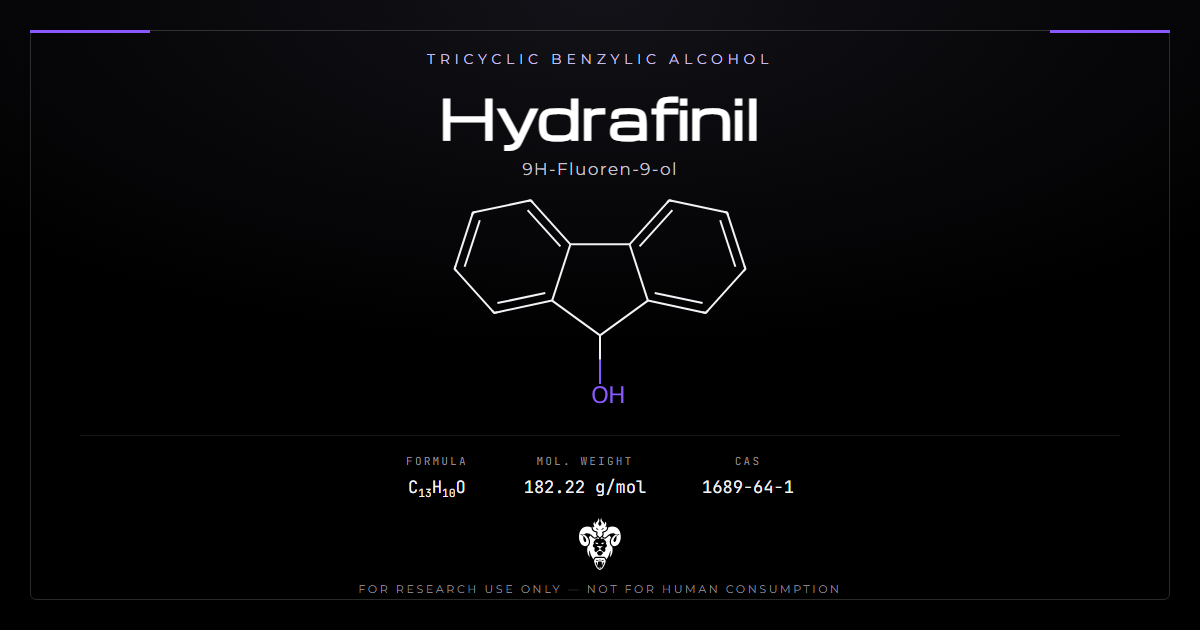
Hydrafinil is sold as a wakefulness compound and described as a modafinil relative. The molecule behind the name is 9H-fluoren-9-ol, and it has a substantial published literature.
That literature is not about wakefulness. Search the chemical name rather than the trade name and a different compound appears. It shows up as a urinary biomarker of polycyclic aromatic hydrocarbon exposure, as a substrate in organic methodology papers, and in one pilot human elimination study run by an anti-doping laboratory.
The gap between those two bodies of writing is the useful thing to understand about this compound. What follows separates them.
Chemical identity: 9H-fluoren-9-ol
The molecule is a tricyclic aromatic alcohol. Two benzene rings joined by a five-membered ring, with a hydroxyl at the bridging carbon.
| Property | Value |
|---|---|
| Systematic name | 9H-fluoren-9-ol |
| Common names | Hydrafinil, fluorenol, 9-fluorenol, 9-hydroxyfluorene |
| Molecular formula | C13H10O |
| Molecular weight | 182.22 g/mol |
| PubChem CID | 74318 |
| CAS number | 1689-64-1 |
| InChIKey | AFMVESZOYKHDBJ-UHFFFAOYSA-N |
| SMILES | C1=CC=C2C(=C1)C(C3=CC=CC=C32)O |
| Functional group | Secondary benzylic alcohol |
| Parent hydrocarbon | Fluorene |
| Oxidation product | 9-fluorenone |
| Stereocentres | None |
The name Hydrafinil has no chemical registry status
Query PubChem for “hydrafinil” and it returns no compound. Query “9H-fluoren-9-ol” and it returns CID 74318. The trade name exists in supplement catalogues. It also appears in one doping-control paper, which adopts it to describe what laboratories were finding in real samples [9].
This is worth knowing before any literature search. Searching the marketing name returns close to nothing. Searching 9-fluorenol or 9-hydroxyfluorene returns several hundred papers, most of them chemistry and environmental science.
What fluorenol is structurally
Fluorene itself is a three-ring polycyclic aromatic hydrocarbon, a component of coal tar and combustion emissions. Hydroxylating the bridging carbon gives 9-fluorenol.
Nothing about that skeleton resembles modafinil. Modafinil is a diphenylmethylsulfinylacetamide: two phenyl rings on a saturated carbon, then a sulfoxide and an amide. Fluorenol has no sulfur, no nitrogen and no amide. The two rings are locked together rather than free to rotate.
The visual resemblance is limited to “two benzene rings near each other”. That is not a pharmacophore.
The modafinil comparison and where it came from
A figure circulates attaching a specific potency multiple to Hydrafinil relative to modafinil. It is usually stated as a percentage advantage at the dopamine transporter.
No published source supports it. A PubMed search pairing fluorenol with the dopamine transporter returns zero results. No binding affinity, no functional uptake assay, no in vivo wakefulness experiment for this molecule appears in the indexed literature.
That absence should be stated as absence. It is not evidence that the compound is inactive. It means no published measurement exists to compare against modafinil, so any stated multiple has no traceable origin.
What the modafinil mechanism actually requires
The comparison is harder to make than it looks. Modafinil’s own mechanism is more specific than “dopamine transporter binding”.
Yang and colleagues lesioned midbrain dopamine neurons in mice and then tested modafinil-induced arousal [10]. Lesioning the substantia nigra pars compacta cut the effect by 6.7 percent. Removing the ventral tegmental area cut it by 32.8 percent. Taking out both abolished it. Dorsal raphe lesions did nothing.
Modafinil at 90 mg/kg produced 355 minutes of continuous wakefulness in control mice (PMID 34399438). That effect depended on intact mesencephalic dopamine neurons. Transporter affinity alone does not predict it. Membership in the class would require testing in the same paradigm. Fluorenol has never entered it.
The one human study
Knoop and colleagues published the only human administration study on this compound (PMID 34378339). The work came out of the Center for Preventive Doping Research in Cologne [9].
Design
Three healthy male volunteers received a single oral 50 mg dose. Urine was collected before dosing and up to 72 hours afterwards. Samples went through both gas chromatography-mass spectrometry and liquid chromatography-mass spectrometry, with metabolite identity confirmed by high-resolution tandem mass spectrometry.
Their stated motivation was preventive. Cologne wanted detection methods ready in case the World Anti-Doping Agency classified the compound as prohibited.
What they found
The intact compound was detectable in urine, alongside phase I and phase II metabolites. Phase I products were hydroxylated. Phase II products were glucuronidated or sulfo-conjugated, in some cases on top of the hydroxylation.
That pattern is ordinary xenobiotic handling. A benzylic alcohol gets further oxidised or hydroxylated on the ring system, then conjugated for excretion.
One detail is worth drawing out. The conjugated metabolites are the same chemical species that PAH biomonitoring measures after hydrolysis, so a laboratory running a standard hydroxylated-PAH urine panel would register a Hydrafinil dose as an apparent fluorene exposure. Both literatures meet in the same analytical run.
The group also reported two findings of the compound and its metabolites in real out-of-competition doping control samples. Those were not pursued to confirmatory analysis, since the compound was not prohibited.
What the study does and does not establish
Three things are established. Hydrafinil is orally absorbed in humans at 50 mg, it undergoes phase I and phase II metabolism, and it remains detectable in urine across a measurable window.
The study does not measure plasma concentrations, half-life, bioavailability or brain penetration. No pharmacodynamic endpoint of any kind was recorded. Three volunteers is a pilot, and the paper is published as a letter rather than a full research article.
This remains the single most informative human data point on the molecule. It exists because an anti-doping laboratory went looking.
The larger literature: a pollutant biomarker
Here is where the compound has a real quantitative record. 9-hydroxyfluorene is one of the standard monohydroxylated polycyclic aromatic hydrocarbon metabolites measured in human urine to estimate PAH exposure.
It appears in the US National Health and Nutrition Examination Survey panel, in occupational monitoring studies, and in wastewater epidemiology.
The measurement is well established. Urine is hydrolysed to release the conjugates, the freed metabolites are extracted and derivatised, then quantified by gas chromatography-mass spectrometry against isotope-labelled internal standards. Typical population concentrations sit in the nanogram-per-litre to low microgram-per-litre range, orders of magnitude below anything a deliberate dose would produce.
Associations reported in population data
| Study | Population | Outcome | Reported association for 9-hydroxyfluorene |
|---|---|---|---|
| Sun 2019 [6] | NHANES 2003-2012, 6,072 adults | Rheumatoid arthritis prevalence | Highest quartile OR 1.60 (95% CI 1.10-2.33) |
| Zhou 2021 [8] | NHANES 2007-2016, 8,975 adults | Kidney stone prevalence | OR 1.39 (95% CI 1.06-1.84) |
| Xing 2023 [11] | NHANES 2011-2012, 1,645 adults | Thyroid hormones | Positive with total T3; free T3 β = 0.049 |
| Luo 2023 [12] | 679 late-pregnancy women | Coagulation time | Shorter activated partial thromboplastin time |
What those associations can and cannot mean
This needs stating carefully, because the temptation to read the table the wrong way is strong.
These are cross-sectional associations between a urinary exposure marker and a health outcome. The marker reflects fluorene exposure from combustion sources: tobacco smoke, traffic, cooking, occupational settings. Nobody in these studies took the compound deliberately.
The measured molecule is a marker of exposure to a mixture. Fluorene arrives alongside naphthalene, phenanthrene, pyrene and dozens of other PAHs. The studies here measured nine or ten metabolites at once, because the exposures travel together. Sun and colleagues found several metabolites associated with the same outcome, which is what a correlated mixture produces [6].
So the table does not say that this molecule causes kidney stones or moves thyroid hormone. It says that people with more of it in their urine, meaning more PAH exposure overall, showed these outcomes more often. The data are cross-sectional survey data.
What the table does establish is that the molecule appears in human urine at population scale from environmental sources. Toxicologists have tracked it for years, under a different name than the one on a supplement label.
Occupational and environmental measurement
Díaz de León-Martínez and colleagues measured ten hydroxylated PAH metabolites in 149 precarious workers in Mexico [7]. 9-hydroxyfluorene was one of them. The occupations covered brickmaking, stonemasonry, indigenous labour and mercury mining.
Total metabolite concentrations reached a median of 101.2 µg/L in one group. Some values exceeded those recorded in occupations the International Agency for Research on Cancer classifies as carcinogenic. The authors argued for routine biological monitoring in these settings.
Styszko and colleagues extended the approach to wastewater [13]. They quantified seven hydroxylated PAHs including 9-hydroxyfluorene in raw and treated sewage in Kraków. Back-calculation gave a per-resident daily absorption of roughly 2.1 µg in summer and 4.1 µg in winter across the measured markers.
The compound also turns up in environmental biota. Martínez-Gómez and colleagues measured 9-fluorenol in the bile of red mullet along the Spanish Mediterranean coast [2]. Its contribution to the measured oestrogenic potency was negligible.
Reactivity and handling
The chemistry literature is where this molecule is best characterised, and several findings bear on storing and analysing it.
Oxidation to 9-fluorenone
The benzylic alcohol oxidises to the ketone. Gołąbek and colleagues exploited this. They used the 9-fluorenol to 9-fluorenone conversion as a proton NMR assay for oxidant activity in sodium hypochlorite solutions [5].
If a reaction that clean is usable as an analytical readout, the reverse conclusion holds for storage. Oxidising conditions convert the material into a different compound. 9-fluorenone is the thing to look for in a purity check.
Acid-catalysed carbocation formation
Masui and colleagues generated a secondary carbocation from 9-fluorenol inside the pores of an acidic zeolite [4]. It survived over a week at ambient temperature. Such cations form reversibly, with the equilibrium controlled by moisture.
The practical reading is that the hydroxyl is ionisable under acid. The ring system stabilises the fluorenyl cation. That is why the molecule is a favourite substrate for carbocation studies.
Photochemistry and radical behaviour
Dyblenko and colleagues generated fluorenyl radicals photochemically from 9-substituted fluorenols and trapped a TEMPO adduct from 9-fluorenol itself [3]. Product distribution depended on solvent.
Koike and colleagues went further. They used 9-fluorenol as a catalytic single-electron reductant for dehalogenating aryl halides, without light or electricity [14]. That is a molecule willing to give up an electron under mild conditions.
Amber glass, cool storage and an inert headspace follow from these three findings. So does re-checking identity after any prolonged storage.
How Hydrafinil compares with the characterised wakefulness agents
Placing the compound next to the compounds it is marketed against makes the size of the gap concrete.
| Compound | Molecular target data | In vivo wakefulness study | Human pharmacokinetics | Regulatory status |
|---|---|---|---|---|
| Modafinil | Yes, dopamine transporter binding and functional data | Yes, including lesion studies [10] | Yes, extensive | Approved medicine, WADA prohibited |
| Adrafinil | Yes, as a modafinil prodrug | Yes, in the parent literature | Yes, as prodrug conversion | Formerly marketed, withdrawn |
| Fladrafinil, flmodafinil | Partial, from analogue series work | Limited | No | Unscheduled research chemicals |
| Hydrafinil | None published | None published | Urinary elimination only [9] | Not prohibited at time of study [9] |
Reading the table honestly
Every row above Hydrafinil rests on measurements someone published. The Hydrafinil row rests on one urine study and an absence.
That does not make the compound uninteresting. A molecule with confirmed oral absorption, characterised metabolism and no pharmacology at all is an unusual object, and the missing measurements are the obvious ones for a laboratory to make.
It does mean that any claim about what Hydrafinil does is currently a claim about what someone expects it to do, based on a structural resemblance the chemistry does not support. Treating it as a member of the modafinil series is a hypothesis, not a description.
The compound most likely to be confused with it in a purity check is 9-fluorenone, and the compounds most likely to be confused with it in a literature search are its ring-hydroxylated isomers. Both problems are addressed below.
Distinguishing Hydrafinil from its isomers
The formula C13H10O covers more than one compound, and the near neighbours matter both analytically and when reading the epidemiology.
The ring-hydroxylated isomers
2-hydroxyfluorene and 3-hydroxyfluorene carry the hydroxyl on an aromatic ring rather than at the C9 bridge. Same formula, same nominal mass, different molecule.
They sit in the same NHANES panel as 9-hydroxyfluorene, and the surveys report them separately for good reason. In the rheumatoid arthritis analysis, 3-hydroxyfluorene and 2-hydroxyfluorene each carried their own odds ratio alongside the 9- isomer [6]. In the thyroid analysis, 2-hydroxyfluorene tracked total T3 while 3-hydroxyfluorene tracked antibody prevalence in men [11].
Reading a population figure for the wrong isomer is an easy mistake to make, and the reported associations differ between them.
Why the distinction is analytically real
A ring phenol and a benzylic alcohol behave differently. The phenol is acidic and hydrogen-bonds strongly, so it elutes and derivatises differently in the GC-MS methods these surveys use. The benzylic alcohol at C9 oxidises readily to the ketone, which the phenols do not do.
Proton NMR separates them without ambiguity. The C9 proton of Hydrafinil is a one-proton singlet on a saturated carbon, and it has no counterpart in a ring-hydroxylated isomer, where the aromatic region carries an extra substitution pattern instead.
Any purity method for this material should be able to demonstrate that separation rather than assume it.
Verifying research material
Proton and carbon NMR resolve fluorenol from fluorenone directly. The C9 proton of the alcohol is a distinctive singlet, and it disappears on oxidation. The ketone carbonyl carbon appears far downfield.
GC-MS gives the molecular ion at m/z 182 for the alcohol and 180 for the ketone. Unit resolution handles a two-mass-unit difference.
Melting point is a cheap first screen. The alcohol and the ketone differ enough that a mixed or oxidised sample shows a depressed and broadened range.
A third-party certificate of analysis should report purity by a method that detects 9-fluorenone specifically. That compound is both the likely contaminant and the likely degradation product.
Kimera publishes third-party certificates of analysis for every lot in its COA database. Laboratories source Hydrafinil as a fluorenol reference standard. Comparative work on wakefulness-agent chemistry usually sets it against the characterised members of that class, including adrafinil, flmodafinil, fladrafinil and modafiendz. Related chemistry appears in the nootropics category.
What is absent from the record
The absences here are unusually complete, so listing them is most of the honest description of this compound.
No receptor or transporter binding data. Nothing at the dopamine transporter, the noradrenaline transporter, histamine receptors or orexin receptors.
No in vivo behavioural or sleep study. Rodent electroencephalography, locomotor assays and wakefulness measurement are all missing, in every species.
No plasma pharmacokinetics. Knoop measured urine, not blood [9].
No dedicated toxicology. The compound has never been through a standard subchronic or reproductive toxicity package under its own name. Its parent hydrocarbon fluorene has environmental toxicology behind it. 9-fluorenol also appears in the metabolism of nitrated fluorenes, which are themselves direct-acting mutagens [1]. Both of those are read-across from adjacent chemistry, and neither transfers to this molecule.
No published basis for the modafinil potency comparison.
Common questions about Hydrafinil
Is Hydrafinil a modafinil analogue? Not structurally. It shares no functional group with modafinil and lacks the sulfoxide and amide that define that series. The description appears in marketing rather than in chemistry.
Does any study show it promotes wakefulness? No published study measures wakefulness, arousal or sleep architecture for it, in any species.
Why is it in anti-doping literature then? Doping control laboratories develop detection methods ahead of a ban rather than after one. Knoop and colleagues ran their pilot study for that reason and found the compound in two real control samples [9].
Is 9-hydroxyfluorene in NHANES the same molecule? Yes. The NHANES panel measures it as a marker of polycyclic aromatic hydrocarbon exposure from combustion sources [6][8][11].
Do the NHANES associations describe a risk of taking the compound? No. They describe outcomes associated with environmental PAH exposure in people who took nothing. The molecule serves as one marker of a correlated mixture.
What is the most likely impurity? 9-fluorenone, the oxidation product. It is the compound to look for in any purity method [5].
Summary of the evidence
Identity: 9H-fluoren-9-ol, C13H10O, 182.22 g/mol, CAS 1689-64-1, PubChem CID 74318. The name Hydrafinil itself has no registry entry.
Structure: a secondary benzylic alcohol on a rigid tricyclic aromatic frame, unrelated to the modafinil sulfinylacetamide series.
Human data: one pilot elimination study. Three volunteers, 50 mg oral, urinary phase I and phase II metabolites characterised over 72 hours [9]. No pharmacodynamic endpoint measured.
Claimed mechanism: unsupported. No transporter or receptor data exists. Modafinil-type arousal requires intact mesencephalic dopamine neurons, in a paradigm this compound has never entered [10].
Environmental record: measured as 9-hydroxyfluorene in NHANES, in occupational cohorts [7], in wastewater [13] and in fish bile [2]. In each case as a marker of PAH exposure.
Population associations: reported with rheumatoid arthritis [6], kidney stones [8], thyroid hormone levels [11] and coagulation time [12]. All cross-sectional, all reflecting mixture exposure rather than administration.
Handling: oxidises to 9-fluorenone [5] and forms a stabilised carbocation under acid [4]. It generates radicals on photolysis [3] and acts as a single-electron reductant [14].
Status: supplied for laboratory research use only.
References
- Pothuluri JV, Evans FE, Heinze TM, Fu PP, Cerniglia CE. Fungal metabolism of 2-nitrofluorene. J Toxicol Environ Health. 1996;47(6):587-599. PMID 8614025. DOI
- Martínez-Gómez C, Lamoree M, Hamers T, et al. Integrated chemical and biological analysis to explain estrogenic potency in bile extracts of red mullet (Mullus barbatus). Aquat Toxicol. 2013;134-135:1-10. PMID 23537582. DOI
- Dyblenko T, Chtchemelinine A, Reiter R, et al. Photochemical generation of 9H-fluorenyl radicals. Photochem Photobiol. 2014;90(2):470-475. PMID 24329554. DOI
- Masui Y, Hattori T, Onaka M. Reversible generation of labile secondary carbocations from alcohols in the nanospace of H-mordenite and their long-lasting preservation at ambient temperature. J Am Chem Soc. 2017;139(25):8612-8620. PMID 28565906. DOI
- Gołąbek H, Borys KM, Kohli MR, Brus-Sawczuk K, Strużycka I. Chemical aspect of sodium hypochlorite activation in obtaining favorable outcomes of endodontic treatment: an in-vitro study. Adv Clin Exp Med. 2019;28(10):1311-1319. PMID 31469948. DOI
- Sun L, Ye Z, Ling Y, et al. Relationship between polycyclic aromatic hydrocarbons and rheumatoid arthritis in US general population, NHANES 2003-2012. Sci Total Environ. 2020;704:135294. PMID 31791769. DOI
- Díaz de León-Martínez L, Flores-Ramírez R, Rodriguez-Aguilar M, et al. Analysis of urinary metabolites of polycyclic aromatic hydrocarbons in precarious workers of highly exposed occupational scenarios in Mexico. Environ Sci Pollut Res Int. 2021;28(18):23087-23098. PMID 33442806. DOI
- Zhou X, Jin K, Qiu S, et al. Associations of exposure to polycyclic aromatic hydrocarbons and kidney stones in U.S. general population: results from the National Health and Nutrition Examination Survey 2007-2016. World J Urol. 2022;40(2):545-552. PMID 34716773. DOI
- Knoop A, Fußhöller G, Haenelt N, et al. Mass spectrometric characterization of urinary hydrafinil metabolites for routine doping control purposes. Drug Test Anal. 2021;13(11-12):1915-1920. PMID 34378339. DOI
- Yang YF, Dong H, Shen Y, et al. Mesencephalic dopamine neurons are essential for modafinil-induced arousal. Br J Pharmacol. 2021;178(24):4808-4825. PMID 34399438. DOI
- Xing W, Gu W, Liang M, et al. Sex-specific effect of urinary metabolites of polycyclic aromatic hydrocarbons on thyroid profiles: results from NHANES 2011-2012. Environ Sci Pollut Res Int. 2023;30(16):47168-47181. PMID 36735133. DOI
- Luo L, Tian K, Chen Y, et al. Single and joint associations of exposure to polycyclic aromatic hydrocarbons with blood coagulation function during pregnancy: a cross-sectional study. Sci Total Environ. 2023;885:163949. PMID 37149174. DOI
- Styszko K, Pamuła J, Sochacka-Tatara E, Pac A, Kasprzyk-Hordern B. Estimation of public exposure to PAH and environmental risks via wastewater-based epidemiology. Ecotoxicol Environ Saf. 2025;292:117920. PMID 39987684. DOI
- Koike S, Kashihara M, Nakao Y. Dehalogenation of aryl halides by 9-fluorenol catalysis. Chem Asian J. 2026;21(1):e70538. PMID 41533459. DOI
Hydrafinil is sold for laboratory research use only. Not for human consumption, nor medical, veterinary, or household uses.
Literature retrieved from PubMed.