
Methylcobalamin sells on one claim. It is the active form, so the body uses it directly, while cyanocobalamin needs converting first.
The first half of that is true and the second half does not follow. Cells strip the methyl group off before use, and the methyl group that ends up on the working cofactor is not the one that arrived [5].
That does not make the compound interchangeable with cyanocobalamin. A real argument for preferring it exists, it is well documented, and it has nothing to do with which form is active. Meanwhile a separate literature gives methylcobalamin by injection at roughly twenty thousand times the dietary requirement, where the word vitamin stops being useful.
Chemical identity
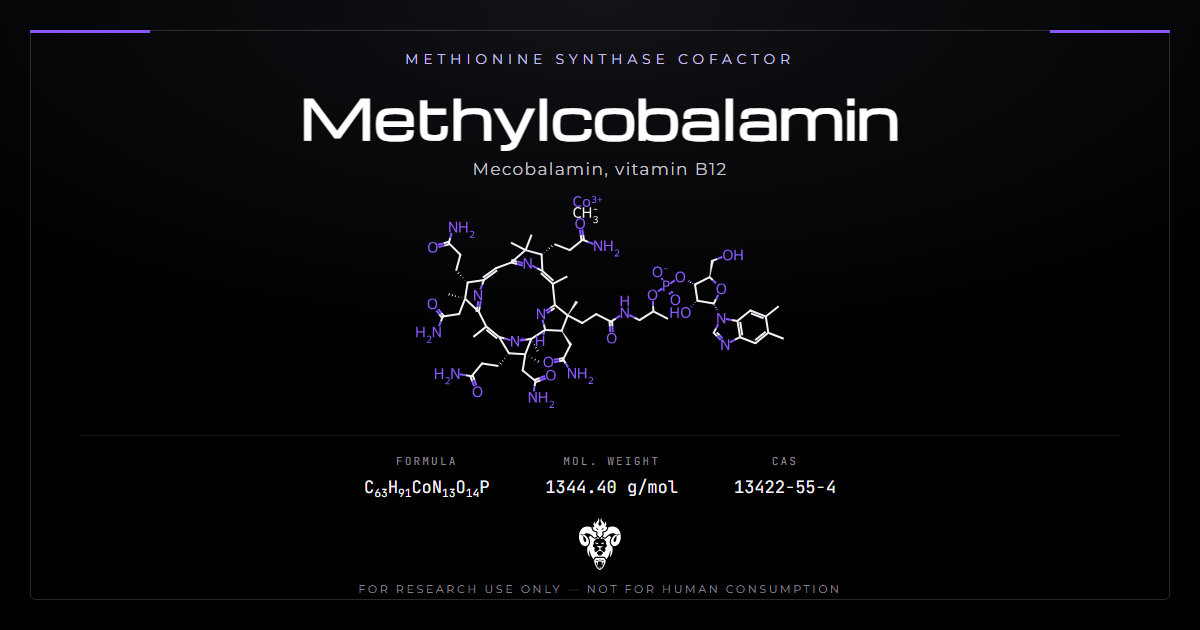
A cobalt atom held in a corrin ring, with a methyl group on the upper axial position and a dimethylbenzimidazole nucleotide below.
| Property | Value |
|---|---|
| Systematic name | Methyl-5,6-dimethylbenzimidazolylcobalamin |
| Common names | Methylcobalamin, mecobalamin, MeCbl |
| Molecular formula | C63H91CoN13O14P |
| Average mass | 1344.4 g/mol |
| Monoisotopic mass | 1343.5878 Da |
| CAS number | 13422-55-4 |
| PubChem CID | 10898559 |
| InChIKey | ZFLASALABLFSNM-WYVZQNDMSA-L |
| Stereocentres | 20 |
| Metal centre | Cobalt(III) |
| Upper axial ligand | Methyl |
The four forms
Cobalamin chemistry turns on what occupies the upper axial position of the cobalt. Swap that ligand and the name changes.
| Form | Upper ligand | Occurs in biology | Role |
|---|---|---|---|
| Methylcobalamin | Methyl | Yes | Cofactor for methionine synthase |
| Adenosylcobalamin | 5′-deoxyadenosyl | Yes | Cofactor for methylmalonyl-CoA mutase |
| Hydroxocobalamin | Hydroxyl | Yes | Circulating form; cyanide antidote |
| Cyanocobalamin | Cyanide | Trace only | Synthetic, used for fortification |
Three of those occur in biology. Cyanocobalamin does not, beyond traces following cyanide exposure such as smoking [5]. It exists because it crystallises well and resists degradation, which made it the practical choice for fortification and for most supplements.
The irony is worth noting. The form chosen for its stability is the one that carries a group the body has to remove.
The cobalt-carbon bond
Methylcobalamin contains one of the very few cobalt-carbon bonds in biology, and that bond is the reason the compound is difficult to handle.
It breaks under light. Photolysis of the cobalt-methyl bond is fast enough that ordinary room lighting degrades solutions during an experiment, which shapes every practical recommendation later in this article [13].
Two enzymes, two cofactors
Human biology uses cobalamin in exactly two reactions, and they need different forms.
Methionine synthase
Methylcobalamin is the cofactor for methionine synthase, in the cytosol. That enzyme transfers a methyl group from 5-methyltetrahydrofolate to homocysteine, producing methionine.
Failure here raises homocysteine and traps folate in a form the cell cannot use. This is the reaction behind every homocysteine-lowering trial discussed below.
Methylmalonyl-CoA mutase
Adenosylcobalamin is the cofactor for methylmalonyl-CoA mutase, in mitochondria. That enzyme converts methylmalonyl-CoA to succinyl-CoA in the catabolism of odd-chain fatty acids and several amino acids.
Failure here raises methylmalonic acid, which is why methylmalonic acid is the more specific marker of cobalamin deficiency than homocysteine.
Why one form cannot serve both
Supplying methylcobalamin does nothing directly for the mitochondrial enzyme, which needs the adenosyl form. Any complete account of cobalamin status therefore requires interconversion, and interconversion is where the marketing claim breaks down.
The active form argument does not survive contact with cells
Paul and Brady reviewed the assimilation pathways for all four forms [5].
What actually happens to an ingested dose
The cell reduces every supplemental or dietary form to a core cobalamin molecule. From that core, the cell builds both active cofactors.
The decisive finding is the ratio. Cells make intracellular methylcobalamin and adenosylcobalamin in proportions that the ingested form does not influence [5]. Feed the cell one form and it makes the same mix.
More pointedly still, the cell cleaves and discards the methyl and adenosyl groups on supplemental cobalamins. Those groups never appear on the intracellular cofactors [5].
So the methyl group you buy is not the methyl group your methionine synthase uses. It is a leaving group.
Where the trafficking actually limits things
Cobalamin has to pass through the lysosome to reach the cytosol, and that transit is a genuine bottleneck.
Zhao and colleagues argue that lysosomal function deteriorates in long-lived post-mitotic cells such as neurons, and that impaired lysosomal processing of cobalamin may contribute to age-related neurological decline [2]. Their case is mechanistic rather than trial-based, and it identifies a step that no choice of upper axial ligand addresses.
Absorption, transport and cellular uptake can all limit cobalamin status [5]. Starting with the methylated form bypasses none of those steps.
The argument that does hold up
A real reason to prefer methylcobalamin exists. It concerns the cyanide in cyanocobalamin, and it emerged from stroke prevention trials.
What the trials found
Cyanocobalamin carries a cyanide ion that the body must remove and excrete, a trivial burden with intact kidneys.
Spence traced a set of confusing trial results to exactly that step [4]. In the Vitamin Intervention for Stroke Prevention trial and in DIVINe, cyanocobalamin appeared to harm participants with impaired renal function. That harm offset the benefit seen in participants whose kidneys worked normally.
The dose pattern supports it. Hankey’s review found folic acid with a low cyanocobalamin dose of 0.05 mg/day or less cut stroke risk by 25 percent, while folic acid with 0.4 mg/day or more showed no reduction at all [6]. Trials in the second group all included patients with chronic kidney disease.
What the authors recommend
Both reviewers reach the same conclusion. Future homocysteine-lowering trials should use methylcobalamin or hydroxocobalamin rather than cyanocobalamin [6], and Spence and Hankey put that recommendation into a direct critique of the American Heart Association secondary stroke prevention guideline [12].
Note the shape of the argument. It is not that methylcobalamin works better. It is that cyanocobalamin carries a liability in a specific population, and the alternatives do not.
That is a narrower claim than the marketing makes, and unlike the marketing claim it has trial evidence behind it.
The pharmacological dose literature
A separate body of work gives methylcobalamin at doses that have nothing to do with nutrition.
The dietary requirement sits near 2.4 micrograms per day. The ALS trials use 50 milligrams by intramuscular injection twice weekly [11], roughly twenty thousand times that amount.
At that scale the trials test a pharmacological effect. Deficiency correction is not the hypothesis.
The 1998 observation
Kaji and colleagues compared ultrahigh-dose against low-dose methylcobalamin in 24 patients with ALS (PMID 9843082). Doses were 25 mg/day and 0.5 mg/day intramuscularly for 14 days [1].
Compound muscle action potential amplitude rose at four weeks in the ultrahigh-dose group. The low-dose group showed no change at either two or four weeks.
Twelve patients per arm and an electrophysiological endpoint. The authors called for a larger trial and said their result might prove clinically useful if one confirmed it.
The phase 3 trial, 24 years later
Oki and colleagues ran that trial (PMID 35532908). Multicentre, placebo-controlled, double-blind, across 25 Japanese neurology centres [11].
Design deserves attention here. Patients diagnosed within one year of onset entered a 12-week observation period first, and only those whose ALSFRS-R score fell by 1 or 2 points during it were randomised. That enriches for a moderate progression rate and excludes both fast and slow progressors.
Of 130 randomised patients, the treated group declined 2.66 points on ALSFRS-R over 16 weeks against 4.63 on placebo. The difference of 1.97 points reached p = 0.01, with a 95 percent confidence interval of 0.44 to 3.50. Adverse event rates matched between groups.
Why a vitamin would do anything in ALS
The mechanism proposed for these doses is not deficiency correction.
Animal work supports nerve regeneration, inhibition of cyclooxygenase enzymes and effects on other pain-signalling pathways, all at doses far above nutritional requirement [7]. Homocysteine is separately neurotoxic, and methionine synthase activity governs it.
Neither line is established in humans at these doses. The honest position is that the phase 3 trial demonstrated an effect without demonstrating why.
How far that result travels
The enrichment is the limit. Findings apply to patients diagnosed within a year, still ambulatory, with forced vital capacity above 60 percent and a documented moderate rate of decline.
Sixteen weeks is also short for a disease measured in years, and the confidence interval reaches down to 0.44 points. Whether the separation continues or converges is a question the double-blind period could not answer.
Measuring cobalamin status
Deciding whether a cobalamin intervention did anything requires knowing what to measure, and serum cobalamin is the weakest of the options.
Why serum cobalamin misleads
Total serum cobalamin counts molecules bound to two carrier proteins. Most rides on haptocorrin, which does not deliver to tissue. Only the fraction on transcobalamin, holotranscobalamin, reaches cells.
A normal total can therefore sit alongside functional deficiency at the enzyme. Spence calls metabolic cobalamin deficiency very common and usually undiagnosed, reporting it in 30 percent of stroke patients over 71 [4].
The functional markers
Methylmalonic acid and homocysteine measure whether the two cobalamin enzymes are working, which is the question that matters.
Methylmalonic acid is the more specific of the pair, because only the mitochondrial mutase produces it. Homocysteine also rises with folate deficiency and with renal impairment, so it needs interpreting alongside both.
Batista and colleagues list the panel worth running: total cobalamin, holotranscobalamin, homocysteine, methylmalonic acid and folate [10]. Trials that report only serum cobalamin cannot distinguish a repleted pool from a working enzyme.
The folate complication
Folate fortification changes the picture in a way that catches people out.
Adequate folate normalises the haematological signs of cobalamin deficiency while the neurological damage continues, so the blood count stops working as a warning. In fortified populations, Spence notes, the main causes of raised homocysteine reduce to renal failure and metabolic cobalamin deficiency [4].
That is also why fortification status changes trial results. Folic acid supplementation cut stroke risk about 15 percent in countries without mandatory fortification and showed no effect in countries with it [6].
The neuropathy and pain literature
The largest volume of published work sits here, and it is the weakest.
Diabetic neuropathy
Jiang and colleagues pooled 18 randomised trials covering 1,410 participants [3]. Nerve conduction velocities improved on the combination that added lipoic acid to prostaglandin E1 plus methylcobalamin.
Read the comparison carefully. Methylcobalamin appears in both arms, so the trial tests lipoic acid rather than the cobalamin. Heterogeneity ran from 79 to 85 percent on the conduction velocity endpoints.
A Cochrane review supplies a cleaner data point. Comparing acetyl-L-carnitine against methylcobalamin 1.5 mg/day in 232 participants, neuropathy disability scores fell in both arms with no important difference between them, at low certainty [8].
Pain
Buesing and colleagues reviewed the pain literature and found animal evidence for nerve regeneration and cyclooxygenase inhibition, alongside clinical trials in low back pain and neuralgia [7].
Their own summary calls the data fairly limited, with optimal regimens unidentified. They recommend it as a possible adjunct on the strength of its safety rather than its efficacy.
Autism
Rossignol and Frye pooled 17 studies, of which four were placebo-controlled [9]. Methylation and glutathione redox markers improved with subcutaneous methylcobalamin, and those biochemical changes correlated with clinical scores.
Of the 17, most fall into the uncontrolled, retrospective or case-report categories. Adverse events included hyperactivity in 11.9 percent and sleep disturbance in 7.6 percent, not significantly different from placebo.
How to read a trial of this compound
Four questions separate an informative cobalamin trial from an uninformative one.
Was the population deficient? Repleting an empty pool and adding cobalamin to a full one are different experiments. Most neuropathy trials do not report baseline status at all.
Which endpoint? Serum cobalamin will rise on any form and proves only that the dose was absorbed. Methylmalonic acid and homocysteine test whether the enzymes responded [10].
Nutritional or pharmacological dose? A 1.5 mg daily oral dose and a 50 mg twice-weekly injection sit in different worlds [8][11]. Results do not transfer between them in either direction.
Was the comparator another cobalamin? Trials holding methylcobalamin constant across both arms test whatever else changed, not the cobalamin [3].
What the record does not establish
No trial has shown methylcobalamin correcting deficiency better than another form in the general population. Both methylcobalamin and cyanocobalamin raise serum cobalamin and lower methylmalonic acid and homocysteine [10], and no head-to-head trial separates them on those endpoints.
Nobody has tested the renal argument prospectively either. It rests on subgroup analyses and reanalyses of trials using cyanocobalamin [4][12]. No trial has randomised patients between forms.
Nobody has replicated the ALS result outside Japan. It also comes from a population selected for a specific progression rate, over just 16 weeks [11].
Oral high-dose methylcobalamin has no evidence behind it at the doses the ALS work used. Those trials injected intramuscularly, and the compound’s oral absorption depends on the same intrinsic factor pathway that limits any cobalamin.
Genetic polymorphism testing has outrun the evidence. Paul and Brady note that the polymorphisms which might favour one form are not the ones commercial tests report [5].
Verifying research material
Two properties dominate handling, and both come from the cobalt-carbon bond.
Light sensitivity
Methylcobalamin is photolabile. Light cleaves the cobalt-methyl bond, converting the compound to hydroxocobalamin, and the reaction proceeds fast enough to matter during routine bench work.
Work under amber light or in foil-wrapped vessels. Prepare solutions immediately before use, and treat any material left out under room lighting as partly converted. Temova Rakuša and colleagues review the full stability picture, including sensitivity to temperature, pH, oxidants, reductants and other water-soluble vitamins in the same formulation [13].
That last point catches people out. Combining cobalamin with vitamin C or thiamine in one solution accelerates its degradation.
Identity and purity
Average mass is 1344.4 and monoisotopic mass 1343.5878. Cobalt makes the compound straightforward to quantify by ICP-MS against total cobalt, which is a useful orthogonal check on a chromatographic purity figure.
Photolysis yields hydroxocobalamin, the expected impurity. A certificate should name it rather than folding it into a single purity number. Colour offers a rough field check. Methylcobalamin solutions run red, and the shade shifts as degradation proceeds.
Store cold, dark and dry. A certificate that does not state light protection during handling has not addressed the main failure mode of this compound.
Kimera publishes third-party certificates of analysis for every lot in its COA database. Laboratories source methylcobalamin as a methionine synthase cofactor, often alongside NAD+ where one-carbon and redox metabolism intersect, or glutathione and CoQ10 where a different cofactor pool is the comparator. Related work appears in the redox and cofactors category.
Common questions about methylcobalamin
Is methylcobalamin the active form? Two active intracellular forms exist, methylcobalamin and adenosylcobalamin. An ingested dose still does not arrive ready to use, because cells cleave the methyl group and rebuild both cofactors from a core cobalamin [5].
So is it better than cyanocobalamin? Not on the active-form argument. A better-supported reason exists: cyanocobalamin carries cyanide, which appeared harmful in trial participants with impaired renal function [4][12].
Does the dose matter for that? Yes. Folic acid with 0.05 mg/day or less of cyanocobalamin cut stroke risk 25 percent, while 0.4 mg/day or more showed no reduction [6].
Why do the ALS trials use 50 mg? Because they are testing a pharmacological effect rather than correcting a deficiency. That dose is roughly twenty thousand times the dietary requirement and given by intramuscular injection [11].
How strong is the ALS evidence? One phase 3 trial in 130 patients found a 1.97-point ALSFRS-R difference at 16 weeks, p = 0.01 [11]. Enrolment covered only patients with a documented moderate rate of decline, so the result does not generalise across the disease.
Which marker shows cobalamin status best? Methylmalonic acid is more specific, since it reflects the mitochondrial enzyme. Homocysteine also rises in folate deficiency and renal impairment.
Why does it have to be kept in the dark? The cobalt-methyl bond photolyses. Light converts methylcobalamin to hydroxocobalamin during ordinary bench work [13].
Summary of the evidence
Identity: methylcobalamin, C63H91CoN13O14P, 1344.4 g/mol, CAS 13422-55-4. Cobalt(III) corrin with a methyl upper axial ligand and 20 stereocentres.
Biochemistry: cofactor for cytosolic methionine synthase. Adenosylcobalamin serves mitochondrial methylmalonyl-CoA mutase, so no single supplemental form covers both reactions.
The active-form claim: cells reduce every form to a core cobalamin, then build both cofactors in a fixed ratio and discard the supplemental methyl group [5].
The supported argument: cyanocobalamin carries cyanide and appeared harmful in renal impairment across stroke prevention trials, leading two review groups to recommend methylcobalamin or hydroxocobalamin instead [4][6][12].
Pharmacological dosing: 50 mg intramuscularly twice weekly slowed ALSFRS-R decline by 1.97 points over 16 weeks in 130 selected patients [11], following a 24-patient electrophysiological observation from 1998 [1].
Weaker literatures: diabetic neuropathy trials mostly hold methylcobalamin constant across arms [3], pain data remain thin [7], and most autism studies lack controls [9].
Handling: photolabile through the cobalt-carbon bond, degrading to hydroxocobalamin under ordinary lighting [13].
Status: supplied for laboratory research use only.
References
- Kaji R, Kodama M, Imamura A, et al. Effect of ultrahigh-dose methylcobalamin on compound muscle action potentials in amyotrophic lateral sclerosis: a double-blind controlled study. Muscle Nerve. 1998;21(12):1775-1778. PMID 9843082. DOI
- Zhao H, Brunk UT, Garner B. Age-related lysosomal dysfunction: an unrecognized roadblock for cobalamin trafficking? Cell Mol Life Sci. 2011;68(24):3963-3969. PMID 22015613. DOI
- Jiang DQ, Li MX, Wang Y, Wang Y. Effects of prostaglandin E1 plus methylcobalamin alone and in combination with lipoic acid on nerve conduction velocity in patients with diabetic peripheral neuropathy: a meta-analysis. Neurosci Lett. 2015;594:23-29. PMID 25800109. DOI
- Spence JD. Homocysteine lowering for stroke prevention: unravelling the complexity of the evidence. Int J Stroke. 2016;11(7):744-747. PMID 27462097. DOI
- Paul C, Brady DM. Comparative bioavailability and utilization of particular forms of B12 supplements with potential to mitigate B12-related genetic polymorphisms. Integr Med (Encinitas). 2017;16(1):42-49. PMID 28223907.
- Hankey GJ. B vitamins for stroke prevention. Stroke Vasc Neurol. 2018;3(2):51-58. PMID 30022794. DOI
- Buesing S, Costa M, Schilling JM, Moeller-Bertram T. Vitamin B12 as a treatment for pain. Pain Physician. 2019;22(1):E45-E52. PMID 30700078.
- Rolim LC, da Silva EM, Flumignan RL, Abreu MM, Dib SA. Acetyl-L-carnitine for the treatment of diabetic peripheral neuropathy. Cochrane Database Syst Rev. 2019;6(6):CD011265. PMID 31201734. DOI
- Rossignol DA, Frye RE. The effectiveness of cobalamin (B12) treatment for autism spectrum disorder: a systematic review and meta-analysis. J Pers Med. 2021;11(8):784. PMID 34442428. DOI
- Batista KS, Cintra VM, Lucena PAF, et al. The role of vitamin B12 in viral infections: a comprehensive review of its relationship with the muscle-gut-brain axis and implications for SARS-CoV-2 infection. Nutr Rev. 2022;80(3):561-578. PMID 34791425. DOI
- Oki R, Izumi Y, Fujita K, et al. Efficacy and safety of ultrahigh-dose methylcobalamin in early-stage amyotrophic lateral sclerosis: a randomized clinical trial. JAMA Neurol. 2022;79(6):575-583. PMID 35532908. DOI
- Spence JD, Hankey GJ. Problem in the recent American Heart Association guideline on secondary stroke prevention: B vitamins to lower homocysteine do prevent stroke. Stroke. 2022;53(8):2702-2708. PMID 35748292. DOI
- Temova Rakuša Ž, Roškar R, Hickey N, Geremia S. Vitamin B12 in foods, food supplements, and medicines: a review of its role and properties with a focus on its stability. Molecules. 2022;28(1):240. PMID 36615431. DOI
Methylcobalamin is sold for laboratory research use only. Not for human consumption, nor medical, veterinary, or household uses.
Literature retrieved from PubMed.