
Most people know meldonium from a doping headline. Researchers know it as something more interesting: a clever piece of metabolic pharmacology. Mildronate, its brand name, is a synthetic metabolic modulator from Soviet-era Latvia. It does not stimulate a receptor the way most famous compounds do. Instead, it works upstream of energy production. It reroutes how cells make ATP, and as a side effect, how blood vessels behave. That two-part mechanism made it a long-standing cardioprotective drug across Eastern Europe. It also made it a recurring subject in the research-compound literature — one Kimera stocks in its analytical reagents catalog. This profile covers what Mildronate is, the two ways it works, its unusual pharmacokinetics, its origins, and the ban that made it famous.
What Is Mildronate?
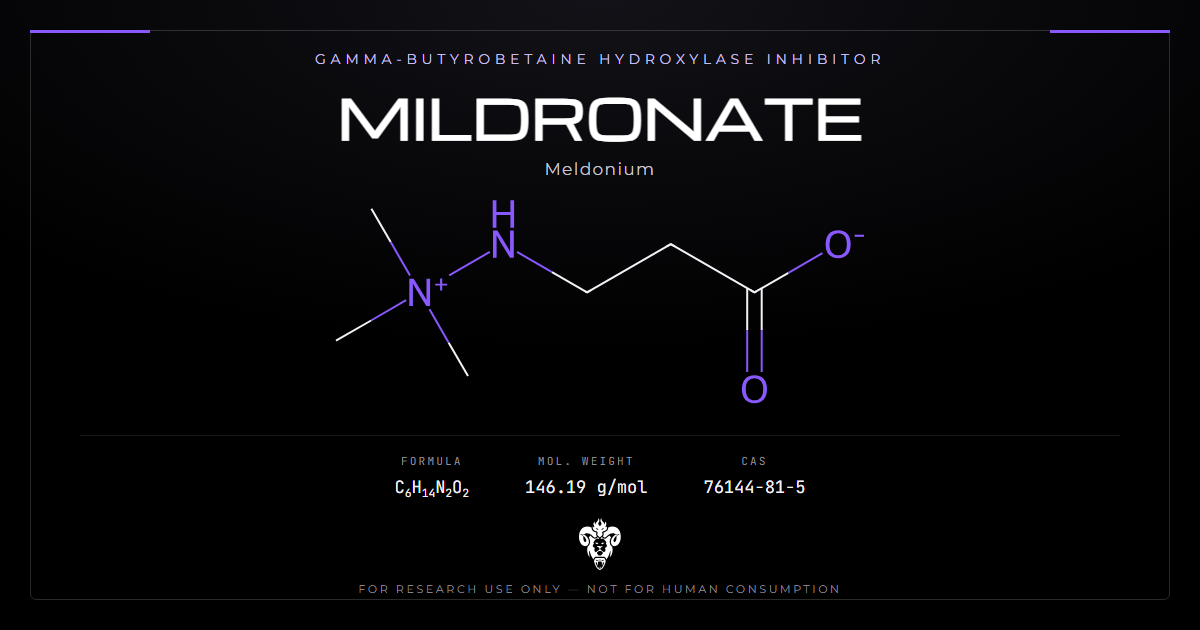
Mildronate goes by several names: meldonium, THP, and MET-88. Chemically, it is 3-(2,2,2-trimethylhydrazinium)propionate. That makes it a close structural analog of gamma-butyrobetaine (GBB), the natural precursor to L-carnitine. This mimicry is the key to everything the molecule does. Because it resembles GBB, it slips into the same machinery the body uses to build carnitine. Grindeks, a Latvian company, developed it and still makes it under the Mildronate brand. The molecule is an inner salt — a zwitterion carrying both a positive and a negative charge. It has no chiral center, so there are no enantiomers to separate. Kimera supplies Mildronate as the meldonium dihydrate — the stable crystalline form (CAS 86426-17-7, C₆H₁₈N₂O₄, 182.22 g/mol) — for laboratory research in powder and capsule formats.
How Mildronate Works, Part One: The Carnitine Mechanism
Mildronate’s main mechanism centers on carnitine. It targets gamma-butyrobetaine hydroxylase (BBOX), the enzyme that turns GBB into L-carnitine. Early reports called it a non-hydroxylatable analog. Later crystallography refined that picture. Meldonium actually binds the enzyme’s substrate pocket and acts as an alternative substrate, which makes it a competitive inhibitor (Wikipedia). It also blocks OCTN2, the transporter that handles carnitine uptake and kidney reabsorption.
Together, these actions lower L-carnitine throughout the body. L-carnitine shuttles long-chain fatty acids into mitochondria. Remove it, and cells lose much of their ability to burn fat for fuel. Researchers have measured this effect in people. In one Latvian study, four weeks of meldonium dropped plasma carnitine by 18% (Greenblatt & Greenblatt, 2016). As a BBOX inhibitor, it is potent, with IC50 values in the 34–62 μM range. With fat oxidation limited, cells compensate by shifting toward glucose oxidation. That shift anchors its anti-ischemic reputation.
How Mildronate Works, Part Two: The Nitric Oxide Mechanism
The carnitine story is only half the picture. This is the part most write-ups skip. When BBOX slows down, its substrate GBB does not vanish. It builds up instead. Research shows the cell diverts that surplus GBB into a different route, forming GBB esters (Berlato & de Bairros, 2020). One ester, GBB ethyl ester, resembles acetylcholine and shows cholinergic activity.
That resemblance matters. Those esters activate endothelial nitric oxide synthase (eNOS) through the PI3K–Akt pathway. In turn, they stimulate nitric oxide production in the vascular endothelium. More nitric oxide brings vasodilation and better microcirculation. Studies also report lower blood pressure and heart rate alongside it. So meldonium is not a one-trick molecule. It works on two fronts at once: metabolic and vascular. Researchers study endothelial dysfunction in models driven by high glucose or hypertension. They point to this second mechanism for the compound’s vaso-protective effects.
The Metabolic Logic
Why does the carnitine shift matter? It comes down to oxygen. Aerobic glucose oxidation uses less oxygen per unit of ATP than fatty acid oxidation. Normally that gap is trivial. Under ischemia, when oxygen runs short, it becomes meaningful. The cell squeezes more energy from each available oxygen molecule. The founding Latvian work framed it simply. Limiting carnitine prevents toxic fatty-acid intermediates from piling up in starved tissue. It also steers metabolism toward the cleaner-burning fuel. Researchers report a second benefit, too. Meldonium lowers trimethylamine-N-oxide (TMAO), a gut metabolite tied to atherosclerosis, along with long-chain acylcarnitines. This profile — carnitine-lowering, metabolism-shifting, TMAO-reducing — underlies its long study as a cardioprotective agent.
Pharmacokinetics: An Unusually Long Tail
Meldonium’s pharmacokinetics deserve their own section. They explain how it became infamous. After a single oral dose, its half-life sits around 3 to 7 hours. Repeated dosing stretches that toward 15 hours in the washout phase, a sign of nonlinear kinetics. Multi-compartment modeling reveals something stranger. A three-compartment model shows a very slow terminal excretion phase. In volunteer studies, the drug stayed detectable in urine for 94 to 162 days after use. That long tail is no footnote. It is the single fact that turned a regional cardiac drug into a global doping story. Traces lingered for months after an athlete stopped taking it.
A Latvian Origin and a Wide Clinical Footprint
Mildronate came out of the Latvian Institute of Organic Synthesis. The chemist Ivars Kalviņš developed it in the 1970s. Grindeks brought it to market. Across the Baltics, Russia, and neighboring countries, doctors prescribed it widely. Its approved uses there are strikingly broad. In cardiology, they cover ischemic heart disease, stable angina, chronic heart failure, cardiomyopathy, and myocardial infarction. In neurology, they include cerebral circulation disorders and recovery from physical or emotional overload. Some markets extend even further, into pulmonology, narcology, and ophthalmology. Most of this literature appeared in Russian. That language barrier is a big reason meldonium stayed obscure to Western researchers for decades. English-language reviewers still note how little peer-reviewed data on healthy subjects exists outside it.
Beyond the Heart: Neurological Research
Ischemia is not unique to the heart. So researchers have studied meldonium in neurological settings too. Preclinical work has probed its effects on cerebral ischemia and cognition. In one study, aged mice on meldonium showed better long-term and short-term memory. They also had less mitochondrial DNA damage and lower oxidative-stress markers in the hippocampus. Findings like these keep the compound useful as a research tool. It helps probe where energy metabolism, mitochondrial quality control, and neuroprotection intersect. As with the cardiac data, though, the strongest results still come from animal and in vitro models, not large human trials.
The WADA Story
Mildronate’s fame arrived in January 2016. The World Anti-Doping Agency moved it from its monitoring program to its banned list. WADA classified it as a “metabolic modulator,” the same category as trimetazidine. The concern started with a puzzle. Meldonium kept appearing as an unexplained mass-spectrometry peak in some athlete urine samples, but not others. WADA cited evidence that athletes used it to boost performance and recovery. Once the ban took effect, the drug’s long excretion tail produced a cascade of positive tests across many sports. The point is worth stating plainly. This history reflects meldonium’s prohibited status in sport, and any performance-related research must account for it. Tellingly, reviews of the human ergogenic evidence find it thinner than the reputation suggests.
Regulatory Status
Mildronate holds no FDA approval. The European Union has not authorized it either. Its approval covers mainly the countries where it began. In the United States, it exists strictly as a research chemical. Kimera makes no health claims about it and supplies it for in vitro and laboratory research only.
Sourcing and COA Verification
For a metabolic research compound, identity and purity decide whether results mean anything. That holds especially for a small, highly polar zwitterion, where analytical confirmation matters. Every Kimera lot ships with third-party COA verification. We publish the results openly in our public COA archive. Before ordering Mildronate, reviewers can check the current COAs for identity and purity data.
Frequently Asked Questions
What is Mildronate?
Mildronate (meldonium) is a synthetic metabolic modulator and carnitine biosynthesis inhibitor. Latvia developed it, and Eastern European medicine uses it as a cardioprotective, anti-ischemic agent.
How does Mildronate work?
It works two ways. First, it inhibits gamma-butyrobetaine hydroxylase (BBOX) and the OCTN2 transporter to lower L-carnitine. That shifts metabolism from fatty acid oxidation toward oxygen-efficient glucose oxidation. Second, the buildup of gamma-butyrobetaine feeds a nitric-oxide pathway with vascular effects.
Why did so many athletes test positive after the 2016 ban?
Meldonium has an unusually long terminal excretion phase. Studies detected it in urine for up to 94 to 162 days, so traces persisted long after use stopped.
Why was Mildronate banned by WADA?
WADA added meldonium to its prohibited list in January 2016. It classified the compound as a metabolic modulator and cited evidence of athletes using it to enhance performance.
What is Mildronate’s molecular weight?
Kimera supplies Mildronate as the meldonium dihydrate: molecular formula C₆H₁₈N₂O₄, molar mass 182.22 g/mol (CAS 86426-17-7). The anhydrous parent molecule is C₆H₁₄N₂O₂ at 146.19 g/mol (CAS 76144-81-5).
Kimera sells Mildronate for laboratory and research use only. Not for human consumption, nor for medical, veterinary, or household use.
References
- Greenblatt HK, Greenblatt DJ. Meldonium (Mildronate): a performance-enhancing drug? Clin Pharmacol Drug Dev. 2016. https://accp1.onlinelibrary.wiley.com/doi/full/10.1002/cpdd.264
- Berlato DG, de Bairros AV. Meldonium: pharmacological, toxicological, and analytical aspects. Toxicol Res Appl. 2020. https://journals.sagepub.com/doi/10.1177/2397847320915143
- Dambrova M, et al. Pharmacological effects of meldonium: biochemical mechanisms and biomarkers of cardiometabolic activity. Pharmacol Res. 2016.
- Dambrova M, Liepinsh E, Kalvinsh I. Mildronate: cardioprotective action through carnitine-lowering effect. Trends Cardiovasc Med. 2002;12(6):275–279.
- Meldonium. Wikipedia. https://en.wikipedia.org/wiki/Meldonium
- Meldonium, PubChem CID 123868 (anhydrous parent); Kimera product is meldonium dihydrate, CAS 86426-17-7. https://pubchem.ncbi.nlm.nih.gov/compound/123868