

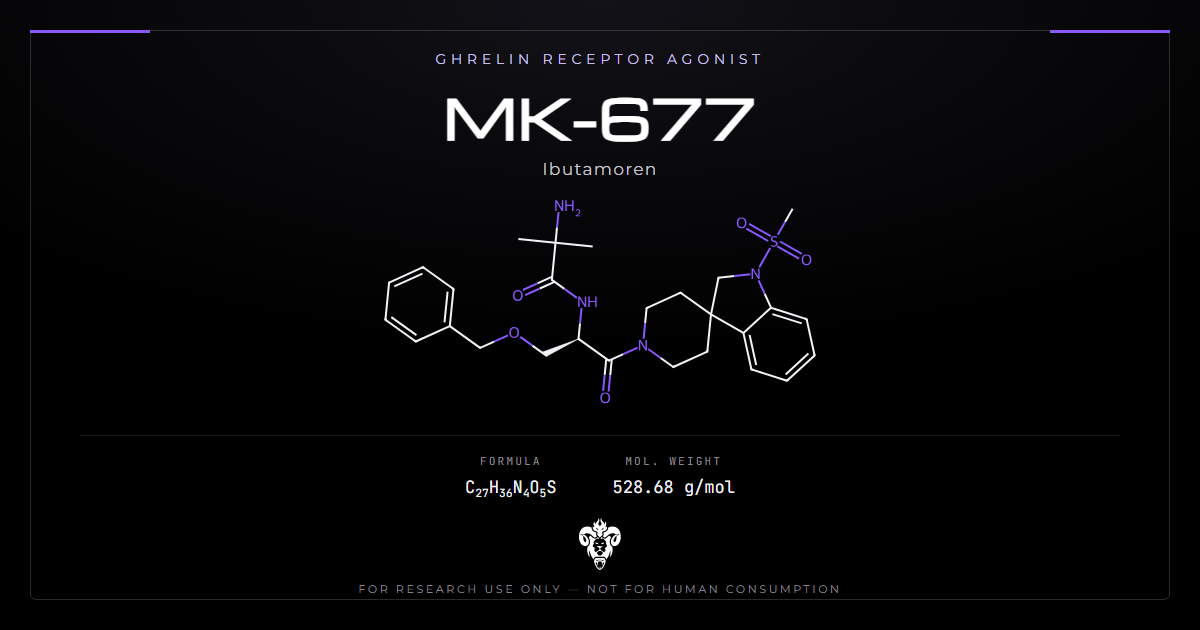
Most compounds in this catalogue fail for want of evidence. MK-677 is the opposite case. It has a large randomised clinical record, and that record is the most interesting thing about it.
The compound does exactly what it was designed to do. Across trials it raises growth hormone and insulin-like growth factor I reliably, by margins of 50 to 90 percent. That holds in healthy elderly adults, in growth-hormone-deficient children, and in patients with Alzheimer disease [4][5][6][7][8].
Converting that into a functional outcome proved much harder. In a two-year trial, fat-free mass rose while strength and function did not [8]. A 563-patient Alzheimer trial found target engagement with no effect on disease progression [7]. And a hip fracture trial stopped early on a cardiac safety signal, concluding that the compound had an unfavourable safety profile in that population [9].
That gap between biochemical effect and functional outcome is the thing to understand before designing anything around this compound. What follows covers the chemistry, the receptor and how it was found, the trial record in detail, and analytical handling.
Chemical identity: what you are actually handling
MK-677 is a spiroindoline piperidine, structurally unlike the peptides it mimics.
| Property | Value |
|---|---|
| INN | Ibutamoren |
| Development code | MK-677, MK-0677 |
| Free base formula | C27H36N4O5S |
| Free base weight | 528.66 g/mol |
| Free base PubChem CID | 178024 |
| Free base InChIKey | UMUPQWIGCOZEOY-JOCHJYFZSA-N |
| Mesylate formula | C28H40N4O8S2 |
| Mesylate weight | 624.77 g/mol |
| Mesylate PubChem CID | 6450830 |
| Stereocentre | One, (R) |
| Molecular target | Growth hormone secretagogue receptor (GHS-R1a) |
| Originator | Merck Research Laboratories |
The salt form is not a footnote
Material is commonly supplied as the mesylate salt, and the two forms differ by 96 g/mol.
The free base is 528.66 g/mol and the mesylate 624.77 g/mol, so the free base accounts for roughly 84.6 percent of mesylate mass. Weighing 25 mg of mesylate delivers about 21 mg of ibutamoren.
Clinical papers generally specify which form they dosed. The widely cited 25 mg figure refers to the mesylate in most of the trial literature [4][9]. Anyone reproducing a published exposure must match the form as well as the number.
The scaffold
The core is a spiro[indoline-3,4′-piperidine]. In that bicyclic system the indoline and piperidine rings share a single carbon. A methanesulfonyl group sits on the indoline nitrogen, and an O-benzyl serine-derived linker connects to a terminal 2-methylalaninamide.
That arrangement carries one defined stereocentre in the (R) configuration. It matters analytically, because the epimer shares formula and mass exactly.
The receptor, and how it was found backwards
The history here is unusual and worth knowing, because it explains why a synthetic compound preceded the hormone it mimics.
Smith describes the programme as reverse pharmacology [3]. Neither the receptor nor the natural ligand controlling growth hormone pulse amplitude was known when the work began. Lead identification therefore proceeded on function alone.
Four routes to raising pulse amplitude seemed possible. Increasing releasing-hormone secretion. Amplifying releasing-hormone signalling in pituitary somatotrophs. Reducing somatostatin release. Or antagonising somatostatin receptor signalling [3].
The secretagogues turned out to act through all four [3]. Medicinal chemistry proceeded from peptide leads through progressively more drug-like non-peptides. MK-677 emerged as an orally active compound suitable for once-daily dosing [2][10].
The receptor came afterwards. Expression cloning identified it as a previously unknown G-protein coupled receptor, expressed predominantly in brain, pituitary and pancreas [3]. Researchers then used the cloned receptor to find its endogenous agonist, ghrelin. That closed the reverse-pharmacology loop and established these compounds as ghrelin mimetics [3].
Structure-activity work in the series continued afterwards, producing compounds substantially more potent in vitro than MK-677 itself [11].
Why pulsatile secretion was the design goal
One further point explains why the programme pursued a secretagogue rather than the hormone itself.
Growth hormone is not secreted continuously. It arrives in pulses, and the pattern of those pulses carries information that a steady infusion does not reproduce. Early work in this field concentrated specifically on regulating secretion rather than replacing the hormone, and the peptidomimetic programme was framed around that distinction from the outset [1].
A secretagogue acting through a receptor preserves the pulse structure and remains subject to the axis’s own negative feedback. Exogenous hormone overrides both. Smith and colleagues describe the resulting profile in elderly subjects as a reproduction of the young-adult physiological pattern rather than a pharmacological override [3].
That architectural argument is sound, and it is why the compound remains interesting as a research tool even after its clinical failures. A tool that raises the axis physiologically is useful for asking what the axis does, independent of whether raising it helps anyone.
Where MK-677 sits among secretagogues
The class is broader than the one compound, and placing MK-677 within it clarifies what it is for.
| Compound | Type | Route | Distinguishing feature |
|---|---|---|---|
| GHRP-6 | Peptide | Injection | Early lead, established the pharmacology [10] |
| Ghrelin | Endogenous peptide | Injection | Natural receptor ligand, found after the drugs [3] |
| MK-677 | Non-peptide | Oral | Once-daily oral dosing, extensive trial record [3][8] |
| Later analogues | Non-peptide | Oral | More potent in vitro than MK-677 [11] |
Two things follow from that table. MK-677 is not the most potent compound in its series, since later medicinal chemistry produced substantially more active molecules [11]. And it remains the most studied, which is why it is the reference compound rather than the best one.
For a laboratory, being well characterised usually matters more than being potent. MK-677 has a published human dose-response, a known engagement marker, and documented adverse effects, which is more than any of its more potent successors can offer.
What MK-677 does biochemically
The endocrine effect is consistent and well documented across populations.
In healthy volunteers under caloric restriction, a single 25 mg dose produced a peak growth hormone response of 55.9 µg/L. That fell to 22.6 µg/L after a week of dosing, against placebo peaks near 9 and 7 µg/L [4].
That decline between day 1 and day 7 is worth noting. Peak response attenuates with repeated dosing even as the compound continues to work. It is a general feature of secretagogue pharmacology rather than a failure.
Insulin-like growth factor I rises more durably. The Alzheimer trial reported a 60.1 percent increase at six weeks and 72.9 percent at twelve months, sustained across a year of dosing [7]. The hip fracture trial reported an increase of 51.4 ng/mL against placebo [9]. In elderly subjects across three studies, increases ranged from 55 to 94 percent [5].
Binding protein 3 rises alongside, while binding protein 2 did not change significantly in the nitrogen balance study [4].
The trial record
Four randomised trials define what is known, and they should be read together rather than selectively.
Nitrogen balance under caloric restriction
Murphy and colleagues ran a double-blind, randomised, placebo-controlled two-period crossover study. Eight healthy volunteers were calorically restricted to 18 kcal/kg per day across two 14-day periods [4].
During the drug week, mean daily nitrogen balance was 0.31 g/day on MK-677 against -1.48 g/day on placebo [4]. That is a shift from net protein loss to approximate balance, and it is the cleanest positive result in the compound’s file.
Cortisol and prolactin responses did not differ significantly from placebo after seven days of dosing [4].
Bone turnover markers
Murphy and colleagues pooled 187 elderly adults across three randomised placebo-controlled studies. They measured bone formation and resorption markers [5].
Nine weeks of treatment increased serum osteocalcin by 29.4 percent and bone-specific alkaline phosphatase by 10.4 percent. Both are formation markers. Urinary N-telopeptide excretion, a resorption marker, rose 22.6 percent [5].
Read that carefully. Both formation and resorption rose, which describes accelerated turnover rather than net bone gain. Turnover markers are not a density outcome, and the paper does not claim they are.
The two-year body composition trial
Nass and colleagues ran the most informative study. It was a two-year double-blind randomised placebo-controlled modified-crossover trial in 65 healthy adults aged 60 to 81 [8].
Growth hormone and insulin-like growth factor I rose into the young-adult range without serious adverse events [8]. Fat-free mass increased by 1.1 kg, against a 0.5 kg decrease on placebo. Body cell mass moved similarly [8].
The rest of the result set complicates the headline.
No significant difference appeared in abdominal visceral fat or total fat mass. Limb fat rose more on drug than placebo, 1.1 kg against 0.24 kg. Body weight rose 2.7 kg against 0.8 kg [8].
Fasting glucose rose by 0.3 mmol/L and insulin sensitivity decreased [8]. Cortisol rose by 47 nmol/L [8]. Bone density changes consistent with increased remodelling appeared, matching the turnover marker results [5][8].
The authors state the central negative finding plainly. Increased fat-free mass did not result in changes in strength or function [8]. They also note the study lacked power to evaluate functional endpoints properly, which is a fair caveat rather than a rebuttal.
Common side effects were increased appetite, which subsided over months. Transient mild lower-extremity oedema and muscle pain also occurred [8].
The Alzheimer disease trial
Sevigny and colleagues randomised 563 patients with mild to moderate Alzheimer disease to MK-677 25 mg or placebo daily for twelve months. In total 416 completed [7].
The rationale was mechanistic. Insulin-like growth factor I increases clearance of beta-amyloid in animals, and serum levels decline with age and further in the disease [7].
Target engagement was unambiguous, at the 60 to 73 percent increases described above. Four outcome measures covered global impression, cognition, activities of daily living and dementia severity. No significant differences appeared between groups over twelve months [7].
The authors’ conclusion is the useful sentence. Despite evidence of target engagement, the compound was ineffective at slowing progression [7].
The hip fracture trial and the safety signal
Adunsky and colleagues ran a multicentre randomised double-blind phase IIb study in 123 elderly hip fracture patients. Sixty-two received 25 mg daily and 61 received placebo [9].
Insulin-like growth factor I rose by 51.4 ng/mL against placebo, again confirming engagement [9]. Gait speed showed a small significant improvement. Stair climbing power did not differ significantly, and several other functional measures showed none either [9].
The trial terminated early because of a congestive heart failure safety signal in a limited number of patients [9]. The authors concluded that the rise in insulin-like growth factor I was not paralleled by improvement in most functional measures. They described the safety profile in that population as unfavourable [9].
That is the most consequential finding in the file, and it is routinely omitted from summaries of this compound.
What the record supports and what it does not
Stating this precisely matters more here than for most compounds, because the evidence is real in both directions.
Supported: reliable, sustained elevation of growth hormone and insulin-like growth factor I after oral dosing [4][7][8][9]. Improvement in nitrogen balance under caloric restriction [4]. Increased bone turnover markers [5]. Increased fat-free mass over one to two years [8].
Not supported: improvement in strength or physical function [8][9], benefit in Alzheimer disease progression [7], or reduction in visceral fat [8].
Documented adverse findings: decreased insulin sensitivity with raised fasting glucose [8], raised cortisol [8], increased appetite, oedema and muscle pain [8], and a congestive heart failure signal sufficient to stop a trial [9].
Regulatory status: no marketing approval in any jurisdiction, despite an unusually extensive clinical programme.
Physicochemical properties and handling
The molecule carries two amide bonds, a sulfonamide, a benzyl ether and a primary amine.
The primary amine on the terminal 2-methylalaninamide is the basic centre and the site of salt formation. Amide bonds and the sulfonamide hold up under ordinary storage. The benzyl ether resists hydrolysis, though it undergoes hydrogenolysis, which is not a storage concern.
Aqueous solubility is modest for the free base and better for the mesylate, which is why the salt is the supplied form.
Store the solid sealed, dry, cold and dark. Confirm salt form before any molar calculation.
Analytical characterisation
Four checks cover this compound.
Salt form determination comes first in practice. The 96 g/mol difference between free base and mesylate propagates into every concentration derived from a weighed mass. Ion chromatography or NMR integration of the mesylate methyl signal settles it directly.
Accurate mass confirms C27H36N4O5S at 528.66 for the free base. One sulfur in the free base and two in the mesylate give different isotope contributions.
Chiral purity addresses the single (R) stereocentre. The epimer shares formula and accurate mass, so only a chiral method reports it.
Proton NMR confirms the spiro architecture and the methanesulfonyl group. That distinguishes the compound from related secretagogues in the same medicinal chemistry series [11].
What a rigorous certificate should contain
Salt form, stated explicitly, with the counterion named.
Chromatographic purity with method conditions.
Accurate mass confirming the formula for the stated form.
Chiral purity at the (R) centre.
Residual solvents from synthesis.
Kimera publishes third-party certificates of analysis for every lot in its COA database. Laboratories source MK-677 (Ibutamoren) as a reference secretagogue, often alongside MK-777, its acetylated relative, or CJC-1295 (no DAC), which acts on a different receptor in the same axis. Related chemistry appears in the SARMs category.
Common misclassifications
Four errors recur.
MK-677 is called a SARM. It is a ghrelin receptor agonist acting on the growth hormone axis, with no androgen receptor activity whatsoever.
Copy describes it as a growth hormone. The compound instead stimulates endogenous pulsatile secretion through a receptor, which produces a different profile from exogenous hormone administration [3][12].
Its body composition data are read as strength data. The two-year trial measured both and found fat-free mass rose while strength and function did not [8].
Its safety record is described as clean. A phase IIb trial stopped early on a congestive heart failure signal [9], and the two-year trial documented decreased insulin sensitivity and raised cortisol [8].
Experimental design considerations
Specify and match the salt form. The 25 mg figure in the trial literature generally refers to mesylate [4][9].
Measure glucose and insulin sensitivity. Both moved in the longest trial, and a study not measuring them will miss a documented effect [8].
Measure function, not just composition. The central finding of this literature is that the two dissociate [8][9].
Expect peak attenuation. Growth hormone peak response fell more than half between day 1 and day 7 of dosing in one study [4].
Interpret bone markers as turnover. Formation and resorption markers both rose, which is not the same as net bone accrual [5].
Include cortisol in the panel. It rose measurably over two years [8] while remaining unchanged over one week [4]. The timescale determines whether the effect appears at all.
Frequently asked questions
What is MK-677? Ibutamoren, an orally active non-peptide growth hormone secretagogue and ghrelin receptor agonist developed at Merck. Kimera supplies it as a laboratory research material.
Does it reliably raise IGF-1? Yes. Increases of 50 to 94 percent have been reported across multiple randomised trials [5][7][8][9].
Did that translate into functional improvement? No. The two-year trial found increased fat-free mass without changes in strength or function [8], and the hip fracture trial found no improvement in most functional measures [9].
What happened in the hip fracture trial? It was terminated early because of a congestive heart failure safety signal, and the authors described the safety profile in that population as unfavourable [9].
Does it affect glucose metabolism? Yes. Fasting glucose rose and insulin sensitivity decreased over two years [8].
Is it a SARM? No. It acts on the ghrelin receptor, not the androgen receptor.
Is it approved anywhere? No, despite an extensive clinical programme.
Why does the salt form matter for dosing calculations? Free base and mesylate differ by 96 g/mol. Weighing the mesylate delivers about 85 percent of that mass as ibutamoren, so a protocol written for free base and executed with mesylate runs roughly 15 percent low.
Is the growth hormone rise sustained or does it fade? Peak growth hormone response attenuates within a week [4], while insulin-like growth factor I elevation persists for at least twelve months [7].
Summary of the evidence
Identity: C27H36N4O5S at 528.66 g/mol as free base, commonly supplied as the mesylate at 624.77 g/mol, one (R) stereocentre.
Target: growth hormone secretagogue receptor, identified after the compounds were made and later matched to its endogenous ligand ghrelin [3].
Biochemical effect: reliable and sustained elevation of growth hormone and insulin-like growth factor I [4][5][7][8][9].
Positive findings: improved nitrogen balance under caloric restriction [4], increased bone turnover markers [5], increased fat-free mass over one to two years [8].
Negative findings: no change in strength or function [8], no effect on Alzheimer disease progression across 563 patients [7], no reduction in visceral fat [8].
Safety findings: decreased insulin sensitivity, raised fasting glucose and raised cortisol [8], plus a congestive heart failure signal that ended a phase IIb trial early [9].
Status: no approval anywhere.
References
- Smith RG, Van der Ploeg LH, Howard AD, et al. Peptidomimetic regulation of growth hormone secretion. Endocr Rev. 1997;18(5):621-645. PMID 9331545. DOI
- Patchett AA, Smith RG, Wyvratt MJ. Orally active growth hormone secretagogues. Pharm Biotechnol. 1998;11:525-554. PMID 9760695. DOI
- Smith RG. Development of growth hormone secretagogues. Endocr Rev. 2005;26(3):346-360. PMID 15814848. DOI
- Murphy MG, Plunkett LM, Gertz BJ, et al. MK-677, an orally active growth hormone secretagogue, reverses diet-induced catabolism. J Clin Endocrinol Metab. 1998;83(2):320-325. PMID 9467534. DOI
- Murphy MG, Bach MA, Plotkin D, et al. Oral administration of the growth hormone secretagogue MK-677 increases markers of bone turnover in healthy and functionally impaired elderly adults. J Bone Miner Res. 1999;14(7):1182-1188. PMID 10404019. DOI
- Codner E, Cassorla F, Tiulpakov AN, et al. Effects of oral administration of ibutamoren mesylate, a nonpeptide growth hormone secretagogue, on the growth hormone-insulin-like growth factor I axis in growth hormone-deficient children. Clin Pharmacol Ther. 2001;70(1):91-98. PMID 11452249. DOI
- Sevigny JJ, Ryan JM, van Dyck CH, et al. Growth hormone secretagogue MK-677: no clinical effect on AD progression in a randomized trial. Neurology. 2008;71(21):1702-1708. PMID 19015485. DOI
- Nass R, Pezzoli SS, Oliveri MC, et al. Effects of an oral ghrelin mimetic on body composition and clinical outcomes in healthy older adults: a randomized trial. Ann Intern Med. 2008;149(9):601-611. PMID 18981485. DOI
- Adunsky A, Chandler J, Heyden N, et al. MK-0677 (ibutamoren mesylate) for the treatment of patients recovering from hip fracture: a multicenter, randomized, placebo-controlled phase IIb study. Arch Gerontol Geriatr. 2011;53(2):183-189. PMID 21067829. DOI
- Micic D, Casabiell X, Gualillo O, et al. Growth hormone secretagogues: the clinical future. Horm Res. 1999;51 Suppl 3:29-33. PMID 10592441. DOI
- Lu Z, Tata JR, Cheng K, et al. Highly potent growth hormone secretagogues. Bioorg Med Chem Lett. 2007;17(13):3657-3659. PMID 17482461. DOI
- Nieman LK, Biller BM, Findling JW, et al. The diagnosis of Cushing’s syndrome: an Endocrine Society Clinical Practice Guideline. J Clin Endocrinol Metab. 2008;93(5):1526-1540. PMID 18334580. DOI
MK-677 is sold for laboratory research use only. Not for human consumption, nor medical, veterinary, or household uses.
Literature retrieved from PubMed.