
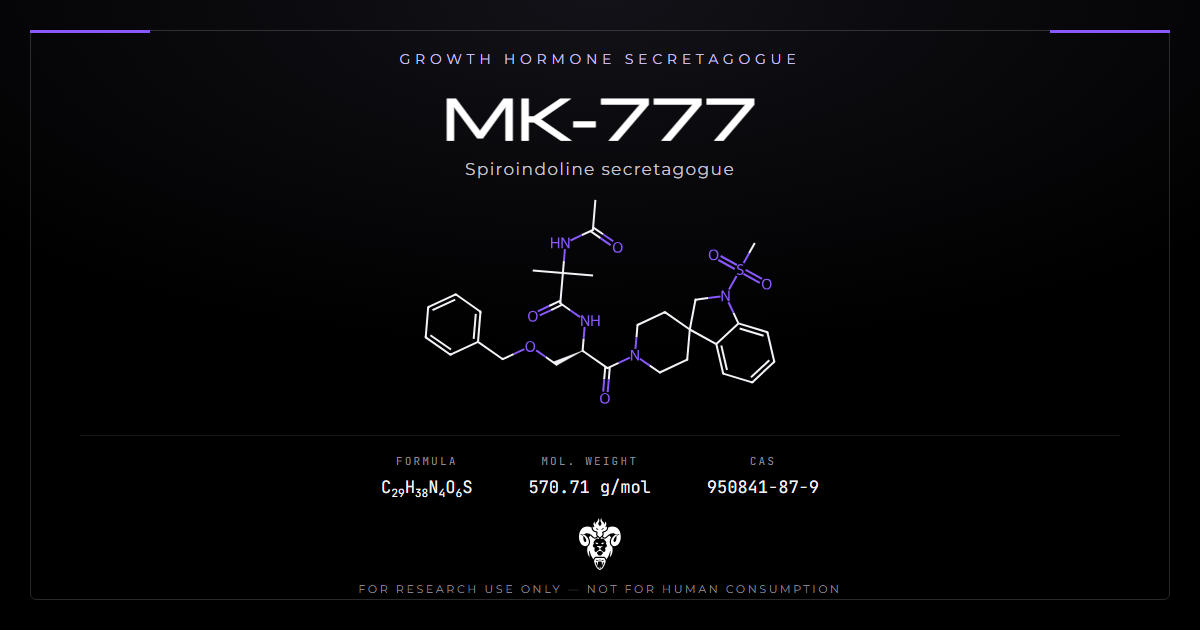
MK-777 differs from MK-677 by two carbons, two hydrogens and one oxygen. That is an acetyl group, and it sits on the single basic nitrogen in the molecule.
The trade name gives it away. Acetamoren is acetyl plus ibutamoren, and the arithmetic confirms the reading: 528.7 g/mol for the parent, 570.7 for MK-777, a difference of 42.
What that acetyl group does pharmacologically remains unknown. No published study of this compound exists under any of its names. That leaves a question with three genuinely different answers, and the receptor involved makes the question harder rather than easier.
This article covers the verified identity, what acetylating that particular nitrogen could plausibly do, why the receptor’s unusual behaviour widens the range of possibilities, what the parent compound’s substantial literature does and does not tell you, and how to verify the material.
Chemical identity: what you are actually handling
MK-777 is the N-acetylated analogue of ibutamoren.
| Property | Value |
|---|---|
| IUPAC name | 2-acetamido-2-methyl-N-[(2R)-1-(1-methylsulfonylspiro[2H-indole-3,4′-piperidine]-1′-yl)-1-oxo-3-phenylmethoxypropan-2-yl]propanamide |
| Trade name | Acetamoren |
| CAS | 950841-87-9 |
| Molecular formula | C29H38N4O6S |
| Molecular weight | 570.71 g/mol |
| PubChem CID | 57595228 |
| Parent compound | MK-677 (ibutamoren), 528.66 g/mol |
| Mass difference | 42.04, one acetyl group |
| Stereocentre | One, (R) |
| Published studies | None |
The scaffold is unchanged
Everything except the terminal nitrogen is identical to the parent. The core is a spiro[indoline-3,4′-piperidine] with a methanesulfonyl group on the indoline nitrogen, an O-benzyl serine-derived linker, and a terminal 2-methylalanine residue.
That architecture came out of the Merck secretagogue programme. The chemists moved from peptide leads through progressively more drug-like non-peptides toward orally active compounds [2][3].
The one difference
MK-677 carries a free primary amine on its terminal 2-methylalanine residue. MK-777 carries an acetyl group on that same nitrogen.
The change converts a primary amine into a secondary amide. Three properties shift at once.
The positive charge disappears. A primary aliphatic amine takes a proton at physiological pH, while an amide nitrogen has no meaningful basicity and carries no charge.
The molecule also loses a hydrogen-bond donor, while gaining an acceptor through the new carbonyl.
And lipophilicity rises, because removing a charged centre favours partition into membranes.
What acetylating that nitrogen could mean
Three outcomes are consistent with the structure, and they are not variations on a theme. They are different compounds behaviourally.
Loss of activity
The first possibility is that the amine matters for receptor engagement, and capping it abolishes binding.
Charged groups frequently anchor ligands through salt bridges to acidic receptor residues. Removing the charge removes that interaction. Under this reading MK-777 is a structurally close but pharmacologically inert analogue.
A prodrug of MK-677
The second possibility runs the other way. Medicinal chemists use amine acetylation as a prodrug strategy precisely because amidases cleave the cap and release the parent compound.
Under this reading MK-777 is a delivery form of MK-677, with different absorption and a delayed onset, and the parent’s ultimate pharmacology.
Distinguishing these two is straightforward in principle. Incubate with liver microsomes or plasma and look for the appearance of a 528.7 species. If deacetylation occurs, the prodrug reading gains support; if the compound is stable, it does not.
Something else entirely
The third possibility is the one most often overlooked, and the receptor is why.
What the medicinal chemistry series suggests
The parent scaffold did not arrive by accident, and the campaign that produced it offers indirect evidence about which parts matter.
Early work in the field concentrated on regulating secretion rather than replacing the hormone, and the peptidomimetic programme was organised around reproducing the effects of growth hormone releasing peptides in a small molecule [1]. That meant identifying which features of a hexapeptide could be discarded and which had to be preserved.
The resulting series retained a basic nitrogen throughout its development [2]. Later optimisation within the same chemotype produced compounds substantially more potent in vitro than MK-677 itself, one of them active in animals at oral doses as low as 0.06 mg/kg [11]. Those later compounds also carry basic amine functionality.
A group conserved across an entire optimisation campaign is usually conserved for a reason. That observation is suggestive rather than decisive, since the campaign was optimising for potency and oral availability rather than probing each group’s necessity, but it does shift the prior. An analogue that caps the one basic nitrogen in the molecule is modifying a feature the medicinal chemists kept.
Contemporaneous reviews of the class framed the secretagogues as offering a more physiological and safer secretion profile than the hormone itself, at the cost of lower potency [10]. That trade-off is the reason the chemistry mattered: a compound too weak to raise the axis has no advantage over the hormone, so potency-determining groups were not casually discarded.
None of this establishes that MK-777 is inactive. It establishes that the modification is at a position the development programme treated as load-bearing, which is a reason to measure rather than assume.
The receptor makes “inactive” an incomplete answer
The growth hormone secretagogue receptor does not sit quietly waiting for a ligand.
Els and colleagues describe it as possessing naturally high constitutive activity, representing roughly 50 percent of its maximal activity [12]. The receptor is half-on in the absence of any agonist.
That single fact changes the logic. At a quiescent receptor, a ligand either activates it or does nothing. At a receptor already half-active, a ligand has four available behaviours: full agonism, partial agonism, neutral antagonism, or inverse agonism that pushes activity below baseline.
A modified ligand that has lost full agonist activity has not necessarily become inert. It may have become a partial agonist, which would produce submaximal signalling and block the endogenous ligand. Or it may have become an inverse agonist, which would reduce signalling below the unstimulated level.
Nature exploits this range. Beyond ghrelin, the receptor has a second endogenous ligand, LEAP-2. It acts both as a competitive antagonist of ghrelin and as an inverse agonist of the constitutive activity [13]. Circulating LEAP-2 moves inversely to ghrelin with energy status, and the ratio between them modulates intake [13].
For MK-777 the implication is direct. Reporting that the compound fails to raise growth hormone would not establish that it does nothing. Answering the question requires an assay capable of detecting activity below baseline, which a simple agonist screen is not.
What the published record contains for MK-777
Nothing.
Searches return no primary study, no binding assay, no pharmacokinetic profile and no in vivo work under the name MK-777, under Acetamoren, or under CAS 950841-87-9. The compound has a chemical database entry and an established identity, and that is the extent of it.
Everything in the next section describes MK-677, the parent. It is included as context for the scaffold, not as evidence about MK-777.
The parent compound’s record, as context
MK-677 has an unusually complete clinical file for a compound in this catalogue, and its shape is instructive.
Reliable biochemical effect
The parent raises growth hormone and insulin-like growth factor I consistently. A single 25 mg dose produced a peak growth hormone response of 55.9 µg/L against a placebo peak near 9 µg/L, attenuating to 22.6 µg/L after a week of dosing [4].
Insulin-like growth factor I elevation proved more durable, at 60.1 percent after six weeks and 72.9 percent after twelve months in one large trial [7]. Increases of 55 to 94 percent appeared across elderly subjects in three further studies [5], and the compound raised the same markers in growth-hormone-deficient children [6].
Functional outcomes did not follow
A two-year randomised trial in 65 healthy adults aged 60 to 81 found fat-free mass increased by 1.1 kg, against a 0.5 kg decrease on placebo. Increased fat-free mass did not result in changes in strength or function [8].
That trial also documented decreased insulin sensitivity with raised fasting glucose, and raised cortisol [8].
A 563-patient trial in Alzheimer disease found clear target engagement and no effect on any of four progression measures over twelve months [7].
The safety signal
A phase IIb trial in 123 elderly hip fracture patients terminated early because of a congestive heart failure safety signal. Its authors concluded the compound had an unfavourable safety profile in that population [9].
That finding belongs in any discussion of this scaffold, including discussion of analogues.
The two compounds side by side
| Property | MK-677 (ibutamoren) | MK-777 (Acetamoren) |
|---|---|---|
| Molecular weight | 528.66 | 570.71 |
| Terminal nitrogen | Free primary amine | Acetamide |
| Charge at pH 7.4 | Positive | Neutral |
| Salt forms available | Mesylate and others | None, no basic centre |
| Expected aqueous solubility | Moderate as salt | Lower, neutral solid |
| Receptor activity | Full agonist, well characterised | Unmeasured |
| Human trials | Multiple randomised [4][7][8][9] | None |
| Published studies | Extensive | None |
Reading down that table, the two compounds share a scaffold and diverge on almost everything a laboratory would want to know. The right-hand column has two entries reading “none” and one reading “unmeasured”, and those three cells are the whole situation.
Why read-across fails here
The temptation with MK-777 is to import the parent’s file wholesale. Three arguments say not to.
The modification sits at a functional group, not at a peripheral position. Converting a charged primary amine to a neutral amide is among the larger single changes available in medicinal chemistry, comparable in magnitude to the amine-versus-amide distinction that separates other closely named research compounds.
The direction of the change is unknown. As set out above, the compound could be inert, a prodrug, a partial agonist or an inverse agonist. Those four possibilities span the full range from no effect to effects opposite in sign to the parent’s.
And the parent’s own record is mixed rather than uniformly positive. Importing it means importing the negative functional findings [7][8][9] alongside the biochemical ones, which supplier copy rarely does.
Kimera lists MK-777 and MK-677 (Ibutamoren) separately for these reasons.
Physicochemical properties and handling
The molecule carries three amide bonds, a sulfonamide and a benzyl ether, with no basic centre remaining after acetylation.
Losing the basic amine carries a practical consequence worth planning for. Suppliers commonly provide MK-677 as a mesylate salt, which improves aqueous solubility. MK-777 cannot form that salt, having no basic nitrogen to protonate. It will be supplied as a neutral solid with correspondingly lower water solubility.
Dimethyl sulfoxide is therefore the expected stock solvent, and aqueous working solutions may require more care than the parent.
Amide bonds hold up under ordinary storage conditions. The acetamide will resist hydrolysis in a vial, though it remains the bond an amidase would target biologically.
Store the solid sealed, dry, cold and dark.
One stability question is specific to this compound rather than the scaffold. If the acetamide were to hydrolyse in storage, the degradation product would be MK-677 itself, which is pharmacologically active. Most degradants are inert or weakly active, so the usual assumption that degradation dilutes potency does not hold here. A stability-indicating method for this material should therefore quantify the parent specifically rather than reporting total impurities.
Analytical characterisation
This compound is unusually easy to verify, because the thing it might be confused with differs by a clean 42 mass units.
The 42 dalton test
Accurate mass confirms C29H38N4O6S at 570.71. The parent MK-677 comes in at 528.66.
A 42.04 difference is unambiguous at any reasonable mass resolution, and it distinguishes MK-777 from the parent immediately. There is no ambiguity of the kind that plagues stereoisomers or regioisomers.
Two failure modes deserve explicit checking. Material sold as MK-777 that assays at 528.7 is MK-677. Material showing both masses is a mixture, most plausibly from incomplete acetylation during synthesis.
The other three checks
Proton NMR confirms the acetyl group directly. A three-proton singlet near 2 ppm appears in MK-777 and has no counterpart in the parent spectrum.
Chiral purity addresses the single (R) stereocentre carried over from the parent. The epimer shares formula and mass exactly, so only a chiral method reports it.
Residual starting material deserves quantification. The plausible synthesis acetylates MK-677, so the plausible impurity is unreacted parent.
What a rigorous certificate should contain
Accurate mass confirming 570.71, with explicit confirmation that no 528.7 species is present.
Chromatographic purity with method conditions stated.
Structural confirmation by NMR, showing the acetyl singlet.
Chiral purity at the (R) centre.
Residual MK-677 content, quantified rather than assumed absent.
Kimera publishes third-party certificates of analysis for every lot in its COA database. Laboratories source MK-777 as a structural analogue for ghrelin receptor work, sometimes alongside CJC-1295 (no DAC), which acts elsewhere in the same axis. Related chemistry appears in the SARMs category.
Common misclassifications
Four errors recur with MK-777.
Suppliers describe it as having MK-677’s pharmacology. Nobody has published a study of MK-777, and the modified group is the one most likely to matter for receptor engagement.
It is called a SARM. The scaffold acts on the growth hormone secretagogue receptor, not the androgen receptor, and MK-777’s activity there is unmeasured.
Copy presents it as an improved or longer-acting version of the parent. That claim requires pharmacokinetic data, and none exists for this compound.
Readers assume it is inactive because it is capped. Given a receptor with roughly 50 percent constitutive activity [12], a ligand short of full agonism may still be a partial agonist, a neutral antagonist or an inverse agonist.
Experimental design considerations
Establish activity before assuming it. A binding assay and a functional assay at the receptor are the first experiments, not optional refinements.
Use an assay that detects inverse agonism. Constitutive activity means signalling can fall below baseline, and an agonist-only readout cannot see that [12][13].
Test metabolic stability early. Incubation with microsomes or plasma, watching for a 528.7 species, distinguishes the prodrug hypothesis from the inert-analogue hypothesis in a single experiment.
Include MK-677 as a comparator. Without the parent in the same assay, no statement about relative activity is possible.
Verify no residual parent. A few percent of unreacted MK-677 would produce apparent activity that belongs to the contaminant rather than to MK-777.
Do not import the parent’s dosing. The 25 mg figure in the clinical literature refers to MK-677 mesylate [4][9], and it carries no established relevance here.
Frequently asked questions
What is MK-777? The N-acetyl analogue of MK-677, CAS 950841-87-9, sold as Acetamoren. Kimera supplies it as a laboratory research material.
How does it differ from MK-677? By one acetyl group on the terminal primary amine, a difference of 42 mass units.
What does the published literature say about it? Nothing. No primary study exists under any of its names.
Is it a prodrug of MK-677? Possibly, and a metabolic stability experiment would answer it. Acetylated amines are a recognised prodrug strategy, but no data confirms the reading for this compound.
Could it be inactive? Possibly. It could also be a partial agonist or an inverse agonist, because the receptor carries substantial constitutive activity [12].
How do I confirm I have the right compound? Accurate mass at 570.71 with no 528.7 species present, plus an acetyl singlet near 2 ppm in the proton spectrum.
Is it approved anywhere? No, and no clinical trial of it has been conducted.
Why can’t it be supplied as a mesylate like MK-677? Salt formation needs a basic centre to protonate. Acetylation removes the only one in the molecule, so MK-777 exists as a neutral solid with correspondingly lower aqueous solubility.
Does the parent’s safety record apply to it? Not directly, and importing it cuts both ways. The parent’s file includes decreased insulin sensitivity, raised cortisol and a trial halted for a cardiac signal [8][9]. A laboratory that treats the two compounds as equivalent inherits those findings alongside the biochemical ones.
What is the single most useful first experiment? Metabolic stability with a mass readout. Watching for a 528.7 species after incubation separates the prodrug hypothesis from the inert-analogue hypothesis in one run.
Summary of the evidence
Identity: C29H38N4O6S, 570.71 g/mol, one (R) stereocentre, verified against chemical databases.
Relationship to parent: N-acetyl MK-677, differing by exactly 42.04 mass units.
Chemical consequence: loss of the basic centre, loss of positive charge at physiological pH, loss of a hydrogen-bond donor, increased lipophilicity, and inability to form the mesylate salt used for the parent.
Published pharmacology: none, in any species, by any route.
Plausible behaviours: inert analogue, prodrug of the parent, partial agonist, or inverse agonist. The receptor’s roughly 50 percent constitutive activity keeps all four open [12][13].
Parent compound context: reliable elevation of growth hormone and insulin-like growth factor I [4][5][6][7], without accompanying gains in strength or function [8][9], alongside decreased insulin sensitivity and raised cortisol [8], and a trial halted for a cardiac safety signal [9].
Read-across: not supportable, because the modified group is the one most likely to govern receptor engagement.
Status: research material with an established identity and no pharmacology.
References
- Smith RG, Van der Ploeg LH, Howard AD, et al. Peptidomimetic regulation of growth hormone secretion. Endocr Rev. 1997;18(5):621-645. PMID 9331545. DOI
- Patchett AA, Smith RG, Wyvratt MJ. Orally active growth hormone secretagogues. Pharm Biotechnol. 1998;11:525-554. PMID 9760695. DOI
- Smith RG. Development of growth hormone secretagogues. Endocr Rev. 2005;26(3):346-360. PMID 15814848. DOI
- Murphy MG, Plunkett LM, Gertz BJ, et al. MK-677, an orally active growth hormone secretagogue, reverses diet-induced catabolism. J Clin Endocrinol Metab. 1998;83(2):320-325. PMID 9467534. DOI
- Murphy MG, Bach MA, Plotkin D, et al. Oral administration of the growth hormone secretagogue MK-677 increases markers of bone turnover in healthy and functionally impaired elderly adults. J Bone Miner Res. 1999;14(7):1182-1188. PMID 10404019. DOI
- Codner E, Cassorla F, Tiulpakov AN, et al. Effects of oral administration of ibutamoren mesylate on the growth hormone-insulin-like growth factor I axis in growth hormone-deficient children. Clin Pharmacol Ther. 2001;70(1):91-98. PMID 11452249. DOI
- Sevigny JJ, Ryan JM, van Dyck CH, et al. Growth hormone secretagogue MK-677: no clinical effect on AD progression in a randomized trial. Neurology. 2008;71(21):1702-1708. PMID 19015485. DOI
- Nass R, Pezzoli SS, Oliveri MC, et al. Effects of an oral ghrelin mimetic on body composition and clinical outcomes in healthy older adults: a randomized trial. Ann Intern Med. 2008;149(9):601-611. PMID 18981485. DOI
- Adunsky A, Chandler J, Heyden N, et al. MK-0677 (ibutamoren mesylate) for the treatment of patients recovering from hip fracture: a multicenter, randomized, placebo-controlled phase IIb study. Arch Gerontol Geriatr. 2011;53(2):183-189. PMID 21067829. DOI
- Micic D, Casabiell X, Gualillo O, et al. Growth hormone secretagogues: the clinical future. Horm Res. 1999;51 Suppl 3:29-33. PMID 10592441. DOI
- Lu Z, Tata JR, Cheng K, et al. Highly potent growth hormone secretagogues. Bioorg Med Chem Lett. 2007;17(13):3657-3659. PMID 17482461. DOI
- Els S, Beck-Sickinger AG, Chollet C. Ghrelin receptor: high constitutive activity and methods for developing inverse agonists. Methods Enzymol. 2010;485:103-121. PMID 21050913. DOI
- Lu X, Huang L, Huang Z, et al. LEAP-2: an emerging endogenous ghrelin receptor antagonist in the pathophysiology of obesity. Front Endocrinol (Lausanne). 2021;12:717544. PMID 34512549. DOI
MK-777 is sold for laboratory research use only. Not for human consumption, nor medical, veterinary, or household uses.
Literature retrieved from PubMed.