
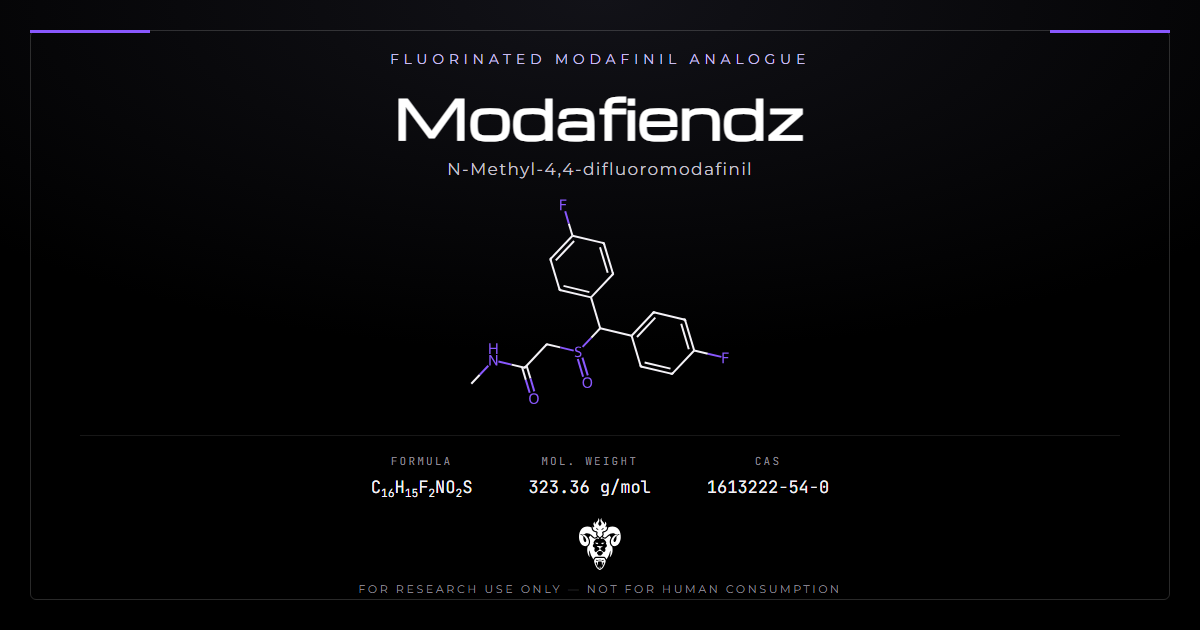
Modafiendz is the trade name for N-methyl-4,4-difluoromodafinil, CAS 1613222-54-0. It is a synthetic sulfinylacetamide in the modafinil structural series. Laboratories source Modafiendz as a reference material for analytical method development. It also serves as a comparator in structure-activity work across the eugeroic class. The published record is narrow and almost entirely analytical. What that record leaves empty matters here, because the name gets confused with a different molecule.
What is Modafiendz?
Modafiendz is 2-[bis(4-fluorophenyl)methylsulfinyl]-N-methylacetamide. The molecular formula is C16H15F2NO2S, with an average molecular weight of 323.36 g/mol and a monoisotopic mass of 323.08 Da. Two structural edits separate it from modafinil: a fluorine at the para position of each phenyl ring, and a methyl group on the amide nitrogen.
Regulatory and chemical databases index it under PubChem CID 132989661 and UNII 223VWC34TA. No regulatory authority has approved it for any use.
The compound reached circulation as one of several non-clinical modafinil analogs. Bakota and Nandrea list it alongside adrafinil, CRL-40,940, and CRL-40,941 as unscheduled analogs that turn up in products sold as dietary supplements [2]. Napoletano and colleagues documented the wider pattern. Their crawler catalogued 142 distinct cognitive-enhancer entries from online fora, checked against EMCDDA and UNODC databases [13]. This compound sits inside that population: commercial presence, almost no pharmacological literature.
Why fluorinate the rings
Both structural edits are standard medicinal chemistry moves, and knowing why they get made clarifies what the compound was built to do.
Para-fluorination of an aromatic ring serves a specific purpose. The para position is the site most exposed to cytochrome P450 hydroxylation, and aromatic hydroxylation there is a common first step in clearing a benzhydryl compound. Placing fluorine at that position blocks it, because the carbon-fluorine bond resists oxidative attack far better than the carbon-hydrogen bond it replaces.
Fluorine is also small enough to occupy the position without much steric penalty, and electron-withdrawing enough to deactivate the ring toward oxidation more generally. The intended result is slower metabolism and longer exposure from the same dose.
Whether that intention was realised for this compound is unknown, since no pharmacokinetic study of it exists. The related des-methyl compound has been studied, and metabolism work on flmodafinil and fladrafinil mapped their acid and sulfone metabolites for doping-control purposes [4].
Why methylate the amide
The second edit sits on the amide nitrogen, and it does something different.
A primary amide carries two hydrogen-bond donors. Methylating one nitrogen removes a donor and raises lipophilicity, which generally improves membrane permeability. Secondary amides are also somewhat more resistant to amidase hydrolysis than primary ones.
There is a countervailing consideration worth noting. Modafinil’s primary amide is not incidental to its activity, and the acid metabolite formed by hydrolysing it, modafinic acid, is inactive. Blocking that hydrolysis changes the metabolic fate rather than simply extending it.
Taken together, the two edits describe a compound designed for longer exposure rather than for a different mechanism. That is a hypothesis about intent, not a finding about behaviour.
Modafiendz is not flmodafinil
These two names get swapped often enough to corrupt records, so the distinction is worth stating plainly.
Flmodafinil also goes by CRL-40,940, bisfluoromodafinil and lauflumide. It is 2-[bis(4-fluorophenyl)methylsulfinyl]acetamide, C15H13F2NO2S, at 309.33 g/mol. Modafiendz carries one additional methyl group on the amide nitrogen, adding 14 mass units. Both share the difluorinated benzhydryl core, which is why the trivial names drift together.
The literature treats them as separate entities. Dowling and colleagues analysed six distinct compounds in one degradation study: modafinil, modafinic acid, adrafinil, CRL-40,940, CRL-40,941 and Modafiendz [1]. Bakota and Nandrea’s validated method quantitates CRL-40,940 and N-methyl-4,4-difluoromodafinil as separate analytes [2]. A laboratory ordering one and receiving the other will see a 14 Da offset in the mass spectrum and a different retention time.
Kimera lists Flmodafinil (CRL-40,940) and Fladrafinil (CRL-40,941) as separate catalog entries for this reason. More of the nootropics category covers adjacent compounds in the series.
Where Modafiendz sits in the benzhydrylsulfinyl series
The series is larger than the two compounds usually compared, and laying it out prevents most of the naming errors.
| Compound | Aryl substitution | Amide | Formula | MW |
|---|---|---|---|---|
| Modafinil | None | Primary amide | C15H15NO2S | 273.35 |
| Adrafinil | None | Hydroxamic acid | C15H15NO3S | 289.35 |
| Flmodafinil (CRL-40,940) | Two para-fluorines | Primary amide | C15H13F2NO2S | 309.33 |
| Fladrafinil (CRL-40,941) | Two para-fluorines | Hydroxamic acid | C15H13F2NO3S | 325.33 |
| Modafiendz | Two para-fluorines | N-methyl amide | C16H15F2NO2S | 323.36 |
Two axes generate the whole series. The rings are either unsubstituted or carry two para-fluorines. The tail is a primary amide, a hydroxamic acid, or an N-methyl amide.
Reading the mass column reveals the practical hazard. Fladrafinil at 325.33 and Modafiendz at 323.36 differ by only two mass units, which is within the range a low-resolution instrument might blur. High-resolution accurate mass separates them without difficulty, and nominal-mass methods should not be trusted to.
The two hydroxamic acids are prodrugs of their corresponding amides, so fladrafinil converts to flmodafinil in the same way adrafinil converts to modafinil [4]. Modafiendz has no corresponding prodrug in circulation, since methylating the amide precludes the hydroxamic acid version.
Mechanism of action
No target-binding study on Modafiendz has been published. There is no reported affinity, occupancy, or functional assay for this molecule. Everything below describes modafinil, the parent compound, and applies here only as a structural hypothesis.
Federici and colleagues tested modafinil in mouse brain slices and in cocaine-insensitive DAT knock-in mice. Modafinil inhibited firing in substantia nigra pars compacta dopaminergic neurons. It also increased stimulus-evoked dopamine outflow in dorsal striatum. Neither effect appeared in the knock-in animals, which places the action at the cocaine binding site on the transporter [7].
Human PET work supports the same target. Volkow and colleagues measured [11C]cocaine and [11C]raclopride binding in ten male volunteers. They found transporter occupancy in caudate, putamen and nucleus accumbens, alongside a rise in extracellular dopamine [5]. Kim and colleagues reported mean striatal DAT occupancies of 51.4% and 56.9% at the two oral doses studied, using [18F]FE-PE2I [6]. Wisor’s review characterizes modafinil as a weak but selective transporter inhibitor with an unusually protracted pharmacodynamic response [11].
A second pathway runs through orexin. Ishizuka and colleagues found that modafinil raised hypothalamic histamine release in wild-type mice. Orexin neuron-deficient mice showed no such change, and no c-Fos activation in the tuberomammillary nucleus [9].
Preclinical research findings
Rodent wakefulness models
Luca and colleagues recorded EEG and EMG in C57BL/6J mice after intraperitoneal lauflumide (NLS-4), modafinil, or vehicle. Lauflumide produced longer wakefulness than modafinil. Recovery sleep after lauflumide showed less NREM sleep and a shorter delta power increase than recovery after modafinil [10]. Lauflumide is the des-methyl fluorinated analog, not Modafiendz.
Non-human primate
Andersen and colleagues dosed rhesus monkeys intravenously, combining microdialysis, PET and behavioural measures. Modafinil raised striatal extracellular dopamine at a dose producing 64.4 percent transporter occupancy in putamen and 60.2 percent in caudate. It also increased night-time locomotor activity and reinstated cocaine-maintained responding [8].
Structure-activity series in mice
Zhu and colleagues synthesised two series of 2-[(diphenylmethane)sulfinyl] and 2-[(diphenylmethyl)thio] acetamides. They screened them in an independent activity assay in ICR mice. Compounds 6c, 6f and 6n showed measurable central stimulatory activity, and 6h exceeded the modafinil control [3]. The paper maps the sulfinylacetamide scaffold this compound belongs to.
Human clinical context
Karila and colleagues ran a randomised double-blind trial of modafinil in 29 cocaine-dependent men, with [11C]-PE2I PET. Two weeks of treatment cut transporter binding potential by 65.6 percent. Clinical outcomes matched placebo during hospitalisation. Over outpatient follow-up, the modafinil arm recorded more therapeutic failures [12].
What the record does not contain
For Modafiendz specifically there is no published receptor binding data, no in vivo pharmacology in any species, no pharmacokinetic profile, and no toxicology. Parent-compound findings stay bound to the parent compound. Any statement that transfers modafinil pharmacology onto this analog is an inference, not a result.
That gap deserves a moment’s attention, because the inference is more fragile than it looks.
Modafinil’s own transporter affinity is weak. Wisor characterises it as exceptionally weak yet apparently very selective, with conformational constraints on how it engages the transporter that appear unique among catecholaminergic agents [11]. A compound acting through a narrow conformational fit is precisely the kind of compound whose activity a structural edit can abolish.
Two edits sit between modafinil and this analogue, and both fall on parts of the molecule involved in that fit. The aryl rings occupy the binding pocket. The amide carries the hydrogen-bonding capacity that orients the tail.
None of that predicts loss of activity. It does mean the structural argument runs in both directions, and treating the analogue as a more durable version of the parent assumes an answer nobody has measured.
The comparison available in the literature is instructive here. Lauflumide, the des-methyl fluorinated compound, was tested head to head against modafinil in mice and produced longer wakefulness with a different recovery-sleep profile [10]. That is evidence that fluorination alters behaviour in this series. It is not evidence about the N-methylated member.
Physicochemical properties and handling
| Property | Value |
|---|---|
| Chemical name | 2-[bis(4-fluorophenyl)methylsulfinyl]-N-methylacetamide |
| Synonym | N-methyl-4,4-difluoromodafinil |
| CAS | 1613222-54-0 |
| Molecular formula | C16H15F2NO2S |
| Average MW | 323.36 g/mol |
| Monoisotopic mass | 323.08 Da |
| PubChem CID | 132989661 |
| UNII | 223VWC34TA |
| SMILES | CNC(=O)CS(=O)C(c1ccc(F)cc1)c1ccc(F)cc1 |
| InChIKey | MQZWTCIUDSDFCQ-UHFFFAOYSA-N |
| Form | Crystalline solid |
Third-party NMR characterisation on current lots runs in both DMSO-d6 and CDCl3. The compound therefore dissolves adequately in dimethyl sulfoxide and in chloroform for spectroscopic work. Both are useful, since the two solvents resolve different parts of the spectrum. Store the solid dry, sealed, and protected from light. The sulfoxide is the reactive handle in this molecule, and heat is the documented failure mode, covered in the next section.
Analytical characterization and quality
The gas chromatography problem
Gas chromatography misreports this compound, and the finding deserves more than a footnote because GC-MS remains a default choice in forensic and clinical laboratories.
Dowling and colleagues exposed modafinil, modafinic acid, adrafinil, CRL-40,940, CRL-40,941 and Modafiendz to a heated GC injection port across a range of solvents [1]. The compounds did not survive intact.
For the unfluorinated compounds, the key degradation products were diphenylmethanol and 1,1,2,2-tetraphenylethane. The authors confirmed the latter by synthesising it independently and characterising it by X-ray crystallography [1]. Diphenylmethane and thiobenzophenone appeared in some runs.
Modafiendz produced the fluorinated analogue of tetraphenylethane by the same route [1].
The mechanism, and why it produces cross-products
The proposed pathway explains an observation that would otherwise look like contamination.
Heat generates a benzhydrylium ion from the parent compound. That cation then reacts with the sulfoxide oxygen of another parent molecule, giving an oxysulfonium intermediate that collapses to the tetraphenylethane product [1].
Because the reaction is intermolecular, two different parent compounds in the same injection can react with each other. Dowling and colleagues demonstrated exactly that. Injecting a mixture of modafinil and Modafiendz produced three products rather than two: the two expected tetraphenylethane analogues, plus a mixed species, 4,4′-(2,2-diphenylethane-1,1-diyl)bis(fluorobenzene) [1].
What this means in practice
Three consequences follow, and they matter for anyone verifying material of this class.
A GC-MS chromatogram of this compound shows degradants, not analyte. Reporting those peaks as the compound is an error, and reporting their absence as evidence of absence is a worse one.
A mixed sample produces a peak belonging to neither component. That cross-product could easily be mistaken for an unknown impurity or an adulterant.
And the artefact is thermal rather than chemical, so it says nothing about the stability of the material in the vial. A compound that decomposes at injector temperatures may be entirely stable at room temperature.
Liquid-phase methods avoid the problem entirely, which is why the validated methods for this compound class use them.
Liquid-phase methods
Bakota and Nandrea validated an LC-HRMS method that identifies and quantitates modafinil plus four analogues, N-methyl-4,4-difluoromodafinil among them [2]. Krug and colleagues applied LC-HRMS to the related flmodafinil and fladrafinil. That work mapped the acid and sulfone metabolites, reaching detection limits of 0.2 to 4 ng/mL in urine and blood [4]. Those figures give a realistic sense of what a modern liquid-phase method achieves on this chemical series. Fladrafinil converts to flmodafinil, so both routes yield the same metabolite pair.
Fluorine NMR is the fast discriminator. The two para-fluorines give a 19F signal that modafinil and adrafinil lack, which separates the fluorinated analogs from the unfluorinated ones in a single experiment. Quantitative 1H NMR against a certified internal standard, HPLC-UV area percent, and HPLC-MS accurate mass together establish identity and purity.
Kimera publishes third-party certificates of analysis for every lot in its COA database, covering chromatographic purity, mass confirmation, and NMR identity.
What a rigorous Modafiendz certificate should contain
Given the analytical situation described above, the method matters as much as the number.
Accurate mass by LC-HRMS, confirming C16H15F2NO2S at 323.36 rather than the 309.33 of the des-methyl compound.
Fluorine NMR, confirming two equivalent para-fluorines in a single clean signal.
Proton NMR, confirming the N-methyl group specifically. This is the signal that separates Modafiendz from flmodafinil, and its absence would indicate the wrong compound.
Chromatographic purity by a liquid-phase method, with the conditions stated. A purity figure derived by gas chromatography should be treated as uninterpretable for this compound.
Residual solvents from synthesis.
Common misclassifications
Four errors recur with this compound.
Modafiendz is equated with flmodafinil. They differ by an N-methyl group and 14 mass units, and published methods separate them as distinct analytes [1][2].
Modafinil pharmacology is transferred onto it. No binding, occupancy or functional assay for this molecule has been published, and every mechanistic statement available describes the parent [5][6][7][11].
Gas chromatography results are reported at face value. The compound degrades in the injector to a tetraphenylethane analogue [1].
It is described as a studied compound. Its indexed literature is analytical and forensic rather than pharmacological, and it appears in that literature as an unscheduled analogue found in consumer products [2][13].
Experimental design considerations
Use liquid-phase separation. This is the single most important methodological point for the compound [1][2].
Verify the N-methyl group explicitly. Mass alone distinguishes it from flmodafinil, but proton NMR confirms which position carries the methyl.
Include both parent and des-methyl comparators. Any structure-activity question about the two edits requires modafinil and flmodafinil in the same experiment.
Do not inherit dosing from modafinil. The compound has no published pharmacokinetics, and the fluorination was presumably intended to alter exposure.
Watch for cross-products in mixtures. If gas chromatography is unavoidable for some reason, a mixed injection can generate species belonging to neither component [1].
Frequently asked questions
What is Modafiendz? N-methyl-4,4-difluoromodafinil, CAS 1613222-54-0, a synthetic analog of modafinil carrying two aromatic fluorines and an N-methyl amide. It is supplied as a laboratory reference material.
Is Modafiendz the same as flmodafinil? No. Flmodafinil (CRL-40,940) is the des-methyl compound, C15H13F2NO2S at 309.33 g/mol. Modafiendz is C16H15F2NO2S at 323.36 g/mol. Published methods separate them [1][2].
Has Modafiendz been studied in vivo? No in vivo pharmacology has been published for this compound. The literature covering it is analytical.
Which methods identify Modafiendz? LC-HRMS, HPLC-UV, 1H and 13C NMR, and 19F NMR. Gas chromatography risks thermal degradation in the injector [1].
How does Modafiendz differ from modafinil structurally? Modafinil is 2-[(diphenylmethyl)sulfinyl]acetamide. The analog adds a para-fluorine to each phenyl ring and a methyl to the amide nitrogen, moving the mass from 273.35 to 323.36 g/mol.
Is Modafiendz an approved drug? No. It holds no marketing approval in any jurisdiction and appears in the literature as an unscheduled modafinil analog [2].
Summary of the evidence
Identity: C16H15F2NO2S, 323.36 g/mol, CAS 1613222-54-0, indexed under PubChem CID 132989661 and UNII 223VWC34TA.
Relationship to modafinil: two edits, para-fluorine on each ring and a methyl on the amide nitrogen, moving mass from 273.35 to 323.36.
Relationship to flmodafinil: the des-methyl compound at 309.33 g/mol, treated as a separate analyte in published methods [1][2].
Published pharmacology for this compound: none. No binding, occupancy, functional assay, pharmacokinetics or toxicology.
Parent compound context: dopamine transporter engagement confirmed electrophysiologically [7], by human PET at 51 to 57 percent striatal occupancy [6], and in non-human primates at above 60 percent [8], with a secondary orexin-dependent histaminergic pathway [9].
Analytical position: liquid-phase methods validated [2][4]; gas chromatography produces thermal degradation artefacts including cross-products in mixtures [1].
Regulatory status: no marketing approval anywhere, appearing in the literature as an unscheduled analogue recovered from consumer products [2][13].
References
- Dowling G, Kavanagh PV, Talbot B, et al. Outsmarted by nootropics? An investigation into the thermal degradation of modafinil, modafinic acid, adrafinil, CRL-40,940 and CRL-40,941 in the GC injector. Drug Test Anal. 2017;9(3):518-528. PMID 27928893. DOI
- Bakota EL, Nandrea JM. Development and Validation of an Analytical Method to Identify and Quantitate Novel Modafinil Analogs in Products Marketed as Dietary Supplements. J Diet Suppl. 2025;22(2):329-344. PMID 39466147. DOI
- Zhu X, Tang Y, Gao C, Zhang LQ, Huang WL. Synthesis and biological evaluation of novel diphenyl methane sulfinyl and diphenylthio-acetamide derivatives. Yao Xue Xue Bao. 2013;48(3):372-376. PMID 23724650
- Krug O, Guddat S, Görgens C, et al. Investigations Into the Metabolism and Elimination of Flmodafinil and Fladrafinil for Sports Drug Testing Purposes. Drug Test Anal. 2026;18(8):1076-1087. PMID 42210629. DOI
- Volkow ND, Fowler JS, Logan J, et al. Effects of modafinil on dopamine and dopamine transporters in the male human brain. JAMA. 2009;301(11):1148-1154. PMID 19293415. DOI
- Kim W, Tateno A, Arakawa R, et al. In vivo activity of modafinil on dopamine transporter measured with positron emission tomography and [18F]FE-PE2I. Int J Neuropsychopharmacol. 2014;17(5):697-703. PMID 24451483. DOI
- Federici M, Latagliata EC, Rizzo FR, et al. Electrophysiological and amperometric evidence that modafinil blocks the dopamine uptake transporter to induce behavioral activation. Neuroscience. 2013;252:118-124. PMID 23933217. DOI
- Andersen ML, Kessler E, Murnane KS, et al. Dopamine transporter-related effects of modafinil in rhesus monkeys. Psychopharmacology (Berl). 2010;210(3):439-448. PMID 20386883. DOI
- Ishizuka T, Murotani T, Yamatodani A. Modafinil activates the histaminergic system through the orexinergic neurons. Neurosci Lett. 2010;483(3):193-196. PMID 20696213. DOI
- Luca G, Bandarabadi M, Konofal E, et al. Lauflumide (NLS-4) Is a New Potent Wake-Promoting Compound. Front Neurosci. 2018;12:519. PMID 30158846. DOI
- Wisor J. Modafinil as a catecholaminergic agent: empirical evidence and unanswered questions. Front Neurol. 2013;4:139. PMID 24109471. DOI
- Karila L, Leroy C, Dubol M, et al. Dopamine Transporter Correlates and Occupancy by Modafinil in Cocaine-Dependent Patients. Neuropsychopharmacology. 2016;41(9):2294-2302. PMID 26892922. DOI
- Napoletano F, Schifano F, Corkery JM, et al. The Psychonauts’ World of Cognitive Enhancers. Front Psychiatry. 2020;11:546796. PMID 33024436. DOI
Modafiendz is sold for laboratory research use only. Not for human consumption, nor medical, veterinary, or household uses.
Literature retrieved from PubMed.