
Search the human literature for NAD+ and something odd turns up. Trial after trial names it in the title. Almost none of them gave it to anyone.
They gave precursors instead: nicotinamide riboside, nicotinamide mononucleotide, combinations with pterostilbene. The dinucleotide itself appears as an outcome measure, a number in a blood sample, rather than as the thing administered.
Exactly one published human study infused NAD+ directly [7]. What happened in those six hours explains why everyone else uses a precursor, and it is the most useful single result in this whole field.
Chemical identity
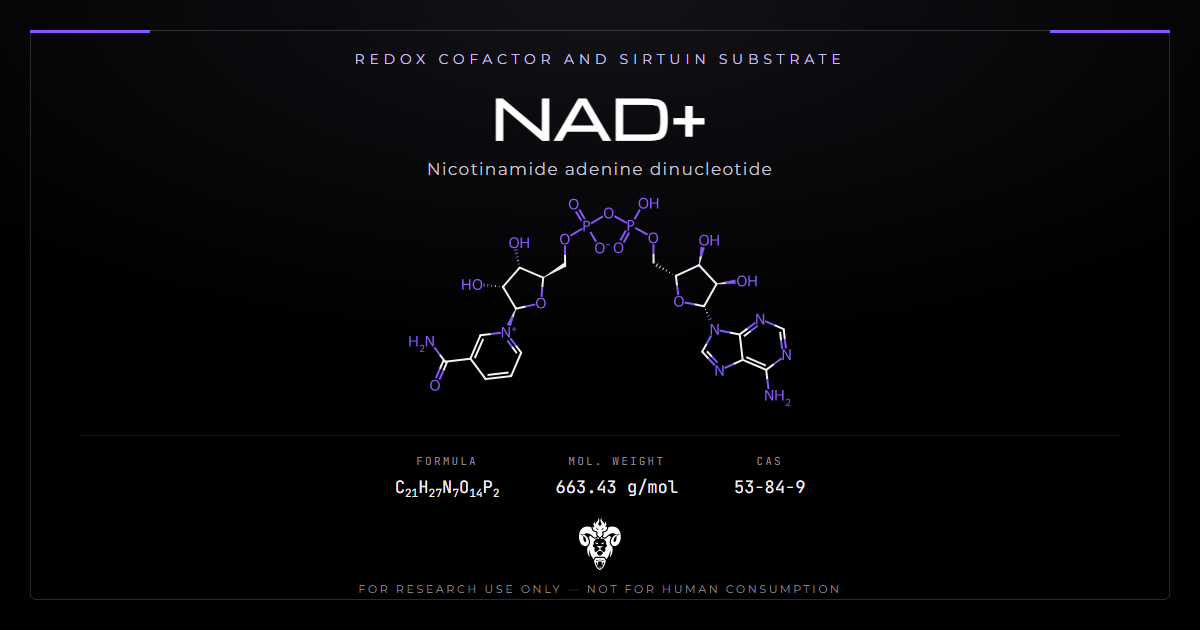
Two nucleotides joined tail to tail through a pyrophosphate bridge. One carries nicotinamide, the other adenine.
| Property | Value |
|---|---|
| Systematic name | Nicotinamide adenine dinucleotide |
| Common names | NAD+, nadide, coenzyme I, diphosphopyridine nucleotide |
| Molecular formula | C21H27N7O14P2 |
| Average mass | 663.4 g/mol |
| Monoisotopic mass | 663.1091 Da |
| CAS number | 53-84-9 |
| PubChem CID | 5892 |
| InChIKey | BAWFJGJZGIEFAR-NNYOXOHSSA-N |
| Stereocentres | 12 |
| Net charge at pH 7 | Anionic overall, with a quaternary pyridinium |
| Reduced form | NADH |
| Phosphorylated form | NADP+ |
Why the charge matters
The plus sign is not decoration. It marks a permanent positive charge on the nicotinamide ring nitrogen, present whatever the pH.
Two phosphate groups carry negative charges alongside it. The molecule is therefore a zwitterion with a formal net negative charge, weighing 663 daltons, with twelve stereocentres and no lipophilic character at all.
Nothing about that description suggests a molecule that crosses membranes. Passive diffusion is not available to it, and no transporter for the intact dinucleotide has been established in humans.
The oxidised and reduced forms are different reagents
NAD+ and NADH are the two halves of one redox couple, and a certificate naming the wrong one is describing different chemistry.
The oxidised form accepts a hydride. The reduced form donates one. Their absorbance differs, which is what makes the couple the workhorse of enzyme assays: NADH absorbs at 340 nm and the oxidised form does not.
Phosphorylation at the adenosine 2′ position gives NADP+, which serves biosynthetic reductions rather than catabolic oxidations. Cells hold the two pools at different redox ratios on purpose.
What NAD+ does in a cell
Two distinct roles, and confusing them is the source of most loose claims in this area.
The redox role
As a hydride carrier the molecule is catalytic. It cycles between oxidised and reduced states thousands of times, and the cell neither gains nor loses any in the process.
Glycolysis, the citric acid cycle and fatty acid oxidation all feed electrons into this couple. Nothing is consumed, so nothing needs replacing.
The consumed role
A second group of enzymes cleaves the molecule and keeps a piece. Sirtuins, PARPs and CD38 all break the glycosidic bond, releasing nicotinamide and transferring the ADP-ribose portion elsewhere [1].
This is the role that creates demand. An enzyme that destroys its substrate to do its job forces continuous resynthesis, and the salvage pathway exists to meet that.
Rajman and colleagues review the consumers in detail [1]. Their argument for supplementation rests on this second role, and it depends on synthesis failing to keep pace with consumption.
The molecule almost nobody has studied directly
Grant and colleagues ran the only published human infusion study (PMID 31572171).
The one infusion study
They infused NAD+ intravenously at 3 µmol/min for six hours, then tracked plasma and urine [7].
For the first two hours, nothing happened. Plasma levels of the compound did not rise. Neither did nicotinamide, methylnicotinamide, ADP-ribose or nicotinamide mononucleotide. The authors describe their own result as surprising.
Their conclusion is direct: at that infusion rate NAD+ leaves the plasma rapidly and completely for at least two hours. A dose going in continuously produced no measurable rise in the thing being dosed.
What the metabolite profile showed
The pattern that emerged after two hours identified the mechanism. Products were consistent with glycohydrolase and pyrophosphatase activity [7], meaning enzymes cleaving the glycosidic bond and the pyrophosphate bridge.
Both cuts destroy the molecule. Circulating material meets enzymes that dismantle it faster than an infusion can supply it.
Urinary excretion carried its own detail. The parent compound and methylnicotinamide appeared, and nicotinamide did not.
Why this is one pilot study
Seven participants, one infusion rate, no placebo arm. This is a pilot and the authors label it as such.
It is also the entire direct human evidence base. Every other trial discussed below administered something else.
Why the oral question is the wrong one
Given the infusion result, oral NAD+ faces a harder problem still.
Material taken by mouth meets the gut wall and liver before circulation, and the same hydrolytic enzymes operate there. The two-hour plasma silence during a continuous intravenous infusion sets an upper bound on what any oral route could achieve.
The field drew that conclusion years ago, which is why the trial literature runs on precursors. Nicotinamide riboside and nicotinamide mononucleotide are smaller, and they enter the salvage pathway rather than needing to arrive intact.
This mirrors the glutathione situation exactly. There the gamma-glutamyl bond means only one enzyme cleaves the tripeptide, and that enzyme sits where an oral dose passes. Here two enzyme classes attack a charged dinucleotide in the bloodstream itself.
The precursor trials
Fourteen years of controlled trials, almost all of them dosing something upstream.
| Trial | n | Agent and dose | Duration | Headline |
|---|---|---|---|---|
| Dellinger 2017 [2] | 120 | NR + pterostilbene | 8 weeks | Blood pool +40% at 1X, +90% at 2X |
| Dollerup 2018 [4] | 40 | NR 2,000 mg/day | 12 weeks | No change in insulin sensitivity |
| Martens 2018 [3] | 24 | NR 1,000 mg/day | 6 weeks, crossover | Tolerated; blood pressure signal only |
| Conze 2019 [5] | 140 | NR 100/300/1,000 mg | 8 weeks | +22%, +51%, +142%, dose-ordered |
| Elhassan 2019 [6] | 12 | NR 1,000 mg/day | 21 days | Muscle pool up, bioenergetics unchanged |
| Grant 2019 [7] | 7 | Infused directly, 6 h | Single | No plasma rise for 2 hours |
| Yoshino 2021 [9] | 25 | NMN 250 mg/day | 10 weeks | Muscle insulin sensitivity improved |
| Brakedal 2022 [12] | 30 | NR 1,000 mg/day | 30 days | Brain pool up, variably |
| Norheim 2024 [14] | 40 | NR | 6 weeks | Sputum IL-8 down 52.6% |
Nicotinamide riboside
NR carries most of the weight. Conze and colleagues gave 100, 300 or 1,000 mg daily to overweight adults for eight weeks [5]. Whole blood levels rose 22, 51 and 142 percent within two weeks and held for the rest of the study.
That is a clean dose-response on the biomarker, with no flushing and no adverse event separation from placebo.
Dellinger and colleagues found the same shape using NR with pterostilbene in 120 adults aged 60 to 80 [2]. The single dose raised the pool about 40 percent and the double dose about 90 percent, sustained across eight weeks.
Nicotinamide mononucleotide
NMN sits one step closer to the finished molecule. Pencina and colleagues gave a pharmaceutical-grade formulation to 32 overweight adults aged 55 to 80 [13].
Blood levels rose in a dose-related way over 14 days. Little unmodified NMN appeared in urine, and the response did not vary with sex, body mass index or age.
The biomarker moves reliably
Across these trials one finding never fails. Give a precursor and measured NAD+ rises.
It rises in whole blood [5][2], in aged skeletal muscle [6], in the brain measured by phosphorus magnetic resonance spectroscopy [12], and in hospitalised patients whose levels had fallen [8].
Simic and colleagues supply the sharpest version. In acute kidney injury, whole blood levels fell 50 percent over 48 hours on placebo, and precursor treatment raised them 37 percent instead [8].
So the pharmacology works. Something taken by mouth reaches tissue and raises a metabolite that was falling. Whether that matters is a separate question, and the trials answer it less consistently.
The endpoints mostly do not
Raising the number and changing an outcome have turned out to be different achievements.
Insulin sensitivity
Dollerup and colleagues ran the strictest test (PMID 29992272). Forty obese, insulin-resistant men took 2,000 mg NR daily for 12 weeks, with insulin sensitivity measured by hyperinsulinaemic euglycaemic clamp [4].
Nothing moved. Insulin sensitivity, endogenous glucose production, glucose disposal and oxidation all failed to improve. Resting energy expenditure, lipolysis, lipid oxidation and body composition failed as well.
The trial used the reference method, the highest dose in the set and a twelve-week exposure. A null result under those conditions carries weight.
Muscle and mitochondria
Elhassan and colleagues supplemented twelve aged men with 1 g NR daily for 21 days in a placebo-controlled crossover [6].
Targeted metabolomics confirmed the muscle pool rose. RNA sequencing then showed energy metabolism and mitochondrial pathways moving down rather than up, and direct measurement found mitochondrial bioenergetics unchanged.
That combination deserves attention. The substrate arrived, the transcriptome responded, and the function the whole rationale points at did not shift.
Cardiovascular measures
Martens and colleagues tested 1,000 mg daily in healthy middle-aged and older adults across a six-week crossover [3]. Their conclusion was that chronic supplementation is tolerated and stimulates NAD+ metabolism.
On physiology they went no further than suggesting future trials should assess blood pressure and arterial stiffness. That phrasing is the authors telling you the effect did not reach a conclusion.
Where trials did land something
Three results break the pattern, and they share a feature worth noticing.
Yoshino and colleagues gave NMN to 25 prediabetic postmenopausal women who were overweight or obese, for ten weeks (PMID 33888596). Muscle insulin sensitivity rose on the clamp, and muscle insulin signalling rose with it [9]. Dollerup’s null and this positive both used the reference method, in different populations.
Norheim and colleagues treated 40 patients with stable COPD for six weeks [14]. Sputum interleukin-8 fell 52.6 percent against placebo, and the separation persisted twelve weeks after treatment stopped. Plasma interleukin-6 did not change.
Brakedal and colleagues ran NR in 30 treatment-naive Parkinson’s patients for 30 days [12]. Brain levels rose, described by the authors as significant but variable. Only the participants whose brain levels actually rose showed altered cerebral metabolism and mild clinical improvement.
That last detail is the shared feature. Responders drove the result, and averaging across everyone would have buried it.
The one consistent signal
Read the positive findings side by side and an unplanned pattern appears. Three independent groups, studying three unrelated conditions, all landed on inflammation.
Elhassan and colleagues found circulating inflammatory cytokines depressed in aged men, in a trial whose mitochondrial endpoint came back flat [6]. Brakedal and colleagues measured lower inflammatory cytokines in both serum and cerebrospinal fluid in Parkinson’s patients [12]. Norheim and colleagues cut sputum interleukin-8 by half in COPD, with the effect outlasting treatment by twelve weeks [14].
None of these trials set out to test an anti-inflammatory hypothesis. Elhassan’s group describes the finding as an identification rather than a confirmation [6].
Three accidental findings pointing one way is weaker than one trial designed to test it. It is also the most reproducible result in this literature, and it sits beside a metabolic hypothesis that keeps failing its own endpoints.
Does the pool fall with age
Every trial here rests on one premise: NAD+ declines with age, and restoring it helps. That first half now has decent human support, and it arrives with a complication.
What the human muscle data show
Janssens and colleagues compared muscle metabolomes across young adults and three groups of older adults: exercise-trained, normally active, and physically impaired [11].
The coenzyme was among the metabolites most clearly lower in older participants. Impaired individuals were lower still. Exercise-trained older individuals had levels resembling those of the young.
NAD+ abundance correlated with average steps per day, and with mitochondrial and muscle function.
Cause or consequence
Read that finding carefully. A trained 70-year-old looks like a 25-year-old on this measure.
If activity level predicts the number that well, the decline may be tracking fitness rather than driving it. The design is cross-sectional, so it cannot separate the two, and the authors claim an association rather than a mechanism.
That possibility reframes the supplementation case. Restoring a marker that follows physical activity is a different proposition from restoring a depleted substrate, and no human trial has separated them.
What consumes NAD+
CD38, PARPs and the sirtuins all cleave the molecule to function [1].
CD38 attracts the most attention because its expression rises with age in preclinical work, which would raise consumption as synthesis holds steady. PARP activity rises with DNA damage, drawing on the same pool.
Norheim and colleagues built their COPD trial on that reasoning, pairing DNA damage with loss of the metabolite as parallel features of ageing and disease [14]. Their exploratory analyses pointed at genomic integrity pathways and reduced epigenetic ageing, and they flag those as requiring confirmation.
The consumption argument remains largely preclinical. Human data establish that NAD+ can be raised, not that raising it corrects a specific deficit.
What the record does not establish
Direct NAD+ administration has one pilot study behind it, in seven people, without a control arm [7]. Any claim about giving this compound itself rests on that alone.
Nobody has compared the routes. No trial has tested infusion against an oral precursor with the same endpoint in the same population, so the choice of precursor rests on pharmacokinetic reasoning rather than comparison.
Dose remains unsettled. Trials cluster at 250 to 2,000 mg daily of a precursor because those are the amounts tested, and the 2,000 mg arm produced the clearest null [4].
Combination products complicate attribution. Pterostilbene appears alongside NR in two of the trials above [2][8], and a sirtuin activator paired with a precursor cannot be separated after the fact.
Altay and colleagues show how far that goes. Their mixture combined nicotinamide riboside with serine, N-acetylcysteine and carnitine, and it shortened symptom-free recovery in mild-to-moderate COVID-19 across a phase 2 and a phase 3 trial: 6.6 days against 9.3, then 5.7 against 9.2 [10]. Both results favour the mixture, and neither says which of the four components did anything.
Safety looks reasonable within the tested range. Conze and colleagues reported no LDL cholesterol elevation and no disruption of one-carbon metabolism at up to 1,000 mg daily for eight weeks [5], and the acute kidney injury study found liver function, electrolytes and blood counts unchanged [8]. Those are short exposures in small groups.
Long-term outcome data do not exist. Follow-up runs weeks to months, endpoints are biomarkers and intermediate measures, and no trial has reported a hard clinical outcome.
Verifying research material
NAD+ is hygroscopic, unstable in solution and easy to mislabel, which makes the certificate worth reading closely.
Identity and purity
Mass is 663.4 average and 663.1091 monoisotopic. Mass spectrometry separates NAD+ from NADH by two daltons plus the charge difference.
The faster identity check is spectroscopic. Both forms absorb at 260 nm from the adenine, and only the reduced form absorbs at 340 nm. A 340 nm reading on material sold as the oxidised form is measuring contamination.
Purity by HPLC should report the reduced form and free nicotinamide as named impurities. Both arise on storage, and a single purity figure hides which one dominates.
Storage
Solutions decompose, and the two forms fail under opposite conditions. NAD+ is more stable in acid and degrades in alkali, while NADH does the reverse.
Prepare fresh, keep cold, and avoid repeated freeze-thaw. The solid is hygroscopic enough that absorbed water biases every subsequent weighing in the same direction, so aliquot on receipt.
Expect a pale solid. Yellowing indicates degradation and warrants a fresh 340 nm reading before use.
Kimera publishes third-party certificates of analysis for every lot in its COA database. Laboratories source NAD+ as a redox cofactor and enzyme substrate, often alongside glutathione where a thiol pool is under study, or CoQ10 where the electron transport chain is. Related work appears in the redox and cofactors category.
Common questions about NAD+
Why do trials use precursors instead of the compound itself? Because a six-hour intravenous infusion produced no plasma rise for two hours, with a metabolite profile showing enzymatic cleavage at two separate bonds [7]. Precursors enter the salvage pathway instead of needing to arrive intact.
Does oral supplementation raise the measured pool? Yes, reliably. Doses of 100, 300 and 1,000 mg of nicotinamide riboside raised whole blood levels 22, 51 and 142 percent within two weeks [5].
Does that translate into a physiological effect? Inconsistently. The strictest test, a clamp study at 2,000 mg daily for 12 weeks, found no change in insulin sensitivity or any related measure [4].
Which trials found something? NMN improved muscle insulin sensitivity in prediabetic women [9], nicotinamide riboside cut sputum interleukin-8 by half in COPD [14], and the Parkinson’s trial improved only in participants whose brain levels rose [12].
Do levels really fall with age? Human muscle data say lower in older adults, lowest in the physically impaired, and near-youthful in the exercise-trained [11]. Abundance tracks daily step count, so activity may explain much of it.
What is the difference between the oxidised form and NADH? One hydride. They are the two states of a redox couple, and only the reduced form absorbs at 340 nm.
Is the compound consumed or recycled? Both, by different enzymes. Redox cycling recycles it endlessly; sirtuins, PARPs and CD38 destroy it to work [1].
Summary of the evidence
Identity: nicotinamide adenine dinucleotide, C21H27N7O14P2, 663.4 g/mol, CAS 53-84-9. A charged dinucleotide with twelve stereocentres and no membrane permeability.
Direct administration: one pilot infusion in seven people. No plasma rise for two hours at 3 µmol/min, with products indicating glycohydrolase and pyrophosphatase cleavage [7].
Precursor pharmacology: reliable and dose-ordered. Whole blood up 22 to 142 percent across 100 to 1,000 mg of nicotinamide riboside [5], with parallel findings in muscle [6], brain [12] and depleted patients [8].
Endpoints: mostly null. No change in insulin sensitivity by clamp at 2,000 mg for 12 weeks [4], no change in mitochondrial bioenergetics despite a raised muscle pool [6], no conclusion on vascular measures [3].
Positive results: muscle insulin sensitivity in prediabetic women [9], sputum interleukin-8 down 52.6 percent in COPD [14], and cerebral metabolism in Parkinson’s responders only [12].
Ageing: lower in older muscle, lowest when physically impaired, near-youthful when exercise-trained, and correlated with step count [11]. Association, from a cross-sectional design.
Status: supplied for laboratory research use only.
References
- Rajman L, Chwalek K, Sinclair DA. Therapeutic potential of NAD-boosting molecules: the in vivo evidence. Cell Metab. 2018;27(3):529-547. PMID 29514064. DOI
- Dellinger RW, Santos SR, Morris M, et al. Repeat dose NRPT (nicotinamide riboside and pterostilbene) increases NAD levels in humans safely and sustainably: a randomized, double-blind, placebo-controlled study. NPJ Aging Mech Dis. 2017;3:17. PMID 29184669. DOI
- Martens CR, Denman BA, Mazzo MR, et al. Chronic nicotinamide riboside supplementation is well-tolerated and elevates NAD in healthy middle-aged and older adults. Nat Commun. 2018;9(1):1286. PMID 29599478. DOI
- Dollerup OL, Christensen B, Svart M, et al. A randomized placebo-controlled clinical trial of nicotinamide riboside in obese men: safety, insulin-sensitivity, and lipid-mobilizing effects. Am J Clin Nutr. 2018;108(2):343-353. PMID 29992272. DOI
- Conze D, Brenner C, Kruger CL. Safety and metabolism of long-term administration of NIAGEN (nicotinamide riboside chloride) in a randomized, double-blind, placebo-controlled clinical trial of healthy overweight adults. Sci Rep. 2019;9(1):9772. PMID 31278280. DOI
- Elhassan YS, Kluckova K, Fletcher RS, et al. Nicotinamide riboside augments the aged human skeletal muscle NAD metabolome and induces transcriptomic and anti-inflammatory signatures. Cell Rep. 2019;28(7):1717-1728.e6. PMID 31412242. DOI
- Grant R, Berg J, Mestayer R, et al. A pilot study investigating changes in the human plasma and urine NAD+ metabolome during a 6 hour intravenous infusion of NAD. Front Aging Neurosci. 2019;11:257. PMID 31572171. DOI
- Simic P, Vela Parada XF, Parikh SM, et al. Nicotinamide riboside with pterostilbene (NRPT) increases NAD in patients with acute kidney injury (AKI): a randomized, double-blind, placebo-controlled, stepwise safety study of escalating doses of NRPT in patients with AKI. BMC Nephrol. 2020;21(1):342. PMID 32791973. DOI
- Yoshino M, Yoshino J, Kayser BD, et al. Nicotinamide mononucleotide increases muscle insulin sensitivity in prediabetic women. Science. 2021;372(6547):1224-1229. PMID 33888596. DOI
- Altay O, Arif M, Li X, et al. Combined metabolic activators accelerates recovery in mild-to-moderate COVID-19. Adv Sci (Weinh). 2021;8(17):e2101222. PMID 34180141. DOI
- Janssens GE, Grevendonk L, Perez RZ, et al. Healthy aging and muscle function are positively associated with NAD abundance in humans. Nat Aging. 2022;2(3):254-263. PMID 37118369. DOI
- Brakedal B, Dölle C, Riemer F, et al. The NADPARK study: a randomized phase I trial of nicotinamide riboside supplementation in Parkinson’s disease. Cell Metab. 2022;34(3):396-407.e6. PMID 35235774. DOI
- Pencina KM, Lavu S, Dos Santos M, et al. MIB-626, an oral formulation of a microcrystalline unique polymorph of beta-nicotinamide mononucleotide, increases circulating nicotinamide adenine dinucleotide and its metabolome in middle-aged and older adults. J Gerontol A Biol Sci Med Sci. 2023;78(1):90-96. PMID 35182418. DOI
- Norheim KL, Ben Ezra M, Heckenbach I, et al. Effect of nicotinamide riboside on airway inflammation in COPD: a randomized, placebo-controlled trial. Nat Aging. 2024;4(12):1772-1781. PMID 39548320. DOI
NAD+ is sold for laboratory research use only. Not for human consumption, nor medical, veterinary, or household uses.
Literature retrieved from PubMed.