
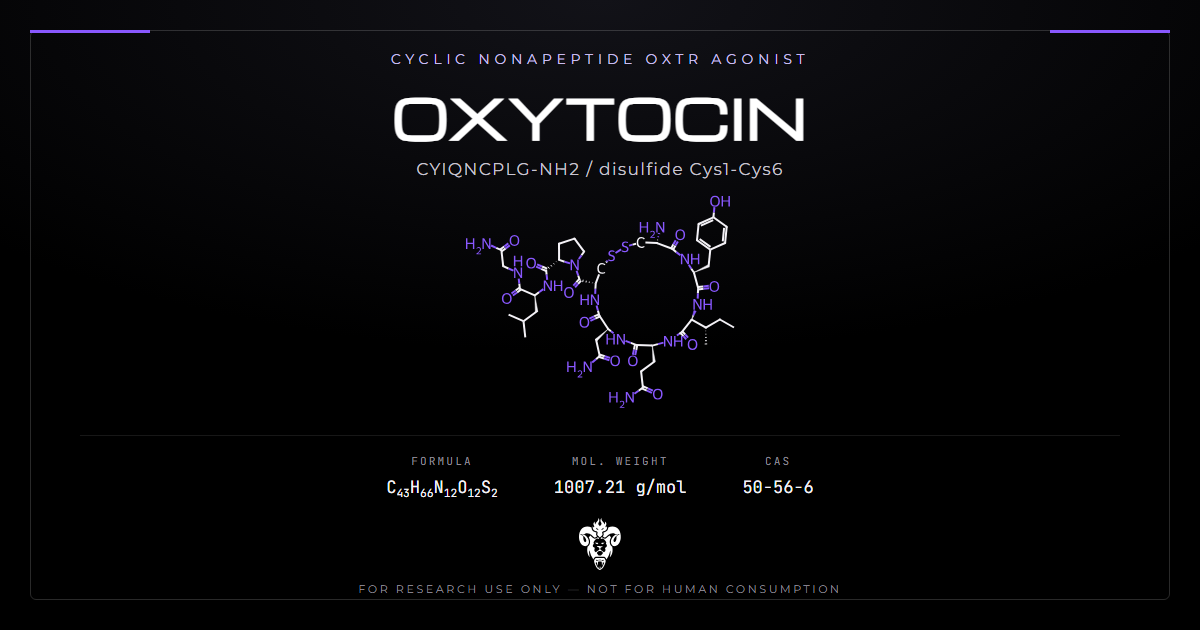
Two residues separate oxytocin from vasopressin. Position three carries isoleucine instead of phenylalanine. Position eight carries leucine instead of arginine. Everything else in the two nonapeptides matches, disulfide bridge included.
That near-identity is the first thing to understand about working with this peptide. Selectivity, not potency, is the hard part of every experiment here.
The second thing is signalling breadth. Oxytocin activates Gq and all Gi/o subtypes at its receptor [7][8]. That breadth makes it the unbiased reference against which biased ligands get measured. Kimera supplies Oxytocin as 5 mg of lyophilised powder for that kind of receptor work.
Oxytocin is an approved medicine in many countries for obstetric use. This material is not supplied for that or any other clinical purpose. Everything below reports laboratory findings and published debate. Research use only, not for human or veterinary use.
What oxytocin is
The molecule is a cyclic nonapeptide. A disulfide bond between the cysteines at positions one and six closes a six-residue ring. A three-residue tail hangs off it, ending in an amide.
Identity and physical data
| Property | Value |
|---|---|
| Compound | Oxytocin |
| Sequence | Cys-Tyr-Ile-Gln-Asn-Cys-Pro-Leu-Gly-NH2 |
| Ring | Disulfide between Cys1 and Cys6 |
| PubChem CID | 439302 |
| CAS number | 50-56-6 |
| Molecular formula | C43H66N12O12S2 |
| Molecular weight | 1007.2 g/mol |
| InChIKey | XNOPRXBHLZRZKH-DSZYJQQASA-N |
| Supplied form | 5 mg lyophilised powder in a 3 mL vial |
The disulfide defines the molecule
Reduce that bond and the ring opens. The linear form is a different molecule with different receptor behaviour, and it weighs two mass units more than the cyclic parent.
Reducing agents open that ring. Dithiothreitol, beta-mercaptoethanol and fresh TCEP all belong nowhere near a working solution unless opening the ring is the point.
The C-terminal amide
Position nine is glycinamide rather than free glycine. That amide is not decoration. Losing it costs receptor affinity. A batch that has partially hydrolysed to the free acid carries an impurity one mass unit heavier, which a low-resolution instrument will miss.
The first hormone anyone synthesised
Oxytocin holds a place in chemistry beyond its pharmacology. It was the first polypeptide hormone to be synthesised, work that earned a Nobel Prize in 1955 and set the pattern for every peptide synthesis that followed.
That history has a practical consequence. Seventy years of synthetic access means the chemistry is settled, and the arguments in this field are about biology, delivery and measurement rather than about whether anyone can make the molecule (PubChem).
The vasopressin problem
Two positions, four receptors
Oxytocin acts at its own receptor, OXTR. Vasopressin acts at V1a, V1b and V2. Two residues of difference do not give four receptors of separation, and cross-reactivity across that family is the central confound of the field.
What that means at the bench
A behavioural or physiological effect attributed to OXTR needs evidence that vasopressin receptors were not carrying it. Selective antagonists provide that evidence, and a 2013 study characterised selective and potent agonists and antagonists specifically for investigating mouse oxytocin receptors [9].
Species matters in that sentence. Ligand selectivity established at human receptors does not transfer to mouse receptors. The 2013 work exists because the mouse pharmacology needed its own tools [9].
The receptor and its signalling
Cloning came in 1992
A Nature paper reported the structure and expression of a human oxytocin receptor in 1992 [1]. Everything downstream, from expression mapping to structural biology, dates from that sequence.
Two pathways, not one
OXTR couples to Gq and to Gi/o. Work on Gαi/o isoform specificity used functional selective oxytocin ligands to separate the contributions of individual isoforms [8]. A 2026 study in cultured astrocytes reported dual pathways coupled to the same receptor [11].
The parent peptide engages the full set of those pathways. That breadth makes it a reference point rather than a tool for dissecting one route.
Where the receptor sits
OXTR appears in uterine and mammary tissue, in several brain regions, and in cardiovascular and gastrointestinal tissue. That distribution is why a systemic exposure hits many targets at once.
For an in vitro experiment the breadth is an advantage: pick the tissue or cell line and the question narrows. For an in vivo experiment it is the reason a systemic route answers a blurrier question than a targeted one.
Biased agonism, and why an unbiased reference matters
Carbetocin is the contrast case
A 2016 study characterised carbetocin, an oxytocin analogue, as a functional selective Gq agonist [7]. It induced beta-arrestin-independent internalisation and did not promote receptor recycling afterwards. One analogue, one pathway, a different cellular outcome.
Bivalent ligands go further
A 2016 paper designed superpotent bivalent ligands targeting receptor dimers through a channel-like structure [4]. A 2026 follow-up reported that bivalent ligands aimed at OXTR homodimers selectively activate distinct G protein and beta-arrestin pathways [5].
The experimental logic
Every one of those results is a comparison against the unbiased parent. Remove oxytocin from the design and biased agonism has no baseline. That is why a laboratory studying analogues still keeps the natural peptide on the shelf.
Structural biology
From sequence to structure took 28 years
The receptor sequence arrived in 1992 [1] and its crystal structure in 2020 [2]. Nearly three decades separate them, which is ordinary for a G protein-coupled receptor and worth remembering when reading the intervening literature.
Work published in that gap inferred receptor geometry from mutagenesis and modelling. Some of those inferences held up and some did not, and the structure is what allows anyone to tell which.
The receptor structure
A 2020 paper in Science Advances reported the crystal structure of the human oxytocin receptor [2]. That structure turned decades of mutagenesis into geometry, and it underpins the docking work in later papers.
A disease-linked variant
A 2022 study examined structure-function relationships of the A218T receptor variant [3]. Variant work of that kind connects receptor structure to population genetics, and it needs the wild-type reference agonist to interpret.
Dimers are part of the picture
The bivalent ligand papers treat OXTR dimers as real pharmacological entities rather than artefacts [4][5]. A ligand engineered to span two protomers is a strong test of that assumption, and it changes what a concentration-response curve means.
Findings in animal models
Receptor gene dosage
A 2013 study reported that mice heterozygous for the oxytocin receptor gene showed impaired social behaviour without increased aggression or cognitive inflexibility [10]. The authors describe a selective haploinsufficiency effect, meaning half the normal receptor complement changed one behavioural domain and not others.
Why animal work carries more weight here
Animal designs can do things human studies cannot. They can delete the receptor, restrict a manipulation to one nucleus, and confirm where the ligand went afterwards.
Those three capabilities address exactly the weaknesses the critics identify in the human literature: uncertain delivery, uncertain site of action and uncertain measurement [13][15]. The animal work is where the mechanistic claims in this field actually rest.
Circuit-level work
A 2025 study manipulated oxytocin receptors within the caudal lateral septum of adult male and female rats [12]. It reported effects on social approach-avoidance, long-term social discrimination and anxiety-like behaviour. Region-specific manipulation is a stronger design than systemic delivery, and it is where the animal literature has been heading.
The social peptide claim, and its critics
The claim
A large literature describes oxytocin as a social neuropeptide. The idea started in maternal behaviour work, where the peptide’s role is best supported, and then widened to social interaction generally.
That widening is the step under dispute. Maternal physiology and social cognition are different problems, and evidence for the first does not carry the second.
The deconstruction
A 2022 analysis in Philosophical Transactions took that claim apart [14]. The authors mapped the citation structure of the field, identified interconnected clusters of papers by theme, and assessed four evidence types separately (PubMed).
That method is worth noting on its own. A field can look large and consistent while resting on a small number of interconnected clusters, and citation mapping is how you see that from outside.
Delivery and measurement, the two methodological cruxes
What the critique says
A 2016 paper in Biological Psychiatry examined the intranasal route directly [13]. Very little of the large amounts applied intranasally appears to reach cerebrospinal fluid. Peripheral concentrations meanwhile rise to supraphysiologic levels, with effects on the gastrointestinal tract, heart and reproductive tract.
The authors call for preregistration, declared primary and secondary outcomes, and prespecified statistics [13]. Two published replies and counter-replies followed in the same journal, which is where anyone reading this debate should go next.
Why it matters for laboratory work
A related compartment result makes the same point from the other direction. A 2016 study gave a peptide oxytocin antagonist systemically to lactating rats and found no central action [6]. The barrier that keeps peripheral peptide out of the brain works in both directions.
If peripheral exposure dominates after intranasal administration, then a behavioural change may reflect peripheral signalling rather than a central one. Route determines which compartment the experiment actually tested, and that question sits upstream of any conclusion about brain oxytocin.
Measurement is its own problem
A 2016 review compared bioassays and immunoassays for oxytocin and vasopressin [15]. Its title puts the conclusion plainly by adding random numbers to that list.
Why the two cruxes compound each other
Delivery decides what reached the target. Measurement decides whether anyone can tell. A study with an uncertain route and an unvalidated assay has two unknowns multiplying, and no statistical treatment separates them afterwards.
That combination explains much of the disagreement in this field better than any single flawed study does.
The extraction question
Unextracted plasma immunoassays report values orders of magnitude above extracted ones for the same samples. Both cannot be right. A published concentration means nothing on its own. The assay and the extraction step have to be named alongside it.
What to do in practice
Use a validated method with extraction, report the platform, and treat historical values from unextracted assays as uninterpretable rather than merely imprecise. For in vitro work the problem disappears, since the concentration is what you prepared.
Designing an experiment with oxytocin
Include a vasopressin receptor control
Selectivity is the first thing a reviewer should ask about. A V1a antagonist arm, or a comparison against vasopressin itself at matched concentrations, separates the two families [9]. Without one of those, an OXTR attribution rests on assumption.
State the species of every receptor
Human, mouse and rat receptors differ in ligand selectivity [9]. A number quoted from a human assay does not set the concentration for a mouse experiment, and mixing the two across a methods section is a common and avoidable error.
Choose the compartment deliberately
Central and peripheral exposure produce different experiments [6][13]. Say which one the design addresses, and avoid describing a systemic result in language that implies a central mechanism.
Prepare fresh and verify
Adsorption and disulfide chemistry both act on the timescale of an experiment. Prepare dilutions immediately before use, and run an aliquot of the working solution at the end of a long experiment to confirm the peptide survived it.
Physicochemical properties and handling
| Property | Detail |
|---|---|
| Appearance | White lyophilised powder |
| Solubility | Water soluble; acetate buffer common for stock preparation |
| Reconstitution | Add diluent down the vial wall, swirl, do not shake |
| Storage, lyophilised | Minus 20 degrees Celsius, desiccated |
| Storage, reconstituted | 2 to 8 degrees Celsius, short term only |
| Stability note | Disulfide exchange and deamidation; adsorbs to surfaces |
| Handling | Standard laboratory controls for a lyophilised peptide |
Adsorption is the underrated loss
Peptides of this size stick to glass and to plastic. A dilute solution in an untreated tube loses a share of its content to the walls before reaching the assay.
Carrier protein or a low concentration of a nonionic surfactant blocks that, and low-binding tubes help. Prepare dilute working solutions immediately before use rather than storing them, because adsorption continues for as long as the solution sits.
Freeze-thaw and vial headspace
Each freeze-thaw cycle costs peptide, and a repeatedly opened vial takes up moisture that no label records. Aliquot on the day of reconstitution into volumes matched to a single experiment.
Headspace matters too. A part-used vial holds air above the solution, and disulfide chemistry proceeds faster with oxygen available. Smaller aliquots in fuller tubes are the cheap fix.
Aqueous stability
Formulation research on this peptide is active because its aqueous stability is limited. A 2021 study examined excipients including glucosamine derivatives and tetraethylene glycol for their effect on stability in aqueous solution [16]. Heat-stable formulation work has gone as far as sublingual fast-dissolving tablets in preclinical evaluation [17].
Two degradation routes matter at the bench. Disulfide exchange scrambles or opens the ring. Deamidation at the asparagine and glutamine residues shifts mass by one unit per event.
Analytical characterization
Mass detection
Electrospray gives a protonated ion at m/z 1007.4 and a doubly charged ion near 504.2. The doubly charged species usually dominates, which is worth expecting rather than discovering mid-run.
Confirming the ring
Run the sample before and after reduction. The cyclic peptide gains two mass units on reduction, and that two-unit shift is direct evidence the disulfide was intact. No other single measurement confirms the ring as cleanly.
Watching for the linear form
The reduced linear peptide is the impurity most worth tracking, because it forms spontaneously under mild reducing conditions and it retains enough structure to look like the parent on a fast method.
Two mass units separate them. A high-resolution instrument sees that immediately, and a low-resolution one may not, which is the case for running the reduction comparison rather than trusting a single spectrum.
Ultraviolet and chromatography
A single tyrosine gives absorbance near 275 nanometres, enough for concentration checks on concentrated stocks. Reversed-phase HPLC separates the parent from the linear reduced form and from deamidated species. All three elute close together, so the gradient has to be shallow. Batch documentation for catalogue material sits in the certificate of analysis database.
Where oxytocin sits among peptide research compounds
| Compound | Studied theme | Length |
|---|---|---|
| Oxytocin | OXTR agonism, Gq and Gi/o signalling | 9 residues, cyclic |
| Kisspeptin-10 | KISS1R signalling, reproductive axis | 10 residues |
| DSIP | Delta EEG activity, seizure and stress models | 9 residues |
| Epithalon | Telomerase, pineal signalling | 4 residues |
Only one of these four has a cloned receptor and a solved receptor structure behind it. Keep that in view when comparing the strength of their literatures. Further reading sits in the peptides research library, including the DSIP article and the Epithalon article.
What this literature does not establish
That intranasal administration delivers to the brain
The 2016 critique argues that very little reaches cerebrospinal fluid while peripheral levels go supraphysiologic [13]. Anyone citing an intranasal behavioural result inherits that argument and should address it.
That the social peptide framing is settled
The 2022 citation analysis found the claim rests on interconnected clusters rather than on independent convergent lines [14]. That is a structural criticism of a field. Another study of the same design does not answer it.
That published concentrations are comparable
Assay method and extraction determine the number [15]. Values from different platforms are not interchangeable, and older unextracted results are the least usable.
That in vivo results identify a site of action
Systemic delivery reaches receptors in uterine, mammary, cardiac and gastrointestinal tissue as well as brain. A behavioural readout after systemic exposure does not localise the mechanism, and the antagonist compartment result makes that concrete [6].
That receptor selectivity comes for free
Two residues separate this peptide from vasopressin, and selective tools exist precisely because the separation is not automatic [9]. An experiment without a selectivity control has not isolated OXTR.
Frequently asked questions
What is the sequence?
Cys-Tyr-Ile-Gln-Asn-Cys-Pro-Leu-Gly-NH2, cyclised by a disulfide between the two cysteines, 1007.2 g/mol.
How does it differ from vasopressin?
Two residues: isoleucine rather than phenylalanine at position three, leucine rather than arginine at position eight.
Why call it an unbiased reference?
Because it activates Gq and all Gi/o subtypes at OXTR, where analogues such as carbetocin activate a subset [7][8]. Biased ligands are defined against the unbiased parent.
How do I confirm the disulfide is intact?
Run the sample before and after reduction and look for a two-unit mass increase. An intact ring gains those two units; an already-reduced peptide does not.
Why does my dilute solution lose potency?
Adsorption to tube walls, most likely. Use low-binding tubes with carrier protein or surfactant, and prepare dilutions fresh.
What makes it an unusual catalogue item?
A cloned receptor, a solved receptor structure, selective antagonist tools and a large critical literature. Few research peptides carry all four, and the criticism is a sign of attention rather than of weakness.
Does the receptor form dimers?
The bivalent ligand work treats OXTR dimers as real pharmacological entities and reports pathway-selective activation through them [4][5].
Is the intranasal literature usable?
Read it alongside the 2016 critique and the replies that followed [13]. The route question sits upstream of the behavioural interpretation.
References
- Kimura T, Tanizawa O, Mori K, et al. Structure and expression of a human oxytocin receptor. Nature. 1992;356(6369):526-9. PubMed DOI
- Waltenspuhl Y, Schoppe J, Ehrenmann J, et al. Crystal structure of the human oxytocin receptor. Sci Adv. 2020;6(29):eabb5419. PubMed DOI
- Meyer M, Jurek B, Alfonso-Prieto M, et al. Structure-function relationships of the disease-linked A218T oxytocin receptor variant. Mol Psychiatry. 2022;27(2):907-917. PubMed DOI
- Busnelli M, Kleinau G, Muttenthaler M, et al. Design and characterization of superpotent bivalent ligands targeting oxytocin receptor dimers via a channel-like structure. J Med Chem. 2016;59(15):7152-66. PubMed DOI
- Busnelli M, Gori A, Chini B. Bivalent ligands targeting oxytocin receptor homodimers selectively activate distinct G protein and beta-arrestin pathways. Biochem Pharmacol. 2026;247:117814. PubMed DOI
- Sabatier N, Leng G. The peptide oxytocin antagonist F-792, when given systemically, does not act centrally in lactating rats. J Neuroendocrinol. 2016;28(4). PubMed DOI
- Passoni I, Leonzino M, Gigliucci V, et al. Carbetocin is a functional selective Gq agonist that does not promote oxytocin receptor recycling after inducing beta-arrestin-independent internalisation. J Neuroendocrinol. 2016;28(4). PubMed DOI
- Busnelli M, Peverelli E, Mantovani G, et al. Deciphering the specific role of Gai/o isoforms: functional selective oxytocin ligands and somatostatin SST5 receptor mutants. Biochem Soc Trans. 2013;41(1):166-71. PubMed DOI
- Busnelli M, Bulgheroni E, Manning M, et al. Selective and potent agonists and antagonists for investigating the role of mouse oxytocin receptors. J Pharmacol Exp Ther. 2013;346(2):318-27. PubMed DOI
- Sala M, Braida D, Donzelli A, et al. Mice heterozygous for the oxytocin receptor gene show impaired social behaviour but not increased aggression or cognitive inflexibility: evidence of a selective haploinsufficiency gene effect. J Neuroendocrinol. 2013;25(2):107-18. PubMed DOI
- Farsetti E, Amato S, Averna M, et al. Dual pathways coupled to oxytocin molecular signals in cultured astrocytes. Cells. 2026;15(10):950. PubMed DOI
- Pirri F, McCormick CM. Oxytocin receptors within the caudal lateral septum regulate social approach-avoidance, long-term social discrimination, and anxiety-like behaviors in adult male and female rats. Neuropharmacology. 2025;271:110409. PubMed DOI
- Leng G, Ludwig M. Intranasal oxytocin: myths and delusions. Biol Psychiatry. 2016;79(3):243-50. PubMed DOI
- Leng G, Leng RI, Ludwig M. Oxytocin, a social peptide? Deconstructing the evidence. Philos Trans R Soc Lond B Biol Sci. 2022;377(1858):20210055. PubMed DOI
- Leng G, Sabatier N. Measuring oxytocin and vasopressin: bioassays, immunoassays and random numbers. J Neuroendocrinol. 2016;28(10). PubMed DOI
- Ghasemisarabbadieh M, Sigurdsson SJ, Dong FVN, et al. The effect of D-(+)-glucosamine, N-acetyl-D-glucosamine and tetraethylene glycol on the stability of oxytocin in aqueous solution. Pharmazie. 2021;76(10):480-483. PubMed DOI
- Zhu C, Lal M. Preclinical safety and pharmacokinetics of heat stable oxytocin in sublingual fast-dissolving tablet formulation. Pharmaceutics. 2022;14(5):953. PubMed DOI