
Query PubMed for “phenylpiracetam hydrazide” and one result comes back, from 1985. RGPU-95, the designation vendors attach to a related compound, returns one more.
Now query the parent. Phenylpiracetam returns twenty-nine results, and phenotropil, its Russian trade name, returns thirty-one.
That gap is the honest starting point. Almost everything written about Phenylpiracetam Hydrazide belongs to the compound it was made from, and the two are not the same molecule.
Chemical identity
One functional group separates it from a much better-studied parent.
| Property | Phenylpiracetam Hydrazide | Phenylpiracetam |
|---|---|---|
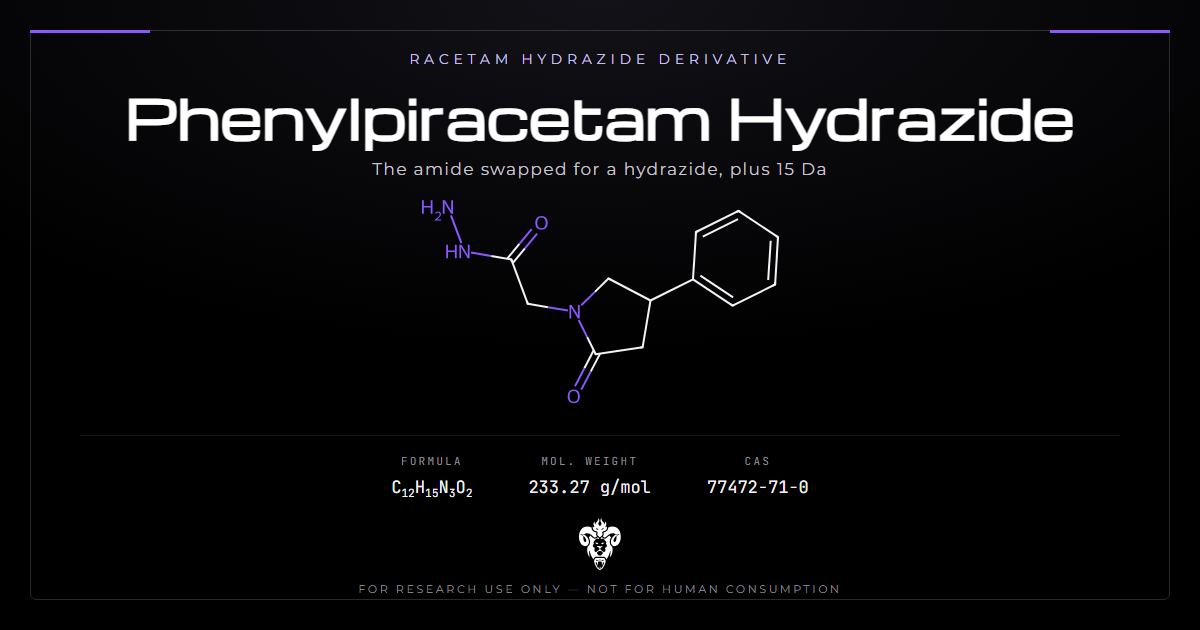
| IUPAC name | 2-(2-oxo-4-phenylpyrrolidin-1-yl)acetohydrazide | 2-(2-oxo-4-phenylpyrrolidin-1-yl)acetamide |
| Molecular formula | C12H15N3O2 | C12H14N2O2 |
| Molecular weight | 233.27 | 218.25 |
| CAS | 77472-71-0 | 77472-70-9 |
| PubChem CID | 4995664 | 132441 |
| InChIKey | AXQUMNYYLGUJIZ-UHFFFAOYSA-N | LYONXVJRBWWGQO-UHFFFAOYSA-N |
The two CAS numbers are consecutive
77472-70-9 and 77472-71-0 sit next to each other in the registry. Somebody made and catalogued the hydrazide alongside the parent rather than finding it separately.
The chemical difference amounts to one nitrogen. An amide becomes a hydrazide, adding NH and 15 mass units. Nothing else in the molecule moves.
Both InChIKeys are flat, and that matters
Neither key carries stereochemistry. Phenylpiracetam has a stereocentre at position 4 of the pyrrolidinone ring, and the hydrazide inherits it. Material of both is racemic.
Hold onto that, because the parent’s most interesting published work is about what the two enantiomers do differently.
What the two hydrazide-adjacent papers say
Both are worth reading in full, because there is so little else.
The 1985 immunology paper
A Russian group studied piracetam and several derivatives in mice [1]. Doses ran 50 to 200 mg/kg with multiple injections. The readout was antibody-forming cells in the spleen after immunisation with sheep red blood cells.
The direction of the effect depended on the chemical modification. Adding a phenyl radical to piracetam strengthened immunosuppression. Inserting a hydrazide group stimulated antibody formation.
That single sentence is the closest thing the indexed literature offers to a mechanistic statement about the hydrazide modification. It is forty years old.
The RGPU-95 paper, and what it does not say
A Volgograd group compared Fenotropil against what the abstract calls its structural analogue, compound RGPU-95, in rats [2].
Both reduced anxious and depressive behaviour more in males than in females. On anxiolytic measures, RGPU-95 significantly exceeded Fenotropil while remaining below diazepam. On antidepressant activity it was comparable to imipramine and exceeded Fenotropil.
The abstract never states RGPU-95’s structure. It says structural analogue and nothing more. So a reader cannot confirm from that abstract which analogue was tested, and vendors assigning the designation to a specific molecule are relying on something outside it.
What the searches actually return
Counts move as databases grow, so these were taken together on one day and are reproducible by anyone.
| PubMed query | Indexed results |
|---|---|
| “phenylpiracetam hydrazide” | 1 |
| fonturacetam hydrazide | 0 |
| RGPU-95 | 1 |
| phenylpiracetam | 29 |
| fonturacetam | 4 |
| “phenotropil” | 31 |
Reading the table
Two entries describe Phenylpiracetam Hydrazide. Sixty-four describe the parent under three different names.
The zero on the second row is worth its own note. Vendors use “fonturacetam hydrazide” as a synonym, and nothing in PubMed answers to it, so anyone searching that phrase will conclude there is no literature at all rather than finding the single 1985 paper.
Three names for one parent
Phenylpiracetam, fonturacetam and phenotropil are the same amide under a chemical name, an international nonproprietary name and a Russian trade name. Searching only one of them returns a third of what exists.
That is worth knowing before concluding anything about either compound, and it is the sort of thing that makes a literature look thinner or fatter than it is depending on which word somebody typed.
The parent compound has a real literature
Everything in this section belongs to phenylpiracetam, the amide. It sits here because people cite it for Phenylpiracetam Hydrazide, and a reader deserves to see what the borrowing involves.
The enantiomers do different things
This is the strongest thread in the parent’s file, and it undercuts any casual treatment of the racemate.
One group characterised S-phenylpiracetam as a selective dopamine transporter inhibitor that reduced body weight gain [3]. The same group reported R-phenylpiracetam, also acting on the dopamine transporter, with neuroprotective and anti-inflammatory activity [4]. They also examined stereoselective pharmacological activity head on [5].
A racemic preparation delivers both. Whatever a racemate does is the sum of two different pharmacologies in unknown proportion for any given endpoint.
The clinical work is Russian-language
A 2025 systematic review and meta-analysis examined fonturacetam in asthenia [6]. A 2024 review covered its pharmacological effects and clinical prospects under the trade name Actitropil [7]. Earlier trial reports cover asthenic syndrome in chronic brain ischaemia [8].
Other work reports psychoimmunomodulatory effects in animals under immune stress [9] and antiaggregant activity among pyrrolidone derivatives [10]. Further papers cover neuroactive amino acid derivatives and psychoemotional state [11], plus an assessment of neuroleptic activity [12].
None of it is about the hydrazide
Every paper in this section studied the amide. Moving those results onto Phenylpiracetam Hydrazide assumes the extra nitrogen changes nothing. The one paper that looked at exactly that modification found it reversing the direction of an immunological effect [1].
Where this sits among the racetams
The family is built by decorating one ring. Piracetam is the parent of the whole class, a 2-oxopyrrolidine acetamide. Phenylpiracetam adds a phenyl group at position 4 of that ring. Phenylpiracetam Hydrazide then converts the acetamide tail to an acetohydrazide.
Two modifications, applied in sequence, each one to a different part of the molecule.
The 1985 study measured both modifications
That detail is what makes the forty-year-old paper useful rather than merely old. It compared what a phenyl addition did against what a hydrazide insertion did, in the same assay [1].
The two went opposite ways. So the compound in question carries one modification that suppressed an immunological readout and another that stimulated it, and nobody has since measured what the pair does together on any other endpoint.
Ring position matters elsewhere in the family too
The related product RGPU-95 is sold as a para-chloro variant of the phenyl ring, a third modification site again.
Whether the compound in the only paper bearing that designation is the same molecule remains unstated in its abstract [2], which is the reason this article treats the designation and the structure as separate questions.
The compound turns up in supplement surveillance
A distinct body of work exists, and it is analytical rather than pharmacological.
Investigators found phenylpiracetam among unapproved drugs in cognitive enhancement supplements sold to consumers [13]. A review traced the history of unauthorised ingredients in products marketed as nootropics [14]. A 2025 survey examined the occurrence of illicit smart drugs across Europe and Australia [15].
Forensic method development has followed, including molecularly imprinted sorbents for sample preparation from biological fluids [16].
Why that matters for reading
When a compound carries a large surveillance literature and a small pharmacology one, most of the people studying it are trying to detect it. TB-500 showed the same pattern, and it signals where a molecule sits.
What a thin literature actually means
Three readings are available, and they are not the same claim.
It has not been studied. True here, and the least interesting reading. Absence of papers is absence of information rather than evidence of anything.
It has been studied and nothing was found. Not supported. Null results do get published, and there is no body of negative work to point at.
The parent’s evidence transfers. This is the reading that circulates, and it is the one the 1985 paper argues against, since the hydrazide modification reversed the direction of an effect the phenyl modification produced [1].
The honest position
Two indexed papers, one from 1985, and one that does not state the structure of the compound it tested. That is the evidence base specific to this molecule.
Everything else on offer belongs to a compound one nitrogen away. That compound’s own literature is largely Russian-language, and its two enantiomers behave differently from each other [3][4][5].
Two experiments that would settle the interpretation
Neither is a recommendation. They are the gaps a reader should notice.
Run the hydrazide beside the amide in one model
The 1985 study did something close, comparing modifications of piracetam in a single immunological assay [1]. Nobody has repeated that design with a behavioural or cognitive readout.
Dosing phenylpiracetam and Phenylpiracetam Hydrazide side by side, in the same animals on the same endpoint, would show whether the extra nitrogen matters. Such an experiment is straightforward. Nothing in the published record contains it.
Establish which analogue RGPU-95 is
The only indexed paper naming RGPU-95 does not give its structure [2]. That single omission undermines every claim built on the paper. A reader cannot verify which molecule produced the anxiolytic and antidepressant results.
Publishing the structure alongside the designation, or citing the primary chemistry that assigns it, would resolve it. Until then, treat RGPU-95 results as belonging to an unspecified analogue.
What a hydrazide is, and why chemists make them
The functional group is not exotic. A hydrazide is an acyl group attached to a nitrogen-nitrogen bond, and synthetic chemists reach for one routinely.
Three reasons recur, and only the third is a pharmacological claim.
It is a synthetic handle
Hydrazides react cleanly with aldehydes and ketones to form hydrazones. That makes them useful intermediates for building larger molecules, and a great many hydrazides exist because somebody wanted the next compound rather than this one.
It changes physical properties
Swapping an amide for a hydrazide alters polarity, hydrogen bonding and crystallinity. Those affect solubility and how a solid behaves, which matters for formulation regardless of what the molecule does biologically.
It sometimes changes activity
This is the claim that would justify selling Phenylpiracetam Hydrazide as a distinct research compound, and it is the one with a single forty-year-old data point behind it [1].
Worth separating the three. A compound can be a sensible thing to synthesise, and a sensible thing to stock, without any evidence that the modification changed what it does.
How to read a claim about this compound
Four questions, and the first eliminates most of what circulates.
Hydrazide or amide?
233.27 or 218.25. The paper will name the compound, and if it says phenylpiracetam, fonturacetam or phenotropil, it studied the amide.
Which enantiomer?
The parent’s dopamine transporter work is stereoselective [3][4][5]. A racemic result is the sum of two pharmacologies.
Pharmacology or surveillance?
A large share of the recent literature is detection methodology and market surveillance [13][14][15][16]. Those papers establish that the compound can be found, not what it does.
Is the source auditable?
Most of the clinical work is Russian-language. That is a limit on verification rather than a judgement. The same care applies here as with any single-country evidence base.
What would change the picture
Three things would move this compound from a thin file to a real one, and they are worth naming so a reader knows what to watch for.
A structure attached to the RGPU designation
The Volgograd group’s numbering scheme is internally consistent, and somewhere there is chemistry assigning each number to a molecule. Publishing or citing that assignment would make the one behavioural result usable [2].
Any pharmacology paper at all on the hydrazide
One paper measuring anything, in any model, would double the specific literature. That is an unusual sentence to write about a compound with a five-figure annual market, and it is accurate.
Enantiomer-resolved work
The parent’s dopamine transporter pharmacology splits by enantiomer [3][4][5]. Phenylpiracetam Hydrazide carries the same stereocentre, and nobody has separated its enantiomers or tested them apart.
Until one of those three lands, the honest description stays what it is: a defined molecule, cleanly identifiable, with a literature of two papers and a parent whose evidence does not automatically transfer.
Verifying research material
The identity checks here are unusually easy, and the synonym check is unusually important.
Fifteen mass units separate it from the parent
233.27 against 218.25. A mass spectrum distinguishes Phenylpiracetam Hydrazide from the amide without difficulty. The two CAS numbers differ only in their final digits, so read both carefully rather than at a glance.
Check that a synonym list belongs to this compound
Synonym fields are where errors hide. Names like beta-phenyl-gamma-aminobutyric acid, PhGABA and PHG belong to phenibut. That is a different molecule at 179.22, with its own separate literature and its own product page.
A synonym list carrying another compound’s names is a common failure. Check the field against PubChem rather than trusting it. The identity that counts is the CAS, the formula, the mass and the InChIKey.
The purity number and the identity question are separate
A high purity figure says the material is mostly one thing. It does not say which thing, and for a compound whose parent differs by 15 mass units and whose synonym field can carry a third molecule’s names, that distinction carries real weight.
Read the mass, the formula and the CAS before reading the percentage.
Racemic unless stated
Both InChIKeys are flat. A certificate claiming a single enantiomer needs chiral chromatography behind it. An ordinary certificate does not address the question at all.
Every batch we supply carries a certificate of analysis recording the identity and purity data behind it.
Handling
A hydrazide is more reactive than the amide it replaced. Hydrazides condense with aldehydes and ketones to form hydrazones. Keep the solid away from solvents and containers that might carry carbonyl contamination. Beyond that, ordinary practice applies: dry, dark, and equilibrated to room temperature before opening.
Common questions about Phenylpiracetam Hydrazide
Identity
How does it differ from phenylpiracetam? One nitrogen. The terminal amide is a hydrazide, which adds 15 mass units.
Is it the same as RGPU-95? The only indexed paper using that designation does not state the structure it refers to [2].
Is it related to phenibut? No. Phenibut is a different molecule at 179.22, and its synonyms sometimes appear on hydrazide listings in error.
Evidence
How many papers are specific to it? Two indexed, one from 1985 [1][2]. Searching the vendor synonym “fonturacetam hydrazide” returns none at all.
Is a thin literature the same as a negative result? No. Nothing has been published either way, which is an absence of information rather than evidence of absence.
What did the 1985 paper find? That inserting a hydrazide group into piracetam stimulated antibody formation, while adding a phenyl radical strengthened immunosuppression [1].
Can I use the phenylpiracetam literature? Only with the modification stated. The one study to compare modifications directly found them acting in opposite directions [1].
Verification
What mass should a certificate show? 233.27. A reading near 218.25 describes the parent amide, which is a different compound with a much larger literature and a different set of claims attached to it.
Which CAS? 77472-71-0 for the hydrazide, 77472-70-9 for the amide.
Why does the synonym field matter so much here? Because the compound has few papers of its own, so a reader chasing evidence follows the names. A wrong synonym sends them to a different molecule’s literature entirely.
Does a hydrazide need different handling from an amide? It is the more reactive of the two, and it condenses with aldehydes and ketones. Keep it away from carbonyl contamination.
Summary of the evidence
Phenylpiracetam Hydrazide is the parent racetam with its terminal amide converted to a hydrazide: 233.27 against 218.25, under a consecutive CAS number. Two indexed papers touch it. One is a 1985 mouse immunology study. It found that the hydrazide modification stimulated antibody formation while a phenyl modification suppressed it. The other compares Fenotropil against a structural analogue whose structure its abstract never states.
The parent’s literature is real, largely Russian-language, and stereoselective. Its two enantiomers act differently at the dopamine transporter, and material of both compounds is racemic. A separate and growing body of work concerns detecting the parent in supplements rather than studying it.
Kimera Chems supplies Phenylpiracetam Hydrazide alongside related research compounds including RGPU-95, with full analytical documentation. Our nootropics research library covers more compounds in this class.
Research use only. Not for human or veterinary use. Nothing here describes a therapy or a dosing protocol.
References
- Ratnikov VI, Ostrovskaia RU, Vazhenina ZP, Skoldinov AP. [Effect of piracetam derivatives on antibody formation]. Biull Eksp Biol Med. 1985;100(11):578-81. PMID 4063506.
- Tiurenkov IN, Bagmetova VV, Shishkina AV, Berestovitskaia VM, Vasil’eva OS, Ostrogliadov ES. [Gender differences in action Fenotropil and its structural analog–compound RGPU-95 on anxiety-depressive behavior animals]. Eksp Klin Farmakol. 2010;73(11):10-4. PMID 21254591.
- Zvejniece L, Svalbe B, Vavers E, Makrecka-Kuka M, Makarova E, Liepins V, Kalvinsh I, Liepinsh E, et al. S-phenylpiracetam, a selective DAT inhibitor, reduces body weight gain without influencing locomotor activity. Pharmacol Biochem Behav. 2017;160:21-29. PMID 28743458. DOI
- Zvejniece L, Zvejniece B, Videja M, Stelfa G, Vavers E, Grinberga S, Svalbe B, Dambrova M. Neuroprotective and anti-inflammatory activity of DAT inhibitor R-phenylpiracetam in experimental models of inflammation in male mice. Inflammopharmacology. 2020;28(5):1283-1292. PMID 32279140. DOI
- Zvejniece L, Svalbe B, Veinberg G, Grinberga S, Vorona M, Kalvinsh I, Dambrova M. Investigation into stereoselective pharmacological activity of phenotropil. Basic Clin Pharmacol Toxicol. 2011;109(5):407-12. PMID 21689376. DOI
- Devlikamova FI, Safina DR. [Efficacy and safety of fonturacetam in asthenia: a systematic review and meta-analysis]. Zh Nevrol Psikhiatr Im S S Korsakova. 2025;125(2):69-79. PMID 40047835. DOI
- Gromova OA, Torshin IY. [Pharmacological effects of fonturacetam (Actitropil) and prospects for its clinical use]. Zh Nevrol Psikhiatr Im S S Korsakova. 2024;124(8):21-31. PMID 39269293. DOI
- Fedin AI, Solov’eva ÉI, Mironova OP, Fedotova AV. [Treatment of asthenic syndrome in patients with chronic brain ischemia: results of the non-interventional observational program TRIUMPH]. Zh Nevrol Psikhiatr Im S S Korsakova. 2014;114(12):104-111. PMID 25726789. DOI
- Samotrueva MA, Tyurenkov IN, Teplyi DL, Serezhnikova TK, Khlebtsova EB. Psychoimmunomodulatory effect of phenotropil in animals with immune stress. Bull Exp Biol Med. 2011;151(1):51-4. PMID 22442801. DOI
- Zhilyuk VI, Levykh AE, Mamchur VI. A study of the mechanisms for antiaggregant activity of pyrrolidone derivatives in rats with chronic hyperglycemia. Bull Exp Biol Med. 2014;156(6):799-802. PMID 24824701. DOI
- Borodkina LE, Smolnyakova YA, Muzyko EA, Tyurenkov IN. [Changes in the psychoemotional state under the influence of derivatives of neuroactive amino acids of rats after chronic alcohol intoxication]. Zh Nevrol Psikhiatr Im S S Korsakova. 2022;122(4):112-116. PMID 35485072. DOI
- Akhapkina VI, Akhapkin RV. [Identification and evaluation of the neuroleptic activity of phenotropil]. Zh Nevrol Psikhiatr Im S S Korsakova. 2013;113(7):42-6. PMID 23994920.
- Cohen PA, Avula B, Wang YH, Zakharevich I, Khan I. Five Unapproved Drugs Found in Cognitive Enhancement Supplements. Neurol Clin Pract. 2021;11(3):e303-e307. PMID 34484905. DOI
- Jędrejko K, Catlin O, Stewart T, Anderson A, Muszyńska B, Catlin DH. Unauthorized ingredients in “nootropic” dietary supplements: A review of the history, pharmacology, prevalence, international regulations, and potential as doping agents. Drug Test Anal. 2023;15(8):803-839. PMID 37357012. DOI
- Vanhee C, Deconinck E, George M, Hansen A, Hackl A, Wollein U, El-Atma O, Beerbaum N, et al. The Occurrence of Illicit Smart Drugs or Nootropics in Europe and Australia and Their Associated Dangers: Results from a Market Surveillance Study by 12 Official Medicines Control Laboratories. J Xenobiot. 2025;15(3). PMID 40558871. DOI
- Voronin AV, Malkova TL, Synbulatov IV. [Molecularly imprinted sorbent for biological fluids sample preparation in forensic toxicology]. Sud Med Ekspert. 2021;64(6):39-42. PMID 34814644. DOI
Research use only. Not for human or veterinary use. Nothing here describes a therapy or a dosing protocol.