...

Phenibut

CAS
3060-41-1
Molecular wt
215.68 g/mol
Compound class
GABA analog / phenylated
Batch
KC-PHB-03
Made
2026-06-01
Reports
3 on file
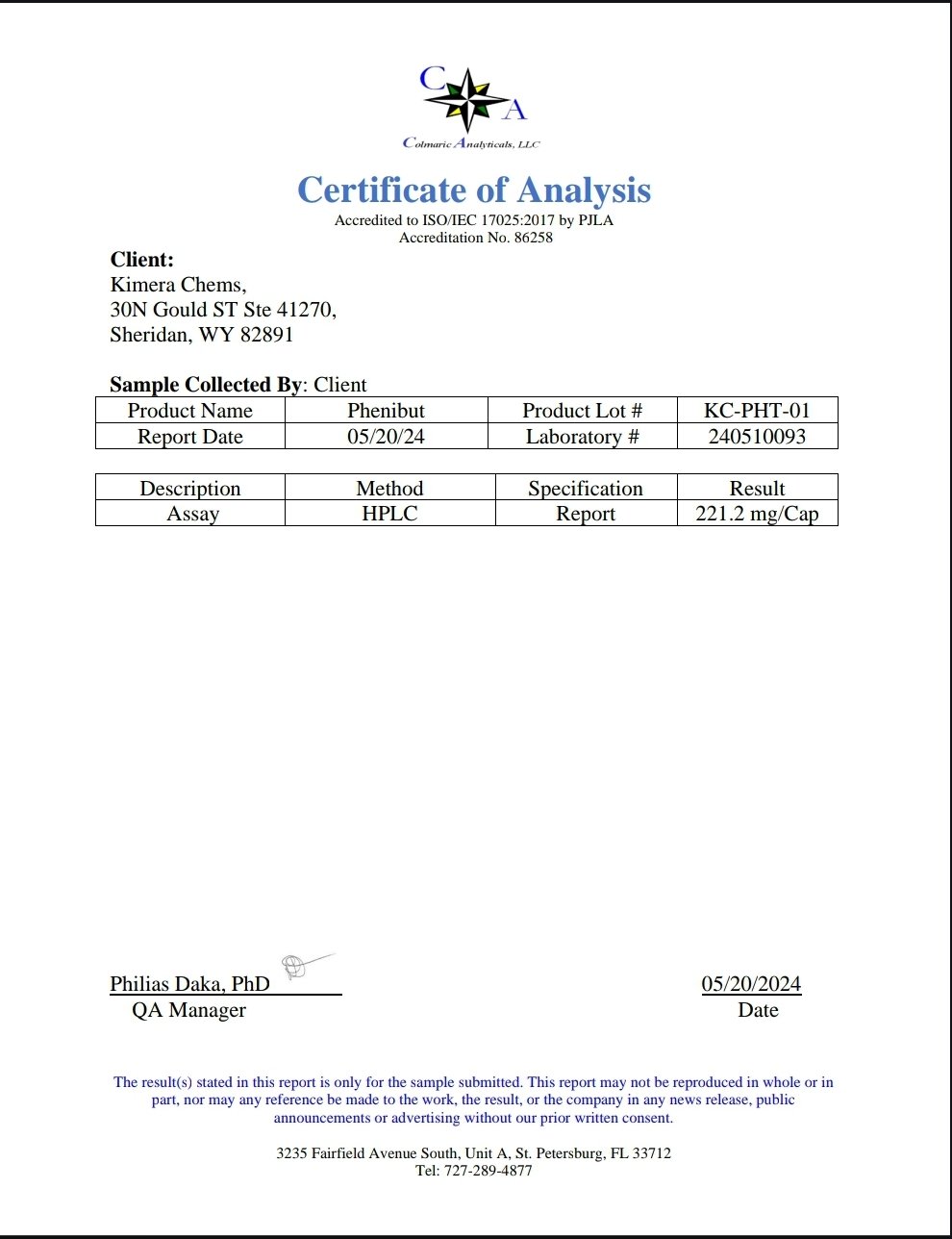
Everything shipping from this page today came off this batch. The code is printed on your label, and one certificate covers the whole batch.

Phenibut

Phenibut is sold for laboratory research use only. Terms of sale apply. Not for human consumption, nor medical, veterinary, or household uses. Please familiarize yourself with our Terms and Conditions prior to ordering.

What is the difference between these?
Dry-Fill Capsule
Capsules filled with the weighed solid. The label gives the amount in each capsule and the number in the bottle.
Powder
Raw material as a solid. Nothing added and nothing portioned; the stated weight is what is in the container.
Each label gives the amount per unit and the total, so compare the totals rather than the container size.

SSL secure checkout

256-bit encryption

3rd party verified

HPLC and mass spectrometry

Description

Phenibut Hydrochloride (β-Phenyl-GABA HCl) Research Standard

Phenibut Hydrochloride is a synthetic derivative of the naturally occurring inhibitory neurotransmitter γ-aminobutyric acid (GABA). By incorporating a phenyl ring onto the GABA backbone, the molecule gains lipophilic properties, enabling it to function as a potent GABA-mimetic in experimental models. In neurobiological research, Phenibut HCl is primarily utilized to investigate inhibitory signaling pathways within the central nervous system, specifically serving as an agonist for the GABA-B receptor and as a ligand for studying alpha-2-delta calcium channel subunits in isolated tissue models.

Technical Specifications

Property Specification
Product Name Phenibut Hydrochloride
Chemical Name 4-Amino-3-phenylbutanoic acid hydrochloride
CAS Number 3060-41-1
Chemical Formula C₁₀H₁₃NO₂·HCl
Molecular Weight 215.68 g/mol
Chemical Class GABA analog (phenylated)
Physical Appearance Fine white to off-white crystalline powder
Assay Purity Refer to the batch-specific Certificate of Analysis (COA) supplied for the lot received

Mechanism of Action & Research Context

Phenibut is engineered to traverse biological barriers in in vivo models, but its primary utility in in vitro laboratory settings lies in its distinct pharmacological activity at neurotransmitter receptors.

  • GABA-B Receptor Agonism: The molecule functions as an agonist at the GABA-B receptor. This interaction is central to studying inhibitory neurotransmission, as it modulates the release of other neurotransmitters—such as dopamine and acetylcholine—via the inhibition of voltage-gated calcium channels.

  • Alpha-2-Delta Interaction: Research also explores the compound’s activity at the alpha-2-delta (α₂δ) subunit of voltage-gated calcium channels, positioning it as a tool for comparing ligand affinity against other gabapentinoid research compounds.

  • Structural Role of the Phenyl Ring: The addition of the phenyl ring to the GABA structure is the primary focus of structure-activity relationship (SAR) studies, as it significantly alters the receptor binding profile compared to endogenous GABA.

Research Applications

Phenibut HCl is a specialized reagent used to map inhibitory circuitry and cellular stress responses.

Primary fields of in vitro and ex vivo laboratory investigation include:

  • Receptor Binding Assays: Quantifying the affinity of the molecule for GABA-B receptor sites in synaptic membrane preparations.

  • Neural Excitotoxicity Models: Studying the compound’s role in mitigating cellular stress or excitotoxicity in cultured neuronal models.

  • Inhibitory Signaling Research: Investigating the modulation of synaptic transmission in isolated neural tissues.

  • Circadian Rhythm Studies: Using the compound in controlled laboratory models to observe its influence on sleep-wake cycle regulation mechanisms.

Storage & Handling Guidelines

Store at controlled room temperature. Keep tightly closed.

Storage guidance is a house recommendation. Analytical documentation is per-lot release testing.

References

  • Lapin I. (2001) “Phenibut (β-phenyl-GABA): a tranquilizer and nootropic drug.” CNS Drug Reviews. 7(4): 471–481.

  • Bowery NG, et al. (1983) “Characteristics of GABAB receptor binding sites on rat whole brain synaptic membranes.” British Journal of Pharmacology. 78(1): 191–206.

  • Tyurenkov IN, et al. (2016) “Comparison of nootropic and neuroprotective features of aryl-substituted analogs of gamma-aminobutyric acid.” Bulletin of Experimental Biology and Medicine. 160(4): 465–469.

Related Research Compounds

Research Use Disclaimer

Research Use Only Disclaimer: This product is developed and distributed strictly as a Research Use Only (RUO) laboratory reference chemical intended exclusively for non-clinical analytical and scientific investigation. It is not an FDA-approved drug, medical treatment, dietary supplement, or food ingredient, and is strictly prohibited for human or animal consumption. Kimera Chems supplies this research material solely to qualified institutions and professional investigators for authorized laboratory research.

Compound Class GABA analog / phenylated
CAS Number 3060-41-1
Other Names β-Phenyl-γ-aminobutyric Acid, β-Phenyl-GABA
IUPAC Name 4-Amino-3-phenylbutanoic acid HCl
Molecular Formula C₁₀H₁₃NO₂•HCl
Molecular Weight 215.68 g/mol
Capsule Concentration 250mg x 60ct
Bulk Powder Quantity 20g

Certificates of Analysis

Currently shipping from batch KC-PHB-03.