
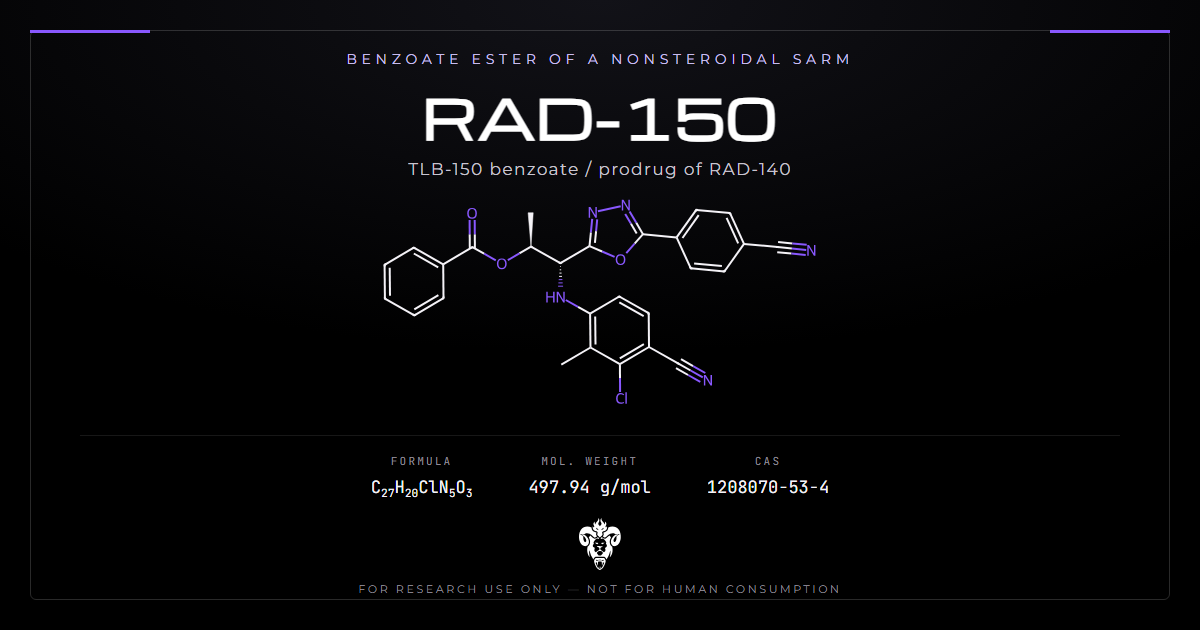
Search PubMed for this compound and you get nothing. Not a thin literature, not a single preclinical paper: nothing indexed describes the benzoate ester of RAD-140 under any of its designations.
RAD-150 is therefore an argument rather than a dataset. The argument runs that esterifying the 2-hydroxy position raises lipophilicity, that esterases then release the parent, and that the resulting exposure profile differs usefully. Each step is plausible. None has been measured for this molecule.
Two things make that gap worth an article instead of a shrug. The parent’s human half-life is already 44.7 hours, which leaves an ester very little to improve [2]. And ester hydrolysis is the least transferable measurement in pharmacokinetics. Species differences are largest in exactly the compartments a prodrug has to pass through [14][15].
Chemical identity
| Property | Value |
|---|---|
| Common names | RAD-150, TLB-150 benzoate |
| Molecular formula | C27H20ClN5O3 |
| Molecular weight | 497.94 g/mol |
| CAS | 1208070-53-4 |
| PubChem CID | 68547459 |
| InChIKey | NQUKIBBKKLFEQU-BXKMTCNYSA-N |
| Class | Benzoate ester of a benzonitrile-oxadiazole SARM |
| Configuration | (1R,2S) |
| Parent on hydrolysis | RAD-140 |
The catalogue carries it as RAD-150, alongside the parent RAD-140.
The name already belonged to something else
Ask PubChem for “RAD-150” and it returns CID 32771. That compound is 2-[5-chloropentyl(methyl)amino]-N-(2,6-dimethylphenyl)acetamide, CAS 29622-29-5, a xylidide haloalkylamine with no androgen activity whatsoever.
The claim is older than the SARM. Ross studied RAD 150 in 1975, following its cyclisation to a piperidinium species inside red blood cells [16]. A PubMed search on the designation returns that paper.
This is a sharper trap than a vendor name that resolves to nothing. A name that resolves to the wrong molecule gives a confident answer instead of an error. The ester’s own PubChem synonym list is more honest than the marketing. It carries “TLB 150 Benzoate”, the CAS number, “RAD150” unhyphenated, and “RAD-150” flagged with a question mark. Its provenance is example 87 of a patent rather than a publication. Verify on CAS 1208070-53-4 and InChIKey NQUKIBBKKLFEQU-BXKMTCNYSA-N.
There is an accident worth noticing in that 1975 paper. Ross was measuring how fast one chemical species converts into another inside blood. That is precisely the measurement the modern compound needs and has never received. He found the conversion much slower in plasma and whole blood than in buffer, and put the difference down to protein binding. Efflux of the cyclised product from rabbit erythrocytes ran at a half-life of 9 hours in vitro and 8 in vivo [16].
The lesson survives the coincidence of names. Conversion rates measured in a clean system overstate what happens in blood, and the size of that overstatement is compound-specific.
What the ester changes on paper
The benzoate sits on the propan-2-yl oxygen of the parent scaffold. Everything else is untouched: the chloro-methyl-benzonitrile aniline, the cyanophenyl oxadiazole, both stereocentres.
Adding a benzoyl group takes the molecule from 393.8 to 497.9 daltons and removes a hydrogen bond donor. Lipophilicity rises. That much follows from the structure, and it is where the published record stops. Nothing measures the partition coefficient, the hydrolysis rate, the enzyme responsible or the exposure that results.
One consequence is arithmetic and worth stating early. The parent accounts for 79.1% of the ester by mass. So a milligram of RAD-150 delivers at most 0.79 mg of RAD-140, and that is the ceiling under complete conversion. Any comparison quoted in milligrams of material rather than in moles is already off by a fifth. That error runs in the direction that flatters the ester, and it arrives before any pharmacology.
What exists, and what does not
| Question | RAD-150 | RAD-140 |
|---|---|---|
| Indexed papers | 0 | 43 |
| Receptor binding | Not measured | Ki 7 nM [1] |
| Animal pharmacokinetics | None | Rat and monkey [1] |
| Human pharmacokinetics | None | Phase 1, 22 patients [2] |
| Published metabolism | None | Horse, in vivo and in vitro [3] |
| Case reports | None | Six [8][9][10][11][12][13] |
| Hydrolysis to the parent | Assumed | Not applicable |
That last row is the whole compound. Conversion is the mechanism of action, and it sits in the assumed column.
The parent, and what its record actually says
Receptor and preclinical numbers
Miller and colleagues at Radius Health reported RAD-140 in 2011 [1]. Curated activities from that paper give an androgen receptor Ki of 7 nM, by displacement of fluorescent R1881. The progesterone receptor IC50 is 750 nM, roughly a hundredfold apart.
Oral bioavailability ran 27% in rat and 65% in monkey. Microsomal half-life exceeded two hours in rat, monkey and human alike. In cynomolgus monkeys dosed for 28 days, body weight rose about 10% at 0.1 mg/kg.
The phase 1 trial
LoRusso and colleagues ran the first human study, in 22 postmenopausal women with ER-positive HER2-negative metastatic breast cancer [2]. Doses were 50, 100 and 150 mg once daily, with 100 mg set as the maximum tolerated dose.
Target engagement was clear. Sex hormone binding globulin fell in 18 of 18 patients and prostate-specific antigen rose in 16 of 20. Clinical benefit at 24 weeks reached 18.2% and median progression-free survival was 2.3 months.
The tolerability line is the one that matters here. The three most frequent adverse events were raised AST at 59.1%, raised ALT at 45.5% and raised bilirubin at 27.3%. All three are liver tests. Grade 3 or 4 events occurred in 72.7% of patients, and events the investigators judged treatment-related in 77.3%. Half-life came out at 44.7 hours.
The case reports
Six published cases describe harm in people who took the parent outside a trial. Three are cardiac. They are acute myocarditis in a young man [8], myopericarditis in a 16-year-old boy after a first dose [9], and heart failure with a fatal outcome [10].
Three are hepatic, and all three are cholestatic. A 52-year-old man had biopsy-confirmed centrilobular canalicular cholestasis that resolved over three months [11]. A 24-year-old man reached a peak total bilirubin of 38.5 mg/dL after five weeks [12]. The most severe on record required plasmapheresis and intensive care, complicated by pancreatitis and acute kidney injury [13].
Esterification is a claim about pharmacokinetics
What a prodrug is normally for
Esters get added to fix specific defects. Short half-life, poor oral absorption, low solubility, a bad taste, a depot requirement. Each is a measurable problem with a measurable answer.
RAD-150 addresses none of the ones the parent has. Oral bioavailability in monkey was already 65% and microsomal stability already exceeded two hours [1]. No published source describes a formulation problem for the parent at all.
Forty-four hours is not a short half-life
The parent’s measured human half-life of 44.7 hours supported once-daily dosing in the phase 1 trial [2]. Testosterone esters exist because unmodified testosterone lasts minutes to hours. That gap is what an ester closes.
There is no comparable gap here. An ester of a compound already dosed once daily changes the shape of the exposure curve at best. The direction and size of that change are exactly what nobody has measured for RAD-150. A slower release could as easily blunt the peak as extend the tail, and those are different drugs.
Ester read-across is the least transferable kind
The whole compound rests on one inference: that esterases release RAD-140 in a useful way. Two studies show why that inference cannot be borrowed from a related molecule or a different species.
Species differences are largest in plasma
Nishimuta and colleagues put 11 prodrugs through hepatocytes, liver, intestinal and kidney fractions and plasma from human, monkey, dog and rat [15]. Their plasma finding is stark: hydrolysis of carboxylesterase substrates was evident only in rat.
So a rodent experiment on an ester tests a compartment humans do not share. Monkey hepatocytes came closest to human, and hepatocyte predictions still averaged only 20% of observed human hepatic intrinsic clearance.
The same ester behaves differently in each species
Fu and colleagues tracked one multiester prodrug across human, dog and rat [14]. Intestinal hydrolysis appeared in human and rat but not dog. The main liver metabolite differed between rat and the other two. Plasma conversion was minimal in human and dog and rapid in rat.
One molecule, three species, three different answers about where and how fast it converts. Their conclusion was that dog predicted human best while rat was useful for something else entirely. Picking the wrong model does not give a slightly wrong number for RAD-150; it gives a different mechanism.
The parent scaffold already hydrolyses
Two labile groups, not one
The clean version of a prodrug story has one cleavage step. Ester goes in, esterase cuts it, parent comes out. RAD-150 does not have that geometry.
So and colleagues list the prominent in vitro biotransformation routes for RAD-140 itself as hydrolysis, hydroxylation, glucuronidation and sulfation, in that order [3]. Hydrolysis leads the list for the unmodified parent, whose oxadiazole ring is the obvious candidate. So the ester adds a second hydrolysable feature to a molecule already carrying one.
That matters because two cleavage sites can be attacked in either order. Cutting the oxadiazole first gives a fragment that is no longer the parent and no longer the ester, and nothing published says which happens first or how often.
Why the binding assay is the decisive experiment
Everything above assumes RAD-150 is inert until converted. Nobody has tested that.
A single competition binding assay against the androgen receptor would settle it. If the intact ester binds, the compound is an analogue with its own pharmacology rather than a prodrug, and the entire conversion argument becomes secondary. If it does not bind, the conversion rate becomes the only thing that matters.
The experiment costs a day. Its absence is why every statement about this compound has to be conditional.
A lipophilicity claim has a published consequence
Increasing lipophilicity is the stated point of the modification, and it is the one property the structure guarantees moves. Skin permeation tracks it.
Korsmeier and colleagues applied 10 or 50 micrograms of RAD-140 to volunteers’ forearms [7]. They recovered the parent in the urine of all five subjects at the higher dose, for up to nine days. Their concern was trace dermal contamination producing adverse analytical findings.
Nothing extends that finding to RAD-150, and the direction of the open question is clear enough to state. A more lipophilic version of a compound that already crosses skin at microgram doses raises a handling question. The published record does not answer it. Gloves and containment are the ordinary response to an unanswered question of that shape.
The organ that converts it is the organ the record flags
Carboxylesterases sit at their highest concentration in the liver, with intestinal and plasma contributions that vary by species [14][15]. Hydrolysing an ester is hepatic work.
Set that beside the parent’s safety record. Raised transaminases were the most common adverse events in the trial, at 59.1% and 45.5% [2]. Every one of the three hepatic case reports describes cholestatic injury [11][12][13].
Nobody has studied whether routing the same molecule in through an ester changes that picture, in either direction. Stating that plainly is the honest position. An unstudied question is not a reassuring answer, and it is not an alarming one either.
Detection and analytical status
The parent has real detection windows
So and colleagues gave RAD-140 to three retired thoroughbred geldings [3]. Hydrolysis, hydroxylation, glucuronidation and sulfation were the prominent routes, with detection to six days in hydrolysed urine and 13 days in plasma. Cutler and colleagues found four equine in vitro metabolites [4].
Korsmeier and colleagues then showed how little exposure a finding needs [7]. They applied 10 or 50 micrograms to the forearms of volunteers. At 50 micrograms the parent appeared in the urine of all five subjects for up to nine days.
The ester is not a separate target
Thevis and colleagues published diagnostic ions for RAD-140 in 2013, including a fragment that forms through an unusually rare intramolecular silyl migration [5]. SARMs joined the prohibited list in 2008 and RAD-140 appears in the class detection reviews [6].
No indexed method describes RAD-150 itself. A laboratory working with it is either monitoring the parent after hydrolysis or developing its own transitions. Fragmentation figures quoted for the ester in trade material have no published source behind them.
What a study of RAD-150 would have to measure
| Measurement | Why it decides the compound | Status |
|---|---|---|
| Hydrolysis rate in human plasma | Distinguishes prodrug from inert ester | Not measured |
| Hydrolysis in human liver and intestinal fractions | Locates conversion, sets first-pass load | Not measured |
| Which esterase does it | Predicts variability between people | Not measured |
| Measured logP against the parent | Tests the lipophilicity claim | Not measured |
| Exposure curve for released parent | The only endpoint that matters | Not measured |
| Whether the intact ester binds the receptor | Determines if it is a prodrug at all | Not measured |
None of these needs a clinical trial. All six are ordinary bench experiments, and the last one is a single binding assay.
Where RAD-150 sits in the catalogue
The rest of this shelf has thin literatures for a shared reason: development stopped. S-23 has one preclinical paper, GSK-2881078 and LGD-2226 appear mainly in metabolism studies.
RAD-150 is a different case, and the difference is worth naming. Those compounds were characterised and then abandoned. This one was never characterised at all. It exists as a patent example and a product listing, which is why the honest comparison is with its own parent rather than with its shelf-mates. More on that molecule sits in the RAD-140 article.
Verifying research material
Batch documentation sits on the certificates of analysis page. Identity here is straightforward and stability is not.
Identity
Formula C27H20ClN5O3, molecular weight 497.94, CAS 1208070-53-4, InChIKey NQUKIBBKKLFEQU-BXKMTCNYSA-N. The mass difference from the parent is 104 daltons, and the single chlorine gives the usual M+2 isotope pattern.
Confirm the designation resolves before trusting a certificate. A document naming only “RAD-150” names a 1975 haloalkylamine as readily as this ester [16].
The ester is the labile part
An ester bond is the one feature of this molecule that can quietly disappear. Partial hydrolysis on the shelf converts material to the parent, and a purity figure by area percentage will not distinguish the two unless the method separates them.
Ask whether the analytical method resolves ester from parent, and whether the certificate reports both. That question matters more here than on any unmodified compound in the class.
Stereochemistry
The BXKMTCNYSA block encodes the (1R,2S) configuration, carried over unchanged from the parent scaffold. Mass spectrometry does not see it and hydrolysis does not create it.
Chiral chromatography against a characterised standard is the check. A certificate reporting purity alone has not addressed configuration at either centre.
Common questions about RAD-150
Is it stronger than RAD-140? No published measurement compares them. The ester has no reported receptor affinity of its own [1].
Does it convert to RAD-140? That is the design intention and no study has demonstrated it for this molecule. Species differences in ester hydrolysis are large enough that the question needs answering in the relevant system [14][15].
Why does the name return a different compound? “RAD 150” was published in 1975 for an unrelated haloalkylamine [16]. Use the CAS number and InChIKey.
Does it last longer than the parent? Unknown. The parent already has a 44.7-hour human half-life [2].
What is known about safety? Nothing directly. The parent’s trial reported liver enzyme elevations as its commonest adverse events, and six case reports describe cardiac and hepatic harm [2][8][9][10][11][12][13].
Is it detectable? The parent is, for days to weeks depending on matrix [3][7]. RAD-150 has no published method of its own.
Summary of the evidence
There is no evidence about this compound. That sentence is the finding, not an omission, and everything above is either the parent’s record or the general pharmacology of esters.
The parent is well documented and the documentation is not flattering. Its phase 1 trial returned grade 3 or 4 events in 72.7% of patients, with transaminase elevations at the top of the list, and six case reports followed [2][8][9][10][11][12][13]. Detection work on the parent is solid [3][4][5][6][7].
Two claims specific to RAD-150 deserve scepticism until measured. First, that the ester improves a compound already carrying a 44.7-hour half-life. Second, that hydrolysis behaviour can be assumed from any other molecule or species [14][15].
The transferable point is short. A prodrug’s central claim is a rate, and a rate is a number somebody has to measure. Naming an enzyme family is not the same as measuring its action on one substrate. More of this literature sits in the SARMs category.
Status: supplied for laboratory research use only.
References
- Miller CP, Shomali M, Lyttle CR, O’Dea LSL, Herendeen H, Gallacher K, Paquin D, Compton DR, Sahoo B, Kerrigan SA, Burge MS, Nickels M, Green JL, Katzenellenbogen JA, Tchesnokov A, Hattersley G. Design, synthesis, and preclinical characterization of the selective androgen receptor modulator (SARM) RAD140. ACS Med Chem Lett. 2011;2(2):124-129. PMID 24900290. DOI
- LoRusso P, Hamilton E, Ma C, Vidula N, Bagley RG, Troy S, Annett M, Yu Z, Conlan MG, Weise A. A first-in-human phase 1 study of a novel selective androgen receptor modulator (SARM), RAD140, in ER+/HER2- metastatic breast cancer. Clin Breast Cancer. 2022;22(1):67-77. PMID 34565686. DOI
- So YM, Wong JKY, Choi TLS, Prabhu A, Stewart B, Farrington AF, Robinson P, Wan TSM, Ho ENM. Metabolic studies of selective androgen receptor modulators RAD140 and S-23 in horses. Drug Test Anal. 2021;13(2):318-337. PMID 32853476. DOI
- Cutler C, Viljanto M, Taylor P, Hincks P, Biddle S, Van Eenoo P. Identification of equine in vitro metabolites of seven non-steroidal selective androgen receptor modulators for doping control purposes. Drug Test Anal. 2022;14(2):349-370. PMID 34714606. DOI
- Thevis M, Piper T, Beuck S, Geyer H, Schänzer W. Expanding sports drug testing assays: mass spectrometric characterization of the selective androgen receptor modulator drug candidates RAD140 and ACP-105. Rapid Commun Mass Spectrom. 2013;27(11):1173-1182. PMID 23650030. DOI
- Thevis M, Schänzer W. Detection of SARMs in doping control analysis. Mol Cell Endocrinol. 2017;464:34-45. PMID 28137616. DOI
- Korsmeier L, Krombholz S, Alhalabi H, Thomas A, Thevis M. Exploring transdermal SARMs exposure: analysis of the elimination profiles and metabolism for doping control purposes. J Anal Toxicol. 2025;49(9):681-690. PMID 40632609. DOI
- Padappayil RP, Chandini Arjun A, Vivar Acosta J, Ghali W, Mughal MS. Acute myocarditis from the use of selective androgen receptor modulator (SARM) RAD-140 (testolone). Cureus. 2022;14(1):e21663. PMID 35233331. DOI
- Schwartzman KH, Kohli U, Chaudhuri NR, Hoda M. Myopericarditis following use of selective androgen receptor modifier “RAD-140”. JACC Case Rep. 2024;29(15):102423. PMID 39157568. DOI
- Skorupski WJ, Marko A, Janus M, Skorupska K, Lesiak M, Klotzka A. Selective androgen receptor modulator abuse-induced heart failure: catastrophic effects of RAD-140 (testolone). Pol Arch Intern Med. 2024;134(7-8):16770. PMID 38864168. DOI
- Barbara M, Dhingra S, Mindikoglu AL. Drug-induced liver injury associated with Alpha Bolic (RAD-140) and Alpha Elite (RAD-140 and LGD-4033). ACG Case Rep J. 2020;7(6):e00409. PMID 33062783. DOI
- Leung K, Yaramada P, Goyal P, Cai CX, Thung I, Hammami MB. RAD-140 drug-induced liver injury. Ochsner J. 2022;22(4):361-365. PMID 36561105. DOI
- Dao D, King B, Dao H, Bahirwani R. Unregulated gains: a case of RAD-140-induced liver injury. Proc (Bayl Univ Med Cent). 2026;1-3. PMID 42417499. DOI
- Fu J, Pacyniak E, Leed MGD, Sadgrove MP, Marson L, Jay M. Interspecies differences in the metabolism of a multiester prodrug by carboxylesterases. J Pharm Sci. 2016;105(2):989-995. PMID 26344572. DOI
- Nishimuta H, Houston JB, Galetin A. Hepatic, intestinal, renal, and plasma hydrolysis of prodrugs in human, cynomolgus monkey, dog, and rat: implications for in vitro-in vivo extrapolation of clearance of prodrugs. Drug Metab Dispos. 2014;42(9):1522-1531. PMID 24994071. DOI
- Ross SB. Pharmacokinetics of haloalkylamines: cyclization and distribution in blood in vitro and in vivo. J Pharm Pharmacol. 1975;27(5):322-328. PMID 239132. DOI
RAD-150 is sold for laboratory research use only. Not for human consumption, nor medical, veterinary, or household uses.
Literature retrieved from PubMed.