
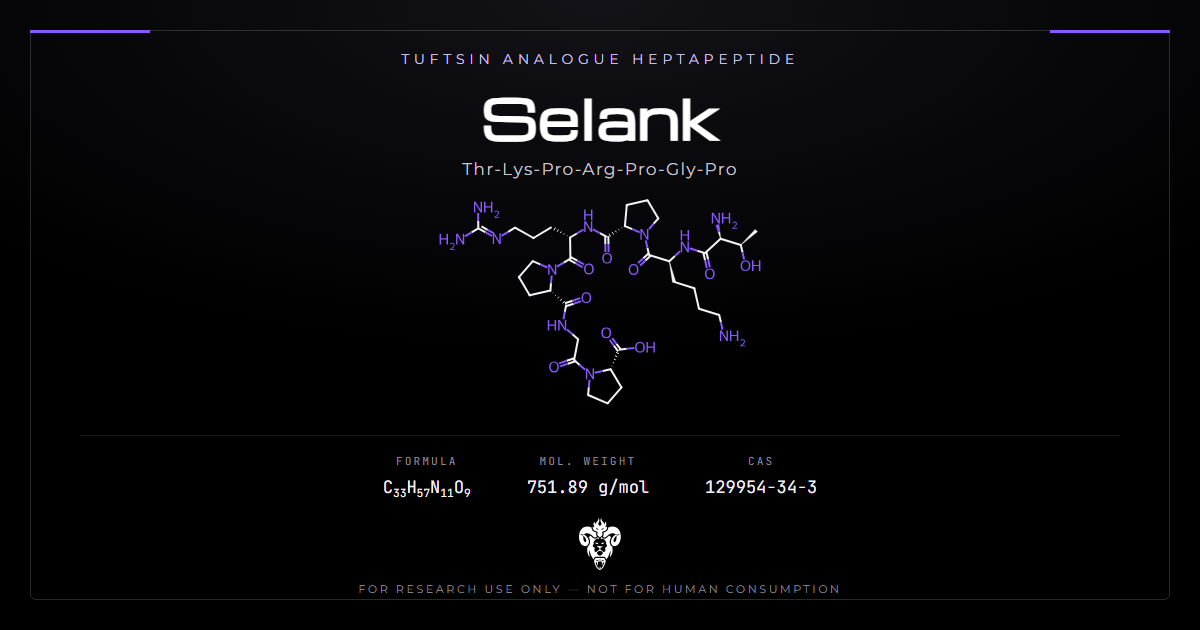
Selank gets described as a GABAergic anxiolytic that works like a benzodiazepine without the drawbacks. That description comes from real experiments, and the experiments are more interesting than the summary.
One study found the peptide altering 45 of 84 neurotransmission genes in rat frontal cortex within an hour [5]. The same group, a year later, gave it to a neuroblastoma cell line and found no change in any of them [7].
Both results are correct. Read together they say something specific about how this peptide works, and it is not the simple story.
Chemical identity
A heptapeptide built from a natural immune peptide with three residues added to the C-terminus.
| Property | Value |
|---|---|
| Sequence | Thr-Lys-Pro-Arg-Pro-Gly-Pro |
| Common names | Selank, TP-7 |
| Molecular formula | C33H57N11O9 |
| Average mass | 751.9 g/mol |
| Monoisotopic mass | 751.4341 Da |
| CAS number | 129954-34-3 |
| PubChem CID | 11765600 |
| InChIKey | JTDTXGMXNXBGBZ-YVHUGQOKSA-N |
| Residues | 7 |
| Stereocentres | 10 |
| Parent peptide | Tuftsin, Thr-Lys-Pro-Arg |
| Origin | Institute of Molecular Genetics, Russian Academy of Sciences |
Reading the sequence
Three prolines in seven residues is unusual, and it is the point.
Proline breaks regular secondary structure and resists many peptidases, so a proline-rich stretch acts as a protective cap. The first four residues carry the biological heritage, and the last three carry the stability.
Threonine, lysine and arginine give the molecule a strongly basic character. Selank carries a net positive charge at physiological pH, which matters for how it behaves in solution and on ion exchange.
The Pro-Gly-Pro tail
The C-terminal tripeptide is a design element rather than an accident, and it belongs to a family the same institute has used repeatedly.
Glyprolines, short proline-glycine peptides, occur endogenously and carry their own activity. Kolomin and colleagues tested the Gly-Pro dipeptide alongside the full heptapeptide on inflammation-related gene expression in mouse spleen [4]. The fragment reproduced most of the parent’s effects, including a threefold fall in complement C3 messenger RNA within 30 minutes.
That result cuts both ways. It supports the tail carrying real activity rather than only stability. It also means an experiment on the intact peptide may partly be an experiment on its fragment.
Tuftsin, the parent peptide
Tuftsin is Thr-Lys-Pro-Arg, a tetrapeptide released from the heavy chain of immunoglobulin G.
It stimulates phagocytosis and carries immunomodulatory activity, which is where this whole line of work started. The peptide is endogenous, short-lived and immunological rather than neurological in its original description.
Selank keeps that sequence intact and extends it. So the compound arrives carrying an immune pedigree, and the immune effects persist in the literature alongside the behavioural ones [4].
Anyone reading the anxiolytic work should hold that in view. The molecule was not designed from a receptor model of anxiety. It was built by stabilising an immune peptide, and the behavioural findings came afterwards.
The design pattern shared with Semax
Selank has a sibling from the same institute, and comparing them shows the method.
Semax is Met-Glu-His-Phe-Pro-Gly-Pro [1]. The first four residues are ACTH(4-7), a fragment of adrenocorticotropic hormone. The last three are the same Pro-Gly-Pro.
So both compounds follow one recipe: take a short natural peptide with known activity, bolt on Pro-Gly-Pro, and test the result. That approach explains the family resemblance in their reported effects and their shared inhibition of the same enzymes [1].
It also sets a limit on inference. Findings on one do not transfer to the other, because the biologically active halves come from unrelated peptides.
What the GABA claim rests on
Two studies from the same laboratory, and the tension between them is where the mechanism lives.
The in vivo gene expression study
Volkova and colleagues gave rats Selank or GABA at 300 µg/kg and measured 84 neurotransmission genes in frontal cortex (PMID 26924987).
At one hour, 45 genes had changed expression. By three hours, 22 had. Critically, the changes produced by Selank correlated positively with those produced by GABA itself [5].
The authors read that as allosteric modulation of the GABAergic system. That reading is the origin of the benzodiazepine comparison which follows this compound around.
The cell line study that found nothing
Filatova and colleagues then ran the equivalent experiment in cultured IMR-32 neuroblastoma cells [7].
Selank alone changed no messenger RNA levels among the genes examined. None.
The combination result is the informative part. When given with GABA, the peptide nearly abolished the expression changes that GABA produced on its own. Applied with olanzapine instead, it increased the number of genes whose expression shifted.
Reading the pair
Consider what that combination means. A compound does nothing alone in cells, alters the effect of GABA when combined, and moves 45 genes in an intact cortex. That pattern locates where it acts.
The straightforward reading has two parts. Selank works on the interaction between GABA and its receptors rather than on transcription directly. The in vivo result then depends on circuitry or cell types that a neuroblastoma line does not have.
The authors put it carefully, saying their data partially confirm that the peptide may affect the interaction of GABA with its receptors [7]. That is a narrower claim than “GABAergic anxiolytic”, and it is the claim the evidence supports.
Nobody has published direct binding data placing this peptide at the benzodiazepine site or any other site on the receptor. The mechanism remains inferred from expression and behaviour.
The enkephalinase route
A second mechanism has better-defined pharmacology and gets less attention.
Kost and colleagues measured the effect of both heptapeptides on enkephalin-degrading enzymes in human serum (PMID 11443939). Selank inhibited them with an IC50 near 20 µM, and Semax near 10 µM [1].
Put that against the reference inhibitor. Puromycin in the same assay gave an IC50 near 10 mM, so the peptides were roughly three orders of magnitude more potent.
Structure-activity data came with it. The pentapeptide fragments retained inhibitory activity while the tri-, tetra- and hexapeptide fragments did not, which locates the activity rather than assuming it.
Slowing enkephalin breakdown raises endogenous opioid tone, and that prediction shows up in the behavioural work. Kolik and colleagues describe Selank as enhancing endogenous opioid system activity [6]. It prevented ethanol-induced hyperlocomotion in mice, much as the opioid antagonist naloxone did.
The animal behavioural literature
Most of the evidence base sits here, in rodents, from a small number of Russian institutes.
| Study | Model | Dose | Finding |
|---|---|---|---|
| Kolik 2016 [6] | Ethanol hyperlocomotion, mice | 0.3 mg/kg | Blocked sensitisation expression, not its formation |
| Fomenko 2019 [8] | Foot-shock stress, rat liver | 100-1000 µg/kg | Reduced degenerative change; best at 300 µg/kg |
| Kolik 2019 [9] | Chronic ethanol, rat memory | 0.3 mg/kg, 7 days | Prevented memory deficit; altered BDNF |
| Panikratova 2020 [10] | Resting-state fMRI, humans | Single dose | Changed amygdala connectivity |
| Konstantinopolsky 2022 [11] | Morphine withdrawal, rats | 0.3 mg/kg | Withdrawal index down 39.6% |
Ethanol and opioid models
Kolik and colleagues found a single dose blocked the expression of ethanol-induced behavioural sensitisation without preventing its formation [6]. That distinction matters, since it separates an effect on the machinery of sensitisation from an effect on its display.
The morphine withdrawal work gives the clearest comparison to a standard drug. Konstantinopolsky and colleagues cut the total withdrawal index by 39.6 percent using 0.3 mg/kg of the peptide [11]. Diazepam at 2 mg/kg cut it by 49.3 percent. Tactile sensitivity threshold rose ninefold on the peptide and thirteenfold on diazepam.
Slightly inferior to a benzodiazepine on a benzodiazepine-responsive model is a fair summary, and the authors report it that way.
BDNF and memory
Kolik and colleagues gave rats ethanol as their only fluid for 30 weeks, then tested object recognition [9].
The peptide prevented the memory and attention deficits appearing during withdrawal, and produced a cognitive effect in older rats never exposed to ethanol.
The BDNF result needs stating precisely, because it is easy to get backwards. Chronic ethanol raised BDNF in hippocampus and frontal cortex, and Selank prevented that rise. The peptide normalised an elevated neurotrophin rather than increasing a low one.
Effects outside the brain
The immune pedigree shows in the range of models. Selank and its metabolites reduced lesion area across three experimental gastric ulcer models [3]. Proline-containing peptides of this family also carry documented anticoagulant activity [2].
Fomenko and colleagues found it limiting stress-induced hepatocyte damage, with the largest effect at an intermediate dose rather than the highest [8]. Non-monotonic dose responses recur in this literature and complicate any simple dosing argument.
How to read a study of this compound
Four questions decide whether a Selank paper tells you anything transferable.
Intact peptide or fragment? Gly-Pro reproduces much of the effect of the parent on inflammation genes [4], so a result on the heptapeptide may belong to a metabolite. Studies testing both are worth more than studies testing one.
In vivo or in vitro? The gene expression work splits exactly on this line, with 45 genes moving in cortex and none in a cell line [5][7]. Anything requiring intact circuitry will vanish in culture.
Which dose? The behavioural work clusters at 0.3 mg/kg [6][9][11], while the liver study found its largest effect at 300 micrograms per kg and less at 1000 [8]. Non-monotonic responses mean a higher dose is not a stronger test.
Compared against what? Diazepam appears as the active comparator in the withdrawal model [11] and naloxone in the ethanol model [6]. A study with no active comparator cannot place the peptide against anything.
The one human imaging study
Panikratova and colleagues ran resting-state functional MRI in 52 healthy participants, comparing Selank, Semax and placebo (PMID 32342318).
Scans ran before dosing and at 5 and 20 minutes after. The regions of interest were amygdala and dorsolateral prefrontal cortex in both hemispheres.
Differences appeared in connectivity between right amygdala and a right-hemisphere region spanning fusiform, inferior and middle temporal and parahippocampal gyri [10]. The authors describe both shared and distinct effects for the two peptides, and present the finding as a first observation.
This is the strongest human evidence available, and it measures brain connectivity rather than symptoms. A change in a functional connectivity map is not a clinical outcome.
Where the compound sits among anxiolytics
Placing this peptide against the drugs it gets compared to clarifies what is and is not claimed.
Benzodiazepines bind a defined allosteric site on the GABA-A receptor, and their pharmacology is characterised down to subunit composition. Selank has no such description. What exists is a correlation between its gene expression signature and that of GABA itself [5], plus evidence that it modifies what GABA does in cells without doing anything alone [7].
The behavioural comparison lands in the same place. On the one model where both were tested head to head, the peptide reached roughly four fifths of diazepam’s effect at a much lower dose [11].
Two features do separate it from the benzodiazepine class in the animal work. It blocked the expression of ethanol sensitisation without preventing its formation [6], which a sedative would not be expected to do selectively. And its enzyme inhibition profile points at endogenous opioid tone rather than at GABA at all [1].
Those are mechanistic differences in animals, not a safety claim. Nobody has run the comparative human work that would justify one.
What the record does not establish
No controlled trial evidence exists in the accessible literature. A 2026 review of therapeutic peptides lists selank among the neuroactive ones. It states plainly that clinical trials are lacking across the whole class [12].
The evidence base is also geographically concentrated. Nearly all of it comes from a small number of Russian institutes, much of it in one journal. Independent replication outside those groups is scarce.
The receptor question stays open. No binding study places this peptide at a defined site. The GABAergic mechanism rests on gene expression and behaviour rather than on pharmacology [5][7].
Attribution between the peptide and its fragments is unresolved. Gly-Pro reproduced most of the parent’s effect on inflammation genes [4], so results on the intact molecule may reflect a metabolite.
Human pharmacokinetics are not described in the accessible literature. Nobody has published a plasma profile, a half-life or a bioavailability figure for any route, which makes dose translation from rodent studies guesswork.
Verifying research material
A basic heptapeptide with three prolines and no cysteine is easier to handle than most peptides, and the checks are correspondingly simple.
Identity
Average mass is 751.9 and monoisotopic mass 751.4341. Mass spectrometry resolves that without difficulty, and the peptide is short enough for full sequence confirmation by tandem MS.
With no cysteine there is no disulfide to scramble and no free thiol to oxidise, which removes the failure modes that dominate larger peptides. Ten stereocentres mean chromatographic identity rather than optical rotation is the practical check.
Deletion sequences are the impurity to ask about. A missing residue shifts the mass by exactly that residue. Three prolines make coupling harder than average, so proline deletions are the plausible ones.
Purity and content
Peptide content deserves separate attention from chromatographic purity. Lyophilised material carries counterions and water, so a lot at 98 percent purity by HPLC may be substantially less peptide by mass.
The strongly basic residues mean the counterion is usually acetate or trifluoroacetate left from purification. Residual trifluoroacetate is worth asking about, since it carries its own biological activity in cell work and can confound a low-concentration experiment.
Handling
The peptide is strongly basic and water-soluble. Lyophilised material should be stored cold and dry, reconstituted immediately before use, and kept cold in solution.
Peptidases in any biological matrix will still act on it despite the proline cap, so incubations in serum-containing media should assume ongoing degradation. Given that Gly-Pro carries its own activity [4], degradation here does not simply mean loss of signal. It means a shift toward a different active species.
That has a practical consequence for experimental design. A time course in serum measures a moving mixture rather than one compound, so anyone comparing early and late timepoints should treat the difference as compositional rather than purely kinetic.
Repeated freeze-thaw is the other avoidable loss. Aliquot on reconstitution to single-use volumes, since a basic heptapeptide adsorbs to plastic at low concentrations and each cycle costs more material than the concentration alone suggests.
Kimera publishes third-party certificates of analysis for every lot in its COA database. Laboratories source Selank as a tuftsin analogue and glyproline reference. It appears alongside noopept, where proline-glycine chemistry is the shared theme, or with ipamorelin and IGF-1 LR3 where a different peptide class is the comparator. Related work appears in the peptides category.
Common questions about Selank
What is Selank made from? Tuftsin, the immunoglobulin-derived tetrapeptide Thr-Lys-Pro-Arg, extended with Pro-Gly-Pro to give a seven-residue sequence [1].
Does it work through GABA receptors? The evidence supports an effect on the interaction between GABA and its receptors rather than direct action. It changed 45 neurotransmission genes in rat cortex [5] and none in a neuroblastoma line, while altering GABA’s own effects there [7]. No binding study has been published.
What is the best-characterised mechanism? Inhibition of enkephalin-degrading enzymes, with an IC50 near 20 µM in human serum and defined fragment activity [1].
How does it compare with a benzodiazepine? On morphine withdrawal in rats it cut the withdrawal index 39.6 percent, against 49.3 percent for diazepam [11]. Slightly less effective, on that model.
Is there human evidence? One resting-state fMRI study in 52 healthy participants found altered amygdala connectivity [10]. A 2026 review notes the absence of clinical trials across this peptide class [12].
Why does the Gly-Pro fragment matter? It reproduced most of the effect of the parent peptide on inflammation gene expression [4]. So the intact molecule may not be the only active species.
Does it raise BDNF? Not straightforwardly. In chronically ethanol-exposed rats it prevented an ethanol-induced rise in BDNF rather than increasing it [9].
Summary of the evidence
Identity: Thr-Lys-Pro-Arg-Pro-Gly-Pro, C33H57N11O9, 751.9 g/mol, CAS 129954-34-3. Tuftsin with a Pro-Gly-Pro extension, from the Institute of Molecular Genetics.
Design: the same Pro-Gly-Pro recipe produced Semax from ACTH(4-7), so the two peptides share a tail and nothing biologically active [1].
GABAergic evidence: 45 of 84 neurotransmission genes altered in rat frontal cortex, correlating with GABA’s own effects [5]. No direct effect in IMR-32 cells, yet near-complete suppression of GABA’s effects when combined [7].
Enzyme inhibition: enkephalin-degrading enzymes inhibited at IC50 near 20 µM, roughly a thousandfold below puromycin, with activity localised to the pentapeptide fragments [1].
Behaviour: blocked ethanol sensitisation expression [6]. Cut the morphine withdrawal index by 39.6 percent against 49.3 for diazepam [11], and prevented ethanol-associated memory deficits while normalising raised BDNF [9].
Human data: one resting-state fMRI study, 52 participants, altered right amygdala connectivity [10]. No clinical trials [12].
Limits: evidence concentrated in a few Russian institutes, with no binding data and no published human pharmacokinetics. Attribution between the peptide and its Gly-Pro fragment stays unresolved [4].
Status: supplied for laboratory research use only.
References
- Kost NV, Sokolov OYu, Gabaeva MV, et al. Semax and Selank inhibit the enkephalin-degrading enzymes from human serum. Bioorg Khim. 2001;27(3):180-183. PMID 11443939. DOI
- Liapina LA, Pastorova VE, Obergan TYu, Samonina GE, Ashmarin IP, Myasoedov NF. Comparison of anticoagulant effects of regulatory proline-containing oligopeptides: specificity of glyprolines, Semax, and Selank and potential of their practical application. Izv Akad Nauk Ser Biol. 2006;(2):193-203. PMID 16634437.
- Pavlov TS, Samonina GE, Bakaeva ZV, Zolotarev YuA, Guseva AA. Selank and its metabolites maintain homeostasis in the gastric mucosa. Bull Exp Biol Med. 2007;143(1):51-53. PMID 18019011. DOI
- Kolomin T, Morozova M, Volkova A, et al. The temporary dynamics of inflammation-related genes expression under tuftsin analog Selank action. Mol Immunol. 2014;58(1):50-55. PMID 24291245. DOI
- Volkova A, Shadrina M, Kolomin T, et al. Selank administration affects the expression of some genes involved in GABAergic neurotransmission. Front Pharmacol. 2016;7:31. PMID 26924987. DOI
- Kolik LG, Nadorova AV, Seredenin SB. Selank inhibits ethanol-induced hyperlocomotion and manifestation of behavioral sensitization in DBA/2 mice. Bull Exp Biol Med. 2016;162(1):56-59. PMID 27878720. DOI
- Filatova E, Kasian A, Kolomin T, et al. GABA, Selank, and olanzapine affect the expression of genes involved in GABAergic neurotransmission in IMR-32 cells. Front Pharmacol. 2017;8:89. PMID 28293190. DOI
- Fomenko EV, Bobyntsev II, Ivanov AV, Belykh AE, Andreeva LA, Myasoedov NF. Effect of Selank on morphological parameters of rat liver in chronic foot-shock stress. Bull Exp Biol Med. 2019;167(2):293-296. PMID 31243679. DOI
- Kolik LG, Nadorova AV, Antipova TA, Kruglov SV, Kudrin VS, Durnev AD. Selank, peptide analogue of tuftsin, protects against ethanol-induced memory impairment by regulating of BDNF content in the hippocampus and prefrontal cortex in rats. Bull Exp Biol Med. 2019;167(5):641-644. PMID 31625062. DOI
- Panikratova YaR, Lebedeva IS, Sokolov OYu, et al. Functional connectomic approach to studying Selank and Semax effects. Dokl Biol Sci. 2020;490(1):9-11. PMID 32342318. DOI
- Konstantinopolsky MA, Chernyakova IV, Kolik LG. Selank, a peptide analog of tuftsin, attenuates aversive signs of morphine withdrawal in rats. Bull Exp Biol Med. 2022;173(6):730-733. PMID 36322304. DOI
- Rahman OF, Lee SJ, Seeds WA. Therapeutic peptides in orthopaedics: applications, challenges, and future directions. J Am Acad Orthop Surg Glob Res Rev. 2026;10(1). PMID 41490200. DOI
Selank is sold for laboratory research use only. Not for human consumption, nor medical, veterinary, or household uses.
Literature retrieved from PubMed.