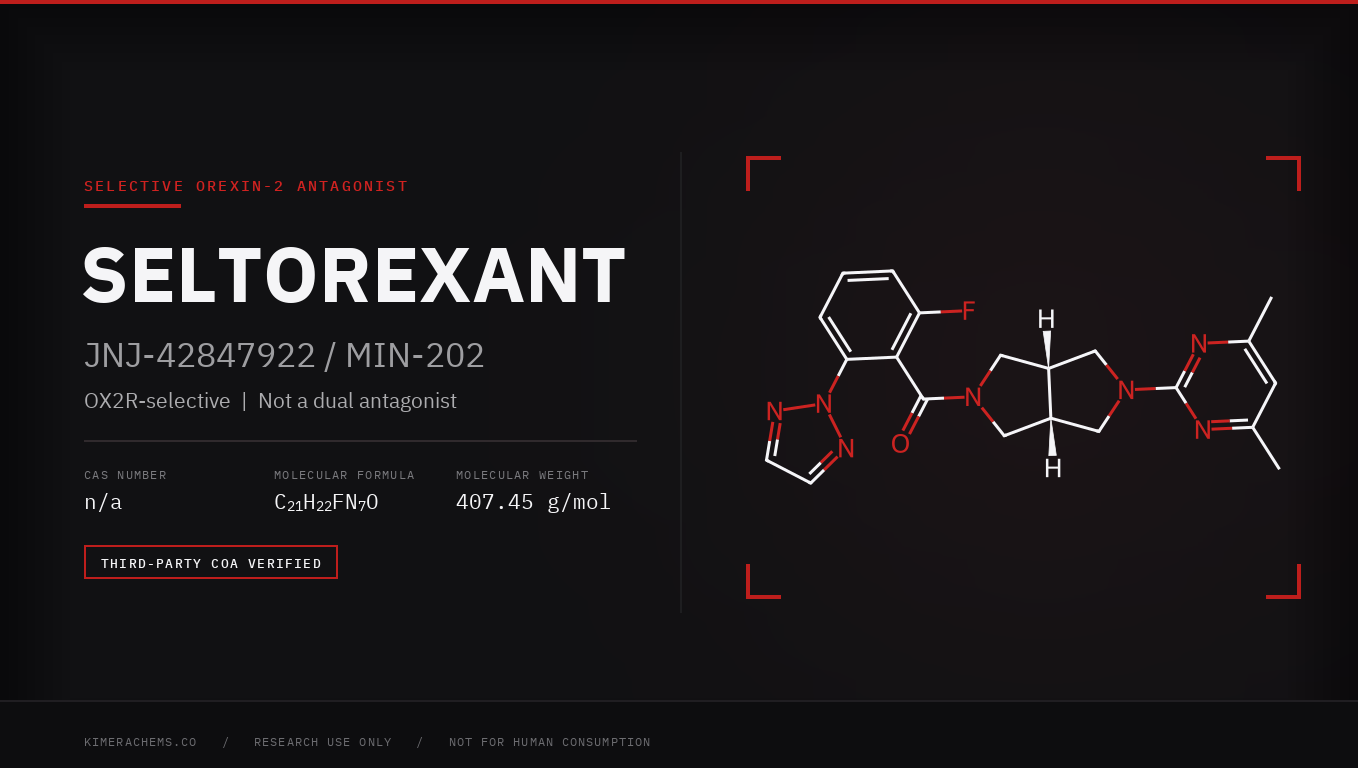
Orexin signals through two receptors. Every orexin antagonist that has reached market blocks both of them. Seltorexant blocks one.
That is the entire premise of the compound. It makes seltorexant the tool for testing a specific hypothesis. The orexin-2 receptor may carry most of the arousal signal, so blocking it alone should separate the sleep effect from whatever the orexin-1 receptor contributes.
The evidence base has moved considerably. A dose-finding polysomnography trial in 364 participants compared seltorexant against both placebo and zolpidem, an established hypnotic. It reported advantages over both at two weeks [10]. Separately, the compound has produced antidepressant signals in phase 2 and phase 3 programmes [12].
What follows covers five areas: the chemistry, the receptor biology behind the selectivity argument, human pharmacokinetics, the insomnia and depression records with their limitations, and how a laboratory verifies the material.
Chemical identity: what you are actually handling
Seltorexant is a bridged bicyclic diamine carrying two distinct heterocycles.
| Property | Value |
|---|---|
| IUPAC name | [(3aS,6aR)-2-(4,6-dimethylpyrimidin-2-yl)-1,3,3a,4,6,6a-hexahydropyrrolo[3,4-c]pyrrol-5-yl]-[2-fluoro-6-(triazol-2-yl)phenyl]methanone |
| Synonyms | JNJ-42847922, MIN-202 |
| Molecular formula | C21H22FN7O |
| Molecular weight | 407.45 g/mol |
| PubChem CID | 86278359 |
| InChIKey | SQOCEMCKYDVLMM-IYBDPMFKSA-N |
| Stereocentres | Two, at the ring fusion |
| Molecular target | Orexin-2 receptor (OX2R) |
| Originator | Janssen |
The bicyclic core and its two heterocycles
The scaffold is a hexahydropyrrolo[3,4-c]pyrrole, a fused bicyclic diamine with a nitrogen at each end. One nitrogen carries a dimethylpyrimidine. The other carries an aroyl group whose aryl ring bears both a fluorine and a 2H-triazole.
Seven nitrogens across a pyrimidine, a triazole and two ring nitrogens make this a nitrogen-rich molecule. That composition is analytically useful, as the section on characterisation explains.
Three names, one compound
Three designations appear in the literature, sometimes within a single paper. Seltorexant is the international nonproprietary name. JNJ-42847922 is the Janssen development code. MIN-202 is the Minerva code from the co-development period.
Anyone searching the literature needs all three. A search on one name alone will miss a substantial fraction of the record.
The orexin system and what Seltorexant selectivity means
Orexin-A and orexin-B are neuropeptides regulating wakefulness, arousal, appetite, the stress response, and reward processing [8].
They act through two G-protein coupled receptors. The orexin-1 receptor binds orexin-A preferentially. The orexin-2 receptor binds both peptides.
The selectivity hypothesis
Approved agents in this class are dual antagonists, blocking both subtypes. Suvorexant, lemborexant and daridorexant all work this way [7].
The argument for selectivity runs as follows. Suppose the orexin-2 receptor carries most of the arousal-promoting signal. Blocking it alone should then deliver the sleep effect while leaving orexin-1 signalling intact. Whatever the orexin-1 receptor contributes to appetite, stress or reward would remain untouched.
That is a hypothesis about division of labour between two receptors. A subtype-selective compound is the instrument for testing it. Whether the separation delivers a clinical advantage is a separate question, and the trials below bear on it only partially.
The medicinal chemistry effort behind selective orexin-2 antagonists continues. Seltorexant serves as the benchmark against which newer candidates are measured in rodent sleep models [9].
Human pharmacokinetics and pharmacodynamics
Van der Ark and colleagues characterised the compound in healthy subjects across five cohorts. Dosing ran from 5 to 60 mg once daily for ten days. Plasma and urine sampling covered 24 hours on days 1, 5 and 10 [6].
Absorption is rapid. Median time to peak concentration ranged from 0.5 to 1.5 hours. The mean half-life fell between 2 and 3 hours [6].
That short half-life is a design feature rather than an oversight. A hypnotic with a long half-life produces residual daytime effects. The study assessed vigilance, sedation and alertness at four, six and eight hours after dosing [6].
Two findings shape how the compound behaves at higher doses. Peak concentration and area under the curve both rose less than dose proportionally from 20 mg upward [6]. Somnolence appeared consistently from 20 mg upward on all study days [6].
One mild decrease in attention appeared above 10 mg at four hours post-dose. Beyond that, the study found no clinically relevant changes in other central measures [6].
The insomnia record
Human sleep work with this compound rests on polysomnography rather than self-report. That is why the record is worth reading closely.
The early crossover studies
De Boer and colleagues ran a randomised two-way crossover phase 2 study in individuals with insomnia and no psychiatric comorbidity. Subjects received seltorexant for five days in one period and placebo in the other. Polysomnography ran over eight hours after single and multiple doses [2].
Twenty-seven subjects completed. Sleep efficiency improved against placebo at both single and multiple dose timepoints. Total sleep time lengthened, latency to persistent sleep shortened, and wake after sleep onset fell. Headache and somnolence were the most common adverse events [2].
The dose-finding trial against zolpidem
The largest and most informative study appeared much later, and it changes the picture.
Mesens and colleagues ran a randomised, double-blind, active- and placebo-controlled dose-finding polysomnography study across 55 sites in six countries. It enrolled adults and older adults with an Insomnia Severity Index score of 15 or above and no psychiatric comorbidity [10].
The design matters. Five arms ran for 14 nights: seltorexant at 5, 10 or 20 mg, placebo, or zolpidem at 5 to 10 mg [10]. An active comparator arm turns a placebo-controlled result into a positional one.
In total 364 participants received treatment, with a mean age of 57.8 years [10]. Two endpoints led. Latency to persistent sleep, and wake after sleep onset over the first six hours.
The night 1 dose-response relationship reached significance for both endpoints across all four prespecified models. Seltorexant at 10 mg and 20 mg improved latency to persistent sleep against placebo. The 20 mg dose also improved it against zolpidem [10].
The two-week results are the more interesting part. Improvements at 10 mg and 20 mg held at night 13, while the zolpidem effect diminished [10].
Against zolpidem on night 13, seltorexant improved latency to persistent sleep by 30 percent at 10 mg and 28 percent at 20 mg. The 20 mg dose improved wake after sleep onset by 31 percent [10].
Tolerability ran in an unexpected direction. Treatment-emergent adverse events occurred in 33.8 percent of participants across the combined seltorexant doses. Placebo ran at 49.3 percent and zolpidem at 42.5 percent [10].
A lower adverse event rate on active drug than on placebo is unusual. It invites scrutiny rather than acceptance. Commentators have flagged exactly that point, alongside the observation that effects appeared to diminish with time at some doses [11].
The depression record
The compound was originally developed against depression rather than insomnia, and that record runs in parallel.
The diphenhydramine control
One study design deserves particular attention, because it addresses the obvious objection to any sedating antidepressant.
Recourt and colleagues enrolled 47 patients with major depressive disorder into a randomised, double-blind, diphenhydramine- and placebo-controlled multicentre study [5].
Diphenhydramine is a sedating antihistamine. Including it as an active control tests whether any antidepressant signal simply reflects improved sleep from sedation.
Ten days of seltorexant produced significant improvement in core depressive symptoms against placebo. The effect held through 28 days of continued treatment. Diphenhydramine was not efficacious [5].
The authors reported one further detail. Seltorexant affected core depressive symptoms without overt changes in the hypnogram. EEG power rose overall, with a relative increase in delta power and decreases in theta, alpha and beta power during stage 2 sleep [5].
Taken together, that pattern carries weight. A sedating comparator failed where seltorexant succeeded, which is the strongest available argument against reading the antidepressant signal as a sleep effect.
The larger depression trials
Brooks and colleagues studied 20 patients with major depressive disorder who remained insomniac on antidepressants. The design was a double-blind four-way crossover with three doses and placebo, washing out seven days between periods [1].
Latency to persistent sleep shortened significantly at all three doses against placebo, with the ratio falling as low as 0.15. Total sleep time and sleep efficiency both improved. A trend toward subjective mood improvement appeared at the highest dose [1].
Savitz and colleagues then ran a phase 2b adaptive dose-finding study. Patients had responded inadequately to one to three prior antidepressants, and were randomised to placebo or seltorexant alongside their existing treatment [3].
The 20 mg group showed greater improvement in depression rating scores than placebo at week 3. The week 6 difference was weaker. Stratifying by baseline insomnia severity, the week 6 improvement was larger in the group with more severe baseline insomnia [3].
That stratification result cuts both ways, and commentary at the time framed it as evidence that orexin-2 antagonists may be most useful precisely where insomnia is a prominent feature [4].
How the class record reads overall
A sober assessment is warranted. Fagan and colleagues reviewed orexin receptor antagonists in depression. They counted four published randomised controlled trials against placebo in major depressive disorder, of which only one showed a statistically significant difference [8].
More recent narrative review reports significant antidepressant effects for seltorexant in both phase 2 and phase 3 trials. It also notes that at least one further unequivocally positive pivotal study would be needed for regulatory approval in the United States [12].
The compound holds no marketing approval in any jurisdiction.
Where the class stands
| Compound | Selectivity | Status |
|---|---|---|
| Suvorexant | Dual (OX1R and OX2R) | Approved for insomnia |
| Lemborexant | Dual | Approved for insomnia |
| Daridorexant | Dual | Approved for insomnia |
| Seltorexant | Orexin-2 selective | Investigational, phase 3 in depression |
| Filorexant | Dual | Investigational, trialled in depression |
Reviews of the class note one shared property. Orexin receptor antagonists appear to lack the dependence- and tolerance-inducing effects of traditional hypnotics, which makes them candidates for long-term use [7].
One comparison remains missing. No published trial has run seltorexant head-to-head against a dual antagonist. That is the study the selectivity hypothesis actually requires. The zolpidem comparison, useful as it is, does not substitute for it.
Imaging and transporter interaction
A fluorinated version of the compound has been developed as a positron emission tomography probe for orexin receptors [13].
The characterisation reported good binding specificity in ex vivo autoradiography. Blood-brain barrier penetration was suitable, with highest brain uptake two minutes after injection in mice [13].
One finding has practical relevance beyond imaging. Pretreatment with a P-glycoprotein competitor significantly increased brain uptake. The compound therefore interacts with P-glycoprotein at the blood-brain barrier [13].
P-glycoprotein is an efflux transporter that pumps substrates out of the brain. A compound subject to it shows brain concentrations lower than passive permeability alone predicts. Its brain exposure also becomes sensitive to anything inhibiting or inducing the transporter.
Physicochemical properties and handling
The molecule is a nitrogen-rich neutral solid. Its basic centres are weak. The pyrimidine and triazole nitrogens sit in aromatic rings, and the two ring nitrogens are acylated or aryl-substituted rather than free.
The amide linking the two halves of the molecule is the only readily hydrolysable bond, and it is stable under ordinary conditions. Strong acid or base would be required to cleave it.
Expect pH-dependent aqueous solubility from the weakly basic nitrogens, and limited solubility overall. Dimethyl sulfoxide is the usual stock solvent.
Store the solid sealed, dry, cold and dark.
One further handling note follows from the stereochemistry. The two ring-fusion centres are configurationally stable, since neither carbon bears an acidic proton adjacent to a carbonyl. Ordinary storage will not racemise the material. Any stereochemical impurity present therefore came from the synthesis rather than from degradation, which means a single characterisation at receipt remains valid for the life of the vial.
Analytical characterisation
Four checks cover this compound, and two of them address risks that a purity figure cannot see.
Accurate mass confirms C21H22FN7O at 407.45. Seven nitrogens produce a distinctive elemental composition. It is unusual enough that accurate mass alone comes close to an identification.
Fluorine NMR gives the fastest single confirmation. The aryl fluorine produces one clean signal.
Triazole regiochemistry requires proton NMR. The 2H-triazole and the 1H isomer share a molecular formula and an accurate mass, so only the spectrum separates them. This is the substitution error most likely to arise in synthesis, and the one mass spectrometry cannot detect.
Chiral purity at the ring fusion needs its own method. The (3aS,6aR) configuration is defined. A cis-fused bicyclic system can in principle form the alternative diastereomer, with identical formula and mass.
Why the two invisible risks matter here
A selective tool is only selective if the material matches the published compound.
Regiochemical error in the triazole changes the molecule without changing its mass. The alternative diastereomer at the ring fusion does the same. Neither appears on a chromatographic purity figure, and neither appears on a nominal mass measurement.
For a compound whose entire value is receptor subtype selectivity, those are not minor risks. They are the specific ways a vial can contain something that behaves differently from what the papers describe while still passing a basic certificate.
Kimera publishes third-party certificates of analysis for every lot in its COA database. Laboratories source Seltorexant as a reference orexin-2 selective antagonist, sometimes alongside Modafiendz or CE-123, which act on arousal from the opposite direction. Related chemistry appears in the nootropics category.
Common misclassifications
Four errors recur.
The compound is described as a sedative or hypnotic of the traditional kind. It is a receptor antagonist acting on an arousal-promoting peptide system. Class reviews note the absence of dependence- and tolerance-inducing effects seen with older hypnotics [7].
It is grouped with suvorexant. That compound blocks both receptor subtypes and is structurally unrelated, with a different formula. No analytical method would confuse them, but summaries do.
Its development stage is understated. The compound has progressed to phase 3 in depression [12] and through a large dose-finding trial in insomnia [10].
The antidepressant effect is assumed to be a sleep effect. A sedating active comparator failed in the same study where seltorexant succeeded [5].
Experimental design considerations
State the subtype. A study describing “an orexin antagonist” without specifying orexin-1 or orexin-2 selectivity has not defined its tool compound.
Include a dual antagonist arm if selectivity is the question. No published trial has done so, which leaves the central hypothesis untested.
Measure sleep objectively. The entire human record rests on polysomnography. Self-report alone would not have produced these results [1][2][10].
Consider P-glycoprotein. Brain exposure is sensitive to efflux transport, so co-administered inhibitors or inducers will shift it [13].
Account for the short half-life. At 2 to 3 hours, exposure does not carry across a full day [6].
Verify regiochemistry and stereochemistry before starting. Both errors are invisible to routine purity methods.
Frequently asked questions
What is Seltorexant? A selective orexin-2 receptor antagonist, also known as JNJ-42847922 and MIN-202. Kimera supplies it as a laboratory research material.
How does it differ from suvorexant? Suvorexant blocks both orexin receptor subtypes. Seltorexant is selective for the orexin-2 receptor.
How does it compare against zolpidem? In a 14-night polysomnography trial, seltorexant at 10 and 20 mg improved latency to persistent sleep by roughly 30 percent against zolpidem at night 13. The zolpidem effect diminished over time [10].
What is the half-life? Between 2 and 3 hours, with peak concentration reached within 0.5 to 1.5 hours [6].
Is the antidepressant effect just improved sleep? Probably not entirely. A sedating antihistamine control failed where seltorexant succeeded. The effect also appeared without overt hypnogram changes [5].
Is it approved? No. It has reached phase 3 in depression and holds no marketing approval in any jurisdiction [12].
Which analytical risk matters most? Triazole regiochemistry and ring-fusion stereochemistry. Both share the molecular formula and accurate mass of the correct compound.
Summary of the evidence
Identity: C21H22FN7O, 407.45 g/mol, seven nitrogens, one aryl fluorine, two ring-fusion stereocentres.
Selectivity: orexin-2 only, which distinguishes it from every approved agent in the class [7].
Pharmacokinetics: rapid absorption, 2 to 3 hour half-life, less than dose-proportional exposure above 20 mg [6].
Objective sleep record: sleep efficiency, total sleep time and latency to persistent sleep improved against placebo under polysomnography [1][2]. At two weeks, 10 and 20 mg outperformed zolpidem [10].
Tolerability: treatment-emergent adverse events lower on seltorexant than on either placebo or zolpidem in the dose-finding trial, a result that has drawn comment [10][11].
Depression record: improvement in core symptoms where a sedating active control failed [5]. A phase 2b signal larger in patients with worse baseline insomnia [3][4]. Reported phase 3 activity [12].
Class context: only one of four published randomised trials of orexin antagonists in depression showed a significant difference against placebo [8].
Missing comparison: no published head-to-head against a dual antagonist, which is the study the selectivity hypothesis needs.
Status: phase 3 in depression, no approval anywhere.
References
- Brooks S, Jacobs GE, de Boer P, et al. The selective orexin-2 receptor antagonist seltorexant improves sleep: an exploratory double-blind, placebo controlled, crossover study in antidepressant-treated major depressive disorder patients with persistent insomnia. J Psychopharmacol. 2019;33(2):202-209. PMID 30644312. DOI
- De Boer P, Drevets WC, Rofael H, et al. A randomized Phase 2 study to evaluate the orexin-2 receptor antagonist seltorexant in individuals with insomnia without psychiatric comorbidity. J Psychopharmacol. 2018;32(6):668-677. PMID 29848147. DOI
- Savitz A, Wajs E, Zhang Y, et al. Efficacy and safety of seltorexant as adjunctive therapy in major depressive disorder: a phase 2b, randomized, placebo-controlled, adaptive dose-finding study. Int J Neuropsychopharmacol. 2021;24(12):965-976. PMID 34324636. DOI
- Jha MK. Selective orexin receptor antagonists as novel augmentation treatments for major depressive disorder: evidence for safety and efficacy from a phase 2B study of seltorexant. Int J Neuropsychopharmacol. 2022;25(1):85-88. PMID 34791262. DOI
- Recourt K, de Boer P, Zuiker R, et al. The selective orexin-2 antagonist seltorexant (JNJ-42847922/MIN-202) shows antidepressant and sleep-promoting effects in patients with major depressive disorder. Transl Psychiatry. 2019;9(1):216. PMID 31481683. DOI
- van der Ark PD, Golor G, van Nueten L, Nandy P, de Boer P. Multiple daytime administration of the selective orexin-2 receptor antagonist JNJ-42847922 induces somnolence in healthy subjects without residual central effects. J Psychopharmacol. 2018;32(12):1330-1340. PMID 30182786. DOI
- Muehlan C, Vaillant C, Zenklusen I, Kraehenbuehl S, Dingemanse J. Clinical pharmacology, efficacy, and safety of orexin receptor antagonists for the treatment of insomnia disorders. Expert Opin Drug Metab Toxicol. 2020;16(11):1063-1078. PMID 32901578. DOI
- Fagan H, Jones E, Baldwin DS. Orexin receptor antagonists in the treatment of depression: a leading article summarising pre-clinical and clinical studies. CNS Drugs. 2023;37(1):1-12. PMID 36436175. DOI
- Brotschi C, Bolli MH, Gatfield J, et al. Pyrazole derivatives as selective orexin-2 receptor antagonists (2-SORA): synthesis, structure-activity-relationship, and sleep-promoting properties in rats. RSC Med Chem. 2023;15(1):344-354. PMID 38283232. DOI
- Mesens S, Krystal AD, Melkote R, et al. Efficacy and safety of seltorexant in insomnia disorder: a randomized clinical trial. JAMA Psychiatry. 2025;82(10):967-976. PMID 40802194. DOI
- Doggrell SA. Is seltorexant, an orexin-2 receptor antagonist, showing promise in insomnia? Expert Opin Investig Drugs. 2026;35(3):211-213. PMID 41766581. DOI
- Thase ME. A new direction for adjunctive therapy of difficult-to-treat depression: examining the role of orexin receptor antagonists. Eur Arch Psychiatry Clin Neurosci. 2025;275(6):1611-1619. PMID 40434499. DOI
- Bai P, Liu Y, Xu Y, et al. Synthesis and characterization of a new positron emission tomography probe for orexin 2 receptors neuroimaging. Bioorg Chem. 2022;123:105779. PMID 35397430. DOI
Seltorexant is sold for laboratory research use only. Not for human consumption, nor medical, veterinary, or household uses.
Literature retrieved from PubMed.