
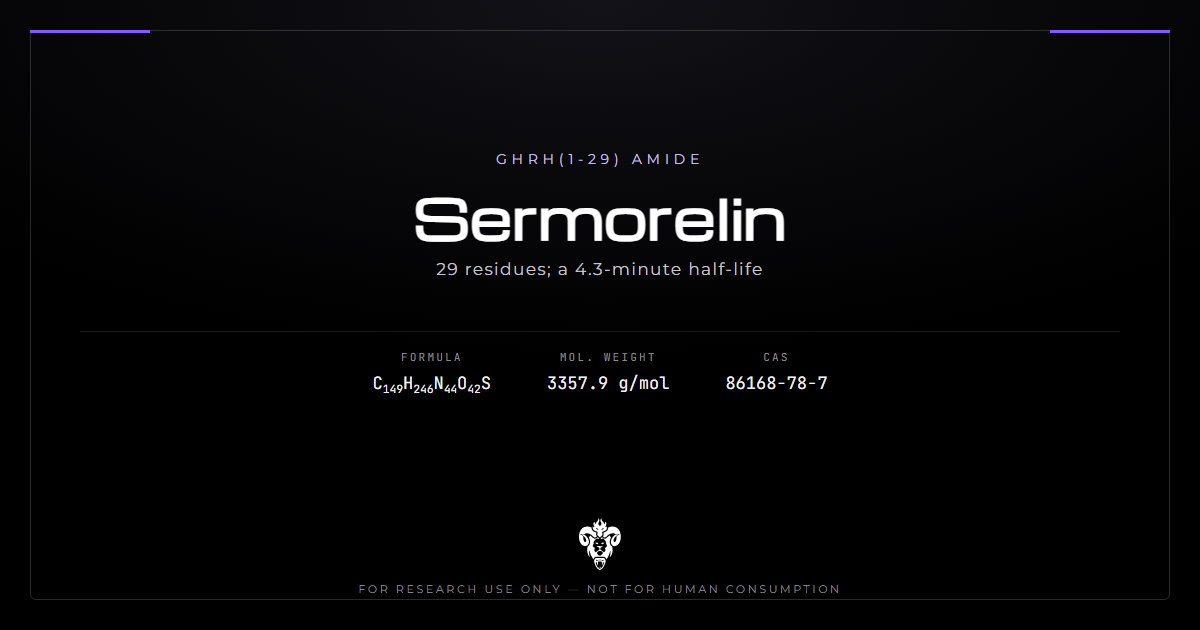
Growth hormone-releasing hormone runs to 44 residues. The first 29 carry the activity, and sermorelin is those 29 with an amide on the end.
Measured in humans, its disappearance half-time came out at 4.3 minutes [1].
Almost everything that has happened to this molecule since follows from that number. An analogue series. Albumin conjugates. Stabilised derivatives now in clinical use. All of them are attempts on those four minutes.
Chemical identity
Twenty-nine residues, and the numbering in the name is the useful part.
| Property | Value |
|---|---|
| Common names | Sermorelin, GHRH(1-29)-NH2, GRF(1-29) amide |
| Molecular formula | C149H246N44O42S |
| Molecular weight | 3357.9 |
| CAS | 86168-78-7 |
| PubChem CID | 16132413 |
| InChIKey | WGWPRVFKDLAUQJ-MITYVQBRSA-N |
| Parent hormone | GHRH, 44 residues |
The C-terminal amide is part of the compound
Papers write it as GHRH(1-29)-NH2 rather than GHRH(1-29) because the amide is there deliberately. A free acid at position 29 is a different molecule.
That matters for reading a certificate. It is also the first of several places in this article where a name and a molecule drift apart.
What the four-minute number came from
A study comparing sermorelin against a modified analogue measured both directly in humans [1].
| Compound | Metabolic clearance rate | Disappearance half-time |
|---|---|---|
| GHRH(1-29)-NH2 | 39.7 ± 3.9 mL/kg/min | 4.3 ± 1.4 min |
| D-Ala2 analogue | 21 ± 1.2 mL/kg/min | 6.7 ± 0.5 min |
The substitution sits at position 2, and swapping in a D-amino acid there roughly halved the clearance rate. The authors concluded that the substitution enhances biological activity by reducing metabolic clearance rather than by binding the receptor better.
Why position 2
An L-alanine at position 2 is the point of attack for the enzyme that clips this class of peptide. Putting a D-amino acid there blocks it, which is a general trick rather than a sermorelin-specific one.
The result was still measured in minutes. Doubling four minutes gets you eight, which is why the field kept going.
What happens downstream is longer than the peptide
A pharmacokinetic study ran in 30 healthy men [2]. Intravenous doses as low as 0.25 micrograms per kilogram produced significant growth hormone release. Maximal release came at 1 to 2 micrograms per kilogram.
The peptide cleared rapidly. Growth hormone stayed elevated for about three hours.
So a short half-life does not mean a short effect. The peptide is a trigger, and the hormone it releases has its own kinetics. That distinction is worth holding, because it is the strongest argument the compound has.
Intranasal delivery does not solve it
The same study tested the nasal route. Absorption through nasal mucosa was low, with bioavailability of only 3 to 5%. Reaching the effect of a 1 microgram per kilogram intravenous dose took about 50 micrograms per kilogram intranasally [2].
Repeated intranasal dosing did not suppress night-time growth hormone secretion, which is a genuinely useful negative result.
What it did in children
The clinical work is real and specific. A multicentre open-label study treated 110 previously untreated prepubertal growth hormone-deficient children [3]. The protocol ran 30 micrograms per kilogram per day, subcutaneously at bedtime, for up to one year.
Eighty-six were eligible for efficacy analysis. Mean height velocity rose from 4.1 ± 0.9 cm/yr at baseline to 8.0 ± 1.5 at six months, then 7.2 ± 1.3 at twelve. At six months, 74% counted as good responders. The ratio of bone age change to height age change did not differ significantly from unity. No adverse changes appeared in biochemical or hormonal measures.
And it did less than growth hormone itself
Here is the finding that rarely travels with the one above.
A review of sermorelin’s use in diagnosis and treatment states it plainly [4]. Height velocity increases on 30 micrograms per kilogram per day of sermorelin came out less than those in children receiving the same daily dose of somatropin.
The two were not compared head to head at the recommended dosage. Effect on final adult height remained undetermined at the time of that review. Tolerability was good, with transient facial flushing and injection site pain as the common adverse events.
So the honest summary of the paediatric work is that it grew children, and growth hormone grew them more.
The successor molecules are all attempts on the half-life
A medicinal chemistry programme has run on this scaffold since the mid-1980s. Reading its sequence tells you what the parent compound’s problem was.
- Super-active analogues of GRF(1-29) amide appeared in 1984 [5].
- Analogues containing reduced peptide bonds followed [6].
- The D-Ala2 substitution halved metabolic clearance [1].
- Further analogues with high and prolonged activity were reported in 1998 [7].
CJC-1295 is a sermorelin derivative, documented as such
The most consequential entry is an albumin bioconjugate programme. Investigators built conjugates of hGRF(1-29) designed to attach to circulating albumin, and the best compound was named CJC-1295 [8].
That paper describes CJC-1295 as a tetrasubstituted form of hGRF(1-29), carrying an added maleimidopropionamide derivative of lysine at the C terminus. It produced a fourfold increase in growth hormone area under the curve over two hours against hGRF(1-29). It also remained detectable in plasma beyond 72 hours. A western blot showed the compound riding on the serum albumin band within 15 minutes.
Four minutes to beyond 72 hours. That is the size of the problem the field was solving. It is also why CJC-1295 exists as a separate product rather than a formulation of this one.
The cognition trials used tesamorelin, not sermorelin
This is the sharpest case of a name and a molecule drifting apart, and these are the most cited modern GHRH trials.
Twenty weeks of daily GHRH administration produced a favourable effect on cognition [9]. It held in adults with mild cognitive impairment and in healthy older adults, at P=0.03 on intent-to-treat and P=0.002 among completers. Executive function improved at P=0.005, with a verbal memory trend at P=0.08. Insulin-like growth factor 1 rose 117% while staying in the physiological range. Body fat fell 7.4%. Fasting insulin rose 35% in the mild cognitive impairment group. Adverse events reached 68% on GHRH against 36% on placebo.
A neurochemical substudy of the same programme names the drug [10]. Participants self-administered tesamorelin, described there as a stabilised analogue of human GHRH, at 1 mg/day.
What follows from that
Tesamorelin is a different molecule from sermorelin, and it exists because sermorelin cleared too fast. Citing that cognition result as evidence for sermorelin runs the finding backwards, from the stabilised analogue onto the compound the stabilisation replaced.
Kimera Chems supplies tesamorelin separately as TH9507, and that is the compound those trials used.
The desensitisation question
Continuous exposure to a releasing hormone raises an obvious worry, and the field raised it early. A 1986 study asked directly whether growth hormone releasing factor desensitises the somatotroph [11]. It reported loss of responsiveness after infusion, which the authors attributed to desensitisation.
Set against that, three intranasal doses in a day left the following night’s growth hormone secretion intact [2].
The two results are not contradictory
One used continuous infusion, the other intermittent dosing. Pulsatile release comes from the interaction between GHRH and somatostatin. A peptide clamp study examined that division of labour in healthy volunteers and in survivors of childhood brain tumours [12].
The practical reading: exposure pattern matters more here than total amount. That is the opposite of how most compounds in this catalogue behave.
What the studies actually used
Doses cluster tightly, which is unusual for this catalogue and reflects an approved-drug history.
| Study | Population | Route and amount |
|---|---|---|
| Paediatric efficacy [3] | 110 GH-deficient children | Subcutaneous, 30 mcg/kg/day at bedtime, up to 1 year |
| Diagnostic use [4] | GH deficiency testing | Single intravenous dose, 1 mcg/kg |
| Pharmacokinetics [2] | 30 healthy men | Intravenous 0.25 to 2 mcg/kg; intranasal about 50 mcg/kg |
| Cognition trial [9][10] | Adults with MCI and healthy older adults | Tesamorelin 1 mg/day subcutaneous, 20 weeks |
| Long-term paediatric [13] | Significantly short children | GHRH(1-29), long-term |
The paediatric protocol is bedtime dosing, and that is deliberate
Growth hormone release peaks during early sleep. The 110-child study dosed at bedtime [3], which puts the releasing hormone alongside the body’s own largest pulse rather than against it.
That is a design choice a reader can miss, and it follows directly from the compound being a releasing hormone. Timing an exogenous hormone matters less, because it does not need the pituitary to cooperate.
The diagnostic dose is thirty times smaller than the treatment dose
One microgram per kilogram intravenously provokes a measurable growth hormone response for testing purposes [4]. Thirty micrograms per kilogram daily was the treatment protocol [3].
A study using the diagnostic dose is measuring pituitary responsiveness. A study using the treatment dose is measuring growth. Reading across them is a category error, and the tenfold-plus gap makes it an easy one to commit.
What being a releasing hormone rather than a hormone implies
Sermorelin does not do anything to tissue. It asks the pituitary to release growth hormone, and everything downstream depends on the pituitary agreeing.
Three consequences follow, and they separate this compound from growth hormone itself.
The pituitary sets a ceiling
Exogenous growth hormone arrives ready-made. A releasing hormone can only mobilise what the somatotrophs hold and are willing to release. That upper bound is a property of the patient rather than of the dose, which is part of why the paediatric response was more variable than somatropin’s [3][4].
It also explains the diagnostic use. A provocative test works precisely because the response reports pituitary capacity [4].
Somatostatin is pushing the other way
Pulsatile growth hormone release comes from GHRH and somatostatin acting in opposition, and a peptide clamp study set out to measure the relative contribution of each [14][12].
Adding GHRH does not remove somatostatin. So the timing of a dose relative to the endogenous rhythm becomes a variable in a way it never is for exogenous hormone.
Feedback stays intact
Insulin-like growth factor 1 and growth hormone both feed back on the hypothalamus and pituitary. That loop is the physiological argument for using a releasing hormone, and it is also a reason the effect should be self-limiting rather than open-ended.
Worth stating as a mechanism rather than as a benefit, because no study in this file measured whether preserved feedback produced a better outcome than exogenous hormone.
Two experiments that would settle the interpretation
Neither is a recommendation. They are the gaps a reader should notice.
Run the head-to-head that was never run
The review comparing sermorelin against somatropin was explicit that the two had not been compared directly at the recommended dosage [4]. Its conclusion, that sermorelin produced smaller height velocity increases, rests on comparing across studies.
A randomised trial at matched doses with final adult height as the endpoint would settle the size of the gap. Thirty years on, the published record does not contain one, and the compound’s approval history means it probably never will.
Test whether preserved pulsatility changes anything
The physiological case for a releasing hormone is that it keeps the feedback loop and the pulse pattern that exogenous hormone overrides. That is an appealing argument and it is untested as an outcome.
Matching two groups on total IGF-1 exposure, one by releasing hormone and one by exogenous growth hormone, would show whether the pattern matters beyond the amount. Nobody has published that comparison, so the pulsatility argument stays mechanistic rather than empirical.
How to read a sermorelin study
Four questions, and two of them are about which molecule.
Sermorelin, or an analogue?
GHRH(1-29)-NH2, D-Ala2 analogues, CJC-1295 and tesamorelin are separate compounds with separate kinetics [1][8][10]. The abstract usually names which, and the naming is not decoration.
Diagnostic dose or treatment dose?
One microgram per kilogram once, or thirty micrograms per kilogram daily [3][4].
Continuous or intermittent?
Infusion produced loss of responsiveness [11]; intermittent dosing did not suppress overnight secretion [2].
What was the comparator?
Against placebo, growth hormone release is easy to demonstrate. Against somatropin at the same dose, sermorelin produced smaller height velocity increases [4].
Verifying research material
The identity risks here are the amide, the sequence length and the analogue confusion.
Mass distinguishes the family members
Sermorelin is 3357.9. A D-Ala2 analogue is a stereoisomer, so it differs by nothing at all in mass and needs sequencing or a chiral method. CJC-1295 and tesamorelin differ by much more, since both carry added groups [8][10].
So mass separates the parent from the stabilised analogues cleanly. It does not separate it from a stereoisomeric substitution at all.
Fragment length is the other axis
Sermorelin is residues 1 to 29 of a 44-residue hormone. Shorter fragments lose activity, and the full-length parent is a different molecule again. A certificate naming “GHRH” without a residue range has not specified which compound it describes.
The same care applies in reverse. Papers written before the generic name existed call it GRF(1-29) amide or hGRF(1-29), and those are this compound under older naming rather than analogues [5][8].
The amide and the sequence
Confirm the certificate specifies the 1-29 fragment with a C-terminal amide. A free acid, or a different fragment length, is a different compound with different activity.
Every batch we supply carries a certificate of analysis recording the identity and purity data behind it.
Handling
A single methionine sits in the sequence. Oxidation adds 16 daltons, so 3373.9 is the mass to watch alongside 3357.9. Beyond that, ordinary peptide practice applies. Keep the lyophilised solid dry, equilibrate a vial to room temperature before opening, and treat reconstituted solutions as short-lived.
Common questions about sermorelin
Identity
What is sermorelin? The first 29 residues of growth hormone-releasing hormone, with a C-terminal amide.
Is it the same as CJC-1295? No. CJC-1295 is a tetrasubstituted derivative of the same 1-29 fragment, built to bind albumin, and it persists in plasma beyond 72 hours [8].
Is it the same as tesamorelin? No. Tesamorelin is a stabilised GHRH analogue and is the compound used in the cognition trials [10].
Evidence
What is the strongest clinical evidence? A 110-child multicentre study raising mean height velocity from 4.1 to 8.0 cm/yr at six months [3]. Eighty-six children entered the efficacy analysis and 74% counted as good responders at that point.
How does it compare with growth hormone? At the same 30 mcg/kg/day, height velocity increases were smaller than with somatropin [4].
Why is the half-life such a focus? Because it is 4.3 minutes [1], and every successor molecule in this family was built to extend it.
Handling and verification
What mass should a certificate show? 3357.9. Check 3373.9 for the methionine sulfoxide.
Does a short half-life mean a short effect? No. The peptide clears in minutes while growth hormone stays elevated for about three hours [2].
Why bedtime dosing in the trials? Because the body’s largest growth hormone pulse comes in early sleep, so the protocol works with the endogenous rhythm rather than against it [3].
Does it keep working with continuous exposure? Infusion produced loss of responsiveness attributed to desensitisation [11]. Intermittent dosing did not [2].
Summary of the evidence
Sermorelin is the shortest fragment of GHRH that retains full activity. Its measured disappearance half-time in humans is 4.3 minutes, and that number organises the whole file. A D-Ala2 substitution took it to 6.7 minutes. An albumin-binding derivative named CJC-1295 took it past 72 hours. A stabilised analogue, tesamorelin, is what the modern cognition trials actually used.
Its own clinical record is a 110-child study that raised height velocity from 4.1 to 8.0 cm per year at six months. Alongside it sits a review stating that the same daily dose of growth hormone did more. Its diagnostic use rests on a dose thirty times smaller than its treatment dose. And the exposure pattern matters: infusion cost responsiveness, while intermittent dosing left overnight secretion intact.
Kimera Chems supplies Sermorelin alongside related research peptides including Ipamorelin and GHRP-2, with full analytical documentation. Our peptides research library covers more compounds in this class.
Research use only. Not for human or veterinary use. Nothing here describes a therapy or a dosing protocol.
References
- Soule S, King JA, Millar RP. Incorporation of D-Ala2 in growth hormone-releasing hormone-(1-29)-NH2 increases the half-life and decreases metabolic clearance in normal men. J Clin Endocrinol Metab. 1994;79(4):1208-11. PMID 7962295. DOI
- Wilton P, Chardet Y, Danielson K, Widlund L, Gunnarsson R. Pharmacokinetics of growth hormone-releasing hormone(1-29)-NH2 and stimulation of growth hormone secretion in healthy subjects after intravenous or intranasal administration. Acta Paediatr Suppl. 1993;388:10-5. PMID 8329825. DOI
- Thorner M, Rochiccioli P, Colle M, Lanes R, Grunt J, Galazka A, Landy H, Eengrand P, et al. Once daily subcutaneous growth hormone-releasing hormone therapy accelerates growth in growth hormone-deficient children during the first year of therapy. Geref International Study Group. J Clin Endocrinol Metab. 1996;81(3):1189-96. PMID 8772599. DOI
- Prakash A, Goa KL. Sermorelin: a review of its use in the diagnosis and treatment of children with idiopathic growth hormone deficiency. BioDrugs. 1999;12(2):139-57. PMID 18031173. DOI
- Lance VA, Murphy WA, Sueiras-Diaz J, Coy DH. Super-active analogs of growth hormone-releasing factor (1-29)-amide. Biochem Biophys Res Commun. 1984;119(1):265-72. PMID 6231028. DOI
- Hocart SJ, Murphy WA, Coy DH. Analogues of growth hormone-releasing factor (1-29) amide containing the reduced peptide bond isostere in the N-terminal region. J Med Chem. 1990;33(7):1954-8. PMID 2141879. DOI
- Toth K, Kovacs M, Zarandi M, Halmos G, Groot K, Nagy A, Kele Z, Schally AV. New analogs of human growth hormone-releasing hormone (1-29) with high and prolonged antagonistic activity. J Pept Res. 1998;51(2):134-41. PMID 9516049. DOI
- Jetté L, Léger R, Thibaudeau K, Benquet C, Robitaille M, Pellerin I, Paradis V, van Wyk P, et al. Human growth hormone-releasing factor (hGRF)1-29-albumin bioconjugates activate the GRF receptor on the anterior pituitary in rats: identification of CJC-1295 as a long-lasting GRF analog. Endocrinology. 2005;146(7):3052-8. PMID 15817669. DOI
- Baker LD, Barsness SM, Borson S, Merriam GR, Friedman SD, Craft S, Vitiello MV. Effects of growth hormone–releasing hormone on cognitive function in adults with mild cognitive impairment and healthy older adults: results of a controlled trial. Arch Neurol. 2012;69(11):1420-9. PMID 22869065. DOI
- Friedman SD, Baker LD, Borson S, Jensen JE, Barsness SM, Craft S, Merriam GR, Otto RK, et al. Growth hormone-releasing hormone effects on brain γ-aminobutyric acid levels in mild cognitive impairment and healthy aging. JAMA Neurol. 2013;70(7):883-90. PMID 23689947. DOI
- Davis JR, Sheppard MC, Shakespear RA, Lynch SS, Clayton RN. Does growth hormone releasing factor desensitize the somatotroph? Interpretation of responses of growth hormone during and after 10-hour infusion of GRF 1-29 amide in man. Clin Endocrinol (Oxf). 1986;24(2):135-40. PMID 2871948. DOI
- Achermann JC, Hindmarsh PC, Robinson IC, Matthews DR, Brook CG. The relative roles of continuous growth hormone-releasing hormone (GHRH(1-29)NH2) and intermittent somatostatin(1-14)(SS) in growth hormone (GH) pulse generation: studies in normal and post cranial irradiated individuals. Clin Endocrinol (Oxf). 1999;51(5):575-85. PMID 10594518. DOI
- Grunt JA, Schwartz ID, Buchanan C, Howard CP. Effects of long-term growth hormone releasing hormone 1-29 in significantly short children. Acta Paediatr. 1995;84(6):631-3. PMID 7670244. DOI
- Ross RJ, Rodda C, Tsagarakis S, Davies PS, Grossman A, Rees LH, Preece MA, Savage MO, et al. Treatment of growth-hormone deficiency with growth-hormone-releasing hormone. Lancet. 1987;1(8523):5-8. PMID 2879138. DOI
Research use only. Not for human or veterinary use. Nothing here describes a therapy or a dosing protocol.