
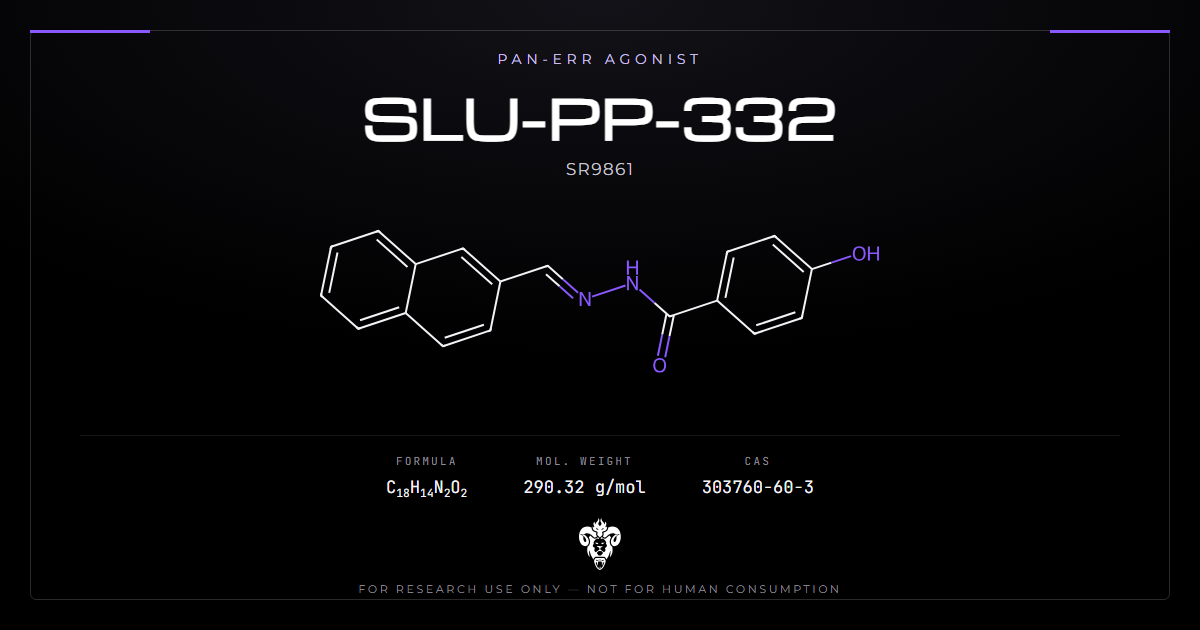
SLU-PP-332 is a synthetic small-molecule pan-ERR agonist. In the laboratory, it activates the estrogen-related receptors (ERRs) to probe mitochondrial energy metabolism and the biology of exercise adaptation. The ERR family sits at the center of how cells manage oxidative metabolism, so the compound has become a frequently referenced probe across metabolic, cardiac, and skeletal-muscle research. This guide explains what it is, how it works, and where it appears in the published literature.
We supply SLU-PP-332 for laboratory research use only. It is not for human consumption, nor for medical, veterinary, or household use. This information is for research context only.
What Is SLU-PP-332? A Pan-ERR Agonist Overview
SLU-PP-332 is a first-generation synthetic agonist of all three estrogen-related receptor subtypes — ERR-alpha, ERR-beta, and ERR-gamma. In cell-based assays it shows the highest potency at ERR-alpha (EC50 about 98 nM), with weaker activity at ERR-beta (about 230 nM) and ERR-gamma (about 430 nM). Because it activates the entire ERR family rather than a single subtype, researchers call it a pan-ERR agonist.
The compound emerged from the medicinal-chemistry program of the Burris laboratory, and the “SLU-PP” name reflects its origin at Saint Louis University. Earlier ERR tool compounds tended to target a single subtype. The Burris team instead built this molecule to switch on the full ERR program at once, which suits broad questions about energy metabolism. We list it among our selective modulators, with research-grade material available in several formats.
How SLU-PP-332 Works: The ERR-PGC-1-alpha Axis
Estrogen-related receptors are orphan nuclear receptors: they have no known natural ligand, even though they belong to the nuclear-receptor superfamily. They act as master regulators of cellular energy balance. They bind DNA sequences called estrogen-related response elements (ERREs) in the promoters of genes that control mitochondrial function and fuel use.
When the compound binds ERR-alpha, it stabilizes the receptor’s active shape and pulls in transcriptional coactivators. It then drives a gene program that mirrors the molecular signature of endurance exercise. A key node in that program is PGC-1-alpha, the master regulator of mitochondrial biogenesis. Through this axis, the molecule turns up fatty-acid oxidation and mitochondrial capacity.
SLU-PP-332 as an Exercise-Mimetic Research Tool
Interest in this pan-ERR agonist centers on its action as a so-called “exercise mimetic” in preclinical models. In skeletal-muscle studies, activating the ERR program shifts fibers toward oxidative characteristics and raises respiratory capacity — changes that resemble endurance training. Reviews of ERR signaling in muscle fitness frame this receptor family as a key driver of the trained-muscle phenotype.
These findings come from cell and animal research, not human use. Investigators mainly use the compound to work out how the ERR axis reprograms metabolism, not to replace training. You can review the primary literature through PubMed.
Metabolic and Cardiac Research Directions
On the metabolic side, preclinical work has examined the compound in obesity, type 2 diabetes, and metabolic-syndrome models, tracking mitochondrial biogenesis, insulin sensitivity, and energy expenditure. The logic stays the same: by activating ERR-alpha and boosting PGC-1-alpha-driven transcription, the molecule raises the cell’s capacity to burn fat and make energy.
The ERR axis also matters in the heart, which leans heavily on fatty-acid oxidation. A 2024 study in Circulation tested SLU-PP-332 and a second pan-ERR agonist, SLU-PP-915, in a pressure-overload model of heart failure. Both raised ejection fraction, cut fibrosis, and improved survival. The authors tied those gains to better cardiac fatty-acid metabolism and mitochondrial function. As with the metabolic work, these are animal findings meant to clarify mechanism.
SLU-PP-332 vs. Related Research Compounds
Researchers often compare it with other compounds that drive oxidative metabolism through different targets. Those distinctions clarify why a lab reaches for one tool over another.
GW-501516 acts on PPAR-delta rather than the ERRs, yet researchers study it for overlapping questions about endurance and fatty-acid oxidation. MOTS-C, by contrast, is a mitochondrial-derived peptide that works through a separate route entirely. SLU-PP-332 fills a distinct niche: it acts upstream, at the nuclear-receptor level, to switch on the ERR network directly. Together, these compounds give researchers several independent handles on mitochondrial and metabolic biology.
Available Forms and Third-Party COA Verification
Because research needs vary, we offer the compound in several laboratory formats — powder, solubilized liquid, and pre-measured capsules. The right format usually comes down to the assay and the lab’s handling workflow.
Third-party COA verification backs every batch, so you can confirm identity and purity before a compound enters an experiment. You can find current and archived certificates of analysis in our COA archive. Independent confirmation matters most for newer research chemicals, where quality varies widely between suppliers.
Handling and Storage Notes for Researchers
Researchers generally handle SLU-PP-332 like other lyophilized or powdered compounds. Store it at controlled room temperature, dry and away from light, and prepare working solutions in lab-appropriate solvents for in vitro use. Storage guidance is a house recommendation. Analytical documentation is per-lot release testing. Standard chemical-safety practice — gloves, eye protection, and good ventilation — applies. These notes cover general lab handling only, not any form of human or animal administration.
SLU-PP-332 Research FAQs
What receptor does SLU-PP-332 target?
It is a pan-ERR agonist that activates ERR-alpha, ERR-beta, and ERR-gamma, with the greatest potency at ERR-alpha. That puts it in the nuclear-receptor class of research tools, not the enzyme- or peptide-based ones.
Is SLU-PP-332 a SARM?
No. We group it among selective modulators for cataloguing, but it acts on estrogen-related receptors, not the androgen receptor that classical SARMs target. Its mechanism and research uses are distinct.
What is it used for in research?
Investigators use it to study mitochondrial biogenesis, oxidative metabolism, and the basis of exercise adaptation, plus metabolic and cardiac disease models. All of this stays strictly in the lab.
How does it differ from GW-501516?
Researchers study both for oxidative metabolism, but they hit different targets: this molecule activates the ERRs, while GW-501516 acts on PPAR-delta. Comparing the two separates ERR-driven effects from PPAR-delta-driven ones.
Research Use Only. We sell SLU-PP-332 exclusively for laboratory and research purposes. It is not a drug, supplement, or food, and it does not diagnose, treat, cure, or prevent any disease. It is not for human consumption, nor for medical, veterinary, or household use. Please review our Terms and Conditions before ordering.