
Do you know if your compound meets the exact standards for your study? Every successful project begins with a clear understanding of the compound’s chemical identity. In your laboratory, you must verify all materials before you start any testing. This YM-178 research compound overview provides a factual look at the substance’s chemical nature and other basic information. When you focus on these basics, you can confidently ensure your lab work stays accurate and reliable.
This article explains the molecular structure and the chemical profile of the compound. It also discusses required handling steps in a lab. Additionally, you will see how to manage research records and follow safety rules. When you understand these simple concepts, it allows you to handle the material correctly in your facility, helping you maintain a very professional research environment.
Core Chemical Identity and Classification
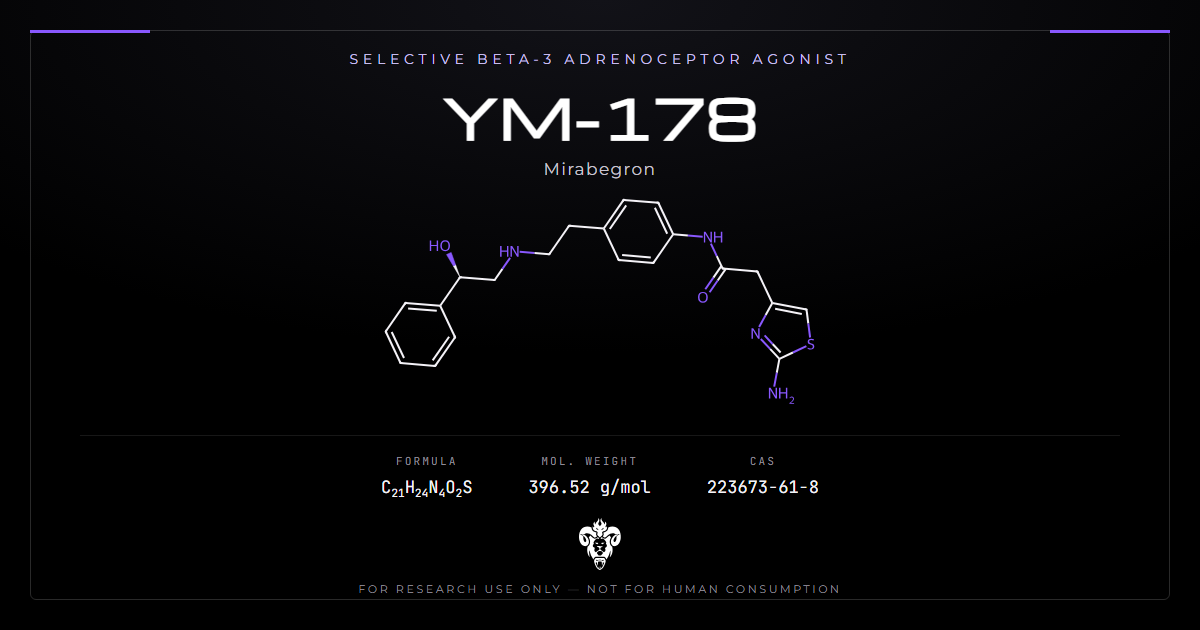
You must accurately identify every material in your laboratory inventory. This YM-178 research compound overview defines the substance as a synthetic small-molecule organic compound. The IUPAC name is 2-(2-amino-1,3-thiazol-4-yl)-N-[4-[2-[[(2R)-2-hydroxy-2-phenylethyl]amino]ethyl]phenyl]acetamide. It has a molecular formula of C₂₁H₂₄N₄O₂S and a molecular weight of 396.5 g/mol. Researchers classify this as an organic molecule with specific functional groups. Researchers interested in comparative synthetic compound classifications may also review GB-115 molecular profile research. Therefore, you should record these identifiers in your lab database.Therefore, you should record these identifiers in your lab database.
Investigators use the following markers to confirm the identity of the material:
- CAS number: 223673-61-8
- Compound class: Small molecule
- Structural category: Heterocyclic compound containing a thiazole ring
- Chemical feature: Presence of a sulfur-containing group
The Molecular Framework of YM-178
As a scientist, you must examine the specific arrangement of atoms in your material. This YM-178 research compound overview focuses on the unique parts of the molecular skeleton. The structure contains two distinct phenyl rings, which are stable aromatic systems. Furthermore, it features a heterocyclic component known as a 1,3-thiazole ring. You can also find several important functional groups, like an amide linkage and a secondary amine. Additionally, a hydroxyl group is part of the chemical chain. These elements create a specific 3D arrangement that defines how the molecule interacts in a lab setting.
When you analyze the structural elements, you will find these key features:
- Aromatic ring systems: Two phenyl rings provide a stable base.
- Nitrogen groups: These include both an amine and the thiazole ring.
- Sulfur group: A sulfur atom is located within the thiazole ring.
- Chiral center: The carbon backbone contains a specific chiral point.
These details help you understand the chemical identity of the compound. Therefore, you can better prepare your laboratory methods based on its structure.
Analytical Verification and Purity Assessment
Before you start your study, you must verify the quality of your material. This YM-178 research compound overview emphasizes checking the supplier’s Certificate of Analysis (COA). A standard COA usually includes:
- The exact batch number
- The chemical purity percentage
- Identification test results
- The date of manufacture
Confirming purity is vital to ensure your laboratory data remains reliable. You may also perform internal verification to double-check the accuracy of your samples. When you keep detailed documentation of these checks, it ensures consistency across all your experiments. Therefore, you protect your research from errors caused by impure chemicals.
Investigators commonly use these analytical techniques to analyze the compound:
- High-Performance Liquid Chromatography (HPLC): Used for measuring chemical purity.
- Nuclear Magnetic Resonance (NMR): Used for confirming the molecular structure.
- Mass Spectrometry (MS): Used for verifying the molecular mass.
- Infrared Spectroscopy (IR): Used for identifying specific functional groups.
- Melting point testing: Used as a basic physical purity check.
Controlled In Vitro Research Applications
In a professional setting, researchers use this substance only within controlled in vitro systems. This YM-178 research compound overview highlights studies on molecular interactions CMS-121 research compound studies and structural behavior. You must perform these experiments in isolated environments or specific solution-based systems. It is important to control variables like temperature, concentration, and solvents carefully.
Binding Interaction Studies
You can study how the molecule connects with specific chemical targets. These tests happen in very specific settings to ensure your data is right.
Molecular Docking Simulations
Investigators use digital tools to see how the structure fits with targets. These patterns help you understand the molecule’s shape in a virtual space.
Transport Interaction Screening
Scientists study how the compound moves across different lab-made barriers. These tests help you understand how the molecule behaves in artificial systems.
Chemical Interaction Assays
You can observe how this substance reacts with other chemical materials. These tests take place in controlled environments where you can easily monitor the changes.
Safe Handling and Preparation in the Lab
When you work with this material, you must follow strict safety steps. This YM-178 research compound overview focuses on maintaining a clean and safe workspace. You should always wear your personal protective equipment (PPE), which includes the following:
- Lab coat
- Protective gloves
- Suitable respirator
- Safety goggles with side shields
You should use an analytical balance to weigh the compound with high accuracy. Moreover, you need to prepare all your solutions in a controlled environment to keep the material stable and pure. Then you need to do proper labelling of every container. These simple habits help you avoid contamination and keep your laboratory results reliable.
You must properly maintain the following records:
- Batch identification records
- Preparation date logs
- Storage temperature records
- Container labeling records
- Disposal tracking records
Research Standards and Documentation
In a professional laboratory, you must prove that your work follows all rules. This YM-178 research compound overview focuses on the “research-use-only” classification of the material. Your institution must control how and where you use the compound. Therefore, you should only buy your materials from verified professional suppliers. These steps show that your laboratory is organized and follows official standards.
You should keep these records updated in your files:
- Supplier verification files: Documents that prove your source is legitimate.
- Project approval records: Formal papers showing your study is authorized.
- Laboratory access logs: A list of who entered the research area and when.
- Audit trail documentation: Records that track the history of the compound in your lab
Conclusion
A clear understanding of chemical identity and molecular structure is the foundation of your work. This YM-178 research compound overview shows that knowing your materials helps you plan more reliable experiments. You must always prioritize proper handling and keep detailed documentation in your files. By following these basic principles, you can create a solid base for all your future laboratory studies.