
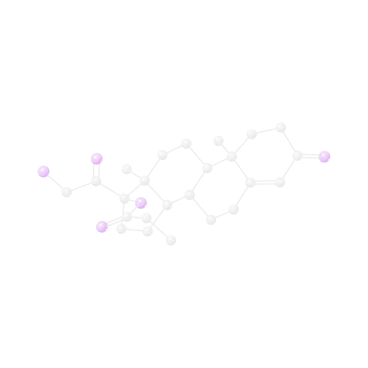
Calculated reference model · not an experimental or batch-certified structure. All 29 atoms shown.
Model data & sources
- Heavy atoms only; hydrogens are omitted from the reference display.
- Source-defined stereochemistry is checked against the calculated coordinates; no energy-minimum, crystal or solution-structure claim is made.
- Reference molecular species only; batch identity, purity, counterions and excipients are not certified.
- Formula
- C24H34O5
- Method
- RDKit ETKDGv3 / MMFF94s calculated reference conformer
CB-03-01
CB-03-01
CB-03-01 (commercially recognized in clinical literature as Clascoterone or Cortexolone 17α-propionate) is a synthetic pregnane steroid derivative that functions as a selective steroidal androgen receptor (AR) antagonist. Structurally optimized via the esterification of 11-deoxycortisol at the C17α position, this investigational compound serves as a critical reference ligand in competitive binding assays and structural pharmacology research. Because it possesses a localized mechanism of action that undergoes rapid biological hydrolysis upon cellular entry into its parent form (cortexolone), CB-03-01 is actively studied to map the precise boundaries of targeted, peripherally selective anti-androgenic activity without causing broad systemic hormone suppression.
Research Applications & Mechanism of Interest
In molecular medicine and receptor pharmacology frameworks, CB-03-01 provides a high-affinity competitive template for evaluating the mechanics of the human androgen receptor's ligand-binding domain. Data published in the Journal of Drugs in Dermatology highlights its sub-micromolar binding capacity (IC₅₀ value of approximately 0.4 to 1 µM), effectively competing against native dihydrotestosterone (DHT) and testosterone to block downstream AR nuclear translocation.
Primary fields of investigative laboratory research include:
-
Androgen Receptor Binding Kinematics: Executing competitive displacement assays in cell-free environments to determine the exact structural contributions of the propionate group to steric fitting within the hydrophobic pocket of receptor proteins.
-
Transcriptional Modulation Mapping: Observing in vitro systems to track how localized antagonist introduction alters the expression of androgen-responsive target genes and transcription factors without modifying systemic endocrine baselines.
-
Lipid and Cytokine Signaling Assays: Utilizing human primary sebocyte cultures to monitor the inhibition of androgen-stimulated lipid synthesis and pro-inflammatory cytokine cascades under controlled conditions.
-
Co-Solute and Carrier Behavior Analysis: Conducted to observe the thermodynamic properties, micellar interaction boundaries, and stable concentration parameters of the steroid matrix when evaluated across diverse vehicle environments.
Storage & Handling Guidelines
Store at controlled room temperature. Do not refrigerate or freeze. Cold storage may cause the solution to cloud or precipitate. If this occurs, return to room temperature and mix until clear.
Storage guidance is a house recommendation. Analytical documentation is per-lot release testing.
Related Research Compounds
Frequently Asked Research Questions
How does CB-03-01 block androgen signaling at the cellular level?
In preclinical assays, CB-03-01 competes directly with endogenous androgens like DHT for the ligand-binding core of the androgen receptor. By locking the receptor in an inactive state, it actively interrupts the nuclear translocation step required to prompt the transcription of androgen-dependent genes.
What is the significance of the 17α-propionate ester modification?
The propionate ester group fundamentally alters both the lipophilicity and the metabolism profile of the compound. While it enhances membrane permeability during cell-free evaluations, cellular esterases rapidly cleave this bond to yield cortexolone, an inactive metabolite that provides a clean model for studying peripherally selective signaling.
Scientific References
-
Celasco, G., Moro, L., Bozzella, R., Ferraboschi, P., Bartorelli, L., Quattrocchi, C., & Nicoletti, F. (2004). "Pharmacological profile of 17α-propionate of cortexolone (CB-03-01), a new topical antiandrogen." Arzneimittelforschung, 54(12), 881–886. doi:10.1055/s-0031-1297043.
-
Rosette, C., Agan, F. J., Mazzetti, A., Moro, L., & Kasmsieh, W. (2019). "Cortexolone 17α-Propionate (Clascoterone) Is a Novel Androgen Receptor Antagonist that Inhibits Production of Lipids and Inflammatory Cytokines in Sebocytes." Journal of Drugs in Dermatology, 18(5), 412–418. PMID: 31141847.
Research Use Only Disclaimer: This product is labeled and sold "For Research Use Only — NOT FOR HUMAN CONSUMPTION." It is not a drug, dietary supplement, food, cosmetic, or medical device, and it is not approved by the FDA or any other regulator for human or veterinary use. It is supplied to approved account holders as a research chemical for laboratory use and must be handled in accordance with applicable law.
