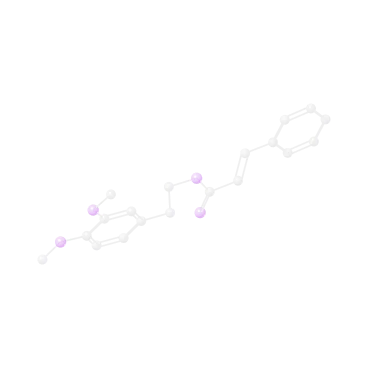
Calculated reference model · not an experimental or batch-certified structure. All 23 atoms shown.
Model data & sources
- Heavy atoms only; hydrogens are omitted from the reference display.
- Source-defined stereochemistry is checked against the calculated coordinates; no energy-minimum, crystal or solution-structure claim is made.
- Reference molecular species only; batch identity, purity, counterions and excipients are not certified.
- Formula
- C19H21NO3
- Method
- RDKit ETKDGv3 / MMFF94s calculated reference conformer
Lemairamin
Lemairamin (WGX-50 / α7nAChR Agonist)
Lemairamin, also identified in research literature as WGX-50, is a synthetic amide derivative characterized by a dimethoxyphenyl group linked to a phenylpropenamide structure. It is extensively utilized in laboratory research as a selective agonist of the α7 nicotinic acetylcholine receptor (α7nAChR). By acting on this specific receptor, Lemairamin serves as a critical probe for investigating pathways related to neuroinflammation, pain hypersensitivity, and neuroprotective signaling mechanisms in cellular models.
Additional Properties
| Property | Specification |
|---|---|
| Mechanism | α7 Nicotinic Acetylcholine Receptor Agonist |
| Appearance | White to off-white powder |
Research Applications
Lemairamin is a primary tool for probing the functional role of the α7 nicotinic acetylcholine receptor in various experimental biological contexts.
Primary fields of in vitro laboratory investigation include:
-
α7nAChR Signaling: Utilizing the compound to trigger and study receptor activation pathways in neuronal and inflammatory cell lines.
-
Neuroinflammation Research: Analyzing the role of α7nAChR modulation in attenuating inflammatory responses in microglial and astrocytic models.
-
Pain Hypersensitivity Studies: Probing receptor-mediated pathways involved in the modulation of pain signaling.
-
Neuroprotective Research: Investigating the compound's effect on cellular survival pathways under conditions of stress relevant to neurodegenerative research.
-
Competitive Binding Studies: Evaluating interaction profiles and receptor occupancy in the presence of other nicotinic ligands.
Storage & Handling Guidelines
Store at controlled room temperature. Keep tightly closed.
Storage guidance is a house recommendation. Analytical documentation is per-lot release testing.
Related Research Compounds
Research Use Disclaimer
Research Use Only Disclaimer: This product is labeled and sold "For Research Use Only — NOT FOR HUMAN CONSUMPTION." It is not a drug, dietary supplement, food, cosmetic, or medical device, and it is not approved by the FDA or any other regulator for human or veterinary use. It is supplied to approved account holders as a research chemical for laboratory use and must be handled in accordance with applicable law.