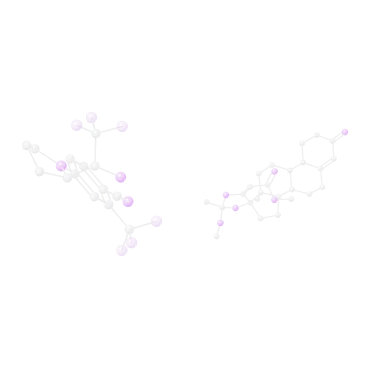
Named molecular components are shown separately. The solution vehicle and the full formulation are not represented, and no combined molecule or measured blend structure is implied.
Calculated reference model · not an experimental or batch-certified structure. All 23 atoms shown.
Model data & sources
- Heavy atoms only; hydrogens are omitted from the reference display.
- Source-defined stereochemistry is checked against the calculated coordinates; no energy-minimum, crystal or solution-structure claim is made.
- Reference molecular species only; batch identity, purity, counterions and excipients are not certified.
- Formula
- C14H12F6N2O
- Method
- RDKit ETKDGv3 / MMFF94s calculated reference conformer
LGD-4033/YK-11
LGD-4033/YK-11 Research Blend
A co-formulated research material containing two selective androgen receptor modulators: LGD-4033 (ligandrol, CAS 1165910-22-4), a pyrrolidinyl-benzonitrile, and YK-11 (CAS 1370003-76-1), a steroidal 19-norpregnadiene. They are supplied together as a single blend for laboratory work.
What is and is not known about this combination
No published study tests these two compounds together. There is no combination pharmacology, no interaction data, and no evidence of additive or synergistic behaviour. Each component is described below from its own literature. Any combined effect is an open question for the researcher using it, not an established property of the blend.
The two also differ structurally in a way that matters for method development: one is nonsteroidal and one is steroidal, so they fragment and metabolise along different pathways and a screening method built for one does not automatically cover the other.
LGD-4033 (ligandrol)
-
Its own chemical class. The pyrrolidinyl-benzonitrile scaffold is catalogued separately from arylpropionamides, quinolinones, indoles and phenyl-oxadiazoles in validated screening methods.[2]
-
Trace-level detection. Quantified in hair at 14–42 pg/mg, the highest of the three commonly encountered SARMs in that matrix.[1]
YK-11
-
Steroidal, not nonsteroidal. Its 19-norpregnadiene nucleus means steroid-type fragmentation and metabolism.[3]
-
Characterised fragmentation and metabolism. In-source dissociation pathways assigned using stable-isotope labelling and DFT computation;[3] seven phase I metabolites in plasma and eleven in urine following oral administration in horses.[4]
-
Mechanism claims are unsettled. The widely repeated myostatin and follistatin claims for YK-11 do not have retrievable primary support in the PubMed record.
Research Applications
-
Multi-analyte method development resolving a steroidal and a nonsteroidal SARM in one sample.[2,3]
-
Combination pharmacology — genuinely uncharted, and the reason to run single-compound arms alongside the blend.
-
Comparative metabolite profiling across the two structural classes.[4]
Analytical Documentation
Purity and identity vary by manufacturing lot. Kimera Chems does not publish a single fixed purity figure for this item; refer to the batch-specific Certificate of Analysis (COA) issued for the lot received, which reflects third-party analytical testing for that lot. For an ester or a multi-component blend the COA is the only document that speaks to what is actually in the vial.
References
These references describe the parent compound(s). None of them studied the material on this page.
- Kintz P, Gheddar L, Ameline A, Raul JS. Perspectives in evaluating selective androgen receptor modulators in human hair: a short communication. Ther Drug Monit. 2021;43(2):298–300. doi:10.1097/FTD.0000000000000859
- Stacchini C, Botrè F, Comunità F, et al. Simultaneous detection of different chemical classes of selective androgen receptor modulators in urine by liquid chromatography-mass spectrometry-based techniques. J Pharm Biomed Anal. 2021;195:113849. doi:10.1016/j.jpba.2020.113849
- Thevis M, Piper T, Dib J, et al. Mass spectrometric characterization of the selective androgen receptor modulator (SARM) YK-11 for doping control purposes. Rapid Commun Mass Spectrom. 2017;31(14):1175–1183. doi:10.1002/rcm.7886
- Harding C, Viljanto M, Habershon-Butcher J, Taylor P, Scarth J. Equine metabolism of the selective androgen receptor modulator YK-11 in urine and plasma following oral administration. Drug Test Anal. 2023;15(4):388–407. doi:10.1002/dta.3425
Storage & Handling
Store at controlled room temperature. Keep tightly closed.
Storage guidance is a house recommendation. Analytical documentation is per-lot release testing.
Related Research Compounds
Research Use Only Disclaimer: This product is labeled and sold "For Research Use Only - NOT FOR HUMAN CONSUMPTION." It is not a drug, dietary supplement, food, cosmetic, or medical device, and it is not approved by the FDA or any other regulator for human or veterinary use. It is supplied to approved account holders as a research chemical for laboratory use and must be handled in accordance with applicable law.