
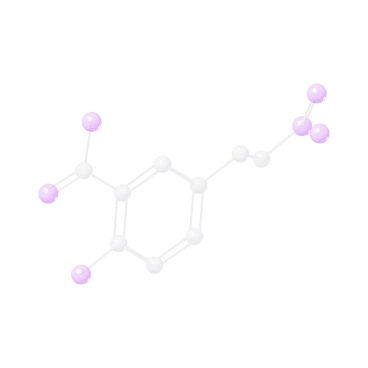
Calculated reference model · not an experimental or batch-certified structure. All 15 atoms shown.
Model data & sources
- Heavy atoms only; hydrogens are omitted from the reference display.
- Source-defined stereochemistry is checked against the calculated coordinates; no energy-minimum, crystal or solution-structure claim is made.
- Reference molecular species only; batch identity, purity, counterions and excipients are not certified.
- Formula
- C9H7NO5
- Method
- RDKit ETKDGv3 / MMFF94s calculated reference conformer
SANA (MVD1)
SANA (MVD1) Research Standard
SANA (MVD1), chemically identified as 5-(2-nitroethenyl)salicylic acid, is a novel nitroalkene derivative of salicylate that serves as a specialized research tool for studying creatine-dependent thermogenesis. Distinct from classical incretin-based metabolic modulators (such as GLP-1 or GIP agonists), SANA (MVD1) is investigated for its capacity to directly influence energy expenditure at the adipocyte level. By upregulating creatine metabolism and promoting futile creatine cycling, it serves as a unique reference compound for exploring UCP1-independent and AMPK-independent thermogenic pathways.
Physical & Handling Properties
| Property | Specification |
|---|---|
| Physical Appearance | Off Yellow Powder |
Mechanism of Action & Research Context
SANA (MVD1) represents a distinct mechanistic class in metabolic research, focusing on the acceleration of ATP hydrolysis through futile cycles.
-
Creatine-Dependent Thermogenesis: The compound is characterized by its ability to upregulate genes associated with creatine metabolism and enhance creatine kinase activity within adipose tissue.
-
Thermogenic Pathway: Unlike classical brown adipose thermogenesis, which relies on Uncoupling Protein 1 (UCP1), SANA functions through a UCP1-independent pathway, driving heat output via the hydrolysis of ATP in a futile creatine cycling loop.
-
Pathway Independence: Preclinical data suggests the compound operates independently of the canonical AMPK energy-sensor pathway, distinguishing it from pharmaceutical agents that modulate systemic appetite or metabolic signaling sensors.
-
Lean Mass Preservation: Research models contrast the metabolic profile of SANA with that of incretin-based agonists, often citing its potential to preserve lean mass during periods of increased energy expenditure.
Research Applications
SANA (MVD1) is an essential reagent for laboratories investigating the nuances of adipose tissue metabolism and bioenergetics.
Primary fields of in vitro laboratory investigation include:
-
Creatine-Dependent Thermogenesis: Mapping the specific molecular steps of creatine-driven futile cycling.
-
Adipocyte Bioenergetics: Measuring direct energy expenditure and ATP hydrolysis rates in isolated adipose cells.
-
Metabolic Comparative Research: Using SANA as a baseline to differentiate outcomes against incretin-class (GLP-1/GIP) compounds.
-
Nitroalkene/Salicylate SAR Studies: Investigating the structure-activity relationship of nitroalkene derivatives on metabolic endpoints.
-
UCP1-Independent Research: Utilizing the compound as a tool to bypass classical brown fat activation models.
Storage & Handling Guidelines
Store at controlled room temperature. Keep tightly closed.
Storage guidance is a house recommendation. Analytical documentation is per-lot release testing.
Related Research Compounds
Further reading: SANA (MVD1) research overview
Research Use Disclaimer
Research Use Only Disclaimer: This product is labeled and sold "For Research Use Only — NOT FOR HUMAN CONSUMPTION." It is not a drug, dietary supplement, food, cosmetic, or medical device, and it is not approved by the FDA or any other regulator for human or veterinary use. It is supplied to approved account holders as a research chemical for laboratory use and must be handled in accordance with applicable law.
