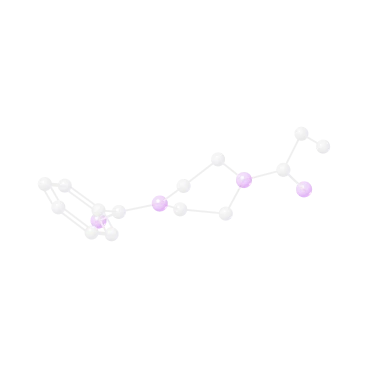
Calculated reference model · not an experimental or batch-certified structure. All 18 atoms shown.
Model data & sources
- Heavy atoms only; hydrogens are omitted from the reference display.
- Source-defined stereochemistry is checked against the calculated coordinates; no energy-minimum, crystal or solution-structure claim is made.
- Reference molecular species only; batch identity, purity, counterions and excipients are not certified.
- Formula
- C14H18N2O2
- Method
- RDKit ETKDGv3 / MMFF94s calculated reference conformer
Sunifiram
Sunifiram (DM-235) Research Standard
Sunifiram (DM-235) is a highly potent synthetic compound belonging to the racetam class of chemicals. Distinguishable by its significantly increased potency compared to earlier molecules such as piracetam, Sunifiram is utilized in laboratory research as a powerful tool for investigating excitatory amino acid receptor signaling. In in vitro models, it serves as a reference material for probing the modulation of AMPA and NMDA receptors and observing the resulting changes in nerve cell activity, synaptic signaling, and cognitive-related neuroplasticity pathways.
Physical & Handling Properties
| Property | Specification |
|---|---|
| Physical Appearance | Fine white or off-white powder |
| Solution Base | Phosphate Buffered Solution, EDTA |
Mechanism of Action & Research Context
Sunifiram is primarily investigated for its pharmacological impact on glutamatergic signaling systems in neural tissue.
-
Receptor Modulation: The compound is characterized by its activity at both AMPA and NMDA receptors. It is hypothesized to function as a positive allosteric modulator, which enhances the signaling efficiency of these receptors in isolated cell preparations.
-
Potency Profile: Sunifiram shows high binding affinity and potency relative to first-generation racetams, which matters when setting concentration ranges in receptor activation assays.
-
Signaling Pathways: Research utilizing Sunifiram focuses on its ability to potentiate synaptic transmission, making it a critical reagent for studying the mechanisms of long-term potentiation (LTP) and synaptic plasticity.
Research Applications
Sunifiram is a specialized reagent used to explore the dynamics of glutamatergic signaling and cognitive neurobiology.
Primary fields of in vitro laboratory investigation include:
-
Memory & Plasticity Studies: Examining changes in hippocampal tissue model activity to understand the mechanisms of neuroplasticity.
-
Synaptic Activity: Monitoring real-time signal propagation and movement between nerve cells in culture.
-
Focus & Pathway Research: Observing pathway activity in attention-related research models.
-
Receptor Signaling: Characterizing the dose-response relationship of AMPA/NMDA receptor activity in controlled nerve tissue environments.
-
Comparative Racetam Analysis: Utilizing Sunifiram as a high-potency benchmark when comparing the efficacy of structurally diverse racetam-class compounds.
Storage & Handling Guidelines
Store at controlled room temperature. Keep tightly closed. Liquid formats: do not refrigerate or freeze. Cold storage may cause the solution to cloud or precipitate. If this occurs, return to room temperature and mix until clear.
Storage guidance is a house recommendation. Analytical documentation is per-lot release testing.
Related Research Compounds
Research Use Disclaimer
Research Use Only Disclaimer: This product is labeled and sold "For Research Use Only — NOT FOR HUMAN CONSUMPTION." It is not a drug, dietary supplement, food, cosmetic, or medical device, and it is not approved by the FDA or any other regulator for human or veterinary use. It is supplied to approved account holders as a research chemical for laboratory use and must be handled in accordance with applicable law.