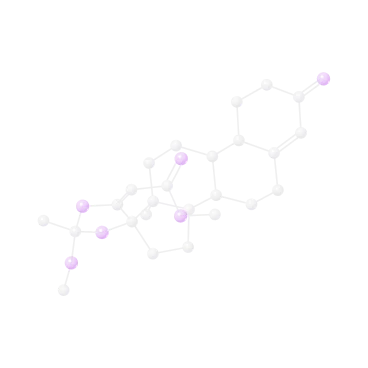
Calculated reference model · not an experimental or batch-certified structure. All 31 atoms shown.
Model data & sources
- Heavy atoms only; hydrogens are omitted from the reference display.
- Source-defined stereochemistry is checked against the calculated coordinates; no energy-minimum, crystal or solution-structure claim is made.
- The source record leaves some stereochemistry unspecified. This calculated conformer does not establish a unique stereoisomer.
- Reference molecular species only; batch identity, purity, counterions and excipients are not certified.
- Formula
- C25H34O6
- Method
- RDKit ETKDGv3 / MMFF94s calculated reference conformer
YK-11 (Myostine)
YK-11 (Myostine) Research Standard
YK-11 (CAS 1370003-76-1) is a steroidal selective androgen receptor modulator built on a 19-norpregnadiene scaffold, which sets it apart from the nonsteroidal arylpropionamide and quinolinone SARMs it is usually shelved beside. It is supplied as a reference standard, and its documented literature is predominantly analytical: mass spectrometric characterisation and metabolite identification rather than receptor pharmacology.[1,2]
Mechanism of Action & Research Context
The molecular target is the androgen receptor (AR, NR3C4), a ligand-activated nuclear hormone receptor that functions as a transcription factor.
-
A steroidal scaffold in a nonsteroidal class. Its 19-norpregnadiene nucleus means it fragments and metabolises along steroid pathways, not arylpropionamide ones. Screening methods built for nonsteroidal SARMs do not automatically cover it, which is why it was characterised separately.[3]
-
Characterised fragmentation behaviour. Under electrospray ionisation YK-11 protonates readily then undergoes substantial in-source dissociation, eliminating methanol, acetic acid methyl ester and ketene. Stable-isotope-labelled analogues and density functional theory computation were used to assign the pathways and identify diagnostic product ions for the steroidal nucleus and the D-ring substituent.[1]
-
Extensive in vivo metabolism. Following oral administration in horses, seven phase I metabolites were detected in plasma and eleven in urine, mostly non-conjugated. The most abundant urinary analytes were a mono-O-demethylated breakdown product and di-O-demethylated YK-11. In vitro incubation produced 79 metabolites with little overlap with the in vivo set — a caution against treating microsomal output as predictive.[2]
-
On receptor pharmacology, the record is thin. The widely repeated claim that YK-11 acts through myostatin or follistatin does not have retrievable primary support in the PubMed record. Treat mechanism claims for this compound as unsettled and cite them carefully.
Research Applications
Primary fields of in vitro and preclinical laboratory investigation include:
-
Mass spectrometric method development using characterised fragmentation pathways and diagnostic product ions.[1]
-
Metabolite identification in plasma and urine, and comparison of in vitro against in vivo profiles.[2]
-
Reference material for screening methods that must cover steroidal as well as nonsteroidal SARMs.[3]
-
Structure-activity work on the 19-norpregnadiene scaffold.
Analytical Documentation
Purity and identity vary by manufacturing lot. Kimera Chems does not publish a single fixed purity figure for this item; refer to the batch-specific Certificate of Analysis (COA) issued for the lot received, which reflects third-party analytical testing for that lot.
References
- Thevis M, Piper T, Dib J, et al. Mass spectrometric characterization of the selective androgen receptor modulator (SARM) YK-11 for doping control purposes. Rapid Commun Mass Spectrom. 2017;31(14):1175–1183. doi:10.1002/rcm.7886
- Harding C, Viljanto M, Habershon-Butcher J, Taylor P, Scarth J. Equine metabolism of the selective androgen receptor modulator YK-11 in urine and plasma following oral administration. Drug Test Anal. 2023;15(4):388–407. doi:10.1002/dta.3425
- Thevis M, Schänzer W. Detection of SARMs in doping control analysis. Mol Cell Endocrinol. 2017;464:34–45. doi:10.1016/j.mce.2017.01.040
Storage & Handling
Store at controlled room temperature. Keep tightly closed. Liquid formats: do not refrigerate or freeze. Cold storage may cause the solution to cloud or precipitate. If this occurs, return to room temperature and mix until clear.
Storage guidance is a house recommendation. Analytical documentation is per-lot release testing.
Related Research Compounds
Research Use Only Disclaimer: This product is labeled and sold "For Research Use Only - NOT FOR HUMAN CONSUMPTION." It is not a drug, dietary supplement, food, cosmetic, or medical device, and it is not approved by the FDA or any other regulator for human or veterinary use. It is supplied to approved account holders as a research chemical for laboratory use and must be handled in accordance with applicable law.