
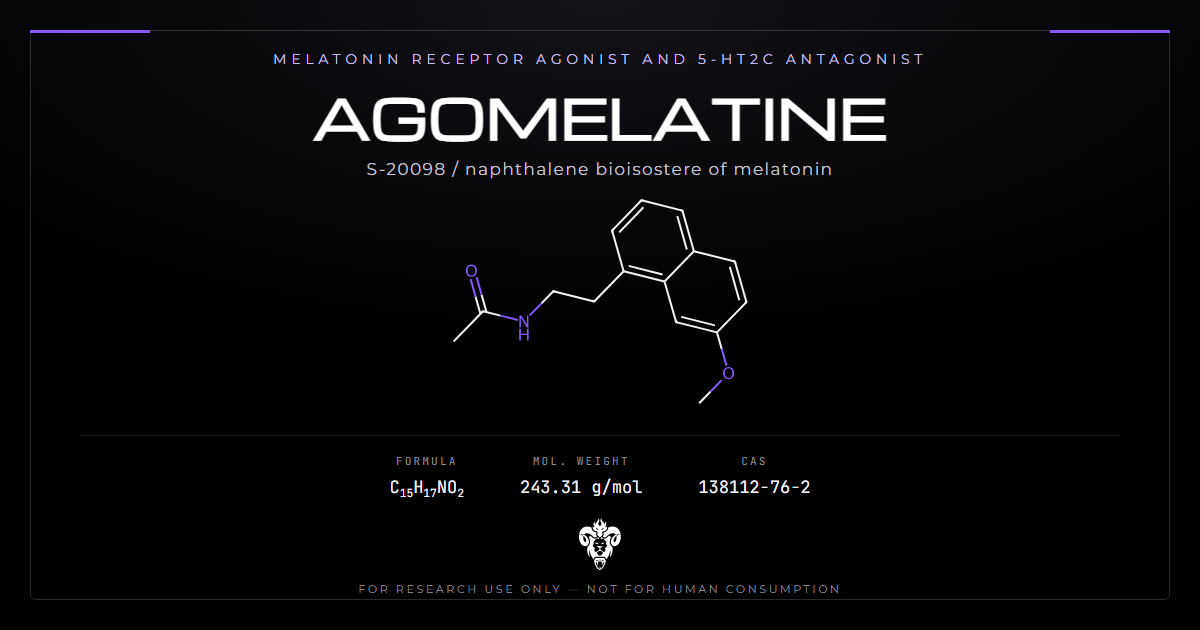
Most compounds in this catalogue never reached a regulator. Agomelatine did. European authorities approved it, and clinicians across Europe prescribe it as an antidepressant.
It never won approval in the United States. That is not a footnote about paperwork. It changes where the compound’s safety signal shows up, and it produces the strangest fact in this article. The drug with a documented liver liability is nearly absent from the world’s largest database for detecting liver liabilities [8].
Three things follow. The efficacy is real and small. The mechanism it is sold on does not do what the name suggests. And the monitoring requirement exists because nobody can predict who will develop the injury.
Chemical identity
| Property | Value |
|---|---|
| Common names | Agomelatine, S-20098 |
| Systematic | N-[2-(7-methoxynaphthalen-1-yl)ethyl]acetamide |
| Molecular formula | C15H17NO2 |
| Molecular weight | 243.30 g/mol |
| CAS | 138112-76-2 |
| PubChem CID | 82148 |
| InChIKey | YJYPHIXNFHFHND-UHFFFAOYSA-N |
| Class | Naphthalene bioisostere of melatonin |
| Stereocentres | None |
The catalogue carries it as Agomelatine.
A naphthalene where melatonin has an indole
The design is a single substitution and it is elegant. Melatonin is an indole carrying a methoxy group and an acetamide-terminated ethyl chain. Agomelatine keeps the methoxy, keeps the ethyl acetamide, and replaces the indole with a naphthalene.
Removing the indole nitrogen removes the site where monoamine oxidase and the other indole-metabolising enzymes act. The molecule keeps enough shape to engage melatonin receptors while losing melatonin’s rapid clearance.
The receptor profile that results is dual: agonism at the MT1 and MT2 melatonin receptors, and antagonism at the 5-HT2C serotonin receptor. No other compound in this catalogue combines those two. Its developers argued that the combination is what separates it from the serotonin reuptake inhibitors.
No stereocentres
The molecule is achiral. The UHFFFAOYSA block in its InChIKey is legitimate here, rather than a stereochemistry-stripped record. That distinction is worth checking on any compound, and it resolves cleanly on this one.
That removes the chiral chromatography question entirely, and it is a genuine simplification compared with most of this shelf.
What the efficacy actually is
The number, from published and unpublished trials together
Maddukuri and colleagues pooled 27 studies and 9,233 patients [1]. They included unpublished trials deliberately. Publication bias runs through antidepressant research and inflates apparent efficacy.
In acute placebo-controlled studies the standardised mean difference came to −0.24 (99% CI −0.39 to −0.09). The response rate ratio was 1.25 (1.07 to 1.47). Against active comparators the relative risk was 0.99 (0.92 to 1.07).
Read those two results together. Agomelatine beats placebo by a small margin, and it matches the antidepressants already in use. Both statements are true and neither is remarkable, which is the ordinary situation for a drug in this class.
The large network meta-analysis of 21 antidepressants took the same care [2]. Its authors searched regulatory agency websites and international registers for unpublished as well as published double-blind trials.
Where it did not beat placebo
Kishi and colleagues examined the maintenance phase, using an enrichment design across 34 studies and 9,384 patients on 20 antidepressants [3]. The outcome was relapse at six months.
Fourteen of the twenty drugs outperformed placebo. Agomelatine was not among them.
That is a specific, checkable absence rather than a positive finding of failure, and the distinction matters. The drug entered the analysis and did not clear the bar on that outcome. Acute response and relapse prevention are different questions, and a drug can answer one and not the other.
Where it does well
Two findings run the other way and belong here. A network meta-analysis of 15 adolescent trials covered 12,258 participants. It put agomelatine at the top of the depression rating scale ranking. The mean difference was −0.34 (95% CI −0.59 to −0.09), with a SUCRA of 86.4% [4].
And in anhedonia, the loss of pleasure that responds poorly to serotonin reuptake inhibitors, agomelatine appears among the agents with promising effects [10]. That is a narrative review rather than a trial. Anhedonia is also exactly the symptom a 5-HT2C antagonist should reach.
The sleep result is not what the mechanism predicts
This is the finding most worth knowing, and it is recent.
Zhang and colleagues compared agomelatine, mirtazapine and trazodone for insomnia in depression across 30 studies, with polysomnography as the primary outcome [5].
| Drug | Objective sleep measures | Subjective sleep |
|---|---|---|
| Agomelatine | No significant change in stage N1 percentage or REM latency | Improved |
| Mirtazapine | Increased total sleep time, slow-wave sleep and efficiency; reduced waking after onset | Improved |
| Trazodone | Increased total sleep time and sleep efficiency | Improved |
All three improved how patients said they slept and all three improved depressive symptoms. Only agomelatine failed to move the objective architecture, and the authors state that it may lack a definitive effect on objective sleep parameters.
State the irony plainly. Of the three drugs compared, only one rests its entire design on melatonin receptor agonism. That one did not change measured sleep. Neither of the two that did is melatonergic at all.
Two honest caveats. Thirty studies of mixed design is not a clean evidence base, and the authors call for larger unified trials. A drug that improves how someone experiences their sleep has also done something real, whatever the electroencephalogram shows.
The two mechanisms, and what each contributes
Neither receptor acts alone in a person
The dual profile is the compound’s whole pitch, and it creates an interpretive problem that no study has solved.
Melatonin receptor agonism and 5-HT2C antagonism arrive together in every dose ever given. Nobody has run agomelatine against a pure MT1/MT2 agonist and a pure 5-HT2C antagonist in one trial. The contribution of each half therefore remains an argument rather than a measurement.
The polysomnography result sharpens that problem considerably. If the melatonergic half were doing the sleep work, objective sleep architecture should move, and it did not [5]. Something is producing the subjective improvement, and the published record does not say which receptor.
The anhedonia signal points at serotonin
One piece of evidence does discriminate, and it points away from melatonin. Anhedonia responds poorly to serotonin reuptake inhibitors, and agomelatine appears among the agents with promising effects on it [10].
That is the pattern a 5-HT2C antagonist would produce rather than a melatonin agonist. It is a narrative review rather than a trial, so it is a direction of evidence and not a finding.
A dual-mechanism drug needs single-mechanism comparators to be understood, and this one has never had them.
The mechanism story runs ahead of the data
The neurogenic account of antidepressant action holds that these drugs work partly by restoring hippocampal neurogenesis. A meta-analysis corrected for publication bias found a small consistent pro-neurogenic effect across monoaminergic treatments [12].
Break that down by compound and it thins immediately. The evidence was firm only for fluoxetine. For agomelatine the number of studies was insufficient to yield definitive evidence, along with several other agents.
Nearly 30% of that literature carried a low risk of bias and 70% an unclear one, which is the usual state of rodent neurogenesis work. The point is not that the neurogenic account is wrong. Agomelatine has a defined receptor pharmacology and no settled account of how that becomes an antidepressant effect. Mechanism language in marketing copy routinely outruns that gap.
The liver, and why monitoring exists
What is required and why it does not work well
Prescribers must monitor liver function throughout treatment with agomelatine. The reason for that requirement is also what makes it unsatisfying. Liver enzymes do not work as predictive biomarkers here [7].
Monitoring detects injury after it starts. It identifies nobody in advance, so clinicians screen every patient repeatedly to find the few who develop it.
Wang and colleagues describe the pattern in a 75-year-old man taking 50 mg nightly. Transaminases exceeded the critical value on day 72, with negative hepatitis serology and no prior liver disease. Withdrawal and supportive treatment resolved it.
Two details from that report generalise. Most affected patients present with acute liver injury, and a minority reach enzyme levels more than thirty times the upper limit of normal. And the onset at day 72 shows why monitoring cannot be a single baseline test.
A metabolic hypothesis with a genetic angle
CYP1A2 is the main enzyme metabolising agomelatine. The same case report analysed the CYP1A2 rs762551 polymorphism. Its authors propose that individual differences in that enzyme drive the injury through the metabolites produced [7].
That remains a hypothesis from a single case, and the article does not present it as established. It is a testable one, and it fits the idiosyncratic pattern: unpredictable, not obviously dose-related, and unrelated to baseline liver health.
A successor built to fix it
Medicinal chemistry supplies the clearest evidence that the field takes this liability seriously. GW117 is a derivative carrying the same dual mechanism. Its developers argue that it keeps the antidepressant action with less hepatotoxicity than agomelatine [9].
They published its acute toxicity and genotoxicity package. Maximum tolerated dose 2,000 mg/kg, with no signal in bacterial reverse mutation, chromosome aberration or mouse micronucleus testing.
A successor sold on having less of the parent’s main problem is the most direct acknowledgement a field can make that the problem is real.
The pharmacovigilance gap
Here is where the regulatory history matters more than it should.
Jiang and colleagues searched the US Food and Drug Administration Adverse Event Reporting System for antidepressant liver injury. The dataset held 324,588 antidepressant cases and 10,355 drug-induced liver injuries across 42 drugs [8].
Nefazodone dominated the signal, with a reporting odds ratio of 18.67 for hepatocellular injury and the only hepatic failure signal in the dataset. Mianserin, maprotiline, clomipramine and mirtazapine also registered.
Agomelatine barely appears. The authors give the reason directly. Few reports exist for drugs not approved by the Food and Drug Administration, such as reboxetine and agomelatine [8].
A spontaneous reporting database records the country that built it. A compound carrying a mandatory hepatic monitoring requirement in Europe sits close to invisible in the American system. Absence there reflects absence from the market, not safety. Anyone assessing this drug from FAERS data alone would reach a badly wrong conclusion, and the same trap applies to every non-US-approved compound in this catalogue.
Where it sits among antidepressants
The largest recent comparison is a network meta-analysis of physiological side effects across 30 antidepressants, 151 studies, 17 FDA reports and 58,534 participants [6].
It reports roughly a 4 kg difference in weight change between agomelatine and maprotiline, with agomelatine at the favourable end of that range. The analysis also tracked cholesterol, glucose, heart rate, blood pressure, QT interval, electrolytes and the liver panel including AST, ALT, alkaline phosphatase and bilirubin.
That is the honest summary of the compound’s position. A small efficacy advantage over placebo. Equivalence with existing drugs. A metabolic profile at the favourable end of the class, and a hepatic liability demanding monitoring. Whether that trade is worth making is a clinical judgement, and this article does not make it.
One registered protocol covers a network meta-analysis of specific adverse events in children and adolescents, listing agomelatine among 19 drugs [11]. That analysis has not reported.
How to read a claim about this compound
Three questions settle most disagreements about agomelatine, and each one comes from a section above.
Which phase does the number describe?
Acute treatment and relapse prevention are separate questions with separate answers here. The compound beats placebo on acute symptom scores at a standardised mean difference of −0.24 [1]. It did not appear among the fourteen drugs beating placebo on six-month relapse [3].
A claim quoting the first while implying the second is not wrong about its number. It is answering a different question from the one the reader is asking.
Did the analysis include unpublished trials?
Both of the careful analyses cited here went looking for unpublished data, one explicitly because publication bias inflates antidepressant efficacy [1][2]. That search costs real effort and most reviews skip it.
An efficacy figure drawn only from published trials in this field should be treated as an upper bound. The same warning applied to the citicoline literature for a different reason, where a pooled analysis searched the manufacturer’s own bibliography.
Whose safety database produced the figure?
This is the question specific to agomelatine, and it is the easiest to get wrong. A liver signal drawn from FAERS understates the compound severely, because it was never marketed in the jurisdiction that database covers [8].
European pharmacovigilance, the case literature and the monitoring requirement itself are the relevant sources. Ask which regulator’s population generated the data before comparing two drugs on adverse event counts.
That third question generalises past this compound. Several products in this catalogue are approved somewhere and nowhere else, or approved for one indication and sold for another. Each of those situations puts the safety record in a different filing cabinet.
The practical version is short. Before quoting an adverse event rate, find out which population was watched, by whom, and under what obligation to report. A mandatory monitoring programme and a voluntary reporting system produce numbers that look comparable and are not.
Verifying research material
Batch documentation sits on the certificates of analysis page.
Identity
Formula C15H17NO2, molecular weight 243.30, CAS 138112-76-2, InChIKey YJYPHIXNFHFHND-UHFFFAOYSA-N.
The molecule is small and unhalogenated, so there is no isotope pattern to exploit. The methoxynaphthalene core gives a distinctive ultraviolet absorbance. Pharmacopoeial characterisation also exists, because this is a marketed medicine, which is unusual for the catalogue.
The melatonin comparison is a check, not a confusion
Melatonin is C13H16N2O2 at 232.28. Agomelatine is C15H17NO2 at 243.30.
Eleven daltons apart, one nitrogen different, and both are methoxy-substituted bicyclics carrying an ethylacetamide. Neither difference is large enough to catch by eye on a certificate, and both compounds are white crystalline solids. Check that a method separates them rather than assuming it does, particularly since melatonin is cheap and widely available.
No chiral question
There are no stereocentres, so purity on an achiral column answers that axis completely. Few compounds covered here allow that sentence without qualification.
Common questions about agomelatine
Is it approved? In Europe, yes, as an antidepressant. It was never approved in the United States [8].
How well does it work? Standardised mean difference of −0.24 against placebo in acute treatment, and equivalence with existing antidepressants at a relative risk of 0.99 [1].
Does it help sleep? Patients report better sleep. Polysomnography did not show it changing objective sleep architecture, while mirtazapine and trazodone did [5].
What is the liver risk? Real enough to require monitoring, unpredictable enough that enzymes are not predictive biomarkers, and possibly linked to CYP1A2 variation [7].
Does it cause weight gain? It sits at the favourable end of the class, about 4 kg from the other extreme [6].
Is it a melatonin substitute? No. It is a melatonin receptor agonist and also a 5-HT2C antagonist, and the two mechanisms are not separable in a person.
Why the naphthalene? Swapping melatonin’s indole for a naphthalene removes the nitrogen that indole-metabolising enzymes attack, which slows clearance while keeping the receptor fit.
Is there a successor compound? GW117 carries the same dual mechanism and is developed on the argument that it causes less hepatotoxicity [9].
Summary of the evidence
Strongest evidence is a large body of randomised trials analysed with unusual care about publication bias, including unpublished studies pulled from regulatory registers [1][2]. Their answer is a small effect against placebo and parity with existing drugs.
Most useful among the negatives is the polysomnography comparison, where the melatonergic compound was the one that did not move objective sleep [5]. Then the maintenance analysis, where fourteen of twenty antidepressants beat placebo on six-month relapse and agomelatine did not appear among them [3].
Safety is clear in outline and unresolved in detail. Monitoring is mandatory, enzymes do not predict, one case implicates CYP1A2, and a successor compound exists specifically to reduce the problem [7][9].
One transferable point is about databases rather than pharmacology. A spontaneous reporting system records the jurisdiction that built it. A compound approved in Europe and not in America will look safer in FAERS than it is [8]. That reasoning applies to a great deal of what this catalogue carries. More sits in the nootropics category, alongside Seltorexant, CDP-Choline and Noopept.
Status: supplied for laboratory research use only.
References
- Maddukuri RK, Hema C, Sri Tejaswi K, Venkata Mounika M, Vegesana BP. Antidepressant efficacy of agomelatine: meta-analysis of placebo controlled and active comparator studies. Asian J Psychiatr. 2021;65:102866. PMID 34592623. DOI
- Cipriani A, Furukawa TA, Salanti G, Chaimani A, Atkinson LZ, Ogawa Y, et al. Comparative efficacy and acceptability of 21 antidepressant drugs for the acute treatment of adults with major depressive disorder: a systematic review and network meta-analysis. Focus (Am Psychiatr Publ). 2026. PMID 42538894. DOI
- Kishi T, Ikuta T, Sakuma K, Okuya M, Hatano M, Matsuda Y, Iwata N. Antidepressants for the treatment of adults with major depressive disorder in the maintenance phase: a systematic review and network meta-analysis. Mol Psychiatry. 2023;28(1):402-409. PMID 36253442. DOI
- Wu T, Song F, Cao W, Liu C, Jia S. Comparative efficacy of antidepressant medication for adolescent depression: a network meta-analysis and systematic review. BMC Psychiatry. 2025;25(1):471. PMID 40349006. DOI
- Zhang X, Chen Y, Deng R, Tao S, Zou M, Wang Q. Management of insomnia symptoms in depressed patients treated with agomelatine, mirtazapine and trazodone: a systematic review and meta-analysis. J Affect Disord. 2026;402:121378. PMID 41679391. DOI
- Taylor RW, et al. The effects of antidepressants on cardiometabolic and other physiological parameters: a systematic review and network meta-analysis. Lancet. 2025. PMID 41135546. DOI
- Wang S, Xu Q, Qu K, Wang J, Zhou Z. CYP1A2 polymorphism may contribute to agomelatine-induced acute liver injury: case report and review of the literature. Medicine (Baltimore). 2021;100(45):e27736. PMID 34766583. DOI
- Jiang A, Wei C, Zhu W, Wu F, Wu B. Adverse event profiles of drug-induced liver injury caused by antidepressant drugs: a disproportionality analysis. Ther Adv Drug Saf. 2024;15:20420986241244585. PMID 38715707. DOI
- Gao M, Ma H, Liu T, Cao C, Zheng Z, Tang L, Gu W, Zhang D, Sun H. Acute toxicity and genotoxicity studies on new melatonergic antidepressant GW117. Heliyon. 2023;9(3):e14026. PMID 36915542. DOI
- Serretti A. Anhedonia: current and future treatments. PCN Rep. 2025;4(1):e70088. PMID 40129874. DOI
- Türkmen C, Sacu S, Furukawa Y, de Cates AN, Schoevers RA, Kamphuis J, et al. Side effect profile and comparative tolerability of newer generation antidepressants in the acute treatment of major depressive disorder in children and adolescents: protocol for a systematic review and network meta-analysis. BMJ Open. 2025;15(10):e102696. PMID 41062142. DOI
- Sampedro-Piquero P, et al. Dissecting the pro-neurogenic effects of monoaminergic medications used to treat depression: a systematic review and meta-analysis. J Psychopharmacol. 2025. PMID 40495440. DOI
Agomelatine is sold for laboratory research use only. Not for human consumption, nor medical, veterinary, or household uses.
Literature retrieved from PubMed.