
Two nationwide cohort studies have asked whether Alpha GPC raises stroke risk. Both drew on the same South Korean insurance database. They reached opposite conclusions.
One followed 12 million people and reported a 46 percent higher ten-year stroke risk among users, rising with duration [9]. The other followed half a million patients with mild cognitive impairment and reported stroke risk falling [12].
Neither is a trial. Both are large, recent, and peer-reviewed, and the gap between them is the most interesting thing in this compound’s file. Working out why they disagree matters more than picking one.
Chemical identity
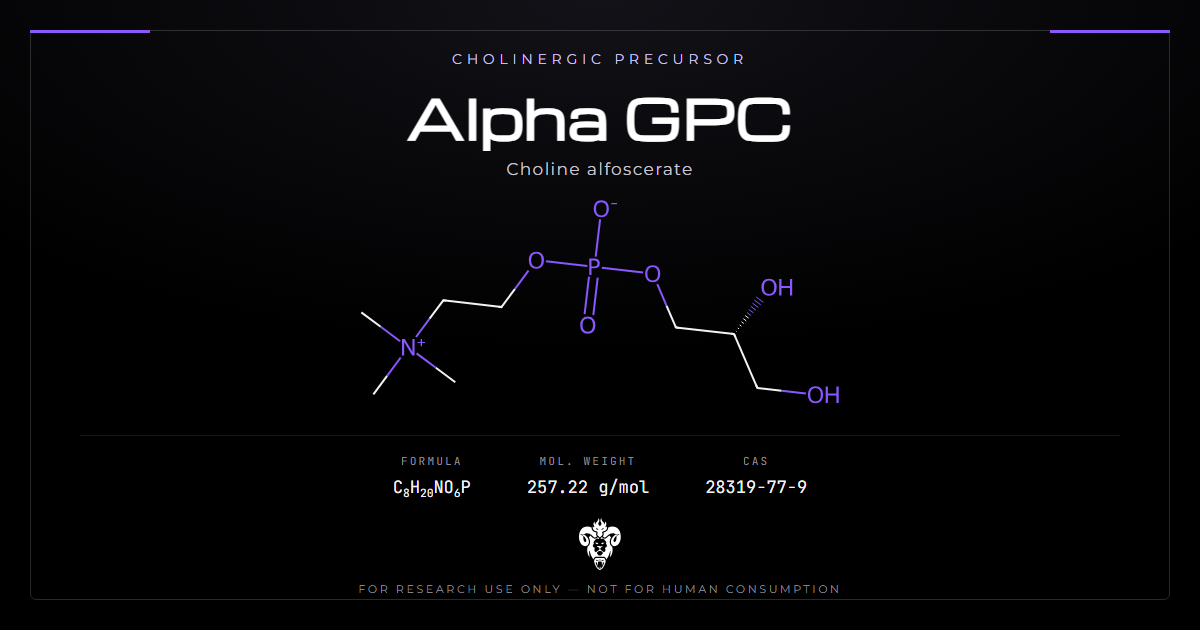
A glycerol backbone carrying a phosphocholine group at the sn-3 position. Nothing exotic, and the molecule occurs naturally in cell membranes.
| Property | Value |
|---|---|
| Systematic name | [(2R)-2,3-dihydroxypropyl] 2-(trimethylazaniumyl)ethyl phosphate |
| Common names | Alpha GPC, choline alfoscerate, choline alphoscerate, L-alpha-GPC |
| Molecular formula | C8H20NO6P |
| Average mass | 257.22 g/mol |
| Monoisotopic mass | 257.1028 Da |
| CAS number | 28319-77-9 |
| PubChem CID | 657272 |
| InChIKey | SUHOQUVVVLNYQR-MRVPVSSYSA-N |
| Stereocentres | 1, R configuration |
| Charge | Zwitterion at physiological pH |
| Choline content | Roughly 40 percent by mass |
The zwitterion
Two permanent charges sit on this molecule and cancel each other.
The trimethylammonium group carries a fixed positive charge, unavailable for protonation or deprotonation. The phosphate diester carries a negative one. Net charge is zero across the physiological range, which is what lets a molecule this polar behave better than its formula suggests.
That balance also explains the handling problems covered further down. A zwitterion with three hydroxyl-adjacent oxygens and a quaternary ammonium is aggressively hygroscopic.
Two names, one molecule
The pharmaceutical literature calls it choline alfoscerate or choline alphoscerate. Search traffic calls it Alpha GPC. The trials use the pharmaceutical names almost exclusively.
Search only the consumer term and the entire clinical record stays hidden. That includes both cohort studies and the trial anchoring every efficacy claim made for Alpha GPC. The same retrieval split hides tesamorelin behind TH9507. Here it runs the opposite way, because the catalogue name is the searched one and the literature name is the obscure one.
What a choline donor does
Alpha GPC delivers choline, and choline has two fates worth separating.
Start with the arithmetic, because it constrains both the efficacy and the safety arguments. Choline makes up roughly 40 percent of the molecule by mass. A 1,200 mg daily dose therefore carries close to 480 mg of choline, which sits in the same range as an adequate daily intake from food.
So the trials are not delivering an exotic quantity. They are delivering an ordinary choline load in a form that absorbs well and reaches the brain.
The acetylcholine route
Choline acetyltransferase combines choline with acetyl-CoA to make acetylcholine. Choline availability can limit that reaction, so supplying more is a plausible way to raise transmitter output.
Every cognition claim for this compound rests on that chain. It is also the rationale for combining it with a cholinesterase inhibitor, since one raises supply while the other slows breakdown [3][4].
The membrane route
Most choline in the body ends up in phosphatidylcholine rather than acetylcholine. It is a structural molecule first and a transmitter precursor second.
That distinction matters for interpreting a null result. A dose that raises membrane phospholipid turnover without changing transmitter output has done something real and irrelevant to cognition.
It matters even more for the safety question. The route that generates the cardiovascular concern is neither of these two, and it does not happen in human tissue at all.
The 2003 trial that anchors the efficacy claim
Before going further, here is the whole human record in one view. Six studies, two of them enormous and observational, four of them small and randomised.
| Study | n | Design | Finding |
|---|---|---|---|
| De Jesus Moreno Moreno 2003 [1] | 261 | RCT vs placebo, 180 days | ADAS-Cog -3.20 vs +2.90 |
| ASCOMALVA 2012-2014 [2][4] | 91 to 113 | RCT, added to donepezil | Decline slowed to 24 months |
| Traini 2020 [8] | 56 | MRI substudy, 3 years | Less grey matter atrophy |
| Lee and Kim 2024 [11] | 119 | Mixed design, 4 arms | ADAS-Cog +18.5% vs +9.4% |
| Lee 2021 [9] | 12,008,977 | Retrospective cohort | Stroke aHR 1.43, dose-ordered |
| Kim 2025 [12] | 508,107 | Cohort, MCI only | Dementia conversion HR 0.899 |
Note the asymmetry. Every randomised trial is small and every large study is observational, which is the shape that makes this compound hard to write about honestly.
One randomised placebo-controlled trial carries the efficacy weight, and it is worth reading carefully rather than citing.
What it measured
De Jesus Moreno Moreno enrolled 261 patients with mild to moderate Alzheimer’s dementia (PMID 12637119). Treatment was 400 mg three times daily, so 1,200 mg/day, against placebo for 180 days [1].
ADAS-Cog fell 3.20 points in the treated group by day 180. In the placebo group it rose 2.90 points. Both changes reached p below 0.001 against their own baselines, and the between-group differences held on MMSE, GDS, ADAS-Total and CGI.
A separation of roughly six points on ADAS-Cog over six months is not a small effect for this class.
What to make of it
Several features deserve stating plainly.
The paper carries a single author and a single institution. It appeared in 2003 in a journal outside the main dementia literature, and it has never been replicated at that size by an independent group.
The placebo arm declined 2.90 points over six months, which is a steeper trajectory than many Alzheimer’s cohorts show. Much of the reported separation comes from that decline rather than from improvement on Alpha GPC. The treated arm did improve on its own baseline.
None of this makes the result wrong. It makes it one trial, and every stronger claim about Alpha GPC and cognition traces back to it.
ASCOMALVA, a decade of interim results
The second body of efficacy evidence comes from one Italian trial, and its publication history is unusual enough to describe on its own.
The design
ASCOMALVA randomised patients with Alzheimer’s disease and documented ischaemic brain damage to donepezil 10 mg plus choline alfoscerate 1,200 mg/day, or donepezil plus placebo [2]. Double-blind, multicentre, with a planned enrolment of 210.
The rationale is additive cholinergic pressure: precursor loading plus breakdown inhibition.
What the reports found
Across the series, the combination beat donepezil alone on most measures. Cognitive decline slowed on MMSE and ADAS-Cog over 24 months [4]. Behavioural symptoms improved, with mood disorders separating clearly [6]. Apathy scores fell in patients whose executive function was intact at baseline [5]. Depression scores fell, most in the mildest patients [10].
Volumetric MRI at three years found less grey matter atrophy in frontal and temporal lobes, hippocampus and amygdala in the combination arm [8].
That last result is the strongest in the set, because a structural endpoint is harder to influence through unblinding than a rating scale.
The problem with the series
Every one of those publications is labelled an interim analysis.
Enrolment was planned at 210 patients. The 2012 report covers 91 [2]. Later papers cover 113 [4][6], then 90 for the depression analysis [10] and 56 for the volumetric one [8]. Across thirteen years the same group published repeatedly from a trial that never reported a completed final analysis at its planned size.
Each paper is legitimate. The pattern is a caution. Repeated interim looks at one dataset inflate the chance of a positive finding somewhere. One group reporting them, selecting a different subgroup each time, compounds that.
The replication attempt
Lee and Kim ran the nearest thing to independent confirmation in 119 patients in South Korea [11].
Patients eligible for donepezil went to donepezil alone, donepezil plus choline alfoscerate, donepezil plus acetyl-L-carnitine, or donepezil plus ginkgo. At 12 weeks ADAS-Cog improved 13.9 percent in the Alpha GPC arm, against a 0.9 percent worsening on donepezil alone. By 24 weeks the gap had widened to 18.5 against 9.4 percent.
The design was mixed, part double-blind and part open-label observation, with roughly 30 patients per arm. It supports the direction of the ASCOMALVA finding without settling it.
The stroke signal
In 2021 the safety question changed shape.
What the 2021 cohort found
Lee and colleagues turned to South Korea’s National Health Insurance Service (PMID 34817582). They followed 12,008,977 people aged 50 or older, none with prior stroke or Alzheimer’s disease [9].
They compared 108,877 people prescribed the drug during 2006 to 2008 against everyone else, then matched users to non-users on all covariates. Over follow-up to 2018, users carried an adjusted hazard ratio of 1.43 for total stroke, 1.34 for ischaemic and 1.37 for haemorrhagic stroke. Risk rose with prescription duration.
A dose-response relationship is the finding that makes this hard to dismiss. Confounders rarely arrange themselves in order of exposure.
Why the size matters and does not settle it
Twelve million people is not a substitute for randomisation.
The raw comparison shows the problem: users averaged 68.3 years against 61.6 for non-users. Doctors prescribe a cholinergic precursor to people they are already worried about. Early cognitive decline is itself a marker of cerebrovascular disease. Matching can adjust for recorded covariates and cannot adjust for the reason a prescription was written.
The authors say as much, closing by calling for work on possible mechanisms rather than declaring causation.
The opposite finding
Four years later the same database produced the reverse.
The 2025 MCI cohort
Kim and colleagues followed 508,107 patients newly diagnosed with mild cognitive impairment between 2013 and 2016 [12].
Users had a lower risk of progressing to Alzheimer’s dementia, at a hazard ratio of 0.899, and to vascular dementia at 0.832. On the secondary endpoint, stroke risk fell among patients who did not progress to dementia.
Reconciling the two
Comparator choice changed between the two, and that is probably the whole story.
Lee and colleagues compared people prescribed Alpha GPC against the general population over 50 [9]. Kim and colleagues compared users against non-users who all carried a mild cognitive impairment diagnosis [12].
Restricting to that population removes the confounding that inflates the first estimate. Both arms now carry the indication, so the prescription no longer marks out a sicker group.
Read together, the pair suggests that much of the 2021 signal reflects who receives Alpha GPC rather than what it does. That reading is plausible and unproven, and the dose-response gradient in the earlier study still wants an explanation.
Neither design can settle it. A randomised trial with vascular endpoints would, and nobody has run one.
TMAO, the proposed mechanism
The stroke hypothesis did not come from nowhere. It came from a different literature about choline.
The choline to TMAO pathway
Gut bacteria convert dietary choline to trimethylamine, and the liver oxidises that to trimethylamine-N-oxide.
Tang and colleagues established the sequence in humans (PMID 23614584). A phosphatidylcholine challenge raised TMAO, broad-spectrum antibiotics abolished the rise, and withdrawing the antibiotics restored it [3]. Among 4,007 patients followed three years, the highest TMAO quartile carried a hazard ratio of 2.54 for death, myocardial infarction or stroke against the lowest.
Alpha GPC is roughly 40 percent choline by mass, and 1,200 mg/day therefore delivers a meaningful choline load. The inference is direct enough that the 2021 authors named it [9].
What nobody has measured
No study has measured TMAO in people taking Alpha GPC.
The mechanism chains two literatures: choline raises TMAO, and TMAO tracks cardiovascular events. Both links have human support [3][7]. The compound-specific step, that this particular choline donor at these doses raises TMAO enough to matter, is assumed.
That gap is testable and cheap to close. A single crossover study with serial TMAO measurement would do it.
Two details would decide the question. Whether Alpha GPC raises TMAO more than an equivalent choline load from food, and whether the rise persists on chronic dosing or adapts. Neither has been measured.
Note also what the pathway requires. Gut bacteria perform the first step, so the response depends on an individual’s microbiota, and Tang and colleagues showed antibiotics abolishing it entirely [3]. A choline load is not a fixed TMAO exposure across people.
How to read a trial of this compound
Four questions separate an informative study from an uninformative one.
What was the comparator? The two cohort studies differ on exactly this and reach opposite answers [9][12]. In observational work on a prescribed cognitive drug, the control group defines the result.
Was it given alone or added to a cholinesterase inhibitor? ASCOMALVA and its replication both test the combination [4][11]. The 2003 trial tested monotherapy [1]. These are different questions and the answers do not transfer.
Which endpoint? Rating scales are vulnerable to unblinding. The volumetric MRI result [8] carries more weight per patient than the scale results it accompanies.
Was choline load measured? No cognition trial reports TMAO. Until one does, the efficacy and the safety literatures cannot be compared on any common quantity.
What the record does not establish
Efficacy in healthy people has no controlled support. Every trial above enrolled patients with dementia or cognitive impairment. Widespread use of Alpha GPC by people with neither has no trial behind it.
Nobody has established a dose-response for cognition. The 1,200 mg/day figure comes from the 2003 trial [1] and the ASCOMALVA protocol [4], and no study has compared doses.
The stroke question is open. One large cohort found harm with a dose gradient [9]. Another found the opposite in a better-matched population [12]. No randomised trial has measured vascular endpoints on Alpha GPC.
The mechanism connecting dose to risk remains inferred rather than measured, since no study has quantified TMAO on this compound [3].
The efficacy literature is also concentrated. One 2003 single-author trial and one Italian group’s repeated interim analyses account for most of it, with a single 119-patient replication attempt from elsewhere [11].
Verifying research material
Two properties dominate the practical handling, and both follow from the structure.
Identity
Mass is 257.22 average and 257.1028 monoisotopic. One stereocentre sits at the glycerol 2-position in the R configuration, corresponding to the natural sn-glycero-3-phosphocholine.
Stereochemistry is the check worth insisting on. The racemate and the natural L-form share a formula, a mass and a fragmentation pattern, so mass spectrometry cannot separate them. Optical rotation or chiral chromatography has to, and material sold without a rotation figure has not been shown to be the natural isomer.
Free choline and glycerophosphate are the expected hydrolysis products and belong on a certificate as named impurities.
Hygroscopicity
This compound is notoriously hygroscopic, which is why it usually ships as a solution or a capsule rather than loose powder.
Solid material pulls water from humid air fast enough to turn tacky during a weighing session. Every subsequent weighing then overstates the water and understates the compound, biasing an entire experiment in one direction. Aliquot on receipt, keep it sealed with desiccant, and let containers reach room temperature before opening so condensation does not form inside.
A dry-fill capsule format sidesteps most of this, at the cost of needing the capsule content assayed rather than assumed.
Kimera publishes third-party certificates of analysis for every lot in its COA database. Laboratories source Alpha GPC as a cholinergic precursor. It appears alongside piracetam where a racetam is under study, or selank and phenibut where a different neurotransmitter system is the comparator. Related work appears in the nootropics category.
Common questions about Alpha GPC
Does Alpha GPC cause strokes? Unresolved. A 12-million-person cohort found a 43 percent higher adjusted risk with a dose gradient [9]. A later cohort restricted to patients with mild cognitive impairment found stroke risk falling [12]. No randomised trial has measured vascular endpoints.
Why do the two cohorts disagree? Most likely the comparator. The first compared users against the general population over 50, the second against non-users who all had the same diagnosis, which removes confounding by indication.
What is the evidence it helps cognition? One 261-patient placebo-controlled trial in Alzheimer’s dementia, 1,200 mg/day for 180 days, ADAS-Cog separating by about six points [1]. Beyond that, a series of interim analyses from one Italian combination trial [4][6][8].
Does it work in healthy people? No controlled trial has tested that. Every trial discussed here enrolled patients with dementia or cognitive impairment.
Is choline alfoscerate the same thing? Yes, along with choline alphoscerate. Those are the names the clinical literature uses, and searching only the consumer term misses it.
What is the TMAO concern? Gut bacteria convert choline to trimethylamine, which the liver oxidises to TMAO, and higher TMAO tracks with cardiovascular events [3]. Nobody has measured TMAO in people taking this compound.
Why is the powder so difficult to weigh? It is strongly hygroscopic. The solid absorbs atmospheric water quickly enough to bias successive weighings in the same direction.
Summary of the evidence
Identity: choline alfoscerate, C8H20NO6P, 257.22 g/mol, CAS 28319-77-9. A zwitterion with one stereocentre, roughly 40 percent choline by mass.
Efficacy: one 261-patient randomised trial at 1,200 mg/day over 180 days, ADAS-Cog down 3.20 against a 2.90 rise on placebo [1]. Single author, never independently replicated at that size.
Combination therapy: ASCOMALVA reported slowed cognitive decline, improved behavioural symptoms, reduced apathy and depression, and less grey matter atrophy on MRI [2][4][5][6][8][10]. Every one of those is an interim analysis of a trial that planned 210 patients and reported on at most 113. One 119-patient replication supports the direction [11].
Safety: adjusted hazard ratio 1.43 for stroke across 12 million people, with a duration gradient [9]. Set against that, reduced stroke and slower dementia conversion in 508,107 patients with mild cognitive impairment [12].
Mechanism of concern: choline to trimethylamine to TMAO, with TMAO in the top quartile carrying a hazard ratio of 2.54 for major cardiovascular events [3][7]. Unmeasured for this compound.
Status: supplied for laboratory research use only.
References
- De Jesus Moreno Moreno M. Cognitive improvement in mild to moderate Alzheimer’s dementia after treatment with the acetylcholine precursor choline alfoscerate: a multicenter, double-blind, randomized, placebo-controlled trial. Clin Ther. 2003;25(1):178-193. PMID 12637119. DOI
- Amenta F, Carotenuto A, Fasanaro AM, Rea R, Traini E. The ASCOMALVA trial: association between the cholinesterase inhibitor donepezil and the cholinergic precursor choline alphoscerate in Alzheimer’s disease with cerebrovascular injury: interim results. J Neurol Sci. 2012;322(1-2):96-101. PMID 22959283. DOI
- Tang WH, Wang Z, Levison BS, et al. Intestinal microbial metabolism of phosphatidylcholine and cardiovascular risk. N Engl J Med. 2013;368(17):1575-1584. PMID 23614584. DOI
- Amenta F, Carotenuto A, Fasanaro AM, Rea R, Traini E. The ASCOMALVA trial: interim results after two years of treatment. J Alzheimers Dis. 2014;42 Suppl 3:S281-S288. PMID 24898643. DOI
- Rea R, Carotenuto A, Traini E, Fasanaro AM, Manzo V, Amenta F. Apathy treatment in Alzheimer’s disease: interim results of the ASCOMALVA trial. J Alzheimers Dis. 2015;48(2):377-383. PMID 26402001. DOI
- Carotenuto A, Rea R, Traini E, et al. The effect of the association between donepezil and choline alphoscerate on behavioral disturbances in Alzheimer’s disease: interim results of the ASCOMALVA trial. J Alzheimers Dis. 2017;56(2):805-815. PMID 28035924. DOI
- Ierardi E, Sorrentino C, Principi M, Giorgio F, Losurdo G, Di Leo A. Intestinal microbial metabolism of phosphatidylcholine: a novel insight in the cardiovascular risk scenario. Hepatobiliary Surg Nutr. 2015;4(4):289-292. PMID 26312245. DOI
- Traini E, Carotenuto A, Fasanaro AM, Amenta F. Volume analysis of brain cognitive areas in Alzheimer’s disease: interim 3-year results from the ASCOMALVA trial. J Alzheimers Dis. 2020;76(1):317-329. PMID 32508323. DOI
- Lee G, Choi S, Chang J, et al. Association of L-alpha glycerylphosphorylcholine with subsequent stroke risk after 10 years. JAMA Netw Open. 2021;4(11):e2136008. PMID 34817582. DOI
- Carotenuto A, Fasanaro AM, Manzo V, Amenta F, Traini E. Association between the cholinesterase inhibitor donepezil and the cholinergic precursor choline alphoscerate in the treatment of depression in patients with Alzheimer’s disease. J Alzheimers Dis Rep. 2022;6(1):235-243. PMID 35719710. DOI
- Lee W, Kim M. Comparative study of choline alfoscerate as a combination therapy with donepezil: a mixed double-blind randomized controlled and open-label observation trial. Medicine (Baltimore). 2024;103(24):e38067. PMID 38875437. DOI
- Kim HK, Park S, Kim SW, et al. Association between L-alpha glycerylphosphorylcholine use and delayed dementia conversion: a nationwide longitudinal study in South Korea. J Prev Alzheimers Dis. 2025;12(4):100059. PMID 40155153. DOI
Alpha GPC is sold for laboratory research use only. Not for human consumption, nor medical, veterinary, or household uses.
Literature retrieved from PubMed.