
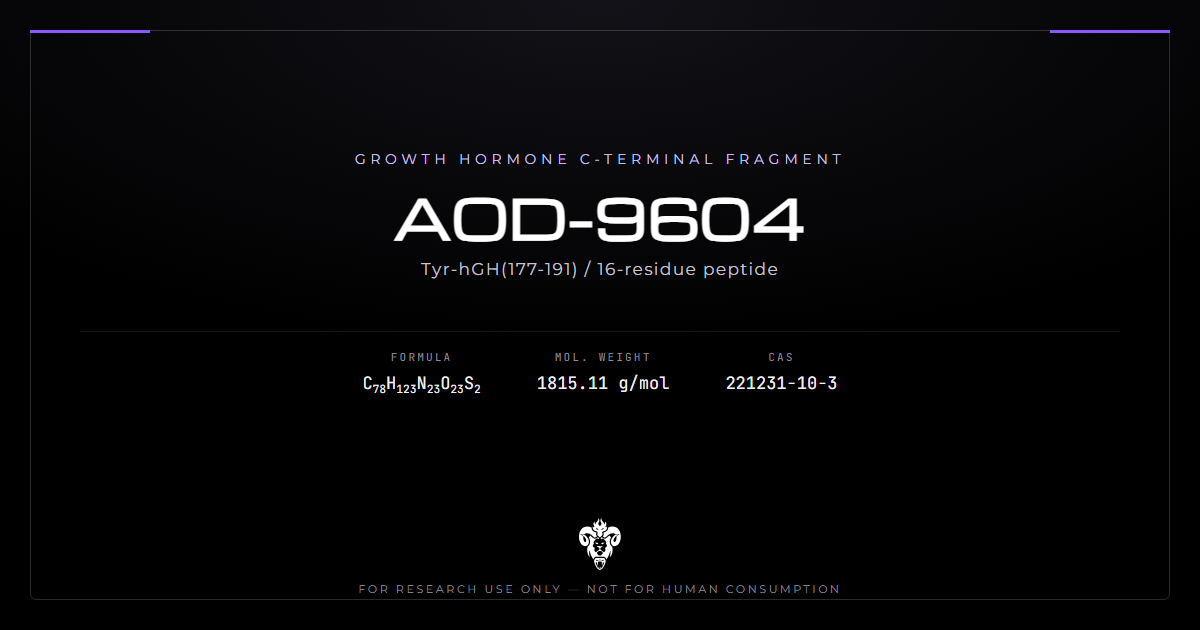
Almost every listing for this peptide calls it human growth hormone fragment 176-191. Residue 176 of human growth hormone is phenylalanine. The molecule being sold starts with tyrosine.
That is not pedantry about a typo. Anti-doping laboratories screen for AOD-9604 and for hGH 176-191 as two separate analytes in the same assay run [17]. They are two different peptides with different masses.
The underlying compound is real and it has a genuine history. Monash University chemists cut the lipolytic end off growth hormone. An Australian company then took it into clinical trials for obesity, reaching phase 2 [4].
Then the record stops. No randomised trial of this peptide in humans appears in PubMed. It has since reappeared in sports medicine as a repair peptide. The mechanism it now carries is one the original papers spent two studies ruling out.
Chemical identity
A 16-residue peptide: the last 15 residues of human growth hormone with a tyrosine added at the front, closed by the native disulfide.
| Property | Value |
|---|---|
| Common name | AOD-9604, written AOD9604 in the literature |
| Meaning of the code | Anti-obesity drug 9604 |
| Sequence | Tyr-Leu-Arg-Ile-Val-Gln-Cys-Arg-Ser-Val-Glu-Gly-Ser-Cys-Gly-Phe |
| Relationship to hGH | Tyrosine plus hGH residues 177-191 |
| Disulfide | Cys182 to Cys189 in growth hormone numbering |
| Residues | 16 |
| Molecular formula | C78H123N23O23S2 |
| Average mass | 1,815.1 Da |
| Monoisotopic mass | 1,813.8604 Da |
| CAS number | 221231-10-3 |
| PubChem CID | 71300630 |
| InChIKey | GVIYUKXRXPXMQM-BPXGDYAESA-N |
| Originator | Monash University and Metabolic Pharmaceuticals, Australia |
Reading the sequence
The parent hormone is 191 residues. Cutting after residue 176 leaves LRIVQCRSVEGSCGF, which carries the small C-terminal disulfide loop between the two cysteines.
The tyrosine at the front is synthetic. Cox and colleagues describe it plainly as an additional residue at the N-terminus rather than part of the hormone [9]. Tyrosine is the residue peptide chemists conventionally add when a molecule needs an iodination site, though the cited papers do not state the reason.
Whatever the motive, it survives into the commercial product, which is why the molecule runs to 16 residues rather than 15.
That single residue is the whole naming problem. Growth hormone position 176 is phenylalanine, so a true 176-191 fragment would begin with Phe and weigh less. Check the sequence against UniProt P01241 rather than against a product page.
Why the wrong name persists
The 176-191 label predates the tyrosine and it stuck. Anti-doping method papers list AOD9604 and hGH 176-191 side by side as distinct targets [17]. That settles the question operationally. Laboratories that have to detect both do not treat them as one compound.
Chemical databases carry a second oddity. PubChem files this peptide under synonyms beginning “Tyr-somatostatin”, and PubMed indexing tags the whole literature with the somatostatin subject heading. Somatostatin is an unrelated hormone with no sequence in common. The naming around AOD-9604 fails at almost every level. That leaves the certificate of analysis as the only thing settling what a vial holds.
What the fragment was built to do
Growth hormone does two separable things: it grows tissue through its receptor, and it mobilises fat. The programme’s premise was that those functions live in different parts of the molecule.
The lipolytic domain idea
Ng and colleagues gave obese Zucker rats 500 µg/kg of the synthetic fragment by mouth, daily for 19 days (PMID 11146367) [1]. Body weight gain fell by more than half, from 35.6 g to 15.8 g. Adipose tissue showed increased lipolytic activity.
The comparison that mattered was metabolic rather than anthropometric. Chronic growth hormone impairs insulin sensitivity. Under euglycaemic clamp, the fragment did not [1], and that single result carried the whole development programme.
Note the route. Those rats took the peptide by mouth. Oral activity is unusual for a peptide, and it sat at the centre of the commercial pitch.
Separating lipolysis from the growth hormone receptor
A companion study treated obese and lean mice for 14 days by osmotic pump [2]. Both growth hormone and the fragment reduced weight gain, raised fat oxidation and raised plasma glycerol. Only growth hormone produced hyperglycaemia and suppressed insulin.
Then the receptor test. In cells transfected with the human growth hormone receptor, AOD-9604 neither competed for binding nor induced proliferation (PMID 11673763) [2]. Growth hormone did both. The authors read this as evidence that growth hormone acts partly as a pro-hormone, with fragments acting through pathways of their own.
That result is the most important one in the file, and it cuts both ways. It supports the safety argument, since a peptide that cannot signal through the growth hormone receptor cannot drive that receptor’s proliferative effects. It also removes the obvious explanation for how the peptide works at all.
The receptor that was proposed and then ruled out
If not the growth hormone receptor, then what? The team’s answer was the beta-3 adrenergic receptor, the main lipolytic receptor on fat cells, and they tested it properly.
The knockout experiment
Both growth hormone and the fragment raised beta-3 receptor messenger RNA in obese mice [3]. Suppressed levels returned to those of lean animals. That is a plausible mechanism, and it predicts that knocking the receptor out should abolish the effect.
It did, for chronic dosing. In beta-3 knockout mice, long-term treatment with either compound failed to change body weight or raise lipolysis [3].
What the authors concluded
One result in the same paper complicates the story. Given acutely, AOD-9604 still raised energy expenditure and fat oxidation in those same knockout animals [3].
So the receptor is needed for the chronic weight effect and not for the acute metabolic one. The authors drew the careful conclusion. Lipolytic action does not run directly through the beta-3 receptor, although both compounds raise its expression [3].
Twenty-five years later, no receptor for this peptide has been identified. Anyone describing its mechanism in a sentence is going beyond the papers.
Three routes to the same endpoint
Several routes reach fat mobilisation, and the differences between them are instructive. Set AOD-9604 beside its two obvious comparators. The gap lies in how well each route is understood rather than in the size of the effect.
The defined receptor
CL-316243 is a beta-3 adrenergic agonist. Its target has a name and its knockout phenotype has a description. It also hits the same receptor the fragment was proposed to work through, and then shown not to require acutely [3].
That comparison is the honest way to read the mechanism section here. Two compounds reach a similar endpoint in rodents; one of them has a receptor and the other has an association.
Raising the hormone itself
Growth hormone secretagogues take the opposite approach. Compounds such as ipamorelin and CJC-1295 act upstream on the somatotropic axis. They raise endogenous growth hormone, which carries the lipolysis and the effects on glucose handling together.
Breaking that link was the point of cutting the molecule up. Chronic growth hormone impairs insulin sensitivity and the fragment did not [1].
What the split costs
Separating the two functions worked, and the price was the loss of a known mechanism. A whole hormone acts through a receptor someone can measure. A fragment selected on a functional readout may act through anything.
That trade sits underneath every claim about this peptide. It also explains why the literature never converged on a mechanism.
The human programme that never published
The compound went into people. Reconstructing what happened means reading pipeline reviews rather than trial reports.
| Year | Source | What it records |
|---|---|---|
| 2000 | Ng, Zucker rats [1] | Oral dosing, weight gain halved, clamp unaffected |
| 2001 | Heffernan, mice [2] | No growth hormone receptor binding, no proliferation |
| 2001 | Heffernan, knockout mice [3] | Beta-3 receptor needed chronically, not acutely |
| 2004 | Drug profile [4] | Phase 2a trials underway by February 2002 |
| 2006 | Obesity pipeline reviews [5][6] | Listed among agents in clinical development |
| 2012 | Patent and pipeline review [7] | Still listed among compounds reducing adiposity |
| 2015 | Rabbit osteoarthritis [12] | Intra-articular injection, cartilage endpoints |
| 2026 | Orthopaedic reviews [14][15] | Reintroduced as a repair peptide |
Phase 2 and the pipeline reviews
A 2004 drug profile records phase 2a trials underway by February 2002 [4]. The peptide then appears in obesity-drug pipeline reviews through 2006 and 2012. Each describes a growth hormone fragment that increases adipose tissue breakdown [5][6][7].
None of those reviews reports an efficacy result, because none had one to report. The compound stopped appearing in later pipeline reviews and the obesity programme ended.
What can and cannot be said
PubMed indexes no randomised controlled trial of AOD-9604 in humans. That is a statement about the indexed literature, and it is the honest limit of what a search establishes.
Company-sponsored safety summaries exist outside the indexed journals, and a phase 2b programme was certainly run. Neither is reachable through the databases searched here, so neither can be weighed. The practical consequence is the same either way: there is no published, peer-reviewed human efficacy result to cite.
The second life as a repair peptide
The marketing has moved on from obesity. AOD-9604 now sells for joints, cartilage and recovery, and the evidence behind that shift is thin in a specific way.
One rabbit study
Kwon and Park injected 32 rabbits with collagenase to induce knee osteoarthritis [12]. Weekly intra-articular treatment followed: saline, hyaluronic acid, AOD-9604, or the peptide combined with hyaluronic acid.
Both active treatments beat saline on morphological and histopathological scores, and the combination beat either alone. The lameness period was shortest in the combination group [12].
That is one study, in one species, with an injected joint model and a chemically induced disease. It is a reason to run more experiments rather than a basis for a clinical claim.
A mechanism the primary literature contradicts
A 2026 orthopaedic review groups AOD-9604 with growth hormone secretagogues such as ipamorelin, CJC-1295 and tesamorelin [14]. It describes the whole group as activating IGF-1 signalling and satellite cell repair.
The fragment does not belong in that group. It does not bind the growth hormone receptor [2], so it cannot raise IGF-1 by the route those compounds use. Secretagogues act on the axis upstream. This peptide does not act on the axis at all.
A second 2026 review handles it better. It stratifies peptides by evidence tier, placing this one among unapproved compounds with favourable animal data and scarce human safety evidence (PMID 41966639) [15]. That review also names something the first one does not: the placebo effect as a mediator of reported peptide benefit, amplified by social media [15].
Read the two together and the pattern is clear. A compound with no established receptor attracts mechanisms by association, and the association travels faster than the correction.
Doping status and detection
The World Anti-Doping Agency prohibits AOD-9604, and the analytical history explains why it needed dedicated attention.
Invisible to the standard growth hormone test
The routine hGH test is an isoform immunoassay. A 2013 study confirmed that AOD-9604 does not influence it (PMID 24124033) [8]. A fragment user returns a clean growth hormone result.
That gap forced purpose-built methods. Detection now runs by liquid chromatography and mass spectrometry, with the peptide included in multi-analyte screens alongside the other prohibited small peptides [11][13]. German sports-testing groups have documented the whole arc [16]. It runs from the first mass spectrometric doping methods of the 1960s to the peptide assays this compound made necessary.
The dedicated methods
Cox and colleagues validated a urine method with a detection limit of 50 pg/mL, recovery of 62%, and imprecision under 20% [9]. They also incubated the peptide in serum and urine and found six metabolites.
One of those metabolites, the fragment CRSVEGSCG, proved considerably more stable than the parent [9]. Screening for the metabolite rather than the parent extends the detection window. It is also a reminder that the parent does not last long in biological fluid.
What the supply chain looks like
Two published observations describe the material itself rather than the pharmacology, and both are worth carrying.
Belgian authorities seized pharmaceutical preparations of unknown composition and identified the contents analytically. They published the result as a case report on AOD9604 [10]. The molecule reaches users through channels where the label is not evidence.
Doping-control laboratories have measured what the peptide does in a vial or a tube. In serum and plasma at 4 °C and at 22 °C, AOD-9604 degraded extensively within one week [17]. Anyone comparing results between laboratories is comparing handling as much as pharmacology.
The two problems compound each other. A label that names the wrong peptide, and a peptide that degrades within days at room temperature, produce a set of user reports with no fixed exposure behind them. This is the same reading problem the melanotan literature has, where every human report describes what someone believed they injected rather than what a laboratory measured.
For a compound whose published human record is empty, that distinction matters more than usual. The anecdotes cannot fill the gap, because nothing anchors them to a characterised molecule at a known dose.
Four questions to ask of any AOD-9604 claim
Most confusion about this compound comes from one of four places.
Which peptide is in the vial?
AOD-9604 and hGH 176-191 are different molecules of different mass, tracked separately by the laboratories that detect them [17]. Kimera lists both AOD-9604 and Fragment 176-191 as separate items, and intact mass on the certificate is what distinguishes them.
Which species, and by which route?
The metabolic evidence is rats and mice [1][2][3]. The joint evidence is rabbits, by injection into the joint itself [12]. No result here comes from an oral or subcutaneous human endpoint.
Is the mechanism the one the papers support?
Two published experiments exclude the growth hormone receptor [2] and place the beta-3 receptor outside the acute effect [3]. Descriptions built on IGF-1 signalling [14] do not follow from the primary work.
Is there a human endpoint at all?
For obesity, the programme reached phase 2 and published nothing [4]. For joints and recovery, no human trial exists. The gap between search volume and published human evidence is close to total.
Verifying research material
A 16-residue disulfide-containing peptide of 1,815 Da has a short and specific analytical checklist.
Identity
Intact mass is the primary check, at 1,815.1 Da average and 1,813.86 monoisotopic. That figure separates the tyrosylated 16-mer from the 15-residue 176-191 species directly. One measurement tells them apart.
Peptide mapping confirms sequence, and at this length tandem mass spectrometry gives full coverage routinely. The added tyrosine sits at the N-terminus, so a b-ion series settles the question quickly.
Purity and the disulfide
The disulfide is the feature to verify. Reduced and oxidised forms differ by two mass units, which a low-resolution instrument can miss. A scrambled or reduced peptide behaves as a different molecule.
Deletion sequences are the expected synthesis impurity. Reversed-phase chromatography with mass detection finds them; ultraviolet detection alone often does not. Peptide content also differs from chromatographic purity. Lyophilised material carries counterions and water, so acetate or trifluoroacetate content belongs on the certificate.
Handling and stability
Doping-control work has quantified the stability question. Every compound tested held for at least two months at -20 °C. AOD-9604 degraded extensively within a week at 4 °C and 22 °C in serum and plasma [17].
Store the lyophilised powder cold, dry and dark, and reconstitute close to the point of use. Aliquot on reconstitution rather than sampling one vial repeatedly, and avoid freeze-thaw cycling, which drives aggregation without changing the label.
Kimera publishes third-party certificates of analysis for every lot in its COA database. Laboratories source this peptide as a growth hormone C-terminal fragment reference. It pairs with the secretagogues above, which work through the axis this fragment bypasses. Related work appears in the peptides category.
Common questions about AOD-9604
Is AOD-9604 the same as hGH fragment 176-191? No. It is tyrosine plus residues 177-191, weighing 1,815 Da, and doping laboratories track the two separately [17].
Does it raise IGF-1? There is no published basis for that. It does not bind the growth hormone receptor and does not induce proliferation through it [2].
What did the animal work show? Reduced weight gain, increased fat oxidation and increased lipolysis in rats and mice, without the insulin-sensitivity penalty growth hormone carries [1][2].
What is its receptor? Unidentified. The beta-3 adrenergic receptor is needed for the chronic weight effect but not for the acute metabolic one [3].
Was it ever tested in people? Phase 2a was underway by February 2002 [4]. No randomised human trial of it appears in PubMed.
Is it detectable in doping tests? Not by the standard growth hormone immunoassay [8], but purpose-built mass spectrometry methods detect it at 50 pg/mL in urine [9].
Summary of the evidence
Identity: 16 residues, Tyr plus hGH 177-191, C78H123N23O23S2, 1,815.1 Da, one disulfide, CAS 221231-10-3.
Naming: the circulating 176-191 label describes a different peptide, since growth hormone position 176 carries phenylalanine. Anti-doping methods list the two as separate analytes [17].
Animal metabolic data: weight gain halved in obese Zucker rats at 500 µg/kg orally for 19 days, with insulin sensitivity unaffected under clamp [1]. Fat oxidation and lipolysis rose in obese mice [2].
Receptor: not the growth hormone receptor, which it neither binds nor signals through [2]. The beta-3 adrenergic receptor is required for the chronic effect and not the acute one [3]. No receptor has been identified.
Human evidence: phase 2a underway in 2002 [4], then appearances in pipeline reviews through 2012 [5][6][7]. No randomised trial exists in the indexed literature.
Joints: one collagenase-induced rabbit study, where the combination with hyaluronic acid beat either treatment alone [12].
Doping: prohibited, and invisible to the standard growth hormone immunoassay [8]. Dedicated mass spectrometry detects it at 50 pg/mL, with a stable metabolite extending the window [9].
Status: supplied for laboratory research use only.
References
- Ng FM, Sun J, Sharma L, Libinaka R, Jiang WJ, Gianello R. Metabolic studies of a synthetic lipolytic domain (AOD9604) of human growth hormone. Horm Res. 2000;53(6):274-278. PMID 11146367. DOI
- Heffernan MA, Thorburn AW, Fam B, Summers R, Conway-Campbell B, Waters MJ, Ng FM. Increase of fat oxidation and weight loss in obese mice caused by chronic treatment with human growth hormone or a modified C-terminal fragment. Int J Obes Relat Metab Disord. 2001;25(10):1442-1449. PMID 11673763. DOI
- Heffernan M, Summers RJ, Thorburn A, Ogru E, Gianello R, Jiang WJ, Ng FM. The effects of human GH and its lipolytic fragment (AOD9604) on lipid metabolism following chronic treatment in obese mice and beta-3-AR knock-out mice. Endocrinology. 2001;142(12):5182-5189. PMID 11713213. DOI
- Wilding J. AOD-9604 Metabolic. Curr Opin Investig Drugs. 2004;5(4):436-440. PMID 15134286.
- Halford JC. Obesity drugs in clinical development. Curr Opin Investig Drugs. 2006;7(4):312-318. PMID 16625817.
- Jensen MD. Potential role of new therapies in modifying cardiovascular risk in overweight patients with metabolic risk factors. Obesity (Silver Spring). 2006;14(Suppl 3):143S-149S. PMID 16931496. DOI
- Khan A, Raza S, Khan Y, Aksoy T, Khan M, Weinberger Y, Goldman J. Current updates in the medical management of obesity. Recent Pat Endocr Metab Immune Drug Discov. 2012;6(2):117-128. PMID 22435392. DOI
- Orlovius AK, Thomas A, Schänzer W, Thevis M. AOD-9604 does not influence the WADA hGH isoform immunoassay. Drug Test Anal. 2013;5(11-12):850-852. PMID 24124033. DOI
- Cox HD, Smeal SJ, Hughes CM, Cox JE, Eichner D. Detection and in vitro metabolism of AOD9604. Drug Test Anal. 2015;7(1):31-38. PMID 25208511. DOI
- Vanhee C, Moens G, Deconinck E, De Beer JO. Identification and characterization of peptide drugs in unknown pharmaceutical preparations seized by the Belgian authorities: case report on AOD9604. Drug Test Anal. 2014;6(9):964-968. PMID 24976118. DOI
- Thevis M, Schänzer W. Analytical approaches for the detection of emerging therapeutics and non-approved drugs in human doping controls. J Pharm Biomed Anal. 2014;101:66-83. PMID 24906629. DOI
- Kwon DR, Park GY. Effect of intra-articular injection of AOD9604 with or without hyaluronic acid in rabbit osteoarthritis model. Ann Clin Lab Sci. 2015;45(4):426-432. PMID 26275694.
- Thevis M, Thomas A, Schänzer W. Detecting peptidic drugs, drug candidates and analogs in sports doping: current status and future directions. Expert Rev Proteomics. 2014;11(6):663-673. PMID 25382550. DOI
- Rahman OF, Lee SJ, Seeds WA. Therapeutic peptides in orthopaedics: applications, challenges, and future directions. J Am Acad Orthop Surg Glob Res Rev. 2026;10(1). PMID 41490200. DOI
- Mendias CL, Awan TM. Safety and efficacy of approved and unapproved peptide therapies for musculoskeletal injuries and athletic performance. Sports Med. 2026;56(8):1921-1935. PMID 41966639. DOI
- Schänzer W, Thevis M. Human sports drug testing by mass spectrometry. Mass Spectrom Rev. 2017;36(1):16-46. PMID 26213263. DOI
- Mazzarino M, Colpaert T, Deventer K, Van Eenoo P. Rapid and harmonized analytical workflow for the determination of peptidic and non-peptidic doping agents in dried and liquid blood matrices. Analyst. 2026;151(15):4398-4413. PMID 42328738. DOI
AOD-9604 is sold for laboratory research use only. Not for human consumption, nor medical, veterinary, or household uses.
Literature retrieved from PubMed.