
Erythropoietin protects tissue. It also makes red blood cells, and that second property is what stopped it becoming a tissue-protective drug: raising haematocrit in a sick patient carries thrombotic risk that a repair benefit does not obviously justify.
ARA-290 is the attempt to keep the first property and discard the second. It is an eleven-residue peptide taken from the helix B surface of erythropoietin, designed to engage the innate repair receptor while leaving the receptor that drives erythropoiesis alone [1].
Whether that worked is answerable, because three phase 2 trials exist. Two reported benefit and one reported none, and the disagreement between them is the useful part.
Chemical identity
Eleven residues, an unusually explicit fragment of a much larger protein.
| Property | Value |
|---|---|
| Common names | ARA-290, cibinetide, pHBSP, PH-BSP |
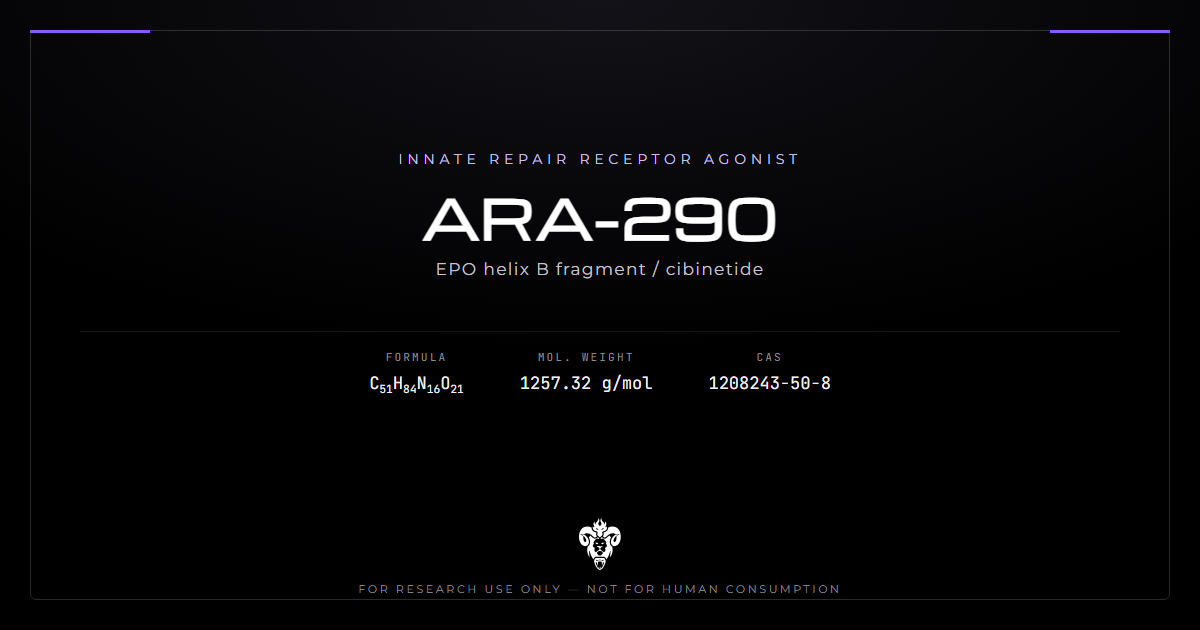
| Molecular formula | C51H84N16O21 |
| Molecular weight | 1257.3 |
| CAS | 1208243-50-8 |
| PubChem CID | 91810664 |
| InChIKey | WZTIQQBMSJTRBR-WYKNNRPVSA-N |
Kimera supplies the material as ARA-290.
What pHBSP stands for, and why it matters
Pyroglutamate helix B surface peptide. Every word is load-bearing.
Helix B names the region of erythropoietin it comes from. Surface narrows that to the solvent-facing face, the part available to touch a receptor. Pyroglutamate is a modification at the N-terminus, a cyclised glutamine that blocks aminopeptidase attack.
So the name is a design specification rather than a label. Chemists reasoned this molecule into existence rather than finding it, and the name records that.
A fragment, not an analogue
Most engineered peptides in this catalogue modify a natural sequence. This one excerpts it: a surface patch lifted out of a 165-residue glycoprotein.
That distinction predicts the pharmacology. A fragment cannot reproduce interactions that depend on the whole fold, which is precisely the point when one of those interactions is the one you want to lose.
Two receptors, and the whole design rests on the difference
Erythropoietin signals through more than one receptor arrangement, and they do different jobs.
The homodimer makes red cells
The classical erythropoietin receptor works as a homodimer, and that assembly drives erythropoiesis. Engaging it raises haematocrit. Clinicians prescribe erythropoietin for exactly that, and it is also what makes the hormone hazardous as a repair agent.
The heterodimer repairs tissue
Tissue protection runs through a different assembly, pairing the erythropoietin receptor with the beta-common receptor. That pairing forms the innate repair receptor, and ARA-290 targets it selectively [1].
A 2024 mouse study made the dependence explicit, examining neuroprotection after middle cerebral artery occlusion and measuring both receptors by western blot [2]. It attributes the brain tissue protection to the beta-common receptor.
Why selectivity is the entire value proposition
If ARA-290 raised haematocrit, it would have no reason to exist. Erythropoietin already does everything else it does, more potently.
Read every study with that in mind. Blood parameters are not an incidental safety measurement here; they are the test of whether the design premise holds.
The three phase 2 trials
Human data is unusual for a catalogue peptide, and three trials in three indications is unusual for anything.
| Trial | n | Indication | Dose | Result |
|---|---|---|---|---|
| Type 2 diabetes [1] | phase 2 | Painful neuropathy | 4 mg/day, 28 days | HbA1c and lipids improved, symptoms improved |
| Sarcoidosis [3] | 64 | Small nerve fibre loss | 1, 4, 8 mg/day, 28 days | Corneal nerve fibre area up at 4 mg only |
| Macular edema [4] | 9 | Diabetic macular edema | 4 mg/day, 12 weeks | No improvement on any measure |
The diabetic neuropathy trial
Subjects self-administered 4 mg or placebo subcutaneously each day for 28 days, then continued a further month without treatment [1]. That follow-up matters: it tests whether an effect persists after dosing stops.
Haemoglobin A1c and lipid profiles improved across the full 56-day observation period. Neuropathic symptoms improved on the PainDetect questionnaire. The investigators identified no safety issues.
The sarcoidosis trial, and its odd dose response
A 28-day randomised phase 2b enrolled 64 subjects with sarcoid-associated small nerve fibre loss and neuropathic pain, comparing 1, 4 and 8 mg daily against placebo [3]. The primary endpoint was change in corneal nerve fibre area, measured by corneal confocal microscopy.
Placebo-corrected mean change at day 28 ran 109 at 1 mg with a confidence interval crossing zero, 697 at 4 mg with an interval of 159 to 1236 and P = 0.012, and 431 at 8 mg with an interval again crossing zero.
The middle dose worked and the highest did not. Regenerating intraepidermal fibres, marked by GAP-43, increased alongside.
The macular edema trial
The trial recruited nine patients and eight completed, self-administering 4 mg daily for 12 weeks [4]. Endpoints covered best corrected visual acuity, central retinal thickness and retinal sensitivity.
Nothing improved. Visual acuity moved -2.9, retinal thickness 10 microns, sensitivity -0.53 dB, all within noise at that group size.
What the disagreement between trials means
A tidy reading would say two indications worked and one did not. The honest reading is more careful than that.
The negative trial is very small
Nine recruited, eight completed. That is a pilot, too small to exclude a modest effect. Its own framing runs to descriptive statistics and exploratory analyses rather than hypothesis testing [4].
Absence of evidence at n=8 is weak evidence of absence. It is not nothing, and it is not a refutation.
The positive trials measured different things
The neuropathy trials used nerve structure and symptom scales [1][3]. The macular edema trial used retinal thickness and acuity.
A tissue-protective agent acting on small nerve fibres has an obvious route to the first. Its route to reversing established retinal oedema is much less direct.
The dose response is not monotonic
This is the finding most worth carrying. In the sarcoidosis trial, 4 mg reached significance and 8 mg did not [3], with the higher dose’s interval crossing zero.
The same pattern appears elsewhere in this catalogue, notably in the larazotide trials where the lowest arm produced the result. Bell-shaped dose responses are real in receptor pharmacology, but chance in a multi-arm trial produces the same picture. Nothing in this literature settles the question, and anyone designing around 4 mg should know they are building on the arm that happened to reach significance.
The preclinical range
Published work covers an unusually wide set of tissues, all consistent in direction.
Neurological and vascular
Stroke, through the beta-common receptor [2]. Retinal repair, where the peptide enhanced the vasoreparative potential of endothelial colony-forming cells in ischaemic retina [5]. Peripheral nerve injury, reviewed alongside other erythropoietin-derived peptides [6].
Immune and metabolic
Systemic lupus erythematosus in mice [7]. Haemolytic-uraemic syndrome, targeting the same receptor axis [8]. Cardiac inflammation and age-associated decline in heart function [9].
Other tissues
Isolated human islets under stress, with improved engraftment in the context of intraportal transplantation [10]. Osteoclastogenesis inhibited in vitro with increased bone mineral density in mice [11]. Endothelial dysfunction corrected in a rat preeclampsia model [12].
Reading that breadth
The same caution applies as to any compound with this pattern: uniform benefit across unrelated models is either a receptor that matters everywhere or a literature that publishes positives. Here the receptor argument carries more weight than usual, because the innate repair receptor really is widely distributed and the designers specified the mechanism before anyone ran the models.
It is still worth noting that no published model reports harm.
The islet result is the one to watch
Of the preclinical set, the islet transplantation work has the clearest route to a real application [10]. Isolated human islets die in transit and during engraftment, and that loss is a known bottleneck in transplantation rather than a hypothesis.
A tissue-protective agent applied to isolated tissue, before it enters a patient, also sidesteps most of the systemic questions. The exposure is bounded and the endpoint is countable.
Bone is the least expected
Inhibiting osteoclastogenesis in vitro and raising bone mineral density in mice [11] sits furthest from anything the design anticipated. Osteoclasts derive from the same myeloid lineage the innate repair receptor sits on, so a mechanism exists, but nobody set out to find it.
Unexpected findings from a specified mechanism are worth more than expected ones. They are harder to produce by looking for what you hoped to see.
Why erythropoietin itself failed at this
The compound only makes sense against the history of the protein it came from, and that history is worth stating.
The tissue protection was real
Erythropoietin protects tissue in a long list of injury models. That observation drove serious clinical interest, because a hormone already licensed and manufactured looked like a shortcut to a neuroprotective drug.
The haematocrit was the problem
Raising red cell mass thickens blood. In a patient who has just had a stroke or a heart attack, that is precisely the wrong direction, and the risk lands on the same population the repair effect was meant to help.
That is an unusually clean case of an on-target side effect. Nothing was contaminating the preparation and no off-target receptor was involved. The molecule simply did two things, and one of them cancelled the other’s clinical value.
Which made receptor separation the only route
Two options existed. Dose low enough to protect without stimulating erythropoiesis, which no one could make reliable. Or build something that engages one receptor assembly and not the other.
ARA-290 is the second option. Reading it as “a small EPO” misses the point entirely: the smallness is incidental, and the selectivity is the entire product.
What a fragment can and cannot inherit
Excerpting eleven residues from a 165-residue glycoprotein has consequences that run in both directions.
What it keeps
Enough of the helix B surface to engage the beta-common receptor pairing [2]. That is the one interaction the design needed, and the published receptor work supports it.
What it loses
Everything requiring the intact fold, the glycosylation, or the parts of the surface that assemble the erythropoietic homodimer. Losing that last one is the objective rather than a compromise.
It also loses the protein’s pharmacokinetics. Erythropoietin’s glycans slow its clearance; an eleven-residue peptide has none of that, which is why the human trials dose daily [1][3][4].
What that means for a bench comparison
Running erythropoietin and ARA-290 side by side is a reasonable experiment and an easy one to misread. They differ in receptor selectivity, in half-life, and in molar potency at once.
A dose that matches on one axis will mismatch on the others. Any comparison needs to state which axis it matched.
One study proposes a mechanism distinct from tissue repair: relief of pathophysiological pain by targeting the TRPV1 channel, framed as an integration between immune signalling and nociception [13].
If correct, that would give the compound two routes to the neuropathy results rather than one, and they would be separable experimentally. Nobody appears to have separated them.
The distinction is not academic. A tissue-repair mechanism predicts structural recovery that outlasts dosing, which is what the corneal nerve fibre endpoint measures [3]. A channel-level analgesic mechanism predicts symptom relief that stops when dosing stops. Both trials measured both kinds of endpoint, and the follow-up month in the diabetes trial [1] is the closest thing available to a test between them.
How to read an ARA-290 study
Four questions, and the first is specific to this compound.
Were blood parameters measured?
The entire premise is tissue protection without erythropoiesis. A study that does not report haematocrit or red cell indices has not tested the premise, whatever else it measured. The stroke study did measure them [2].
Which receptor assembly?
Effects attributed to the innate repair receptor need the beta-common receptor demonstrated, not assumed [2].
Which dose?
4 mg is the arm that produced the human results [1][3][4]. 8 mg did not, in the one trial that tested it.
How large was the trial?
Sixty-four subjects [3] and nine [4] support very different conclusions. The negative result comes from the smallest study here.
Verifying research material
ARA-290 is a defined chemical entity with published identifiers, so verification is arithmetic rather than judgement. Batch documentation sits on the certificates of analysis page.
Identity
Formula C51H84N16O21, molecular weight 1257.3, InChIKey WZTIQQBMSJTRBR-WYKNNRPVSA-N. The name lookup in PubChem resolves to a stereo-defined record here, which is not true of every peptide in this catalogue.
The pyroglutamate is the check to insist on
The N-terminal pyroglutamate is a cyclised glutamine, and cyclisation costs 17 daltons against the uncyclised form. A preparation that failed to cyclise weighs 1274.3 and is not ARA-290.
High-resolution instruments resolve that difference easily. Nominal-mass instruments miss it. It also matters functionally rather than cosmetically: the modification exists to resist aminopeptidase, so an uncyclised batch has a different stability profile from the one every published study used.
Handling
Eleven residues with no cysteine, so disulfide scrambling is not a concern. Ordinary peptide practice applies: lyophilised, cold, dark, and reconstituted solutions treated as short-lived.
Compare with Thymosin Alpha-1, a much larger immunomodulatory peptide, and LL-37, where the residue composition creates different problems.
At eleven residues the synthesis is short enough that deletion sequences are a minor worry rather than the dominant one. Ten coupling steps leaves far less room for accumulation than the twenty-seven a 28-residue peptide requires, so a stated purity figure means more here than it does at that length.
Common questions about ARA-290
Identity and design
What is cibinetide? The same compound. Cibinetide is the international nonproprietary name; pHBSP and ARA-290 both appear in the literature.
What does pHBSP mean? Pyroglutamate helix B surface peptide, which is a design description: the solvent-facing surface of erythropoietin’s helix B, with a cyclised N-terminal glutamine.
Is it an erythropoietin analogue? A fragment rather than an analogue. It excerpts a surface region from the 165-residue protein instead of modifying the whole thing.
Does it raise haematocrit? Not by design. Selectivity for the innate repair receptor over the erythropoietic homodimer is the reason the compound exists [1].
Evidence
Is there human evidence? Three phase 2 trials: diabetic painful neuropathy [1], sarcoid small nerve fibre loss with 64 subjects [3], and diabetic macular edema with nine [4].
Did they all work? No. The first two reported benefit, the third reported none on every endpoint.
Which dose has the evidence? 4 mg daily. In the sarcoidosis trial 8 mg did not reach significance while 4 mg did [3].
What does it do besides nerves? Preclinical work spans stroke, retina, lupus, cardiac ageing, islet transplantation, bone and preeclampsia [2][5][7][9][10][11][12].
Why did erythropoietin not become a tissue-protective drug? Because raising haematocrit thickens blood, and the patients who would benefit from repair are the ones least able to tolerate that.
Is there a second mechanism? One study proposes TRPV1 involvement in the pain effect [13], separable in principle from tissue repair. Nobody has separated them.
Handling and verification
What mass should a batch return? 1257.3. A result near 1274.3 indicates a failed N-terminal cyclisation, which is a different compound with a different stability profile.
Why does the pyroglutamate matter functionally? It blocks aminopeptidase attack. An uncyclised batch degrades on a different timescale from the material every published study used.
Does it need disulfide handling? No cysteine in the sequence, so scrambling is not a concern.
Does PubChem resolve it correctly by name? Yes, unusually. The name lookup returns a stereo-defined record, which is not true across this catalogue.
How many residues? Eleven, excerpted from a 165-residue glycoprotein rather than modified from it.
Summary of the evidence
Strongest evidence: the 64-subject sarcoidosis phase 2b, with a structural primary endpoint measured by corneal confocal microscopy and a supporting regeneration marker [3]. Alongside it, the diabetic neuropathy phase 2 with a month of post-treatment follow-up [1].
Also notable, and rarely stated: the design premise itself has held. No published study reports the erythropoietic effect the designers set out to avoid.
Weakest evidence: the macular edema trial [4], not because it was negative but because eight completers cannot settle much either way. And the dose response, where the highest arm underperformed the middle one [3].
Read plainly, ARA-290 is the rare research peptide with real human trial data, a mechanism specified in advance, and a design goal that appears to have been met. What it does not yet have is a large trial in any single indication.
That gap is the whole story of the compound’s position. Three phase 2 trials in three indications spread the evidence thin rather than deepening it anywhere, and 64 subjects is the largest number attached to any result here. A single adequately powered trial in sarcoid small fibre neuropathy would tell you more than the existing three combined, and nobody has run one.
For laboratory work the position is better than for clinical inference. The mechanism is specified, the receptor dependence has been demonstrated, and the compound does the one thing it was built to do.
The rest of the peptide literature sits in the peptides category.
Status: supplied for laboratory research use only.
References
- Brines M, Dunne AN, van Velzen M, Proto PL, Ostenson CG, Kirk RI, Petropoulos IN, Javed S, et al. ARA 290, a nonerythropoietic peptide engineered from erythropoietin, improves metabolic control and neuropathic symptoms in patients with type 2 diabetes. Mol Med. 2015;20(1):658-66. PMID 25387363. DOI
- Wang RL, Yang ZH, Huang YY, Hu Y, Wang YL, Yan F, Zheng YM, Han ZP, et al. Erythropoietin-derived peptide ARA290 mediates brain tissue protection through the β-common receptor in mice with cerebral ischemic stroke. CNS Neurosci Ther. 2024;30(3):e14676. PMID 38488446. DOI
- Culver DA, Dahan A, Bajorunas D, Jeziorska M, van Velzen M, Aarts LPHJ, Tavee J, Tannemaat MR, et al. Cibinetide Improves Corneal Nerve Fiber Abundance in Patients With Sarcoidosis-Associated Small Nerve Fiber Loss and Neuropathic Pain. Invest Ophthalmol Vis Sci. 2017;58(6):BIO52-BIO60. PMID 28475703. DOI
- Lois N, Gardner E, McFarland M, Armstrong D, McNally C, Lavery NJ, Campbell C, Kirk RI, et al. A Phase 2 Clinical Trial on the Use of Cibinetide for the Treatment of Diabetic Macular Edema. J Clin Med. 2020;9(7). PMID 32674280. DOI
- O’Leary OE, Canning P, Reid E, Bertelli PM, McKeown S, Brines M, Cerami A, Du X, et al. The vasoreparative potential of endothelial colony-forming cells in the ischemic retina is enhanced by cibinetide, a non-hematopoietic erythropoietin mimetic. Exp Eye Res. 2019;182:144-155. PMID 30876881. DOI
- Liu G, Liang J, Li W, Jiang S, Song M, Xu S, Du Q, Wang L, et al. The protective effect of erythropoietin and its novel derived peptides in peripheral nerve injury. Int Immunopharmacol. 2024;138:112452. PMID 38943972. DOI
- Huang B, Jiang J, Luo B, Zhu W, Liu Y, Wang Z, Zhang Z. Non-erythropoietic erythropoietin-derived peptide protects mice from systemic lupus erythematosus. J Cell Mol Med. 2018;22(7):3330-3339. PMID 29570934. DOI
- Dennhardt S, Pirschel W, Wissuwa B, Imhof D, Daniel C, Kielstein JT, Hennig-Pauka I, Amann K, et al. Targeting the innate repair receptor axis via erythropoietin or pyroglutamate helix B surface peptide attenuates hemolytic-uremic syndrome in mice. Front Immunol. 2022;13:1010882. PMID 36211426. DOI
- Winicki NM, Nanavati AP, Morrell CH, Moen JM, Axsom JE, Krawczyk M, Petrashevskaya NN, Beyman MG, et al. A small erythropoietin derived non-hematopoietic peptide reduces cardiac inflammation, attenuates age associated declines in heart function and prolongs healthspan. Front Cardiovasc Med. 2022;9:1096887. PMID 36741836. DOI
- Yao M, Domogatskaya A, Ågren N, Watanabe M, Tokodai K, Brines M, Cerami A, Ericzon BG, et al. Cibinetide Protects Isolated Human Islets in a Stressful Environment and Improves Engraftment in the Perspective of Intra Portal Islet Transplantation. Cell Transplant. 2021;30:9636897211039739. PMID 34498509. DOI
- Awida Z, Bachar A, Saed H, Gorodov A, Ben-Califa N, Ibrahim M, Kolomansky A, Iden JA, et al. The Non-Erythropoietic EPO Analogue Cibinetide Inhibits Osteoclastogenesis In Vitro and Increases Bone Mineral Density in Mice. Int J Mol Sci. 2021;23(1). PMID 35008482. DOI
- Korokin M, Gureev V, Gudyrev O, Golubev I, Korokina L, Peresypkina A, Pokrovskaia T, Lazareva G, et al. Erythropoietin Mimetic Peptide (pHBSP) Corrects Endothelial Dysfunction in a Rat Model of Preeclampsia. Int J Mol Sci. 2020;21(18). PMID 32942669. DOI
- Zhang W, Yu G, Zhang M. ARA 290 relieves pathophysiological pain by targeting TRPV1 channel: Integration between immune system and nociception. Peptides. 2016;76:73-9. PMID 26774587. DOI
ARA-290 is sold for laboratory research use only. Not for human consumption, nor medical, veterinary, or household uses.