Skip to content

LL-37 Research Standard
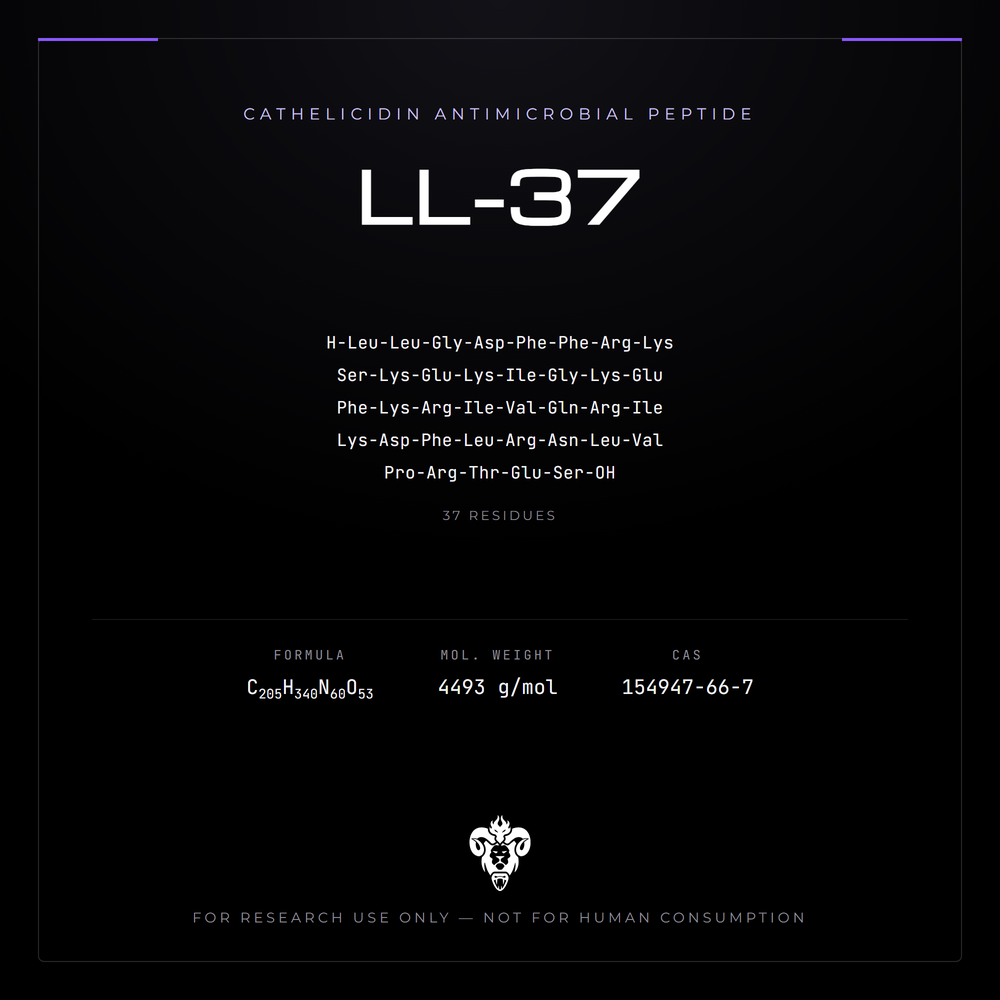
LL-37 (CAS 154947-66-7) is the only cathelicidin-derived polypeptide found in humans, supplied as a 5 mg lyophilized powder in a 3 mL vial. It kills both prokaryotic and eukaryotic cells through direct physical interaction with membranes rather than through a receptor — which makes it a biophysics tool as much as a microbiology one.[1,2]
Mechanism of Action & Research Context
Its killing mechanism is genuinely unsettled, and the two leading models come from different techniques. That disagreement is the most useful thing to know before designing an experiment with it.
-
The carpet model, from solution NMR. Reconstituted into dodecylphosphocholine micelles, LL-37 adopts a helix-break-helix conformation with both termini unstructured and solvent exposed. The break sits at K12, stabilised by a hydrophobic cluster of I13, F17 and I20 plus a K12–E16 salt bridge. The peptide adsorbs onto the micelle surface with its hydrophilic face to water and hydrophobic face buried — supporting a non-pore, carpet-like mechanism.[2]
-
The channel model, from crystallography. Crystallised in the presence of detergents, LL-37 forms a narrow tetrameric channel with a strongly charged core. Tetramer formation was confirmed by cross-linking, a small but defined conductivity was measured in planar lipid membranes, and molecular dynamics showed the channel stable in membranes with pathways for water passage.[1]
-
What both agree on. Time-lapse imaging of treated E. coli shows discontinuities in the outer membrane, followed by cell wall damage and cell death. The sequence of events is settled even where the molecular mechanism is not.[1]
-
Beyond killing. LL-37 has roles in moderating inflammation, promoting wound healing and supporting immune function, which is why it appears in immunology work as well as antimicrobial screening.[2]
Research Applications
Primary fields of in vitro laboratory investigation include:
-
Membrane interaction studies in micelles, planar lipid bilayers and liposomes.[1,2]
-
Structural characterisation by solution NMR and crystallography.[1,2]
-
Conductance measurement in planar lipid membranes to test channel formation.[1]
-
Time-lapse bacterial imaging resolving membrane damage from cell death.[1]
-
Derivative design, where the structural work provides a rational starting point.[1]
Analytical Documentation
Purity and identity vary by manufacturing lot. Kimera Chems does not publish a single fixed purity figure for this item; refer to the batch-specific Certificate of Analysis (COA) issued for the lot received, which reflects third-party analytical testing for that lot.
References
- Sancho-Vaello E, Gil-Carton D, François P, et al. The structure of the antimicrobial human cathelicidin LL-37 shows oligomerization and channel formation in the presence of membrane mimics. Sci Rep. 2020;10(1):17356. doi:10.1038/s41598-020-74401-5
- Porcelli F, Verardi R, Shi L, Henzler-Wildman KA, Ramamoorthy A, Veglia G. NMR structure of the cathelicidin-derived human antimicrobial peptide LL-37 in dodecylphosphocholine micelles. Biochemistry. 2008;47(20):5565–5572. doi:10.1021/bi702036s
Storage & Handling
Store at controlled room temperature, sealed and protected from light.
Storage guidance is a house recommendation. Analytical documentation is per-lot release testing.
Related Research Compounds
Research Use Only Disclaimer: This product is labeled and sold “For Research Use Only – NOT FOR HUMAN CONSUMPTION.” It is not a drug, dietary supplement, food, cosmetic, or medical device, and it is not approved by the FDA or any other regulator for human or veterinary use. It is supplied to approved account holders as a research chemical for laboratory use and must be handled in accordance with applicable law.