...

Larazotide

Don’t see your product’s COA?

Search our full archive of third-party verified Certificates of Analysis to pull the exact batch you received.

Browse the COA Database

Larazotide

500mcg Per Dry-Fill Capsule

30mg

60ct Total

Larazotide is intended for in vitro research use only. Not for human or veterinary use. Not for use in food, drugs, or cosmetics. All product information is provided for educational and scientific reference purposes only. Kimera Chems makes no health claims and does not represent this compound as a treatment or preventive for any condition. Researchers should consult current literature and comply with all applicable institutional and regulatory guidelines prior to use.

Trust badges: SSL secure checkout with 256-bit encryption, and third-party verification by HPLC and mass spectrometry

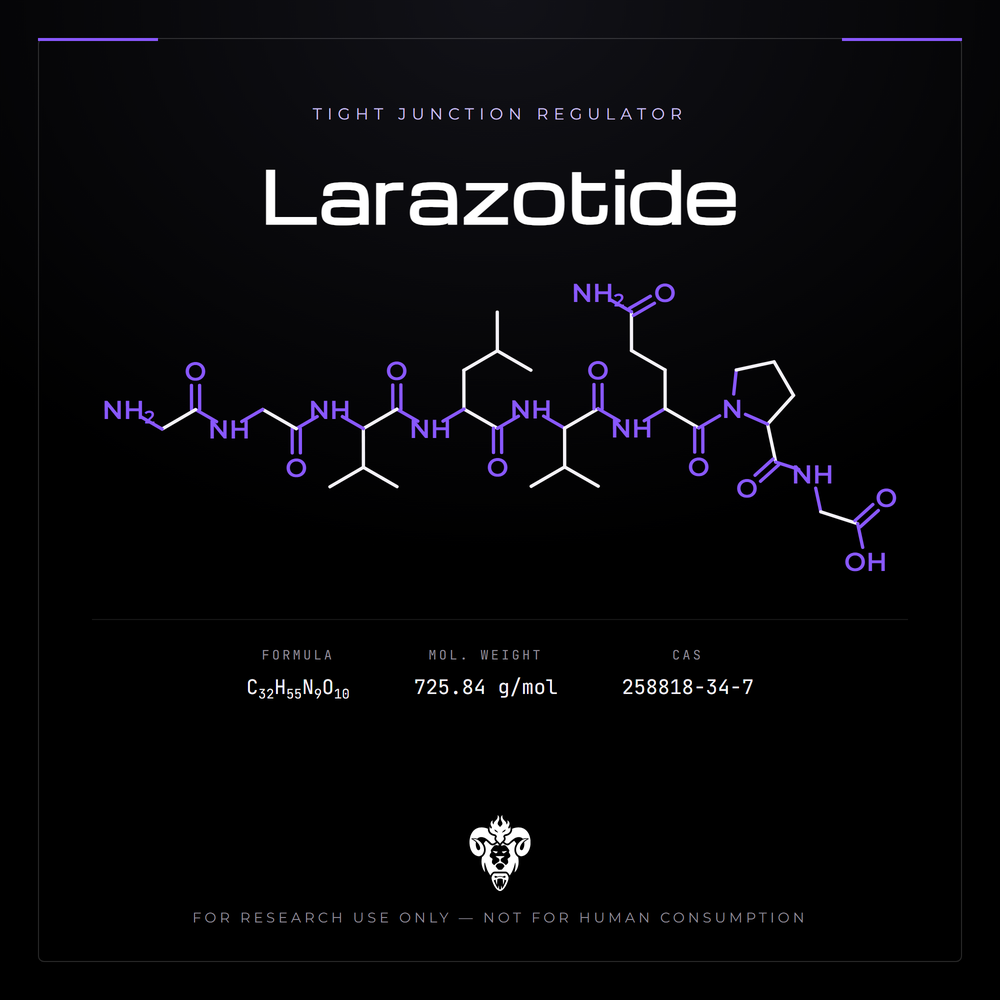
Larazotide is a synthetic octapeptide, Gly-Gly-Val-Leu-Val-Gln-Pro-Gly, derived from the zonula occludens toxin of Vibrio cholerae. It is the reference antagonist of the zonulin pathway, the endogenous signalling route that loosens epithelial tight junctions, and it occupies an unusual position among barrier-function tools: rather than disrupting junctions to study what happens, it blocks their disassembly, which lets an experiment ask whether barrier loss is a cause of a downstream effect or merely a consequence of it.

Two properties make it practical in the laboratory. It acts locally at the luminal surface rather than systemically, and it is not appreciably absorbed, so its effect can be attributed to the epithelium it contacts. That locality is the point: it isolates the barrier variable from the systemic ones that usually travel with it.

Technical Specifications

Property Specification
Product Name Larazotide
Synonyms AT-1001, INN-202, FZI/0
Sequence Gly-Gly-Val-Leu-Val-Gln-Pro-Gly
CAS Number 258818-34-7
Molecular Formula C₃₂H₅₅N₉O₁₀
Molecular Weight 725.8 g/mol
Salt Form Acetate
Chemical Class Synthetic octapeptide; zonulin receptor antagonist
Molecular Target Zonulin pathway / tight junction regulation
Appearance White to off-white lyophilized powder

Research Applications & Mechanism of Action

Zonulin signalling triggers rearrangement of the actin cytoskeleton and displacement of tight junction proteins from the cell-cell contact, opening the paracellular route. Larazotide antagonises that signal, so junction proteins stay where they are and paracellular permeability is preserved. The readouts are correspondingly physical rather than biochemical: transepithelial electrical resistance, flux of an inert marker such as labelled dextran, and the distribution of occludin and ZO-1 by immunofluorescence.

Primary fields of in vitro and preclinical laboratory investigation include:

  • Barrier Integrity Assays: Measuring transepithelial electrical resistance and paracellular tracer flux in polarised epithelial monolayers.

  • Tight Junction Protein Localisation: Imaging occludin, claudin and ZO-1 distribution after a permeability challenge, with and without antagonist present.

  • Barrier-Autoimmunity Models: Testing whether preserving epithelial integrity alters the transition from asymptomatic autoimmunity to inflammatory disease in animal models.

  • Zonulin Pathway Mapping: Serving as the standard pharmacological block for attributing an observed permeability change to zonulin rather than to another mechanism.

  • Analytical Reference Work: A defined octapeptide standard for chromatographic and mass-spectrometric method development.

Selected Research Literature

Peer-reviewed literature indexed on PubMed, provided for scientific context only. Nothing here describes or implies a use for this material.

  • Tajik N, Frech M, Schulz O, et al. Targeting zonulin and intestinal epithelial barrier function to prevent onset of arthritis. Nat Commun. 2020;11(1):1995. doi:10.1038/s41467-020-15831-7
  • Troisi J, Venutolo G, Terracciano C, Delli Carri M, Di Micco S, Landolfi A, Fasano A. The therapeutic use of the zonulin inhibitor AT-1001 (larazotide) for a variety of acute and chronic inflammatory diseases. Curr Med Chem. 2021;28(28):5788-5807. doi:10.2174/0929867328666210104110053

Assay note. Tajik et al. used barrier restoration as an intervention in the pre-symptomatic window rather than after disease onset. Timing is therefore a design variable in its own right for this compound, and a null result obtained after barrier loss has already occurred says little about the pathway.

Analytical Documentation

Purity, identity, and composition vary by manufacturing lot. Kimera Chems does not publish a single fixed purity figure for this item; refer to the batch-specific Certificate of Analysis (COA) issued for the lot received, which reflects third-party analytical testing for that lot. Contact us if a COA for your lot is required.

Related Research Compounds

Research Use Disclaimer

Research Use Only Disclaimer: This product is developed and distributed strictly as a Research Use Only (RUO) laboratory reference chemical intended exclusively for non-clinical analytical and scientific investigation. It is not an FDA-approved drug, medical treatment, dietary supplement, or food ingredient, and is strictly prohibited for human or animal consumption. Kimera Chems supplies this research material solely to qualified institutions and professional investigators for authorized laboratory research.

Description

Larazotide (AT-1001)

Larazotide is a synthetic octapeptide, Gly-Gly-Val-Leu-Val-Gln-Pro-Gly, derived from the zonula occludens toxin of Vibrio cholerae. It is the reference antagonist of the zonulin pathway, the endogenous signalling route that loosens epithelial tight junctions, and it occupies an unusual position among barrier-function tools: rather than disrupting junctions to study what happens, it blocks their disassembly, which lets an experiment ask whether barrier loss is a cause of a downstream effect or merely a consequence of it.

Two properties make it practical in the laboratory. It acts locally at the luminal surface rather than systemically, and it is not appreciably absorbed, so its effect can be attributed to the epithelium it contacts. That locality is the point: it isolates the barrier variable from the systemic ones that usually travel with it.

Technical Specifications

Property Specification
Product Name Larazotide
Synonyms AT-1001, INN-202, FZI/0
Sequence Gly-Gly-Val-Leu-Val-Gln-Pro-Gly
CAS Number 258818-34-7
Molecular Formula C₃₂H₅₅N₉O₁₀
Molecular Weight 725.8 g/mol
Salt Form Acetate
Chemical Class Synthetic octapeptide; zonulin receptor antagonist
Molecular Target Zonulin pathway / tight junction regulation
Appearance White to off-white lyophilized powder

Research Applications & Mechanism of Action

Zonulin signalling triggers rearrangement of the actin cytoskeleton and displacement of tight junction proteins from the cell-cell contact, opening the paracellular route. Larazotide antagonises that signal, so junction proteins stay where they are and paracellular permeability is preserved. The readouts are correspondingly physical rather than biochemical: transepithelial electrical resistance, flux of an inert marker such as labelled dextran, and the distribution of occludin and ZO-1 by immunofluorescence.

Primary fields of in vitro and preclinical laboratory investigation include:

  • Barrier Integrity Assays: Measuring transepithelial electrical resistance and paracellular tracer flux in polarised epithelial monolayers.

  • Tight Junction Protein Localisation: Imaging occludin, claudin and ZO-1 distribution after a permeability challenge, with and without antagonist present.

  • Barrier-Autoimmunity Models: Testing whether preserving epithelial integrity alters the transition from asymptomatic autoimmunity to inflammatory disease in animal models.

  • Zonulin Pathway Mapping: Serving as the standard pharmacological block for attributing an observed permeability change to zonulin rather than to another mechanism.

  • Analytical Reference Work: A defined octapeptide standard for chromatographic and mass-spectrometric method development.

Selected Research Literature

Peer-reviewed literature indexed on PubMed, provided for scientific context only. Nothing here describes or implies a use for this material.

  • Tajik N, Frech M, Schulz O, et al. Targeting zonulin and intestinal epithelial barrier function to prevent onset of arthritis. Nat Commun. 2020;11(1):1995. doi:10.1038/s41467-020-15831-7
  • Troisi J, Venutolo G, Terracciano C, Delli Carri M, Di Micco S, Landolfi A, Fasano A. The therapeutic use of the zonulin inhibitor AT-1001 (larazotide) for a variety of acute and chronic inflammatory diseases. Curr Med Chem. 2021;28(28):5788-5807. doi:10.2174/0929867328666210104110053

Assay note. Tajik et al. used barrier restoration as an intervention in the pre-symptomatic window rather than after disease onset. Timing is therefore a design variable in its own right for this compound, and a null result obtained after barrier loss has already occurred says little about the pathway.

Analytical Documentation

Purity, identity, and composition vary by manufacturing lot. Kimera Chems does not publish a single fixed purity figure for this item; refer to the batch-specific Certificate of Analysis (COA) issued for the lot received, which reflects third-party analytical testing for that lot. Contact us if a COA for your lot is required.

Related Research Compounds

Research Use Disclaimer

Research Use Only Disclaimer: This product is developed and distributed strictly as a Research Use Only (RUO) laboratory reference chemical intended exclusively for non-clinical analytical and scientific investigation. It is not an FDA-approved drug, medical treatment, dietary supplement, or food ingredient, and is strictly prohibited for human or animal consumption. Kimera Chems supplies this research material solely to qualified institutions and professional investigators for authorized laboratory research.

Compound Class Synthetic octapeptide
CAS Number 258818-34-7
Other Names AT-1001
IUPAC Name glycyl-glycyl-L-valyl-L-leucyl-L-valyl-L-glutaminyl-L-prolyl-glycine acetic acid
Molecular Formula C₃₂H₅₅N₉O₁₀
Molecular Weight 725.8


Kimerachems
By starting a chat with our artificial intelligence-powered assistant, you agree to the automated processing of your personal data.
Kimera Chems assistant
...