Skip to content

Thymosin Alpha-1 Research Standard
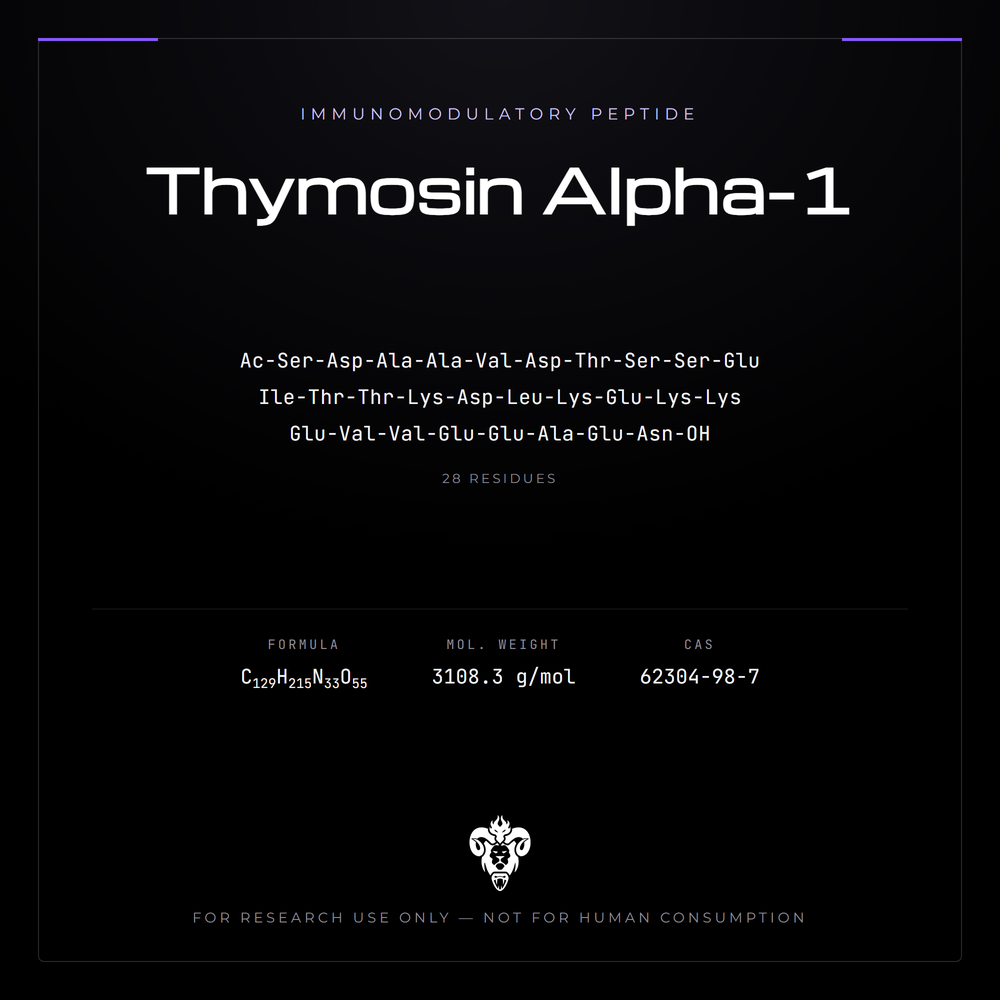
Thymosin alpha 1 (CAS 62304-98-7), also indexed as thymalfasin, is a peptide originally isolated from thymic tissue as the component responsible for restoring immune function in thymectomised mice.[1] It is supplied as a 10 mg lyophilized powder, and ships with one Acetic Acid 0.6%, 10 mL, per five units ordered.
Mechanism of Action & Research Context
Its mechanism is described in the literature as pleiotropic, affecting multiple immune cell subsets rather than acting on one receptor with one output.[1]
-
Toll-like receptors on dendritic cells are the entry point. Tα1 acts through TLRs in both myeloid and plasmacytoid dendritic cells, activating signalling pathways and initiating production of immune-related cytokines. Working through the innate sensor rather than a dedicated receptor is what gives it such a broad downstream footprint.[1]
-
It can activate or inhibit immune responses. This is the point most often lost in summary. By modulating signals delivered through innate immune receptors on dendritic cells, Tα1 shapes adaptive responses via both effector and regulatory T-helper functions — earning the review title “the regulator of regulators”. It is a modulator in the literal sense, not a stimulant, and the direction depends on context.[2]
-
Regulatory T cells are part of the picture. Treg populations are a pivotal mechanism of immunological tolerance, and malfunctioning Treg responses are documented in chronic inflammatory and autoimmune disease. Tα1’s ability to reach that compartment is why it is studied as a tolerance modulator rather than only an immune stimulant.[2]
Research Applications
Primary fields of in vitro and preclinical laboratory investigation include:
-
Dendritic cell activation assays across myeloid and plasmacytoid subsets.[1,2]
-
Toll-like receptor signalling studies.[1]
-
T-helper effector and regulatory function assays, designed to detect modulation in either direction.[2]
-
Cytokine production panels in immune cell subsets.[1]
Analytical Documentation
Purity and identity vary by manufacturing lot. Kimera Chems does not publish a single fixed purity figure for this item; refer to the batch-specific Certificate of Analysis (COA) issued for the lot received, which reflects third-party analytical testing for that lot.
References
- King R, Tuthill C. Immune modulation with thymosin alpha 1 treatment. Vitam Horm. 2016;102:151–178. doi:10.1016/bs.vh.2016.04.003
- Bonifazi P, D’Angelo C, Fallarino F, et al. Thymosin alpha1: the regulator of regulators? Ann N Y Acad Sci. 2010;1194:1–5. doi:10.1111/j.1749-6632.2010.05465.x
Storage & Handling
Store at controlled room temperature, sealed and protected from light.
Storage guidance is a house recommendation. Analytical documentation is per-lot release testing.
Related Research Compounds
Research Use Only Disclaimer: This product is labeled and sold “For Research Use Only – NOT FOR HUMAN CONSUMPTION.” It is not a drug, dietary supplement, food, cosmetic, or medical device, and it is not approved by the FDA or any other regulator for human or veterinary use. It is supplied to approved account holders as a research chemical for laboratory use and must be handled in accordance with applicable law.