
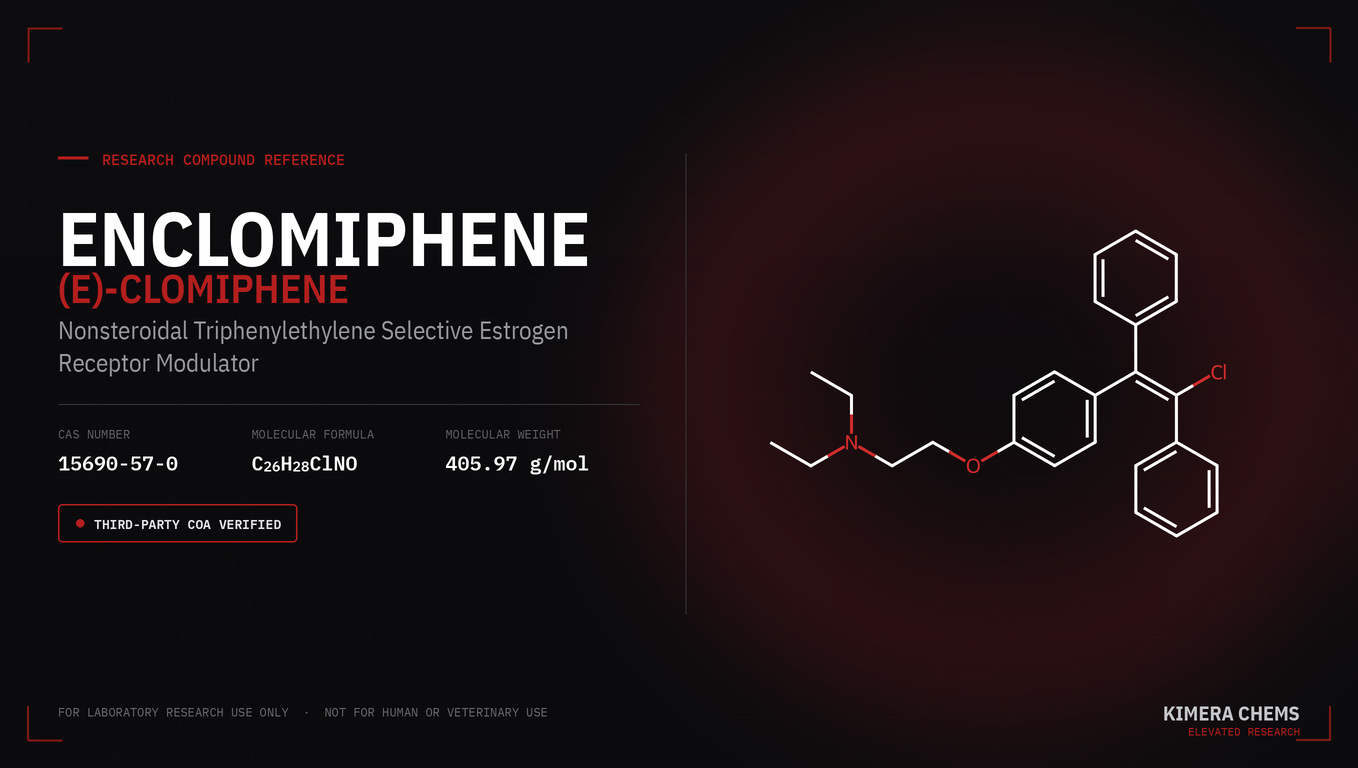
Enclomiphene is the (E)-geometric isomer of clomiphene, isolated from the racemic mixture that has been sold as a fertility drug since the 1960s. That single sentence contains the entire reason the compound exists as a separate research material — and the entire reason it is harder to verify analytically than almost anything else in a small-molecule catalog.
Two molecules with the same formula, the same exact mass, the same fragmentation pattern, and opposite pharmacology. One of them is what you ordered. Distinguishing them is not optional, and it is not something a mass spectrum can do on its own.
Chemical Identity
Enclomiphene is a nonsteroidal triphenylethylene, structurally part of the same chemical family as tamoxifen and toremifene.
| Property | Value |
|---|---|
| CAS number (free base) | 15690-57-0 |
| Molecular formula | C₂₆H₂₈ClNO |
| Molecular weight | 405.97 g/mol |
| Exact mass | 405.1859 Da |
| InChIKey | GKIRPKYJQBWNGO-OCEACIFDSA-N |
| Configuration | (E) at the C=C bond |
| Common salt | Enclomiphene citrate, 598.09 g/mol |
| Legacy synonyms | trans-clomiphene, Androxal, ICI-46474 series |
The scaffold is a tri-aryl ethylene: three phenyl rings arranged around a central carbon–carbon double bond, with a chlorine on the vinyl carbon and a 2-(diethylamino)ethoxy side chain hanging off the para position of one ring. The basic tertiary amine is the only meaningfully polar feature on an otherwise very lipophilic molecule (cLogP ≈ 6.6, TPSA 12.5 Ų), which is why it behaves the way it does in reverse-phase chromatography and why solvent choice matters in stock preparation.
A naming trap worth flagging. The historical literature calls enclomiphene trans-clomiphene and zuclomiphene cis-clomiphene. Under formal Cahn–Ingold–Prelog rules the assignments read the other way: enclomiphene is (E) and zuclomiphene is (Z). Both conventions appear in current supplier documentation, and some reference databases list “trans-clomifene” as a synonym on the zuclomiphene record. When you are reconciling a certificate of analysis against a reference standard, verify by InChIKey or by retention-time match to a characterized standard — not by the words cis and trans.
Enclomiphene Is Not Clomiphene
Clomiphene citrate as marketed is a mixture. The FDA-approved Clomid label states plainly that clomiphene citrate is a mixture of two geometric isomers, cis (zuclomiphene) and trans (enclomiphene), containing between 30% and 50% of the cis-isomer (DailyMed, Clomid prescribing information). That same label notes that the two isomers have mixed estrogenic and antiestrogenic effects, that zuclomiphene appears to have greater estrogenic activity, and that single-dose studies in volunteers showed zuclomiphene persisting in circulation for longer than a month — behavior the label attributes to possible stereospecific enterohepatic recycling or tissue sequestration.
The consequence of that asymmetry shows up directly in human serum. Helo and colleagues measured both isomers in 15 men who had been on daily clomiphene citrate for at least six weeks and found a median zuclomiphene-to-enclomiphene ratio of 20:1, with median concentrations of 44.0 and 2.2 ng/mL respectively. Neither age, BMI, treatment duration, nor testosterone level predicted the ratio (Helo et al., BJU International, 2017). A drug dosed at roughly 3:2 enclomiphene-to-zuclomiphene inverts to 1:20 in circulation. Whatever pharmacology is occurring at steady state under clomiphene is dominated by the isomer with the estrogenic character and the long residence time.
An independent anti-doping study reached the same conclusion from the other direction. Twelve healthy men took clomiphene citrate daily for 30 days; testosterone, LH, and FSH rose by means of 146%, 177%, and 170% respectively, and the zuclomiphene urinary detection window ran from 121 days to beyond 261 days after the final dose (Wenzel et al., Journal of Clinical Endocrinology & Metabolism, 2019).
This is the case for studying the isolated isomer. If an experiment is designed to interrogate estrogen receptor antagonism, a co-administered partial agonist with a multi-month tail is not a background variable — it is a second, uncontrolled arm.
Mechanism: Competitive Antagonism at the Hypothalamus
Enclomiphene acts as an estrogen receptor antagonist in hypothalamic and pituitary tissue. Estradiol normally suppresses GnRH pulse frequency through negative feedback; blocking that signal at the receptor removes the brake, and GnRH output increases. Downstream, the pituitary raises LH and FSH secretion, and in males LH drives Leydig cell steroidogenesis while FSH supports Sertoli cell function and spermatogenesis.
The pharmacological distinction that made the compound interesting is a matter of where the testosterone comes from. Exogenous androgen raises serum testosterone while suppressing the axis above it. Receptor-level antagonism raises testosterone by increasing the gonadotropin drive, leaving the axis intact and functioning. In the published trial literature this was described as restoration rather than replacement — a framing that came directly from the study titles of the era.
For researchers working on other nodes of the same axis, Gonadorelin acts one step upstream as a GnRH decapeptide, and Kisspeptin-10 acts upstream of that at the KISS1R receptor governing GnRH neuron output. The three compounds interrogate different levers on the same circuit.
The Preclinical Isomer Study
The cleanest preclinical separation of the two isomers came from a chronic oral gavage study in male mice. Fontenot, Wiehle, and Podolski dosed five groups — placebo, two enclomiphene levels, and two zuclomiphene levels — and reported that effects on Leydig cells, epididymis, seminal vesicles, and kidneys, along with alterations in serum testosterone, LH, and FSH, were associated with zuclomiphene treatment only. The isolated enclomiphene isomer produced positive effects on testosterone production with no adverse effects on testicular histology. The authors concluded that unopposed high-dose zuclomiphene can have pernicious effects on male mammalian reproductive organs (Fontenot et al., BJU International, 2016).
That is a study design worth noting for anyone building comparative work: the two isomers were run as separate arms rather than as a mixture, which is the only way the attribution holds.
The Human Clinical Record
Enclomiphene was developed by Repros Therapeutics under the name Androxal, and it accumulated a substantial published dataset before the program ended.
Pharmacokinetics and pharmacodynamics. Wiehle and colleagues characterized the compound in men with secondary hypogonadism, reporting restoration of morning testosterone alongside increased LH and FSH (Wiehle et al., BJU International, 2013). A separate short-duration study found serum testosterone responses within 14 days and described a tachyphylactic pattern across dose levels, which the authors read as a safety-relevant ceiling on the response (Wiehle et al., Journal of Men’s Health, 2014).
Comparison against topical testosterone. In the ZA-203 Phase II trial (NCT01270841), oral enclomiphene citrate produced morning serum testosterone, estradiol, and LH increases comparable to a 1% topical testosterone gel in men with secondary hypogonadism. FSH and LH rose with enclomiphene and sperm counts were conserved, while the testosterone arm showed the expected suppression of sperm parameters (Wiehle et al., Fertility and Sterility, 2014). An earlier comparison against testosterone gel had reported a similar dissociation (Kaminetsky et al., Journal of Sexual Medicine, 2013).
Phase III. Two parallel randomized, double-blind, double-dummy, placebo-controlled multicenter trials — ZA-304 and ZA-305 — evaluated two oral dose levels of enclomiphene citrate against AndroGel 1.62% in overweight men aged 18 to 60 with secondary hypogonadism. Enclomiphene raised total testosterone while raising LH and FSH and preserving sperm counts; topical testosterone raised testosterone while suppressing gonadotropins (Kim, McCullough, and Kaminetsky, BJU International, 2016).
The consistent finding across the program is the dissociation of the two endpoints. What the program never resolved was whether that dissociation translated into a clinical benefit the FDA would accept.
Regulatory History
It did not. On December 1, 2015, Repros announced it had received a Complete Response Letter from the FDA for enclomiphene. The agency stated that, based on recent scientific developments, the design of the Phase III studies was no longer adequate to demonstrate clinical benefit, and recommended one or more additional Phase III studies. The letter also raised concerns about study entry criteria, titration, and bioanalytical method validation (Repros Therapeutics press release, filed with the SEC). No sponsor has since carried the compound to approval. There is no FDA-approved enclomiphene product.
A second regulatory event matters more for anyone tracking scrutiny on this compound. On June 8, 2022, the FDA’s Pharmacy Compounding Advisory Committee reviewed enclomiphene citrate as one of four bulk drug substances nominated for the 503A Bulks List, and voted against its inclusion (FDA, Final Summary Minutes of the PCAC Meeting, June 8, 2022). Ammonium tetrathiomolybdate and ferric subsulfate were likewise rejected; only glutathione was voted for inclusion.
Separately, enclomiphene falls under the anti-doping framework covering selective estrogen receptor modulators, which are prohibited at all times in sport. The 2019 JCEM detection-window data above is the practical reason: the zuclomiphene signature from racemic clomiphene remains detectable for months.
None of this changes what the compound is chemically. All of it changes the compliance posture a supplier should hold around it — which is why enclomiphene sits inside our research-use-only framework with no exceptions, and why our Terms and Conditions apply to every unit sold.
What a Certificate of Analysis Has to Prove
Here is where enclomiphene diverges from a routine small-molecule COA, and it is worth being blunt about it.
Mass spectrometry cannot resolve the isomers. Enclomiphene and zuclomiphene share the molecular formula C₂₆H₂₈ClNO, the exact mass 405.1859, and — being geometric isomers about a single double bond — essentially identical collision-induced fragmentation. A mass spectrum showing the expected precursor and product ions confirms that the material is a clomiphene isomer. It does not confirm which one, and it does not confirm that the other one is absent. Any COA that offers MS as the sole identity evidence for enclomiphene has not answered the question the buyer is actually asking.
Chromatography is doing the real work. The identity and purity determination rests on an HPLC method that baseline-resolves the E and Z peaks, run against a characterized reference standard, with zuclomiphene named and quantified as a specified impurity rather than folded into an anonymous “total related substances” figure. If the method has not been shown to separate the two isomers, a 99% area-percent purity result is uninterpretable — it may be 99% of the wrong isomer. This is the same principle behind running orthogonal methods generally, which we cover in more depth in HPLC, Mass Spectrometry, and NMR: Three Lenses on the Same Molecule.
NMR provides the orthogonal check. The vinyl and aromatic proton environments differ between the two geometries, so ¹H NMR gives a structural confirmation that is independent of retention time and independent of the mass spectrometer.
Salt form changes the potency basis. Enclomiphene is commonly supplied as the citrate. The free base is 405.97 g/mol; the 1:1 citrate salt is 598.09 g/mol. The free base therefore accounts for roughly 68% of the salt mass. A gram of enclomiphene citrate is not a gram of enclomiphene, and a COA should state which basis the assay result is reported on. This is the same content-versus-mass distinction that drives net peptide content determination on the peptide side of the catalog, and it is just as easy to get wrong.
Every lot we release carries independent third-party analytical verification, and the certificates are published rather than described. The full archive is public at kimerachems.co/coas — including the Enclomiphene lots currently in stock.
Handling and Storage
The triphenylethylene backbone is the stability-limiting feature. Geometric isomerization about a stilbene-type double bond can be photochemically induced, which means light exposure is not a cosmetic concern for this compound — it is a mechanism by which the material you verified can become the material you did not order. Amber or foil-wrapped containment, tight seals against atmospheric moisture, and a cool, dry, temperature-controlled environment are the baseline. Solubility is high in DMSO and ethanol and negligible in aqueous buffer, consistent with the calculated lipophilicity; stock solutions should be protected from light on the same reasoning as the solid.
For comparative SERM work, Y134 offers an ER-alpha-selective benzothiophene scaffold that contrasts usefully against the triphenylethylene series, and the broader selective modulator research library covers adjacent receptor-modulator chemistry.
Where This Leaves the Compound
Enclomiphene occupies an unusual position. It has a larger and better-controlled human dataset than most compounds in the research-chemical space — multiple randomized, placebo-controlled, actively-comparator-controlled trials with published endpoints. It also has a Complete Response Letter, a negative advisory committee vote, and no approved product anywhere.
For a laboratory, the useful framing is that the isolated (E)-isomer is a cleaner pharmacological tool than the racemic mixture it was extracted from, for reasons the mouse and human isomer data both support. The catch is that the same property that makes it a cleaner tool — being one isomer rather than two — is the property that is hardest to verify and easiest for a supplier to fake, because the wrong isomer passes a mass spectrum without complaint.
Ask for the chromatogram. Ask whether the method resolves E from Z. Ask what basis the assay is reported on.
Enclomiphene is sold for laboratory research use only. Terms of sale apply. Not for human consumption, nor medical, veterinary, or household uses. The clinical literature summarized above is presented as published scientific record and is not a representation about this product. Nothing in this article constitutes administration guidance. Please familiarize yourself with our Terms and Conditions prior to ordering.
References
Enclomiphene is the (E)-geometric isomer of clomiphene, isolated from the racemic mixture that has been sold as a fertility drug since the 1960s. That single sentence contains the entire reason the compound exists as a separate research material — and the entire reason it is harder to verify analytically than almost anything else in a small-molecule catalog.
Two molecules with the same formula, the same exact mass, the same fragmentation pattern, and opposite pharmacology. One of them is what you ordered. Distinguishing them is not optional, and it is not something a mass spectrum can do on its own.
Chemical Identity
Enclomiphene is a nonsteroidal triphenylethylene, structurally part of the same chemical family as tamoxifen and toremifene.
| Property | Value |
|---|---|
| CAS number (free base) | 15690-57-0 |
| Molecular formula | C₂₆H₂₈ClNO |
| Molecular weight | 405.97 g/mol |
| Exact mass | 405.1859 Da |
| InChIKey | GKIRPKYJQBWNGO-OCEACIFDSA-N |
| Configuration | (E) at the C=C bond |
| Common salt | Enclomiphene citrate, 598.09 g/mol |
| Legacy synonyms | trans-clomiphene, Androxal, ICI-46474 series |
The scaffold is a tri-aryl ethylene: three phenyl rings arranged around a central carbon–carbon double bond, with a chlorine on the vinyl carbon and a 2-(diethylamino)ethoxy side chain hanging off the para position of one ring. The basic tertiary amine is the only meaningfully polar feature on an otherwise very lipophilic molecule (cLogP ≈ 6.6, TPSA 12.5 Ų), which is why it behaves the way it does in reverse-phase chromatography and why solvent choice matters in stock preparation.
A naming trap worth flagging. The historical literature calls enclomiphene trans-clomiphene and zuclomiphene cis-clomiphene. Under formal Cahn–Ingold–Prelog rules the assignments read the other way: enclomiphene is (E) and zuclomiphene is (Z). Both conventions appear in current supplier documentation, and some reference databases list “trans-clomifene” as a synonym on the zuclomiphene record. When you are reconciling a certificate of analysis against a reference standard, verify by InChIKey or by retention-time match to a characterized standard — not by the words cis and trans.
Enclomiphene Is Not Clomiphene
Clomiphene citrate as marketed is a mixture. The FDA-approved Clomid label states plainly that clomiphene citrate is a mixture of two geometric isomers, cis (zuclomiphene) and trans (enclomiphene), containing between 30% and 50% of the cis-isomer (DailyMed, Clomid prescribing information). That same label notes that the two isomers have mixed estrogenic and antiestrogenic effects, that zuclomiphene appears to have greater estrogenic activity, and that single-dose studies in volunteers showed zuclomiphene persisting in circulation for longer than a month — behavior the label attributes to possible stereospecific enterohepatic recycling or tissue sequestration.
The consequence of that asymmetry shows up directly in human serum. Helo and colleagues measured both isomers in 15 men who had been on daily clomiphene citrate for at least six weeks and found a median zuclomiphene-to-enclomiphene ratio of 20:1, with median concentrations of 44.0 and 2.2 ng/mL respectively. Neither age, BMI, treatment duration, nor testosterone level predicted the ratio (Helo et al., BJU International, 2017). A drug dosed at roughly 3:2 enclomiphene-to-zuclomiphene inverts to 1:20 in circulation. Whatever pharmacology is occurring at steady state under clomiphene is dominated by the isomer with the estrogenic character and the long residence time.
An independent anti-doping study reached the same conclusion from the other direction. Twelve healthy men took clomiphene citrate daily for 30 days; testosterone, LH, and FSH rose by means of 146%, 177%, and 170% respectively, and the zuclomiphene urinary detection window ran from 121 days to beyond 261 days after the final dose (Wenzel et al., Journal of Clinical Endocrinology & Metabolism, 2019).
This is the case for studying the isolated isomer. If an experiment is designed to interrogate estrogen receptor antagonism, a co-administered partial agonist with a multi-month tail is not a background variable — it is a second, uncontrolled arm.
Mechanism: Competitive Antagonism at the Hypothalamus
Enclomiphene acts as an estrogen receptor antagonist in hypothalamic and pituitary tissue. Estradiol normally suppresses GnRH pulse frequency through negative feedback; blocking that signal at the receptor removes the brake, and GnRH output increases. Downstream, the pituitary raises LH and FSH secretion, and in males LH drives Leydig cell steroidogenesis while FSH supports Sertoli cell function and spermatogenesis.
The pharmacological distinction that made the compound interesting is a matter of where the testosterone comes from. Exogenous androgen raises serum testosterone while suppressing the axis above it. Receptor-level antagonism raises testosterone by increasing the gonadotropin drive, leaving the axis intact and functioning. In the published trial literature this was described as restoration rather than replacement — a framing that came directly from the study titles of the era.
For researchers working on other nodes of the same axis, Gonadorelin acts one step upstream as a GnRH decapeptide, and Kisspeptin-10 acts upstream of that at the KISS1R receptor governing GnRH neuron output. The three compounds interrogate different levers on the same circuit.
The Preclinical Isomer Study
The cleanest preclinical separation of the two isomers came from a chronic oral gavage study in male mice. Fontenot, Wiehle, and Podolski dosed five groups — placebo, two enclomiphene levels, and two zuclomiphene levels — and reported that effects on Leydig cells, epididymis, seminal vesicles, and kidneys, along with alterations in serum testosterone, LH, and FSH, were associated with zuclomiphene treatment only. The isolated enclomiphene isomer produced positive effects on testosterone production with no adverse effects on testicular histology. The authors concluded that unopposed high-dose zuclomiphene can have pernicious effects on male mammalian reproductive organs (Fontenot et al., BJU International, 2016).
That is a study design worth noting for anyone building comparative work: the two isomers were run as separate arms rather than as a mixture, which is the only way the attribution holds.
The Human Clinical Record
Enclomiphene was developed by Repros Therapeutics under the name Androxal, and it accumulated a substantial published dataset before the program ended.
Pharmacokinetics and pharmacodynamics. Wiehle and colleagues characterized the compound in men with secondary hypogonadism, reporting restoration of morning testosterone alongside increased LH and FSH (Wiehle et al., BJU International, 2013). A separate short-duration study found serum testosterone responses within 14 days and described a tachyphylactic pattern across dose levels, which the authors read as a safety-relevant ceiling on the response (Wiehle et al., Journal of Men’s Health, 2014).
Comparison against topical testosterone. In the ZA-203 Phase II trial (NCT01270841), oral enclomiphene citrate produced morning serum testosterone, estradiol, and LH increases comparable to a 1% topical testosterone gel in men with secondary hypogonadism. FSH and LH rose with enclomiphene and sperm counts were conserved, while the testosterone arm showed the expected suppression of sperm parameters (Wiehle et al., Fertility and Sterility, 2014). An earlier comparison against testosterone gel had reported a similar dissociation (Kaminetsky et al., Journal of Sexual Medicine, 2013).
Phase III. Two parallel randomized, double-blind, double-dummy, placebo-controlled multicenter trials — ZA-304 and ZA-305 — evaluated two oral dose levels of enclomiphene citrate against AndroGel 1.62% in overweight men aged 18 to 60 with secondary hypogonadism. Enclomiphene raised total testosterone while raising LH and FSH and preserving sperm counts; topical testosterone raised testosterone while suppressing gonadotropins (Kim, McCullough, and Kaminetsky, BJU International, 2016).
The consistent finding across the program is the dissociation of the two endpoints. What the program never resolved was whether that dissociation translated into a clinical benefit the FDA would accept.
Regulatory History
It did not. On December 1, 2015, Repros announced it had received a Complete Response Letter from the FDA for enclomiphene. The agency stated that, based on recent scientific developments, the design of the Phase III studies was no longer adequate to demonstrate clinical benefit, and recommended one or more additional Phase III studies. The letter also raised concerns about study entry criteria, titration, and bioanalytical method validation (Repros Therapeutics press release, filed with the SEC). No sponsor has since carried the compound to approval. There is no FDA-approved enclomiphene product.
A second regulatory event matters more for anyone tracking scrutiny on this compound. On June 8, 2022, the FDA’s Pharmacy Compounding Advisory Committee reviewed enclomiphene citrate as one of four bulk drug substances nominated for the 503A Bulks List, and voted against its inclusion (FDA, Final Summary Minutes of the PCAC Meeting, June 8, 2022). Ammonium tetrathiomolybdate and ferric subsulfate were likewise rejected; only glutathione was voted for inclusion.
Separately, enclomiphene falls under the anti-doping framework covering selective estrogen receptor modulators, which are prohibited at all times in sport. The 2019 JCEM detection-window data above is the practical reason: the zuclomiphene signature from racemic clomiphene remains detectable for months.
None of this changes what the compound is chemically. All of it changes the compliance posture a supplier should hold around it — which is why enclomiphene sits inside our research-use-only framework with no exceptions, and why our Terms and Conditions apply to every unit sold.
What a Certificate of Analysis Has to Prove
Here is where enclomiphene diverges from a routine small-molecule COA, and it is worth being blunt about it.
Mass spectrometry cannot resolve the isomers. Enclomiphene and zuclomiphene share the molecular formula C₂₆H₂₈ClNO, the exact mass 405.1859, and — being geometric isomers about a single double bond — essentially identical collision-induced fragmentation. A mass spectrum showing the expected precursor and product ions confirms that the material is a clomiphene isomer. It does not confirm which one, and it does not confirm that the other one is absent. Any COA that offers MS as the sole identity evidence for enclomiphene has not answered the question the buyer is actually asking.
Chromatography is doing the real work. The identity and purity determination rests on an HPLC method that baseline-resolves the E and Z peaks, run against a characterized reference standard, with zuclomiphene named and quantified as a specified impurity rather than folded into an anonymous “total related substances” figure. If the method has not been shown to separate the two isomers, a 99% area-percent purity result is uninterpretable — it may be 99% of the wrong isomer. This is the same principle behind running orthogonal methods generally, which we cover in more depth in HPLC, Mass Spectrometry, and NMR: Three Lenses on the Same Molecule.
NMR provides the orthogonal check. The vinyl and aromatic proton environments differ between the two geometries, so ¹H NMR gives a structural confirmation that is independent of retention time and independent of the mass spectrometer.
Salt form changes the potency basis. Enclomiphene is commonly supplied as the citrate. The free base is 405.97 g/mol; the 1:1 citrate salt is 598.09 g/mol. The free base therefore accounts for roughly 68% of the salt mass. A gram of enclomiphene citrate is not a gram of enclomiphene, and a COA should state which basis the assay result is reported on. This is the same content-versus-mass distinction that drives net peptide content determination on the peptide side of the catalog, and it is just as easy to get wrong.
Every lot we release carries independent third-party analytical verification, and the certificates are published rather than described. The full archive is public at kimerachems.co/coas — including the Enclomiphene lots currently in stock.
Handling and Storage
The triphenylethylene backbone is the stability-limiting feature. Geometric isomerization about a stilbene-type double bond can be photochemically induced, which means light exposure is not a cosmetic concern for this compound — it is a mechanism by which the material you verified can become the material you did not order. Amber or foil-wrapped containment, tight seals against atmospheric moisture, and a cool, dry, temperature-controlled environment are the baseline. Solubility is high in DMSO and ethanol and negligible in aqueous buffer, consistent with the calculated lipophilicity; stock solutions should be protected from light on the same reasoning as the solid.
For comparative SERM work, Y134 offers an ER-alpha-selective benzothiophene scaffold that contrasts usefully against the triphenylethylene series, and the broader selective modulator research library covers adjacent receptor-modulator chemistry.
Where This Leaves the Compound
Enclomiphene occupies an unusual position. It has a larger and better-controlled human dataset than most compounds in the research-chemical space — multiple randomized, placebo-controlled, actively-comparator-controlled trials with published endpoints. It also has a Complete Response Letter, a negative advisory committee vote, and no approved product anywhere.
For a laboratory, the useful framing is that the isolated (E)-isomer is a cleaner pharmacological tool than the racemic mixture it was extracted from, for reasons the mouse and human isomer data both support. The catch is that the same property that makes it a cleaner tool — being one isomer rather than two — is the property that is hardest to verify and easiest for a supplier to fake, because the wrong isomer passes a mass spectrum without complaint.
Ask for the chromatogram. Ask whether the method resolves E from Z. Ask what basis the assay is reported on.
Enclomiphene is sold for laboratory research use only. Terms of sale apply. Not for human consumption, nor medical, veterinary, or household uses. The clinical literature summarized above is presented as published scientific record and is not a representation about this product. Nothing in this article constitutes administration guidance. Please familiarize yourself with our Terms and Conditions prior to ordering.
References
- DailyMed / FDA. Clomid (clomiphene citrate) tablets, USP — prescribing information. U.S. National Library of Medicine. https://dailymed.nlm.nih.gov/dailymed/drugInfo.cfm?setid=2ca373c1-4dba-4126-8616-5c533d606fe5
- Helo S, Mahon J, Ellen J, Wiehle R, Fontenot G, Hsu K, Feustel P, Welliver C, McCullough A. Serum levels of enclomiphene and zuclomiphene in men with hypogonadism on long-term clomiphene citrate treatment. BJU International. 2017;119(1):171–176. doi:10.1111/bju.13625. PMID: 27511863. https://pubmed.ncbi.nlm.nih.gov/27511863/
- Wenzel M, Bosman IJ, Sterk SS, et al. Hypothalamic-Pituitary-Testicular Axis Effects and Urinary Detection Following Clomiphene Administration in Males. Journal of Clinical Endocrinology & Metabolism. 2019;104(3):906–914. doi:10.1210/jc.2018-01159. PMID: 30295816. https://pubmed.ncbi.nlm.nih.gov/30295816/
- Fontenot GK, Wiehle RD, Podolski JS. Differential effects of isomers of clomiphene citrate on reproductive tissues in male mice. BJU International. 2016;117(2):344–350. doi:10.1111/bju.13244. PMID: 26220499. https://pubmed.ncbi.nlm.nih.gov/26220499/
- Wiehle R, Cunningham GR, Pitteloud N, et al. Testosterone restoration using enclomiphene citrate in men with secondary hypogonadism: a pharmacodynamic and pharmacokinetic study. BJU International. 2013;112(8):1188–1200. doi:10.1111/bju.12363
- Wiehle RD, Fontenot GK, Willett MS, Garcia WD, Podolski JS. Enclomiphene citrate stimulates serum testosterone in men with low testosterone within 14 days. Journal of Men’s Health. 2014;11(4):196–205. doi:10.1089/jomh.2014.0006
- Kaminetsky J, Werner M, Fontenot G, Wiehle RD. Oral enclomiphene citrate stimulates the endogenous production of testosterone and sperm counts in men with low testosterone: comparison with testosterone gel. Journal of Sexual Medicine. 2013;10(6):1628–1635. doi:10.1111/jsm.12116
- Wiehle RD, Fontenot GK, Wike J, Hsu K, Nydell J, Lipshultz L; ZA-203 Clinical Study Group. Enclomiphene citrate stimulates testosterone production while preventing oligospermia: a randomized phase II clinical trial comparing topical testosterone. Fertility and Sterility. 2014;102(3):720–727. doi:10.1016/j.fertnstert.2014.06.004. PMID: 25044085. https://pubmed.ncbi.nlm.nih.gov/25044085/
- Kim ED, McCullough A, Kaminetsky J. Oral enclomiphene citrate raises testosterone and preserves sperm counts in obese hypogonadal men, unlike topical testosterone: restoration instead of replacement. BJU International. 2016;117(4):677–685. doi:10.1111/bju.13337. PMID: 26496621. https://pubmed.ncbi.nlm.nih.gov/26496621/
- Rodriguez KM, Pastuszak AW, Lipshultz LI. Enclomiphene citrate for the treatment of secondary male hypogonadism. Expert Opinion on Pharmacotherapy. 2016;17(11):1561–1567. doi:10.1080/14656566.2016.1204294. PMID: 27337642.
- Earl JA, Kim ED. Enclomiphene citrate: a treatment that maintains fertility in men with secondary hypogonadism. Expert Review of Endocrinology & Metabolism. 2019;14(3):157–165. doi:10.1080/17446651.2019.1612239. PMID: 31063005.
- Hill S, Arutchelvam V, Quinton R. Enclomiphene, an estrogen receptor antagonist for the treatment of testosterone deficiency in men. IDrugs. 2009;12(2):109–119. PMID: 19204885.
- Repros Therapeutics Inc. Repros Therapeutics Receives Complete Response Letter From FDA for Enclomiphene. December 1, 2015. Filed with the U.S. Securities and Exchange Commission. https://www.sec.gov/Archives/edgar/data/897075/000117184315006596/newsrelease.htm
- U.S. Food and Drug Administration. Final Summary Minutes of the Pharmacy Compounding Advisory Committee Meeting, June 8, 2022 (enclomiphene citrate, 503A Bulks List). https://www.fda.gov/media/161293/download
- U.S. Food and Drug Administration. Bulk Drug Substances Used in Compounding Under Section 503A of the FD&C Act. https://www.fda.gov/drugs/human-drug-compounding/bulk-drug-substances-used-compounding-under-section-503a-fdc-act
- ClinicalTrials.gov. NCT01270841 — Normalization of Morning Testosterone Levels in Men With Secondary Hypogonadism (ZA-203). https://clinicaltrials.gov/study/NCT01270841