
Cerebrolysin is the rare research compound with no CAS number, no molecular formula, and no molecular weight. It is not a molecule. It is a protein hydrolysate: purified porcine brain proteins broken down by controlled enzymatic digestion into a mixture of low-molecular-weight peptides and free amino acids. Everything that makes cerebrolysin interesting and everything that makes it difficult follows from that single structural fact.
The compound has accumulated one of the largest clinical trial bases of any agent that has never been reviewed by the FDA. It also carries a Cochrane review concluding no benefit on mortality alongside a 2025 meta-analysis concluding significant neurological improvement, both drawing on overlapping trials. That contradiction is not a reporting artifact. It reflects genuine methodological disagreement about how to analyze the same data, and understanding it is the most useful thing a researcher can take from the cerebrolysin literature.
This profile covers composition, what mass spectrometry has actually identified in the preparation, the proposed mechanisms, the clinical record across stroke, traumatic brain injury and dementia, and the verification problem that a hydrolysate creates for any supplier. Cerebrolysin is supplied by Kimera Chems for laboratory research use only.
What Cerebrolysin Is
Cerebrolysin was developed in Austria and carries the development designation FPF-1070. It is manufactured by EVER Neuro Pharma, formerly Ebewe Pharma, and has been in continuous clinical use since the 1970s. The reference product is a clear, faintly amber aqueous solution supplied in sealed ampoules at 215.2 mg of peptide hydrolysate per milliliter.
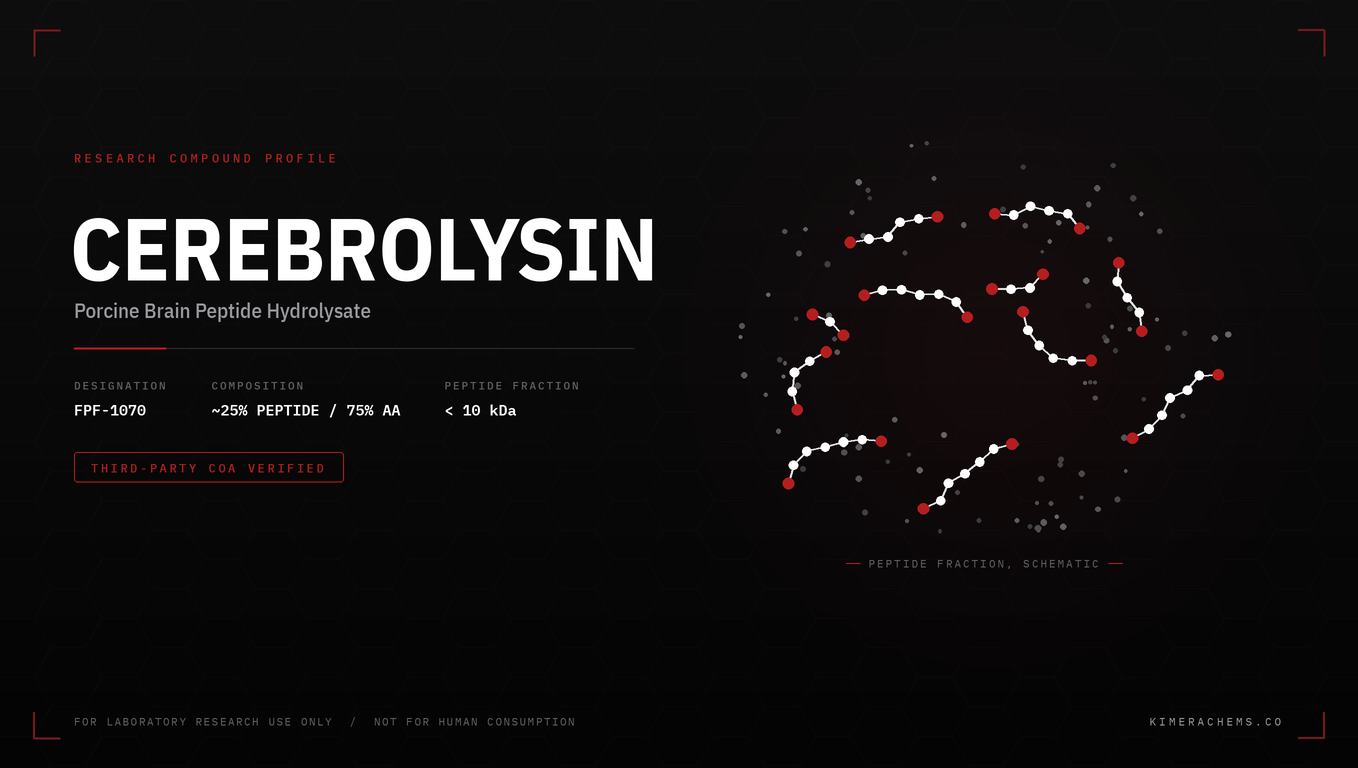
Manufacturer figures put roughly 25% of the preparation by weight in the peptide fraction, with the remaining 75% as free amino acids. The peptide fraction is specified below 10 kDa, a cutoff chosen because smaller fragments are more likely to survive systemic administration and reach central nervous system tissue. Secondary sources report the split as anything from 15/85 to 25/75, which is a useful early signal about how loosely this compound gets described outside the primary literature.
The manufacturing route is controlled proteolytic digestion of lipid-free purified porcine brain protein. Because the input is tissue and the process is enzymatic, the output is a distribution rather than a specification. Two batches produced under identical conditions contain the same classes of fragments in similar proportions. They do not contain identical molecules in identical ratios, and no manufacturing process can make them do so.
Why Cerebrolysin Has No Chemical Identifiers
Every other compound in a research catalog can be pinned to a structure. A defined-sequence peptide like Semax has an exact amino acid sequence, an exact mass, and a purity value that means something specific: the percentage of material in the vial that is the intended molecule rather than a truncation, a deletion sequence, or a solvent residue.
None of that transfers to cerebrolysin. There is no intended molecule. Asking for the purity of cerebrolysin is a category error, in the same way that asking for the purity of serum would be. The analytical questions that replace it are compositional: does the molecular weight distribution match the reference profile, does the peptide-to-free-amino-acid ratio fall within specification, does the peptide fingerprint reproduce across batches, is the material sterile, and is the endotoxin burden within limits.
This is not a technicality. It changes what a certificate of analysis can honestly claim, it changes what an HPLC trace proves, and it changes what a researcher should expect to receive.
What Mass Spectrometry Has Actually Found
The most direct answer to “what is in cerebrolysin” came from an analytical group at Ghent University. Gevaert and colleagues profiled an internet-obtained sample using HPLC coupled to ion trap MS and UHPLC coupled to quadrupole-ion-mobility-TOF MS, with UniProt porcine database matching and de novo sequencing. They identified 638 unique peptides. The dominant contributions came from tubulin alpha and beta chains, actin, and myelin basic protein.1
Those are structural and cytoskeletal proteins. They are the most abundant proteins in brain tissue, which is exactly what a proteolytic digest of brain tissue should be dominated by. The result is unsurprising as chemistry and awkward as marketing, because the widely repeated claim that cerebrolysin “contains BDNF, GDNF, NGF and CNTF fragments” implies enrichment in neurotrophic factor sequences that this dataset does not show.
Later work has been more targeted. Yang and colleagues developed an optimized solid-phase-extraction nanoLC-MS workflow specifically for identifying candidate active peptides in cerebrolysin, then used bioinformatic prediction to flag which of the identified sequences were plausibly bioactive.2 Separate proteomic analyses have reported detection of Leu- and Met-enkephalins and fragments mapping to orexin, galanin, neuropeptide VF and nerve growth factor. Those fragments are present. The honest framing is that they are minor components in a matrix dominated by structural protein digest, and that no study has causally linked any single identified fragment to any clinical outcome.
For a researcher, this is the central open question in the field: after five decades and hundreds of trials, nobody has isolated the active principle of cerebrolysin. The mechanism-to-outcome gap is real, and it is the reason the compound is difficult to defend on first principles even where trial data look favorable.
The Proposed Mechanism of Cerebrolysin
The governing hypothesis is neurotrophic mimicry. Endogenous neurotrophic factors are large proteins that cross the blood-brain barrier poorly. The proposal is that short fragments in cerebrolysin engage overlapping receptor and signaling machinery in a form small enough to distribute after peripheral administration.
Preclinical work has mapped several convergent pathways:
Kinase modulation and amyloid processing. In amyloid precursor protein transgenic mice, cerebrolysin reduced APP phosphorylation through modulation of glycogen synthase kinase-3 beta and cyclin-dependent kinase-5 activity, with associated improvement in synaptic and behavioral measures.3 Because both kinases also phosphorylate tau, follow-up work extended the model by injecting AAV2-mutant TAU into APP transgenic animals and reported reduced neurofibrillary pathology.4
Neurogenesis. In the same transgenic model, treated animals showed increased BrdU-positive cells and doublecortin-positive neuroblasts in the dentate gyrus, alongside reduced TUNEL and activated caspase-3 immunoreactivity.5 The interpretation offered was increased survival of newly generated neurons rather than a purely proliferative effect.
Neuroinflammation. In focal cerebral ischemia models, cerebrolysin attenuated microglial activation through a CREB/PGC-1 alpha dependent mechanism, reducing inflammatory cytokine output in the peri-infarct region.6
Excitotoxicity and calpain. Older in vitro and in vivo work reported protection against glutamate-mediated damage, reduced free radical formation, and inhibition of calpain-mediated proteolysis under hypoxic and ischemic conditions.
One caveat belongs on every line of that list. A substantial share of the foundational mechanistic work was co-authored by scientists affiliated with the manufacturer. That does not invalidate the findings, and the Masliah laboratory work in particular was conducted at an independent academic institution. It does mean the preclinical literature has not been subjected to the volume of unaffiliated replication that its citation count might suggest. Compare this to a compound like Dihexa, where the proposed hepatocyte growth factor and c-Met mechanism sits on a single defined molecule that any laboratory can synthesize and test independently.
Clinical Evidence in Acute Ischemic Stroke
Stroke is where the cerebrolysin evidence base is largest and where the disagreement is sharpest.
CASTA
The Cerebrolysin Acute Stroke Treatment in Asia trial enrolled 1,070 patients, randomizing 529 to cerebrolysin and 541 to placebo, all on background aspirin. The primary endpoint was a combined global directional test of NIHSS, modified Rankin Scale and Barthel Index at day 90. It was neutral.7
A post hoc subgroup restricted to patients with baseline NIHSS above 12 showed a trend favoring treatment on both NIHSS and mRS, with 90-day cumulative mortality of 10.5% in the treated arm against 20.2% on placebo. The investigators attributed the neutral primary result to a ceiling effect: median baseline NIHSS was 9 in both arms, and mildly affected patients recover substantially on standard care alone.
That explanation is plausible. It is also unfalsifiable after the fact, and the subgroup was not pre-specified. CASTA is the trial that most cleanly demonstrates why the cerebrolysin literature splits: the same result reads as a failed trial or as a mis-enrolled trial depending on which assumption you start with.
The CARS Program
CARS-1 was designed around the CASTA critique. It enrolled 208 post-stroke patients into a randomized, double-blind, placebo-controlled trial of cerebrolysin plus standardized rehabilitation, initiated 24 to 72 hours after onset, with the Action Research Arm Test at day 90 as the primary endpoint. In the modified intention-to-treat population of 205 patients, the nonparametric effect size on ARAT indicated large superiority, Mann-Whitney estimator 0.71 with 95% CI 0.63 to 0.79. Multivariate global status across 12 outcome scales gave a Mann-Whitney estimator of 0.62, CI 0.58 to 0.65. Premature discontinuation was 3.8%.8
A pre-planned individual-patient meta-analysis of CARS-1 and CARS-2, totaling 442 patients, reported a day-90 ARAT effect size of 0.62 and early NIHSS benefit at days 14 and 21 with an effect size of 0.59, corresponding to a number needed to treat of 7.1 with a wide confidence interval of 4 to 22.9
Two structural features deserve attention. A high proportion of patients entered with ARAT scores of zero, which the authors acknowledged limits generalizability, and the analysis relied on multivariate Wei-Lachin directional pooling rather than a single conventional endpoint. That method is statistically legitimate and appropriate for multidimensional recovery, but it is unfamiliar to most readers and it is not interchangeable with a dichotomized functional outcome.
What Cochrane Concluded
The 2023 Cochrane review, the seventh version of an assessment first published in 2010, included seven RCTs and 1,773 participants, with evidence searched to June 2022.10 The findings:
- All-cause death: RR 0.96, 95% CI 0.65 to 1.41, six trials, 1,689 participants, moderate-certainty evidence
- Total serious adverse events: RR 1.16, 95% CI 0.81 to 1.66, moderate certainty
- Fatal serious adverse events: RR 0.90, 95% CI 0.59 to 1.38
- Non-fatal serious adverse events: RR 2.39, 95% CI 1.10 to 5.23, moderate certainty
- Total adverse events: RR 1.03, 95% CI 0.92 to 1.14, low certainty
The non-fatal serious adverse event signal strengthened in the higher cumulative exposure subgroup, RR 2.87 with 95% CI 1.24 to 6.69. The review authors also recorded that the manufacturer supported three of the included multicentre studies, whether by full funding or by supplying product, placebo, randomization codes, research grants or statisticians. Risk of bias for selective outcome reporting was rated unclear across all included studies.
Two points of scope matter. The review pooled cerebrolysin with the bovine-derived analogue Cortexin, which contributed 272 participants and is a different preparation from a different species. And Cochrane assessed acute treatment started within 48 hours of onset, which excludes the rehabilitation-phase design that produced the CARS results.
The Opposing Meta-Analyses
A 2025 systematic review restricted to randomized, placebo-controlled, parallel-group trials pooled 14 RCTs and 2,884 patients. It reported a mean difference in NIHSS change of +1.39, 95% CI 0.53 to 2.25, p = 0.020, favoring cerebrolysin. Functional independence at mRS 0 to 2 trended favorably without reaching significance, RR 1.31, CI 0.90 to 1.91. Serious adverse events, mortality and hemorrhagic transformation showed no significant differences.11
A dedicated safety meta-analysis pooling 2,202 patients across 12 randomized trials found no statistically significant safety differences from placebo in main or subgroup analyses.12
Most recently, C-REGS2 ran an open-label prospective comparative effectiveness study across 16 countries between April 2018 and April 2024 in patients with moderate stroke defined as baseline NIHSS 8 to 15. It reported a primary effect size of 0.6157, corresponding to an odds ratio near 2.03 and a number needed to treat around 8.6, with consistent secondary endpoints and a cognitive signal on the MoCA.13 The design is observational and open-label, which places it below the randomized evidence regardless of effect size.
The safety divergence is the part worth sitting with. Cochrane found a doubled risk of non-fatal serious adverse events; two other meta-analyses found nothing. The difference traces to which trials were included, how events were classified, and whether attrition was treated as a bias signal. Same compound, same broad literature, opposite conclusions.
Traumatic Brain Injury
The CAPTAIN program studied cerebrolysin as an add-on to usual care in moderate to severe TBI, enrolling patients by Glasgow Coma Score. CAPTAIN I was a multicentre Asian-Pacific phase IIIb/IV trial; CAPTAIN II was a single-centre trial of 142 patients.1415
The prospective meta-analysis of the series covered 185 patients with mean admission GCS of 10.3 and mean age of 45.3. The primary endpoint, a multidimensional ensemble of functional and neuropsychological scales, showed a small-to-medium effect favoring cerebrolysin, statistically significant at day 30 with a combined Mann-Whitney estimator of 0.60, CI 0.52 to 0.66, p = 0.0156, SMD 0.31, and at day 90 with an estimator of 0.60, CI 0.52 to 0.68, p = 0.0146, SMD 0.34. Safety and tolerability were comparable between arms.16
The TBI data are more internally consistent than the stroke data. They are also smaller. A 185-patient meta-analysis using a multivariate ensemble endpoint is a signal worth following, not a settled result, and no Cochrane review has assessed the TBI indication with the scrutiny applied to stroke.
Vascular Dementia and Alzheimer’s Disease
The dementia literature runs in the opposite direction from the stroke literature: earlier reviews were positive, later reviews downgraded the certainty.
The 2013 Cochrane review of cerebrolysin in vascular dementia pooled six RCTs and 597 participants, reporting improvement on MMSE with a weighted mean difference of 1.10, CI 0.37 to 1.82, on ADAS-cog+ with a WMD of -4.01, CI -5.36 to -2.66, and on global clinical function with a response rate risk ratio of 2.71, CI 1.83 to 4.00.17
The 2019 update reassessed the same territory with GRADE. Pooling MMSE and ADAS-cog+ across three studies and 420 people gave a standardized mean difference of 0.36, CI 0.13 to 0.58, rated very low quality.18 The direction of effect held. Confidence in it did not.
The largest single vascular dementia trial randomized 242 patients and reported that at week 24, ADAS-cog+ improved by 10.6 points on treatment against 4.4 on placebo, a least-squares mean difference of -6.17, with a CIBIC+ treatment difference of 0.84.19 Both primary parameters favored cerebrolysin with wide margins.
In Alzheimer’s disease specifically, meta-analysis has been less consistent. Response rates favored treatment, while pooled ADAS-cog performance did not reach significance across the analyzed studies, with substantial heterogeneity. Alzforum currently lists cerebrolysin at US Phase 2 for Alzheimer’s disease, approved outside the United States for cognitive impairment. No sponsor has advanced it toward a US filing.
Reading the Cerebrolysin Literature Critically
Four structural features shape almost every disagreement in this field.
Investigator network concentration. Muresanu, Heiss, Brainin, Bornstein, Vester and Strilciuc recur across CARS, CAPTAIN, the pooled safety analyses and C-REGS2. The biometrics for the multivariate analyses have repeatedly come from the same contract statistics group. Overlapping authorship in a specialized field is normal. Overlapping authorship combined with manufacturer sponsorship across the positive literature is a reason to weight independent replication heavily.
Endpoint architecture. The positive trials tend to use multivariate directional ensembles pooling many scales. The neutral trials tend to use single combined global tests or dichotomized functional outcomes. Ensemble methods have real statistical advantages for multidimensional recovery and they also produce significance more readily than a single hard endpoint. Both things are true.
Geography and standard of care. Trials cluster in regions where cerebrolysin is already an approved, familiar and reimbursed product. Background rehabilitation intensity, time to presentation and outcome-rating conventions all vary across those settings.
Subgroup dependence. The strongest efficacy claims consistently attach to a subgroup: severe stroke in CASTA, patients with nonzero baseline ARAT in CARS, moderate stroke in C-REGS2, baseline cognitive impairment for the MoCA signal. Each rationale is biologically reasonable. Collectively they describe a compound whose effect keeps needing the right population to become visible.
None of this makes cerebrolysin ineffective. It makes the effect size uncertain in a way that fifty years and 1,700 randomized patients would normally have resolved.
Handling and Stability in Laboratory Work
The reference product ships as a ready-to-use aqueous solution rather than a lyophilized powder, which changes the handling profile relative to most catalog peptides.
In markets where cerebrolysin is registered, the approved product’s own labeling directs storage at room temperature not exceeding 25 degrees Celsius with protection from light in the outer carton, and states that it must not be frozen. Those are that product’s label conditions, described here for context; they are not a specification for material supplied by Kimera Chems, and the two are not equivalent preparations. Only clear, faintly amber solution should be used; cloudiness, particulates or color change indicate a compromised unit. The material is designated single-use, and solution is to be withdrawn immediately before use rather than drawn up and held.
Documented incompatibilities are specific and worth respecting in any bench protocol. The preparation should not be combined with balanced amino acid solutions, is incompatible with lipid-containing solutions, and is incompatible with anything that shifts the solution outside its pH 5.0 to 8.0 window. Kimera Chems specifies refrigeration at 1-6 °C after receipt, with protection from direct light. Do not freeze. Refrigeration is a post-receipt storage condition, not a transit requirement. That is more conservative than the reference label and reflects a supply chain without ampoule-grade primary packaging. The vial contains no antimicrobial preservative, so re-entry after the stopper is punctured is not supported. Storage guidance is a house recommendation. Analytical documentation is per-lot release testing.
Freeze-thaw is the failure mode most likely to matter in practice. A hydrolysate has no single tertiary structure to lose, but aggregation and further hydrolysis both shift the molecular weight distribution, and the distribution is the specification.
Regulatory Status
Cerebrolysin is not approved by the FDA for any indication and has never been reviewed under a New Drug Application. It holds national approvals in roughly 44 to 50 countries including Austria, Russia, China, South Korea, Mexico and much of Eastern Europe, typically for acute ischemic stroke, traumatic brain injury, vascular dementia and Alzheimer’s-type dementia. There is no centrally authorized EMA file for the EU market; the approvals that exist are national.
Because the preparation is a complex biological extract with no defined active pharmaceutical ingredient, it does not map onto the bulk drug substance compounding framework that applies to defined-structure peptides. Any US pathway would require full NDA or BLA review. In the United States, cerebrolysin is a research compound, and Kimera Chems supplies it on that basis only.
What Verification Means for a Hydrolysate
This is where cerebrolysin puts pressure on the standard vendor claim, and it is worth being precise rather than reassuring.
A single HPLC trace on a hydrolysate does not establish identity or purity. It establishes that the chromatographic profile of this batch resembles the profile of a reference batch. That is a fingerprint comparison, and it is genuinely useful, because a fingerprint mismatch is strong evidence that something upstream changed. It is not equivalent to the identity-and-purity determination that third-party COA verification provides for a defined-sequence peptide, and no supplier should imply otherwise.
The compositional questions that actually characterize a batch are the molecular weight distribution and the fraction below 10 kDa, the ratio of peptide-bound to free amino acid nitrogen, the total amino acid profile, sterility, endotoxin burden, pH, and appearance. Peptide mapping by LC-MS adds sequence-level fingerprinting on top of that. Published COAs for every batch are archived at the Kimera Chems COA archive, and for this compound the appropriate reading of those documents is compositional consistency, not purity in the single-entity sense.
Researchers accustomed to evaluating a nootropic small molecule like Noopept, where a 99% purity figure carries an unambiguous meaning, should recalibrate before designing work around a hydrolysate. The right question is not “how pure is it” but “does this batch match the reference distribution, and can the supplier show you the data behind that claim.”
Frequently Asked Questions
Does cerebrolysin have a CAS number or molecular weight? No. It is a mixture of hundreds of peptides plus free amino acids, so no single structure, formula or molecular weight applies. FPF-1070 is a development designation, not a chemical identifier. The peptide fraction is specified below 10 kDa.
Why do Cochrane and other meta-analyses disagree about cerebrolysin? They include different trials, treat attrition and sponsorship differently as bias signals, and analyze different endpoints. Cochrane assessed acute treatment within 48 hours and pooled a bovine-derived analogue alongside cerebrolysin. The competing analyses restricted inclusion to randomized placebo-controlled parallel-group trials and used early neurological change as the primary outcome.
Does cerebrolysin actually contain BDNF or NGF fragments? Proteomic work has detected fragments mapping to nerve growth factor along with enkephalins, orexin and galanin sequences. The most detailed published peptide profile found the sample dominated by tubulin, actin and myelin basic protein fragments. Neurotrophic factor sequences are present as minor components, and no individual fragment has been causally linked to a clinical outcome.
What is the difference between cerebrolysin and a defined-sequence peptide? A defined-sequence peptide has one intended structure, one exact mass, and a purity value describing how much of the vial is that structure. Cerebrolysin has a target composition and a target molecular weight distribution instead. That difference determines which analytical methods are meaningful and what a certificate of analysis can claim.
Further compound profiles are published in the Kimera Chems peptides research library and nootropics research library.
Research Use Only. Cerebrolysin is supplied by Kimera Chems for laboratory research use only. It is not for human or veterinary consumption, and is not a drug, supplement or diagnostic. Nothing in this article constitutes administration guidance. Clinical figures cited here describe published trial populations and are reported for scientific context only.
References
- Gevaert B, Stalmans S, Wynendaele E, et al. Peptide profiling of Internet-obtained Cerebrolysin using high performance liquid chromatography, electrospray ionization ion trap and ultra high performance liquid chromatography, ion mobility, quadrupole time of flight mass spectrometry. Drug Testing and Analysis. 2015. doi:10.1002/dta.1817 ↩
- Yang, et al. Optimized approach for active peptides identification in Cerebrolysin by nanoLC-MS. Journal of Chromatography B. 2023. ↩
- Rockenstein E, Torrance M, Adame A, et al. Neuroprotective effects of regulators of the glycogen synthase kinase-3beta signaling pathway in a transgenic model of Alzheimer’s disease are associated with reduced amyloid precursor protein phosphorylation. Journal of Neuroscience. 2007;27(8):1981-1991. doi:10.1523/JNEUROSCI.4321-06.2007 ↩
- Ubhi K, Rockenstein E, Doppler E, et al. Neurofibrillary and neurodegenerative pathology in APP-transgenic mice injected with AAV2-mutant TAU: neuroprotective effects of Cerebrolysin. Acta Neuropathologica. 2009. doi:10.1007/s00401-009-0505-4. PMID: 19252918 ↩
- Rockenstein E, Mante M, Adame A, Crews L, Moessler H, Masliah E. Effects of Cerebrolysin on neurogenesis in an APP transgenic model of Alzheimer’s disease. Acta Neuropathologica. 2007;113(3):265-275. doi:10.1007/s00401-006-0166-5 ↩
- Guan X, Wang Y, Kai G, et al. Cerebrolysin ameliorates focal cerebral ischemia injury through neuroinflammatory inhibition via CREB/PGC-1alpha pathway. Frontiers in Pharmacology. 2019;10:1245. doi:10.3389/fphar.2019.01245 ↩
- Heiss WD, Brainin M, Bornstein NM, Tuomilehto J, Hong Z; CASTA Investigators. Cerebrolysin in patients with acute ischemic stroke in Asia: results of a double-blind, placebo-controlled randomized trial. Stroke. 2012;43(3):630-636. doi:10.1161/STROKEAHA.111.628537 ↩
- Muresanu DF, Heiss WD, Hoemberg V, et al. Cerebrolysin and Recovery After Stroke (CARS): a randomized, placebo-controlled, double-blind, multicenter trial. Stroke. 2016;47(1):151-159. doi:10.1161/STROKEAHA.115.009416 ↩
- Guekht A, Vester J, Heiss WD, et al. Safety and efficacy of Cerebrolysin in motor function recovery after stroke: a meta-analysis of the CARS trials. Neurological Sciences. 2017. doi:10.1007/s10072-017-3037-z ↩
- Ziganshina LE, Abakumova T, Nurkhametova D, Ivanchenko K. Cerebrolysin for acute ischaemic stroke. Cochrane Database of Systematic Reviews. 2023, Issue 10. Art. No.: CD007026. doi:10.1002/14651858.CD007026.pub7 ↩
- Patel PN, Mangal D, Patel K. Safety and efficacy of Cerebrolysin for neurorecovery after acute ischemic stroke: a systematic review and meta-analysis of 14 randomized controlled trials. Cureus. 2025;17(8):e91054. doi:10.7759/cureus.91054 ↩
- Strilciuc S, Vecsei L, Boering D, Praznikar A, Kaut O, Riederer P, Battistin L. Safety of Cerebrolysin for neurorecovery after acute ischemic stroke: a systematic review and meta-analysis of twelve randomized-controlled trials. Pharmaceuticals. 2021;14(12):1297. doi:10.3390/ph14121297 ↩
- Vosko MR, Sanak D, Do Y, Vatanagul JS, Roushdy T, Bornstein NM, Vester JC, Brainin. C-REGS2: a multinational, high-quality comparative effectiveness study of Cerebrolysin in moderate acute ischemic stroke. International Journal of Stroke. 2025;20(9):1060-1070. doi:10.1177/17474930251375439 ↩
- Poon W, Matula C, Vos PE, et al. Safety and efficacy of Cerebrolysin in acute brain injury and neurorecovery: CAPTAIN I, a randomized, placebo-controlled, double-blind, Asian-Pacific trial. Neurological Sciences. 2020. PMID: 31494820 ↩
- Muresanu DF, et al. Efficacy and safety of Cerebrolysin in neurorecovery after moderate-severe traumatic brain injury: results from the CAPTAIN II trial. Neurological Sciences. 2020. doi:10.1007/s10072-019-04181-y ↩
- Vester JC, Buzoianu AD, Florian SI, et al. Cerebrolysin after moderate to severe traumatic brain injury: prospective meta-analysis of the CAPTAIN trial series. Neurological Sciences. 2021. doi:10.1007/s10072-020-04974-6 ↩
- Chen N, Yang M, Guo J, Zhou M, Zhu C, He L. Cerebrolysin for vascular dementia. Cochrane Database of Systematic Reviews. 2013, Issue 1. Art. No.: CD008900. doi:10.1002/14651858.CD008900.pub2 ↩
- Cui S, Chen N, Yang M, et al. Cerebrolysin for vascular dementia. Cochrane Database of Systematic Reviews. 2019, Issue 11. Art. No.: CD008900. doi:10.1002/14651858.CD008900.pub3 ↩
- Guekht AB, Moessler H, Novak PH, Gusev EI. Cerebrolysin in vascular dementia: improvement of clinical outcome in a randomized, double-blind, placebo-controlled multicenter trial. Journal of Stroke and Cerebrovascular Diseases. 2011;20(4):310-318. ↩