
Almost every compound in this catalogue suffers from the same shortage. One paper, or three, usually in rodents, and any statement about people is inference.
Citicoline has the opposite problem. Roughly 1,440 papers carry its name. Among them are two phase 3 trials with more than 3,500 patients between them, a Cochrane review of 4,281 participants, and meta-analyses in several fields. The evidence base is not thin.
It is also, in its two flagship indications, negative. A 2,298-patient stroke trial stopped for futility. A 1,213-patient brain injury trial found 35.4% improvement against 35.6% on placebo. The interesting question is not whether the compound works. It is why a compound this thoroughly tested remains this widely sold, and what the reading order does to the answer.
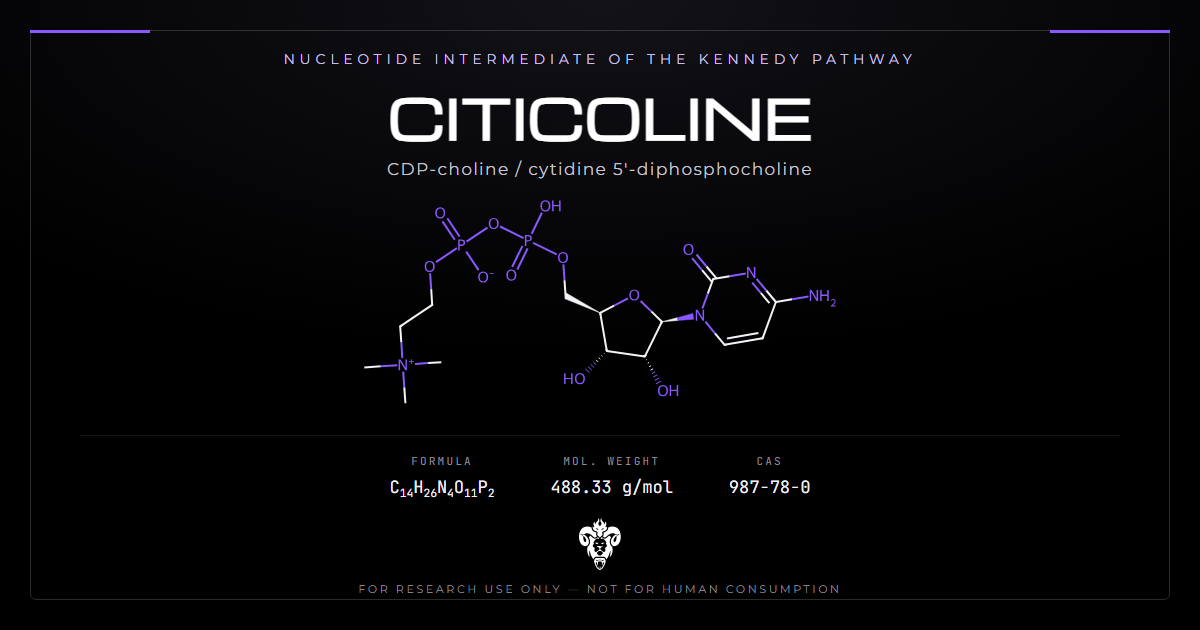
Chemical identity
| Property | Value |
|---|---|
| Common names | Citicoline, CDP-choline |
| Systematic | Cytidine 5′-diphosphocholine |
| Molecular formula | C14H26N4O11P2 |
| Molecular weight | 488.32 g/mol |
| CAS | 987-78-0 |
| PubChem CID | 13804 |
| InChIKey | RZZPDXZPRHQOCG-OJAKKHQRSA-N |
| Class | Nucleotide, inner salt |
| Endogenous | Yes |
The catalogue carries it as CDP-Choline.
An endogenous intermediate, not a xenobiotic
This is the feature that separates the compound from everything else on this shelf. Citicoline is not a designed molecule. It is a normal metabolic intermediate that every nucleated cell already makes.
It sits in the Kennedy pathway, the route cells use to build phosphatidylcholine, the most abundant phospholipid in cell membranes. Choline is phosphorylated, then coupled to cytidine triphosphate to give CDP-choline, and that intermediate donates its choline head group to diacylglycerol. The step that makes it is rate-limiting for the whole pathway.
So the pharmacological argument writes itself: supply more of a rate-limiting intermediate and membrane synthesis should increase. That argument is chemically sound and it is where the trouble starts, because a plausible mechanism is not a demonstrated effect.
What the molecule delivers
Taken orally, citicoline does not arrive at the brain intact. It is hydrolysed first. The useful account of it is as a delivery vehicle for two things at once: a choline moiety and a cytidine moiety.
That dual delivery is the reason the compound gets studied in so many unrelated conditions. Choline feeds acetylcholine synthesis and membrane phospholipid production. Cytidine feeds the nucleotide pool. Two substrates, many pathways, and a correspondingly broad set of claims.
The molecule carries a permanent positive charge on its trimethylammonium group and a negative charge on the diphosphate, making it an inner salt. It is freely soluble in water and sparingly soluble in ethanol.
The human trials at a glance
| Study | Population | n | Result |
|---|---|---|---|
| Dávalos 2002, pooled [1] | Acute ischaemic stroke | 1,372 | Recovery OR 1.33 (1.10 to 1.62), p=0.0034 |
| ICTUS 2012 [2] | Moderate-severe ischaemic stroke | 2,298 | OR 1.03 (0.86 to 1.25), stopped for futility |
| COBRIT 2012 [3] | Complicated mild to severe TBI | 1,213 | 35.4% vs 35.6% improved, OR 0.98 |
| Cochrane 2020 [4] | Acute ischaemic stroke | 4,281 | No difference on any outcome, all trials high risk of bias |
| CAISR 2022 [5] | Post-recanalisation stroke | Single centre | All three ORs below 1, none significant |
| Bonvicini 2023 [6] | Cognitive impairment | 7 studies | SMD 0.56 to 1.57, study quality poor |
| Prinz 2023 [7] | Glaucoma | 424 | No difference on any endpoint |
Read down the fourth column. The first row is the hypothesis and the rest are the tests of it.
The claim, and the analysis that made it
Dávalos and colleagues published an individual patient data pooling analysis in 2002 [1]. They combined four randomised placebo-controlled trials of oral citicoline in acute ischaemic stroke, giving 1,372 evaluable patients.
The result looked convincing. Recovery at three months reached 25.2% on citicoline against 20.2% on placebo, odds ratio 1.33 (95% CI 1.10 to 1.62), p=0.0034. The best dose was 2,000 mg, at odds ratio 1.38. Safety matched placebo.
One methodological detail belongs beside that number. The authors searched MEDLINE, Cochrane and the Ferrer Group bibliographic database [1]. Ferrer is the manufacturer. Using a sponsor’s own bibliography as a search source is disclosed and it is not misconduct. It is also not an independent sampling frame.
ICTUS
The design
The 2002 analysis produced a hypothesis worth testing properly, and the same group tested it. ICTUS enrolled 2,298 patients with moderate-to-severe acute ischaemic stroke across 37 centres in Spain, 11 in Portugal and 11 in Germany [2].
Treatment started within 24 hours: 1,000 mg every 12 hours intravenously for three days, then oral for a total of six weeks. The primary outcome was the same global recovery measure the pooling analysis had used, combining three scales.
The result
The trial was stopped for futility at the third interim analysis. Final global recovery gave an odds ratio of 1.03 (95% CI 0.86 to 1.25), p=0.364 [2]. No differences appeared in safety variables or adverse event rates.
The authors’ conclusion is one sentence: under the circumstances of the trial, citicoline is not efficacious in moderate-to-severe acute ischaemic stroke.
What it means that one group did both
Dávalos led the 2002 pooling analysis and the 2012 trial. Ferrer funded both. The positive finding and the definitive refutation of that finding carry the same lead author and the same sponsor.
That deserves credit rather than suspicion. A group published a promising pooled result, then designed the trial that could kill it. They ran it to 2,298 patients and published the null. That is exactly what the system is supposed to do. The compound came out badly and the science came out well.
COBRIT, and the fifty-nine countries
The brain injury programme ran in parallel and reached the same place. COBRIT was a phase 3 double-blind trial of 1,213 patients at eight US level 1 trauma centres [3]. Dosing was 2,000 mg daily for 90 days.
The numbers are almost eerily flat. Favourable improvement on the Glasgow Outcome Scale-Extended reached 35.4% on citicoline against 35.6% on placebo. The global odds ratio was 0.98 (95% CI 0.83 to 1.15) at 90 days. At 180 days it was 0.87 (0.72 to 1.04). Neither severity subgroup differed.
One line in that paper’s introduction carries more weight than the results. At the time of the trial, citicoline was approved for use in traumatic brain injury in 59 countries [3]. A treatment can reach regulatory approval across most of the world and then, on being tested at scale against placebo, do nothing measurable. Approval breadth is not evidence.
The Cochrane verdict
Martí-Carvajal and colleagues reviewed citicoline in acute ischaemic stroke for Cochrane in 2020, covering 10 randomised trials and 4,281 participants [4].
Every outcome came back flat. All-cause mortality 17.3% against 18.5%, risk ratio 0.94 (0.83 to 1.07). Disability or dependence, risk ratio 1.11 (0.97 to 1.26). Functional recovery on the Barthel Index, 1.03. Neurological function on the stroke scale, 1.08. Serious cardiovascular events, 1.04.
Three observations from the review matter as much as the numbers. All included trials were assessed as high risk of bias, and drug companies sponsored six. No trial measured quality of life at all. And a pre-planned Trial Sequential Analysis suggested no more trials may be needed for the primary outcomes. That is a formal way of saying the question is settled.
The reviewers also note that adverse events were poorly reported, so harms may have been underestimated and the safety profile “remains unknown”. A long record of use is not the same as a characterised safety profile.
The strongest possible test, run in 2022
One reasonable objection to ICTUS is timing. If the compound protects tissue at risk, it should be given when there is tissue to save.
Agarwal and colleagues ran that experiment [5]. CAISR gave citicoline immediately after recanalisation therapy, when penumbral tissue is most susceptible either to rescue or to loss. Dosing was 1 g twice daily intravenously for three days, then orally for 39 days.
Nothing separated. Odds ratios came out at 0.96 for a good stroke scale outcome, 0.92 for modified Rankin 0 to 2, and 0.87 for Barthel at or above 95 [5]. Infarct volume shrank 4.2 cm³ against 2.6 on placebo, p=0.483.
All three point estimates sit below 1. The confidence intervals are wide and the trial was single-centre, so this is a small null rather than a strong negative. It does close the timing objection.
Where the positive evidence is
The picture would be dishonest without this section, because positive findings exist and some are recent.
The cognition meta-analysis
Bonvicini and colleagues pooled studies of citicoline and cognitive performance in mild cognitive impairment, Alzheimer’s disease and post-stroke dementia [6]. Seven studies met criteria and all seven showed a positive effect. Pooled standardised mean differences ran from 0.56 (95% CI 0.37 to 0.75) to 1.57 (0.77 to 2.37). The range depends on the sensitivity analysis.
Taken alone, that is a meaningful effect size in a real clinical population.
What the same authors say about it
They do not take it alone. Their own conclusion calls the general quality of the studies poor, with significant risk of bias in favour of the intervention [6].
Read those two findings together, because they belong together. A pooled effect built from studies the reviewers describe as poor and biased toward the treatment describes the literature, not the compound. The authors were straightforward about it, and a reader quoting only the effect size is not.
Mixed and negative in psychiatry
A 2024 network meta-analysis of neuroprotective drugs in acute ischaemic stroke placed citicoline among agents that reduced mortality relative to conventional care [8]. It also ranked highly for neurological function. In the same analysis it was the one agent whose total treatment effective rate did not beat conventional care. The same paper puts it near the top of one ranking and at the bottom of another.
In bipolar disorder, one randomised trial links citicoline to improvements in declarative memory and verbal learning [11]. A 2026 systematic review across mental disorders reaches the opposite general verdict [12]. Current evidence does not support citicoline as an effective cognitive enhancer, and the authors position it as investigational rather than evidence-based.
Glaucoma, and a head-to-head loss
Citicoline is sold widely for glaucoma on a neuroprotection rationale. Prinz and colleagues reviewed ten clinical studies covering 424 patients, with a mean follow-up of about 12 months [7].
No significant differences appeared between treated patients and controls on intraocular pressure, visual field mean deviation, retinal nerve fibre layer or pattern electroretinogram amplitude. Nor was there improvement from baseline on any of those measures. The conclusion is that evidence is insufficient to say it slows glaucoma progression.
A 2025 randomised trial adds a head-to-head result. In moderate traumatic brain injury, patients on citicoline alone did worse than those on amantadine or the combination [10]. The gap covered coma scale, disability rating, mental state, ventilation days, and both intensive care and hospital length of stay.
What is still being studied
Work continues, and it has moved back to animals and to new questions rather than repeating the stroke trials.
Costa and colleagues showed that vaporised cannabis exposure impairs spatial pattern separation in rats at three ages [13]. Citicoline rescued that deficit, particularly when given during memory encoding and consolidation. Vehicle-exposed animals were unaffected by citicoline, which is the control that makes the result interesting.
A 2026 mouse study reports that citicoline reversed behavioural and hippocampal abnormalities after single prolonged stress [14]. The markers were endoplasmic reticulum stress, mitophagy through PINK1 and parkin, lipid peroxidation and caspase-3.
Both are rodent studies with no human counterpart, which is where most of this catalogue lives. The difference is that for citicoline the human trials were already run, and they came back null.
How to read this literature
Reading order decides the answer
Approach the compound through narrative reviews and you meet a well-tolerated endogenous intermediate with positive findings across neurology, ophthalmology and psychiatry [9]. Approach it through the two phase 3 trials and the Cochrane review and you meet a compound that failed its two definitive tests.
Both accounts cite real papers. What separates them is weighting, and a reader who starts with reviews rarely arrives at the trials.
The rule that follows: find the largest trial with a hard endpoint before reading anything else about a compound. For citicoline that is ICTUS at 2,298 patients, and it takes ten minutes to read.
Who searched what
The second habit is checking the sampling frame. The 2002 pooling analysis searched the manufacturer’s bibliography alongside the public databases [1]. Cochrane found that six of ten trials were company-sponsored and rated all ten at high risk of bias [4].
None of that means the results are wrong. It means the positive literature and the sponsor overlap heavily, and that the independent large trials are the ones carrying the weight.
Verifying research material
Batch documentation sits on the certificates of analysis page.
Identity
Formula C14H26N4O11P2, molecular weight 488.32, CAS 987-78-0, InChIKey RZZPDXZPRHQOCG-OJAKKHQRSA-N.
Four stereocentres sit on the ribose ring in the (2R,3S,4R,5R) configuration, inherited from cytidine. That is a consequence of the starting material rather than a synthetic choice to verify. The compound is normally made from natural nucleosides.
Free acid against sodium salt
This is the practical trap. Citicoline is supplied both as the free acid at 488.32 and as the sodium salt at 510.30. Casual writing treats the two as interchangeable.
A concentration prepared by mass from one while quoting the other is off by about 4.5%. Published trials mostly specify citicoline sodium in milligrams of citicoline base. Confirm which form a certificate describes before converting anything.
Water content
The compound is freely water soluble and hygroscopic. Material equilibrated with room air carries water that a purity figure by chromatographic area will not report.
Ask whether the certificate includes a water determination, by Karl Fischer or loss on drying. On a hygroscopic solid, that number changes the molar amount in a weighed sample more than typical impurity levels do.
Common questions about citicoline
Does it help after a stroke? The two largest trials say no. ICTUS stopped for futility at 2,298 patients, and Cochrane found no difference on mortality, disability or function across 4,281 participants [2][4].
Does it help after brain injury? COBRIT found 35.4% improvement against 35.6% on placebo in 1,213 patients [3].
Is there any positive human evidence? Yes. A meta-analysis in cognitive impairment found pooled effects of 0.56 to 1.57, from studies its own authors describe as poor quality and biased toward the intervention [6].
What about glaucoma? Ten studies and 424 patients showed no difference on any measured endpoint [7].
Is it safe? No serious signal has emerged across thousands of trial participants. Cochrane also notes that adverse events were poorly reported and calls the safety profile unknown [4].
What is it actually doing? Delivering choline and cytidine into pathways that use them. That much is settled biochemistry; the clinical consequence is what the trials tested.
Free acid or sodium salt? Both are sold. The free acid is 488.32 and the sodium salt 510.30, so a mass prepared against the wrong figure is out by roughly 4.5%.
Summary of the evidence
Strongest evidence is two large well-conducted phase 3 trials with hard endpoints, both null [2][3]. A Cochrane review supports them, and its Trial Sequential Analysis suggests the stroke question needs no further trials [4]. A 2022 trial testing the most favourable possible timing was also null [5].
Real positive findings exist in cognitive impairment [6] and in single psychiatric trials [11]. The meta-analysis carrying the strongest effect sizes describes its own inputs as poor and biased. A 2026 review of cognitive enhancement in mental disorders declines to endorse it [12].
Weakest is the gap between how the compound is sold and what the large trials found. Approval in 59 countries for an indication where a 1,213-patient trial showed nothing is the clearest single illustration [3].
The transferable point applies well beyond this molecule. A plausible mechanism, an endogenous substrate and decades of use are three arguments. None of them is a result. Citicoline has all three, and it has also had its hypotheses tested properly. That is more than most compounds here can say. More of this literature sits in the nootropics category, alongside Alpha GPC, Noopept and Aniracetam.
Status: supplied for laboratory research use only.
References
- Dávalos A, Castillo J, Alvarez-Sabín J, Secades JJ, Mercadal J, López S, Cobo E, Warach S, Sherman D, Clark WM, Lozano R. Oral citicoline in acute ischemic stroke: an individual patient data pooling analysis of clinical trials. Stroke. 2002;33(12):2850-2857. PMID 12468781. DOI
- Dávalos A, Alvarez-Sabín J, Castillo J, Díez-Tejedor E, Ferro J, Martínez-Vila E, et al. Citicoline in the treatment of acute ischaemic stroke: an international, randomised, multicentre, placebo-controlled study (ICTUS trial). Lancet. 2012;380(9839):349-357. PMID 22691567. DOI
- Zafonte RD, Bagiella E, Ansel BM, Novack TA, Friedewald WT, Hesdorffer DC, et al. Effect of citicoline on functional and cognitive status among patients with traumatic brain injury: Citicoline Brain Injury Treatment Trial (COBRIT). JAMA. 2012;308(19):1993-2000. PMID 23168823. DOI
- Martí-Carvajal AJ, Valli C, Martí-Amarista CE, Solà I, Martí-Fàbregas J, Bonfill Cosp X. Citicoline for treating people with acute ischemic stroke. Cochrane Database Syst Rev. 2020;8(8):CD013066. PMID 32860632. DOI
- Agarwal A, Vishnu VY, Sharma J, Bhatia R, Garg A, Dwivedi S, et al. Citicoline in acute ischemic stroke: a randomized controlled trial. PLoS One. 2022;17(5):e0269224. PMID 35639720. DOI
- Bonvicini M, Travaglini S, Lelli D, Antonelli Incalzi R, Pedone C. Is citicoline effective in preventing and slowing down dementia? A systematic review and a meta-analysis. Nutrients. 2023;15(2):386. PMID 36678257. DOI
- Prinz J, Prokosch V, Liu H, Walter P, Fuest M, Migliorini F. Efficacy of citicoline as a supplement in glaucoma patients: a systematic review. PLoS One. 2023;18(9):e0291836. PMID 37768938. DOI
- Li M, Huo X, Chang Q, Liu X, Zhang J, Mao Z. Efficacy analysis of neuroprotective drugs in patients with acute ischemic stroke based on network meta-analysis. Front Pharmacol. 2024;15:1475021. PMID 39575393. DOI
- Jasielski P, Piędel F, Piwek M, Rocka A, Petit V, Rejdak K. Application of citicoline in neurological disorders: a systematic review. Nutrients. 2020;12(10):3113. PMID 33053828. DOI
- Badre DSEM, Elbeialy MAK, Fathy M. Citicoline-amantadine trial in traumatic brain injury: a prospective randomized study. J Neurotrauma. 2025;43(1-2):68-77. PMID 41027417. DOI
- Balanzá-Martínez V, Galdámez-Huertas A, Sánchez-Ortí JV, Kapczinski F, De Boni RB, Pomarol-Clotet E, Van Rheenen TE. Lifestyle-based interventions targeting neurocognition in bipolar disorders: a systematic review of randomized controlled trials. Psychiatry Res. 2025;351:116618. PMID 40639301. DOI
- Kucuksahin NG, Kaya TT, Halac E, Sut E, Ciray RO. The impact of citicoline/phosphatidylserine supplementation on cognitive performance and executive functions in mental disorders: a systematic review of controlled trials. Hum Psychopharmacol. 2026;41(5):e70058. PMID 42538853. DOI
- Costa CC, Weiss AS, Limbaker CM, Kirkland AE, Squeglia LM, Reichel CM, Penrod RD, Carter JS. Prior cannabis vapor exposure impairs pattern separation in rodents of multiple ages but is rescued by citicoline administration. Neuroscience. 2026;603:214-227. PMID 41905714. DOI
- Fahmy NG, Kamel NM, Hedya SA, Abd El-Latif AM. Repurposing citicoline for single prolonged stress-induced behavioral and hippocampal molecular abnormalities in male mice. Neuropharmacology. 2026;298:111082. PMID 42320748. DOI
CDP-Choline is sold for laboratory research use only. Not for human consumption, nor medical, veterinary, or household uses.
Literature retrieved from PubMed.