
Most growth hormone secretagogues aimed at treating something and stopped short. GHRP-2 took a different route. In Japan it serves as a pituitary function test, and the reason is a number.
Across 71 pre-operative patients with pituitary tumours, three stimulation tests ran head to head. Median peak growth hormone reached 9.38 µg/L with the insulin tolerance test, 4.43 with arginine, and 28.88 with GHRP-2 [1].
A diagnostic wants a large, reproducible signal rather than a therapeutic effect. On that criterion this compound outperforms the reference standard, which is why its career went the way it did.
Chemical identity
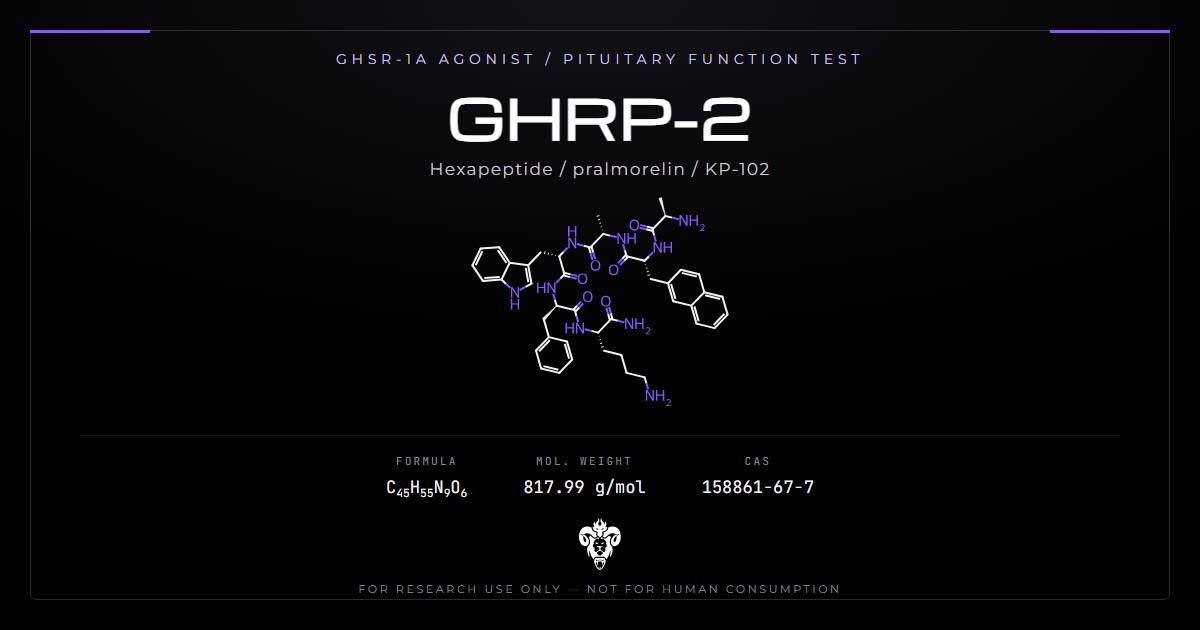
A synthetic hexapeptide with two D-residues and an unnatural aromatic side chain at position two.
| Property | Value |
|---|---|
| Sequence | D-Ala-D-2-Nal-Ala-Trp-D-Phe-Lys-NH2 |
| Common names | GHRP-2, pralmorelin, KP-102 |
| Molecular formula | C45H55N9O6 |
| Molecular weight | 818.0 |
| CAS | 158861-67-7 |
| PubChem CID | 6918245 |
| InChIKey | HRNLPPBUBKMZMT-RDRUQFPZSA-N |
Kimera supplies the material as GHRP-2.
2-naphthylalanine is the distinguishing residue
Position two carries 3-(2-naphthalenyl)-D-alanine, a residue that does not occur in proteins. Its bicyclic aromatic side chain is larger than tryptophan’s indole and lacks the indole nitrogen.
That single substitution separates GHRP-2 from its closest sibling. Hexarelin carries a methylated D-tryptophan at the same position and histidine at position one, where this compound carries D-alanine.
The two peptides are less interchangeable than they look
| GHRP-2 | Hexarelin | |
|---|---|---|
| Position 1 | D-Ala | His |
| Position 2 | D-2-Nal | D-2-methyl-Trp |
| Positions 3-6 | Ala-Trp-D-Phe-Lys-NH2 | Ala-Trp-D-Phe-Lys-NH2 |
| Formula | C45H55N9O6 | C47H58N12O6 |
| Mass | 818.0 | 887.1 |
Four of six residues match. The two that differ carry three fewer nitrogens and 69 daltons between them, and that is enough to give the two compounds different research careers.
The peptide preceded its own hormone
GHRP-2 belongs to a class invented before anyone knew what it acted on.
The sequence of discoveries
A history of the field lays out the order [2]. Somatostatin was isolated in 1973. Unnatural growth-hormone-releasing peptides appeared in 1976. Growth-hormone-releasing hormone followed in 1982.
The hypothesis of a separate natural releasing peptide came in 1984. The secretagogue receptor was discovered in 1996 and cloned shortly after. Ghrelin, the endogenous ligand, was isolated in 1999.
Why that order matters
The synthetic peptides came 23 years before the hormone they mimic. Researchers built compounds, found they released growth hormone, worked backwards to an orphan receptor, and only then found what normally binds it.
This is reverse pharmacology, and it explains a persistent oddity in the literature. GHRP-2 is routinely described as a ghrelin agonist, which is chronologically backwards. Ghrelin is the compound that turned out to mimic the peptides, not the reverse.
The receptor was found where it mattered
Work published in 1998 identified secretagogue receptor messenger RNA in human pituitary tumours and in a rat pituitary cell line [3]. That established the target tissue for the growth hormone effect directly, rather than by inference from a systemic response.
Why a diagnostic rather than a therapy
The insulin tolerance test has been the reference standard for assessing pituitary function. It works by inducing hypoglycaemia, which is exactly as unpleasant and as risky as it sounds.
The safety argument
A 2023 study of 65 patients aged 65 and over described the GHRP-2 test as relatively safe among endocrine stimulation tests for the elderly [4]. Deliberate hypoglycaemia in an elderly patient, or one with cardiac disease, carries real hazard.
A test that produces a larger growth hormone response without inducing hypoglycaemia wins on both accuracy and safety. That combination is unusual, and it is the whole case.
The signal size argument
Return to the head-to-head numbers [1]. GHRP-2 produced roughly three times the peak growth hormone of the insulin tolerance test and more than six times that of arginine.
For diagnosis, a larger separation between normal and deficient responses means fewer ambiguous results. The same property that makes a compound a poor therapeutic candidate, a big transient spike, makes it a good diagnostic agent.
The adrenal axis complication
GHRP-2 also activates the hypothalamic-pituitary-adrenal axis, so a study compared it against the insulin tolerance test for that purpose in 15 patients suspected of hypopituitarism [5]. A 100 µg intravenous dose preceded measurement of plasma ACTH and serum cortisol.
Nine of the 15 met the criteria for adrenal axis failure on the insulin tolerance test. That the compound moves cortisol at all matters for any experiment measuring stress hormones, whether or not that was the intended endpoint.
What a diagnostic agent has to be
The requirements differ from a therapeutic in every respect, which is worth spelling out because it reframes the whole literature.
A test agent needs a response large enough to separate normal from abnormal, reproducible enough that one measurement suffices, and fast enough to complete in a clinic visit. Duration of effect is irrelevant. Tolerance on repeat dosing is irrelevant, because the test runs once.
Most of what disqualifies a compound as a therapy leaves it untouched as a diagnostic. A large transient spike that fades is a problem for treatment and ideal for measurement.
The cut-off question
Diagnostic tests live or die on their threshold, and the threshold depends on the agent. A peak growth hormone value that indicates deficiency after an insulin tolerance test means something different after this one, because the normal response is roughly three times larger [1].
That is why the test-specific literature exists at all. Borrowing a cut-off from a different stimulation test would misclassify patients in both directions, and the Japanese guideline position reflects a body of work establishing this agent’s own numbers.
Comparing the class properly
The Hexarelin article on this site raised a question this compound helps answer: head-to-head potency data across the GHRPs is thinner than the individual literatures suggest.
What is genuinely known
Each compound has its own body of work. GHRP-2 has the diagnostic literature [1][4][5]. Hexarelin has the cardiovascular and CD36 literature. GHRP-6 has its own.
What is scarce is the study that runs two of them side by side, at matched doses, in one protocol. Reviews cover the class together [13], which creates an impression of comparative knowledge that the primary literature does not support.
Why the gap persists
Nobody funds a comparison without a commercial reason to prefer one. The diagnostic use gave GHRP-2 a reason to be characterised carefully against non-peptide comparators, the insulin tolerance test and arginine, rather than against its own siblings.
So the compound is well characterised against the things it competes with clinically and poorly characterised against the things it resembles chemically. That is a common shape and it misleads readers who expect the opposite.
The appetite effect, and where it reverses
Growth hormone is not the only thing this peptide does, and the second effect has a human study behind it.
In healthy men
Seven lean healthy males received subcutaneous infusion at 1 µg/kg/h or saline for 270 minutes, followed by an ad libitum buffet meal [6].
They ate 35.9% more on drug than on saline. Every subject increased intake, including when calculated per kilogram of body weight. A unanimous direction across seven subjects is a stronger result than the group size suggests.
In rats
Earlier work in rats found the food intake effect modified by fasting, restraint stress and somatostatin [7]. So the response depends on the animal’s state rather than being a fixed property of the dose.
In dogs
A study in conscious dogs examined upper gastrointestinal contractile activity alongside food intake [8]. Motility and appetite move together here, which fits a receptor with established gut functions.
In chicks, it goes the other way
Intracerebroventricular injection in neonatal chicks inhibited feeding [9]. Chicken and rat ghrelin suppressed feeding in the same model, as did bullfrog ghrelin.
The authors conclude that the chicken secretagogue receptor responds to several ligand forms. Direction of effect on appetite is not conserved across vertebrate classes, which is a caution against casual read-across.
The wider pharmacology
Two findings sit outside both the growth hormone and appetite stories.
Antinociception
A mouse study reported antinociceptive effects at the supraspinal level, mediated through the opioid receptor rather than directly [10]. An indirect opioid mechanism is unusual for a secretagogue and has not been widely followed up.
Ovarian granulosa cells
Work in human ovarian granulosa cells found attenuation of protein kinase C-induced inflammation [11]. That is in vitro human tissue rather than an animal model, which makes it a different kind of evidence from most of what surrounds it.
Neither finding has the depth of the growth hormone work. Both indicate that a receptor with wide tissue distribution produces effects beyond the one it is named for.
How to treat a single-study finding
Not as wrong, and not as established. A single paper reporting a plausible mechanism in a defined system is a lead, and the correct response is either to replicate it or to leave it alone.
The trap is citing it as though replication had happened. Both findings here appear in secondary sources that state them without the qualification the primary papers carry, which is how a lead becomes a fact without anyone deciding it should.
What the growth hormone effect requires
One detail from the history paper is easy to miss and changes how the compound behaves in an experiment.
The response depends on endogenous machinery
Growth hormone releasing peptides increase pulsatile secretion, and doing so requires endogenous growth hormone releasing hormone [2]. The compound does not act alone; it amplifies an axis that has to be working.
That explains the diagnostic application directly. A test that only produces a response when the axis is intact is precisely what you want for measuring whether the axis is intact.
Synergy was documented early
The history records growth hormone releasing peptide and releasing hormone synergism in humans as a finding from 1990 [2]. Two agents acting at different receptors produce more together than either alone.
For experimental design that means a protocol using this compound alone measures something different from one combining it with a releasing hormone analogue. Neither is wrong, and they are not comparable.
Which is why species and preparation matter
An animal with a suppressed or immature axis will not respond like a healthy adult. The rodent state-dependence [7] and the reversal in chicks [9] both sit comfortably in that frame.
Analytical chemistry
Pralmorelin and its metabolite have been determined in human urine by liquid chromatography with electrospray ionisation mass spectrometry [12].
That work came from sports drug testing, and it produced something useful for any laboratory: a published metabolite target rather than a parent-compound-only method. Detection windows extend when a metabolite is characterised.
Reviews of secretagogue safety and efficacy cover the class together [13], which is convenient for orientation and a hazard for attribution. Class-level statements do not transfer cleanly to individual members, as the structural comparison above should make clear.
How to read a GHRP-2 study
Four questions.
Diagnostic or therapeutic framing?
Most of the strongest human evidence concerns diagnosis [1][4][5]. A large transient growth hormone spike is the desired outcome there. Reading those results as evidence of therapeutic benefit misreads what the studies measured.
Which species?
Appetite direction reverses between mammals and birds [6][9], and rodent responses shift with fasting and stress [7]. Species and state both matter.
Was cortisol measured?
The compound activates the adrenal axis [5]. Any study measuring stress-sensitive endpoints without a cortisol measurement has an uncontrolled variable.
Which peptide, exactly?
GHRP-2, GHRP-6 and Hexarelin are distinct molecules with distinct masses. Reviews treat them as a class [13]; experiments should not.
Verifying research material
GHRP-2 is a defined chemical entity with published identifiers, so verification is arithmetic rather than judgement. Batch documentation sits on the certificates of analysis page.
Identity
Formula C45H55N9O6, molecular weight 818.0, InChIKey HRNLPPBUBKMZMT-RDRUQFPZSA-N. At six residues, tandem mass spectrometry sequences it readily.
The mass separates it cleanly from its siblings. Hexarelin sits at 887.1, and a result near that number indicates the wrong compound rather than an impurity.
The naphthylalanine check
2-naphthylalanine is an unnatural residue, and that helps. Standard amino acid analysis after hydrolysis will not report it as one of the twenty, so its absence from an expected profile is informative rather than confusing.
A preparation substituting tryptophan at that position would weigh 21 daltons less and would not be GHRP-2. High-resolution mass spectrometry catches that comfortably.
Stereochemistry
Two D-residues, at positions one and two. Both resist the proteolysis an all-L peptide would suffer, and neither is visible by mass.
Chiral amino acid analysis after hydrolysis answers it directly. A serum stability time course answers the question that matters, which is whether the peptide survives, and costs less.
Handling
One tryptophan at position four means moderate photolability, less than the two-tryptophan Hexarelin but enough to justify amber glass. Tryptophan oxidation adds 16 daltons and appears as a late-eluting shoulder.
Lyophilised, cold and dark, with reconstituted solutions treated as short-lived. The naphthyl group adds hydrophobicity, so solubility behaviour differs from Ipamorelin despite the shared class.
Common questions about GHRP-2
Identity and class
What is pralmorelin? The same compound. Pralmorelin is the international nonproprietary name, and KP-102 is the development code.
How does it differ from Hexarelin? At two of six positions. GHRP-2 has D-Ala and D-2-naphthylalanine where Hexarelin has His and D-2-methyl-tryptophan, giving 818.0 against 887.1.
Is it a ghrelin analogue? Chronologically the description is backwards. The synthetic peptides came in 1976 and ghrelin was isolated in 1999 [2]. Both bind the same receptor.
Evidence
Why is it used as a diagnostic test? Because it produces a larger growth hormone response than the insulin tolerance test, median 28.88 against 9.38 µg/L, without inducing hypoglycaemia [1][4].
Does it affect appetite in humans? In one study of seven healthy men, food intake rose 35.9% against saline, with every subject increasing [6].
Does it always increase appetite? No. In neonatal chicks it suppressed feeding [9], and in rats the effect shifted with fasting and stress [7].
Does it affect cortisol? Yes, it activates the adrenal axis, which is why it has been compared against the insulin tolerance test for that purpose [5].
Does it work without an intact axis? No. The effect requires endogenous growth hormone releasing hormone [2]. That dependence is what makes it a useful test.
Can it be combined with a releasing hormone analogue? The two synergise in humans, documented in 1990 [2]. A combined protocol measures something different from either alone.
Handling and verification
What mass should a batch return? 818.0. A result near 887.1 indicates Hexarelin, not an impurity.
What does the naphthylalanine check give you? It is an unnatural residue, so standard amino acid analysis will not report it among the twenty. Its absence from that profile is informative rather than confusing.
Why check stereochemistry separately? Two D-residues at positions one and two, and mass spectrometry sees neither. A serum stability time course tests the property that matters more cheaply than chiral analysis.
How photolabile is it? Moderately. One tryptophan at position four, against Hexarelin’s two. Amber glass still applies, and tryptophan oxidation adds 16 daltons as a late-eluting shoulder.
Does the naphthyl group change solubility? Yes. It adds hydrophobicity relative to other hexapeptide secretagogues, so reconstitution behaviour differs within the class.
Summary of the evidence
Strongest evidence: the diagnostic literature. A three-way comparison against the insulin tolerance test and arginine in 71 patients [1], a safety-focused assessment in 65 elderly patients [4], and a dedicated adrenal axis comparison [5]. That body of work is coherent, human, and directed at a single well-defined question.
Also solid: the human appetite result, small but unanimous in direction [6], and the analytical characterisation with a published urinary metabolite [12].
Weakest evidence: the scattered findings in antinociception [10] and ovarian tissue [11], each resting on a single study.
Read plainly, GHRP-2 is the best-characterised member of its class for one specific purpose, and that purpose is measurement rather than treatment. The property that makes it a good pituitary function test, a large clean transient spike, is the same property that kept it from becoming a therapy.
That is a better position than it sounds. A compound validated as a measurement tool has been characterised for reproducibility, for its response distribution across normal and abnormal populations, and for safety in vulnerable groups [4]. Few research peptides carry that. It simply answers a narrower question than the marketing around the class implies.
The rest of the peptide literature sits in the peptides category.
Status: supplied for laboratory research use only.
References
- Kinoshita Y, Tominaga A, Usui S, Arita K, Sakoguchi T, Sugiyama K, Kurisu K. The arginine and GHRP-2 tests as alternatives to the insulin tolerance test for the diagnosis of adult GH deficiency in Japanese patients: a comparison. Endocr J. 2013;60(1):97-105. PMID 23079545. DOI
- Bowers CY. History to the discovery of ghrelin. Methods Enzymol. 2012;514:3-32. PMID 22975043. DOI
- Adams EF, Huang B, Buchfelder M, Howard A, Smith RG, Feighner SD, van der Ploeg LH, Bowers CY, et al. Presence of growth hormone secretagogue receptor messenger ribonucleic acid in human pituitary tumors and rat GH3 cells. J Clin Endocrinol Metab. 1998;83(2):638-42. PMID 9467586. DOI
- Teramoto S, Tahara S, Hattori Y, Kondo A, Morita A. Assessment of anterior pituitary reserve capacity based on growth hormone response to growth hormone-releasing peptide-2 test in the elderly. Growth Horm IGF Res. 2023;71:101545. PMID 37295337. DOI
- Kano T, Sugihara H, Sudo M, Nagao M, Harada T, Ishizaki A, Nakajima Y, Tanimura K, et al. Comparison of pituitary-adrenal responsiveness between insulin tolerance test and growth hormone-releasing peptide-2 test: a pilot study. Peptides. 2010;31(4):657-61. PMID 20045717. DOI
- Laferrère B, Abraham C, Russell CD, Bowers CY. Growth hormone releasing peptide-2 (GHRP-2), like ghrelin, increases food intake in healthy men. J Clin Endocrinol Metab. 2005;90(2):611-4. PMID 15699539. DOI
- Shibasaki T, Yamauchi N, Takeuchi K, Ishii S, Sugihara H, Wakabayashi I. The growth hormone secretagogue KP-102-induced stimulation of food intake is modified by fasting, restraint stress, and somatostatin in rats. Neurosci Lett. 1998;255(1):9-12. PMID 9839714. DOI
- Kudoh K, Shibata C, Funayama Y, Fukushima K, Ueno T, Hayashi K, Inui A, Bowers CY, et al. The effect of growth hormone releasing peptide-2 on upper gastrointestinal contractile activity and food intake in conscious dogs. J Gastroenterol. 2009;44(4):297-304. PMID 19271111. DOI
- Saito ES, Kaiya H, Takagi T, Yamasaki I, Denbow DM, Kangawa K, Furuse M. Chicken ghrelin and growth hormone-releasing peptide-2 inhibit food intake of neonatal chicks. Eur J Pharmacol. 2002;453(1):75-9. PMID 12393062. DOI
- Zeng P, Li S, Zheng YH, Liu FY, Wang JL, Zhang DL, Wei J. Ghrelin receptor agonist, GHRP-2, produces antinociceptive effects at the supraspinal level via the opioid receptor in mice. Peptides. 2014;55:103-9. PMID 24607724. DOI
- Chao YN, Sun D, Peng YC, Wu YL. Growth Hormone Releasing Peptide-2 Attenuation of Protein Kinase C-Induced Inflammation in Human Ovarian Granulosa Cells. Int J Mol Sci. 2016;17(8). PMID 27548147. DOI
- Okano M, Sato M, Ikekita A, Kageyama S. Determination of growth hormone secretagogue pralmorelin (GHRP-2) and its metabolite in human urine by liquid chromatography/electrospray ionization tandem mass spectrometry. Rapid Commun Mass Spectrom. 2010;24(14):2046-56. PMID 20552695. DOI
- Sigalos JT, Pastuszak AW. The Safety and Efficacy of Growth Hormone Secretagogues. Sex Med Rev. 2018;6(1):45-53. PMID 28400207. DOI
GHRP-2 is sold for laboratory research use only. Not for human consumption, nor medical, veterinary, or household uses.