
Search the recent literature for GHRP-6 and a pattern emerges that does not appear for its siblings. A great deal of the work studies something derived from it rather than the compound itself.
The field’s standard ghrelin receptor antagonist is [D-Lys3]-GHRP-6, one substitution away from the parent [1]. Azapeptide analogues serve as selective CD36 ligands [2]. Boron-rich carborane derivatives probe the receptor from another direction [3].
A compound that generates this many tools is doing something more useful than its own pharmacology suggests. That is the case for reading GHRP-6 carefully, and it is a different case from the one for either GHRP-2 or Hexarelin.
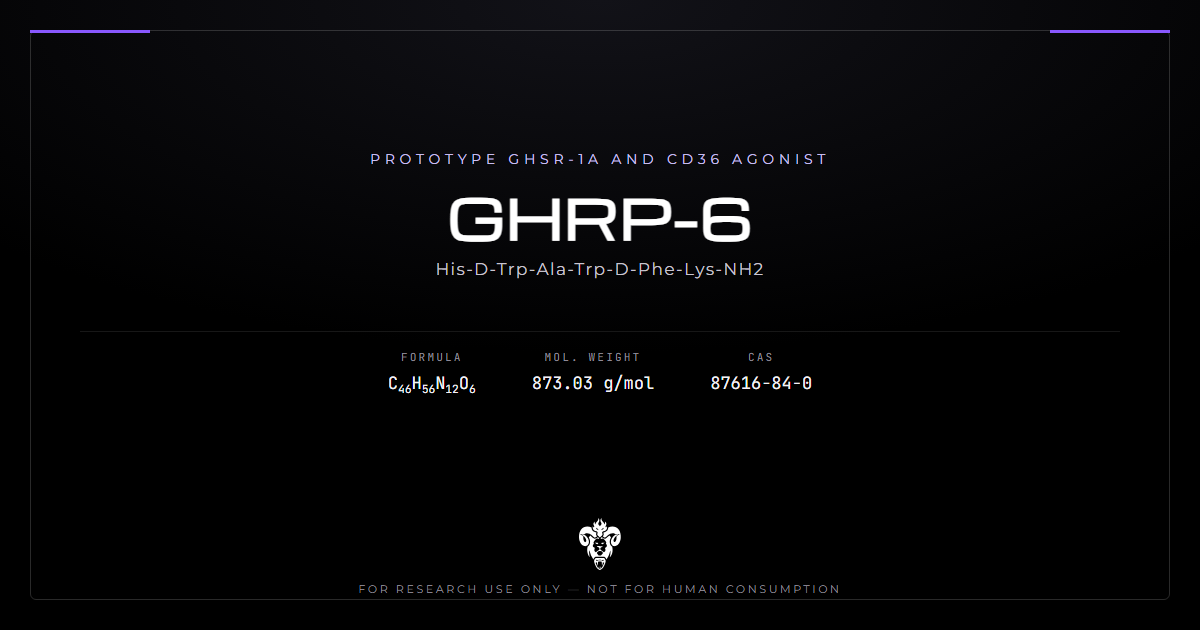
Chemical identity
The simplest member of the class: six residues, two of them D-configured, no unnatural side chains.
| Property | Value |
|---|---|
| Sequence | His-D-Trp-Ala-Trp-D-Phe-Lys-NH2 |
| Common names | GHRP-6, hexapeptide-2, GH-releasing hexapeptide |
| Molecular formula | C46H56N12O6 |
| Molecular weight | 873.0 |
| CAS | 87616-84-0 |
| PubChem CID | 9919153 |
| InChIKey | WZHKXNSOCOQYQX-FUAFALNISA-N |
Kimera supplies the material as GHRP-6.
A warning about the identifiers
PubChem holds two records for this compound, and searching by name returns the wrong one.
The name lookup resolves to a structure with no defined stereochemistry, carrying InChIKey WZHKXNSOCOQYQX-UHFFFAOYSA-N. That record also lists “GHRP-2 Acetate” among its synonyms, which is simply incorrect. The CAS lookup resolves to CID 9919153, InChIKey WZHKXNSOCOQYQX-FUAFALNISA-N, with all stereocentres defined.
Both share the first InChIKey block because the skeleton is identical. Only the second block differs, and that block is the whole point for a peptide whose D-residues carry its stability. Verify against the CAS number rather than the name.
Where it sits in the class
| GHRP-6 | GHRP-2 | Hexarelin | |
|---|---|---|---|
| Position 1 | His | D-Ala | His |
| Position 2 | D-Trp | D-2-Nal | D-2-methyl-Trp |
| Positions 3-6 | Ala-Trp-D-Phe-Lys-NH2 | same | same |
| Mass | 873.0 | 818.0 | 887.1 |
All three share four residues. GHRP-6 carries the unmodified D-tryptophan; the others carry engineered replacements for it. This is the parent form, and the others are what happened when chemists tried to improve on it.
The derivatives are the story
Three tool classes come off this scaffold, and each answers a question the parent cannot.
The antagonist
[D-Lys3]-GHRP-6 blocks the ghrelin receptor rather than activating it, and it is the reagent the field reaches for when it needs to test whether an effect is receptor-mediated.
Its limits are documented. Long-term treatment in nonobese diabetic MKR mice did not improve glucose homeostasis, and the authors note that available data on these antagonists is mostly short-term while the receptor’s signalling is complex [1].
A negative result from a standard tool is worth more than it looks. It bounds what the tool can support, and it warns against reading short-term antagonist data as though it settled a chronic question.
The CD36-selective azapeptides
This is the most interesting work attached to the scaffold. Azapeptide analogues were developed specifically as selective CD36 ligands, separating that receptor’s activity from growth hormone secretagogue receptor activity [2].
Two of them, MPE-001 ([aza-Tyr4]-GHRP-6) and MPE-003, were tested in apolipoprotein E-deficient mice fed a high fat high cholesterol diet, then dosed at 300 nmol/kg daily for nine weeks. They decreased lesion progression in the aortic arch. In the regression protocol they reduced aortic sinus lesion areas below pre-existing levels.
Why that result matters beyond this compound
The Hexarelin article on this site noted that CD36 appears to drive the cardiovascular effects in that class, and that the literature had not systematically separated the two receptors. This work does exactly that separation, from the other direction.
If a CD36-selective derivative retains and even reverses atherosclerosis without the growth hormone activity, then CD36 engagement is sufficient for the vascular effect. That is the stronger half of the question, and it has an answer.
The chemical probes
Azapeptide synthesis methods for expanding side-chain diversity have their own methodological literature [4]. A stable meta-carborane derivative generates boron-rich peptide agonists targeting the receptor [3].
Neither is a therapeutic candidate. Both exist because this scaffold tolerates substitution well enough to carry unusual chemistry.
What “tolerates substitution” is worth
A scaffold that keeps working after modification is a research asset independent of any clinical prospect. Chemists can hang reporters, isotopes and selectivity handles on it and still have something that binds.
That property explains the shape of the literature better than any pharmacological claim does. GHRP-6 is not the most potent member of its class, and it does not need to be. It is the one that accepts changes.
The derivatives outnumber the parent
Count what appears in recent work: an antagonist [1], two CD36-selective azapeptides [2], carborane-bearing agonists [3], and a synthesis methodology built around expanding side chains from this starting point [4].
Against that, the parent compound appears mostly in the cardiac and repair programmes below. For a research catalogue this is the useful framing: buying GHRP-6 buys a reference compound and a synthetic starting point rather than a finished tool.
The parent compound has its own programme
GHRP-6 is not only a starting material. It is the active ingredient in a formal drug development effort.
CIGB-500
A subchronic safety assessment ran CIGB-500, whose active ingredient is GHRP-6, in beagle dogs by daily intravenous administration for 28 consecutive days [5]. Groups received 300, 1000 or 2000 µg/kg/day against control.
Hypersalivation, hypoactivity, reduced heart rate, respiratory changes, pale gums and head erythema appeared in some animals at the two higher doses. The authors record these as transient and classify them as non-adverse, and report no adverse macroscopic findings.
That is regulatory-grade toxicology, which almost nothing else in this catalogue has. Note also that the effects appeared at 1000 µg/kg/day and above, which bounds where the clean range sits.
The cardiac indication
The stated purpose is rescue of cardiac mass affected during acute myocardial infarction [5]. Two recent studies support that direction.
A 2026 study used permanent left descending coronary artery ligation, a non-reperfusion infarct model, with treatment for seven days after surgery [6]. It had first established 0.4 mg/kg as the minimum effective dose for inotropy in healthy rats, and added mitochondrial proteomic analysis.
A 2024 study asked whether concurrent administration prevented doxorubicin-induced dilated cardiomyopathy in otherwise healthy rats, tracking myocardial change by transthoracic echocardiography [7].
The tissue repair literature
Cytoprotection is the second thread, and it predates the cardiac work.
Wound healing
Full-thickness excisional wounds in Wistar rats received topical treatment twice daily for five days, alongside a rabbit ear hypertrophic scar model treated for 30 days [8]. Both used a carboxymethylcellulose jelly at 400 µg/mL.
The rationale is explicitly receptor-based. CD36 is abundantly represented in cutaneous wound granulation tissue, and the study set out to characterise the healing response under CD36 agonist stimulation.
Other repair models
Work in renal tissue repair examined coadministration with epidermal growth factor after kanamycin overdosing [9]. A separate assessment addressed dose-effect and therapeutic time window for the same combination in stroke [10].
Both are combination studies. Neither isolates this compound’s contribution, and the stroke paper is explicitly a preclinical dose-finding exercise rather than an efficacy claim.
Why the combination keeps appearing
Pairing with epidermal growth factor is not arbitrary. One agent drives proliferation and the other is proposed as cytoprotective, so the rationale is complementary rather than redundant.
That makes it a sensible clinical strategy and a poor experimental design for learning what either does. The two goals conflict, and this literature chose the first.
The programme behind it
Much of the repair and cardiac work traces to a single development effort, the one that produced CIGB-500 [5]. Programme-driven literatures have a characteristic shape: consistent methods, consistent direction, and few independent replications.
None of that makes the findings wrong. It does mean the usual reassurance of independent confirmation is thinner than the citation count suggests, and a reader should weigh it accordingly.
Where this compound sits against its siblings
Three articles on this site now cover the hexapeptide secretagogues, and the comparison is clearer with all three in view.
Different fates from four shared residues
GHRP-2 became a diagnostic agent, validated against the insulin tolerance test. Hexarelin accumulated a cardiovascular literature built on CD36. GHRP-6 became the chemistry, generating the antagonist and the selective probes.
None of those outcomes follows from potency. They follow from who picked each compound up and what they wanted from it.
What that means for choosing one
For growth hormone release, all three work and the literature does not settle a ranking. CD36 work is better served by the selective azapeptides off this scaffold than by any of the parents [2]. A pituitary function test has one validated option, and it is GHRP-2 [13].
The honest summary is that the compounds are more similar than their literatures, and the literatures are what actually differ.
That is a useful thing to know before designing an experiment. Picking a compound because its literature is deep in your area imports that literature’s assumptions along with it. Picking on mechanism and then checking what has been done is the safer order.
Analytical and forensic work
The compound appears in several literatures that have nothing to do with its pharmacology.
Thermal degradation
Mass spectrometric and kinetic characterisation identified the modified species generated under thermal stress [11]. That is unusually specific stability data for a research peptide, and it is directly useful for anyone storing or shipping the material.
Detection
Automated dried blood spot sample preparation enables detection of lower molecular mass peptide doping agents including this class [12]. Separately, an analysis of new growth promoting black market products examined what such preparations actually contain [13].
That last one is worth reading for anyone sourcing material. Label and contents diverge in this market, which is the general finding across every such survey.
What the parent compound does on its own
The derivative story can obscure the basic pharmacology, so it is worth stating.
Growth hormone release
GHRP-6 is a GHSR-1a agonist and releases growth hormone. That is the property the class is named for and the reason the compound was made.
Reviews of peptides acting on this axis cover it alongside its siblings [13]. What the class shares is the mechanism. What differs is potency, selectivity and how each one has been developed since.
Appetite
Ghrelin receptor agonism drives food intake, and this compound is no exception. The effect is well known enough that the antagonist derived from it, [D-Lys3]-GHRP-6, became a standard tool for blocking exactly that [1].
Read the antagonist’s existence as evidence about the parent. Nobody builds a blocker for an effect that is hard to produce.
The two receptors again
CD36 binding is not incidental to this compound either. The wound healing work chose it specifically as a CD36 agonist, on the basis that the receptor is abundant in granulation tissue [8].
So the parent carries both activities, and every study using it inherits that ambiguity unless it controls for one.
How to read a GHRP-6 study
Four questions, and the first is unusual to this compound.
Parent or derivative?
[D-Lys3]-GHRP-6 is an antagonist. MPE-001 and MPE-003 are CD36-selective agonists [1][2]. None of them behaves like GHRP-6, and papers name them in ways that read similarly at a glance.
Which receptor?
This scaffold binds both GHSR-1a and CD36. Azapeptide work shows the two can be separated deliberately [2], so a study without a receptor control has not distinguished them.
That control is cheap here in a way it is not for most compounds, because the selective ligands already exist. Running one alongside the parent turns an ambiguous result into an attributable one.
Monotherapy or combination?
The renal and stroke work pairs the peptide with epidermal growth factor [9][10]. Attribution to either component is not available from those designs.
Which dose range?
The beagle toxicology found transient clinical signs at 1000 µg/kg/day and above [5]. Rodent efficacy work sits well below that. A study near the upper bound is measuring something different from one near the lower.
Verifying research material
GHRP-6 is a defined chemical entity with published identifiers, so verification is arithmetic rather than judgement. Batch documentation sits on the certificates of analysis page.
Identity
Formula C46H56N12O6, molecular weight 873.0, InChIKey WZHKXNSOCOQYQX-FUAFALNISA-N. Take that key from the CAS-linked record, not the name-linked one, for the reason given above.
Mass separates the class cleanly. 818.0 indicates GHRP-2, 887.1 indicates Hexarelin, and either result on a GHRP-6 batch means the wrong compound rather than an impurity.
Stereochemistry
Two D-residues, at positions two and five. Neither is visible by mass spectrometry, and an all-L peptide shares the formula exactly.
This compound makes the point better than its siblings do, because its position-two residue is ordinary tryptophan. There is no unnatural residue to catch a substitution by amino acid analysis. Configuration is the only thing distinguishing the real compound from a proteolytically fragile impostor.
Thermal stability is documented
Unusually, published work characterises what this peptide becomes under thermal stress, with kinetics [11]. That is better information than a generic storage recommendation, and it is worth consulting before designing a shipping or storage protocol.
Two tryptophans also make it photolabile, as in Hexarelin. Amber glass, cold, dark, and short-lived reconstituted solutions.
Common questions about GHRP-6
Identity and class
How does it differ from GHRP-2 and Hexarelin? At position two. GHRP-6 has plain D-tryptophan; GHRP-2 has D-2-naphthylalanine and Hexarelin has D-2-methyl-tryptophan. Masses are 873.0, 818.0 and 887.1.
Which PubChem record is correct? CID 9919153, reached via CAS 87616-84-0. The name lookup returns a record with no stereochemistry defined and one incorrect synonym.
What is [D-Lys3]-GHRP-6? An antagonist derived from this scaffold, widely used as a blocking tool [1]. It is not the same compound.
Evidence
What is CIGB-500? A drug development programme with GHRP-6 as its active ingredient, aimed at cardiac rescue after myocardial infarction, with 28-day repeat-dose beagle toxicology published [5].
Do the CD36-selective derivatives work? In apolipoprotein E-deficient mice, azapeptide analogues reduced lesion progression and, in a regression protocol, reduced lesion area below pre-existing levels [2].
Is there human evidence? Not for the cardiac or repair indications. The work above is rodent, rabbit and dog, and much of it comes from one development programme rather than independent groups.
What does the thermal stability work give you? Identified degradation species and kinetics [11], which is more actionable than a generic storage instruction.
Does it release growth hormone? Yes. It is a GHSR-1a agonist, and that is what the class is named for [13].
Does it drive appetite? Yes, and the antagonist built from it exists largely to block that effect [1].
Handling and verification
What mass should a batch return? 873.0. A result at 818.0 indicates GHRP-2 and 887.1 indicates Hexarelin.
Why is stereochemistry harder to police here than in GHRP-2? Because position two is ordinary tryptophan. GHRP-2 has an unnatural naphthylalanine that amino acid analysis will flag; this compound has nothing equivalent, so configuration is the only distinguishing feature.
Which InChIKey should a certificate quote? WZHKXNSOCOQYQX-FUAFALNISA-N. A certificate quoting the UHFFFAOYSA form has copied the flat PubChem record.
How photolabile is it? Two tryptophans, so comparable to Hexarelin and more than GHRP-2. Amber glass, cold, dark.
Is thermal degradation characterised? Yes, with kinetics and identified species [11], which is unusual and useful.
Summary of the evidence
Strongest evidence: the azapeptide work [2]. It is mechanistically decisive in a way most of this class’s literature is not, because it separates CD36 activity from growth hormone activity by design and shows the vascular effect follows CD36. Alongside it, the beagle toxicology [5] is regulatory-grade and rare for a catalogue compound.
Also solid: the thermal degradation characterisation [11], which gives real stability data rather than a recommendation.
Weakest evidence: the repair literature, where the two most cited results are combination studies with epidermal growth factor [9][10] and cannot attribute to this compound alone.
Read plainly, GHRP-6 matters more as a scaffold than as an agent. Its derivatives answered a question about receptor selectivity that the parent compounds in this class could not, and the field’s standard antagonist came off the same six residues.
That is an unusual thing for a catalogue compound to be, and it changes what a purchase is for. A reference standard, a synthetic starting point, and a positive control for receptor work are all reasonable uses. Treating it as the finished article, when better-characterised derivatives exist for the specific questions, is the one reading the literature does not support.
The rest of the peptide literature sits in the peptides category.
Status: supplied for laboratory research use only.
References
- Mosa R, Huang L, Li H, Grist M, LeRoith D, Chen C. Long-term treatment with the ghrelin receptor antagonist [d-Lys3]-GHRP-6 does not improve glucose homeostasis in nonobese diabetic MKR mice. Am J Physiol Regul Integr Comp Physiol. 2018;314(1):R71-R83. PMID 28903914. DOI
- Frégeau G, Sarduy R, Elimam H, Esposito CL, Mellal K, Ménard L, Leitão da Graça SD, Proulx C, et al. Atheroprotective and atheroregressive potential of azapeptide derivatives of GHRP-6 as selective CD36 ligands in apolipoprotein E-deficient mice. Atherosclerosis. 2020;307:52-62. PMID 32721647. DOI
- Worm DJ, Els-Heindl S, Kellert M, Kuhnert R, Saretz S, Koebberling J, Riedl B, Hey-Hawkins E, et al. A stable meta-carborane enables the generation of boron-rich peptide agonists targeting the ghrelin receptor. J Pept Sci. 2018;24(10):e3119. PMID 30168238. DOI
- Chingle R, Proulx C, Lubell WD. Azapeptide Synthesis Methods for Expanding Side-Chain Diversity for Biomedical Applications. Acc Chem Res. 2017;50(7):1541-1556. PMID 28598597. DOI
- Castro J, Shaikh I, Silo S, Hum C, Carrier M, DiFruscia R, Thouin F, Chan J, et al. Subchronic safety assessment of CIGB-500 in beagle dog after repeated daily dose administration over 28 days. Regul Toxicol Pharmacol. 2025;158:105798. PMID 40024561. DOI
- Wang L, Rodriguez-Ulloa A, Berlanga-Acosta J, García-Ojalvo A, Abreu-Cruz A, Gonzalez-López LJ, Besada-López V, Ramos-Gómez Y, et al. Growth Hormone-Releasing Peptide-6 (GHRP-6) Ameliorates Post-Infarct Ventricular Remodeling and Systolic Dysfunction in a Model of Permanent Coronary Ligation. Pharmaceuticals (Basel). 2026;19(3). PMID 41901314. DOI
- Berlanga-Acosta J, Cibrian D, Valiente-Mustelier J, Suárez-Alba J, García-Ojalvo A, Falcón-Cama V, Jiang B, Wang L, et al. Growth hormone releasing peptide-6 (GHRP-6) prevents doxorubicin-induced myocardial and extra-myocardial damages by activating prosurvival mechanisms. Front Pharmacol. 2024;15:1402138. PMID 38873418. DOI
- Mendoza Marí Y, Fernández Mayola M, Aguilera Barreto A, García Ojalvo A, Bermúdez Alvarez Y, Mir Benítez AJ, Berlanga Acosta J. Growth Hormone-Releasing Peptide 6 Enhances the Healing Process and Improves the Esthetic Outcome of the Wounds. Plast Surg Int. 2016;2016:4361702. PMID 27200188. DOI
- Rodriguez Salgueiro S, González Núñez L, García Del Barco Herrera D, Santos Febles E, Maza Ares D, Millares López R, Berlanga Acosta J. Role of epidermal growth factor and growth hormone-releasing peptide-6 in acceleration of renal tissue repair after kanamycin overdosing in rats. Iran J Kidney Dis. 2014;8(5):382-8. PMID 25194405.
- Subirós N, Pérez-Saad HM, Berlanga JA, Aldana L, García-Illera G, Gibson CL, García-Del-Barco D. Assessment of dose-effect and therapeutic time window in preclinical studies of rhEGF and GHRP-6 coadministration for stroke therapy. Neurol Res. 2016;38(3):187-95. PMID 26311576. DOI
- Santana H, Espinosa LA, Sánchez A, Bolaño Alvarez A, Besada V, González LJ. Mass spectrometric and kinetics characterization of modified species of Growth Hormone Releasing Hexapeptide generated under thermal stress in different pH and buffers. J Pharm Biomed Anal. 2021;194:113776. PMID 33272786. DOI
- Lange T, Thomas A, Walpurgis K, Thevis M. Fully automated dried blood spot sample preparation enables the detection of lower molecular mass peptide and non-peptide doping agents by means of LC-HRMS. Anal Bioanal Chem. 2020;412(15):3765-3777. PMID 32300840. DOI
- Krug O, Thomas A, Malerød-Fjeld H, Dehnes Y, Laussmann T, Feldmann I, Sickmann A, Thevis M. Analysis of new growth promoting black market products. Growth Horm IGF Res. 2018;41:1-6. PMID 29864719. DOI
GHRP-6 is sold for laboratory research use only. Not for human consumption, nor medical, veterinary, or household uses.