
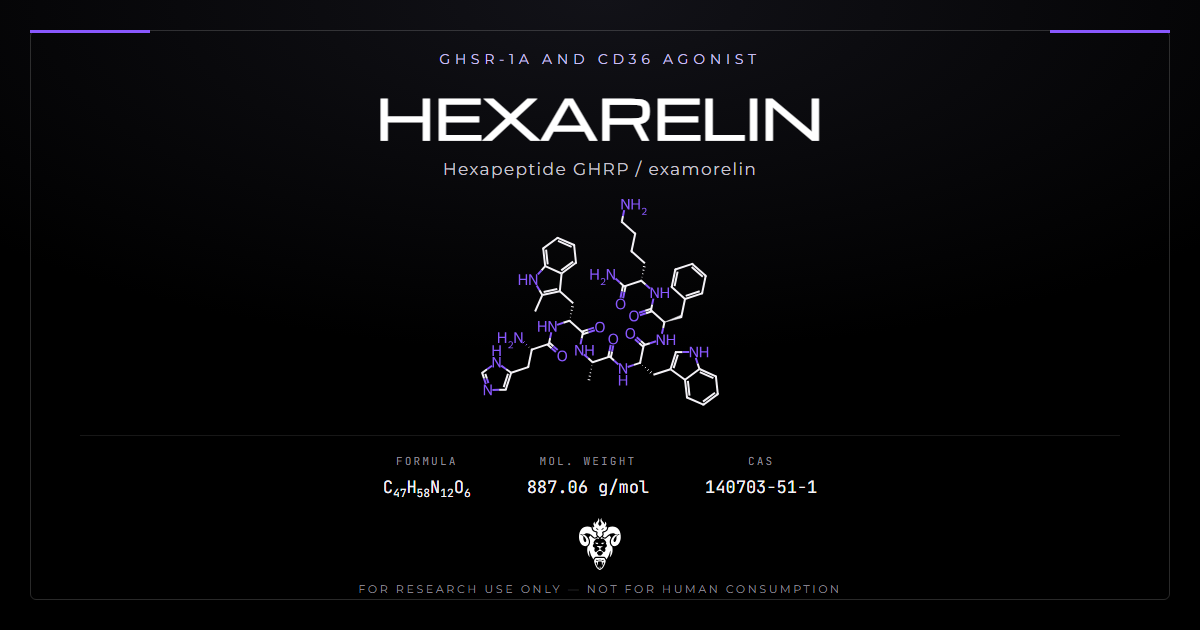
Sort the recent Hexarelin literature by topic and the result is lopsided. Cardiomyocyte protection after ischaemia and reperfusion. Atherosclerosis in two rodent models. Macrophage lipid uptake. Pancreatic beta cell survival. Acute lung injury.
Growth hormone appears in the compound’s classification and in comparatively little of its current research.
The reason is a second receptor. Alongside the growth hormone secretagogue receptor it shares with ghrelin, Hexarelin binds CD36, described as a specific cardiac receptor mediating its cardioprotective effects [1]. Most of what makes this compound interesting runs through that second route.
Chemical identity
A synthetic hexapeptide, amidated at the C-terminus, with two D-amino acids and one methylated residue.
| Property | Value |
|---|---|
| Sequence | His-D-2-methyl-Trp-Ala-Trp-D-Phe-Lys-NH2 |
| Common names | Hexarelin, examorelin, EP-23905, MF-6003 |
| Molecular formula | C47H58N12O6 |
| Molecular weight | 887.0 |
| CAS | 140703-51-1 |
| PubChem CID | 6918297 |
| InChIKey | RVWNMGKSNGWLOL-GIIHNPQRSA-N |
Kimera supplies the material as Hexarelin.
Three modifications, all deliberate
D-tryptophan at position two, D-phenylalanine at position five, and a methyl group on that position-two tryptophan. Each blocks a proteolysis route that would clear an all-L peptide quickly.
Reviews describe the compound as chemically more stable and functionally more potent than ghrelin [1]. Those two properties come directly from the modifications above, and they are the reason a synthetic hexapeptide outperforms the endogenous 28-residue ligand.
Two tryptophans in six residues
That is an unusual density of tryptophan, and it matters twice over. It drives strong ultraviolet absorbance, which makes chromatographic detection straightforward. It also makes the peptide photolabile, which the handling section returns to.
Two receptors, not one
Reading Hexarelin as a growth hormone secretagogue captures half of it.
GHSR-1a, the shared route
Hexarelin binds and activates the growth hormone secretagogue receptor in the brain, as its natural analogue ghrelin does [1]. That produces growth hormone release, and it is the property the compound was developed for.
A 2021 study demonstrated the effect cleanly. Continuous infusion by osmotic pump in melanocortin-4 receptor knockout mice increased pulsatile growth hormone secretion without detectable change in basal secretion [2].
That distinction is worth holding. The compound amplified the existing rhythm rather than raising the floor, which is a different pharmacology from supplying hormone directly.
CD36, the route that carries the literature
CD36 is a scavenger receptor, and it is not a growth hormone receptor in any sense. Reviews identify it as a specific cardiac receptor for Hexarelin, mediating cardioprotective effects independent of the growth hormone axis [1].
That single fact reorganises the compound. Cardiac and vascular findings do not need a growth hormone explanation, and looking for one will mislead.
Why the peripheral distribution matters
GHSR itself appears in heart and blood vessels, not only the brain [1]. So peripheral effects have two candidate routes rather than one, and separating them takes a receptor-specific control rather than an assumption.
Papers that use a CD36 knockout or a receptor antagonist can attribute an effect. Papers that dose and measure cannot.
This is the single most useful filter to apply when reading the compound. It sorts the literature faster than any judgement about journal quality or sample size, and it applies to nearly every study discussed below.
What the cardiovascular work shows
Four studies, all in rodents, all consistent in direction.
| Model | Species | Protocol | Finding |
|---|---|---|---|
| Ischaemia/reperfusion [3] | Rat | 30 min ischaemia, 100 µg/kg/day for 7 days | Cardiomyocyte protection via IL-1 signalling |
| Atherosclerosis [4] | Rat | Vitamin D3 plus high-fat, 30 days dosing | Suppressed atherosclerosis development |
| Atherosclerosis [5] | ApoE-/- mouse | High lipid diet, 100 µg/kg/day for 3 months | Attenuated via LOX-1-NF-κB, reduced macrophage ox-LDL uptake |
| Lipid metabolism [6] | MKR mouse | 200 µg/kg twice daily | Improved lipid aberrations, CD36-mediated |
The ischaemia-reperfusion study
Rat hearts underwent 30 minutes of ischaemia by left coronary artery ligation followed by reperfusion [3]. Treatment ran subcutaneously twice daily for seven days, with ghrelin and saline arms alongside.
Readouts included echocardiography, malondialdehyde, histochemical staining, and Western blot for IL-1β, IL-1Ra and IL-1RI. The interleukin-1 pathway is the proposed mechanism, which is an inflammatory route rather than a hormonal one.
The two atherosclerosis models
The earlier study induced atherosclerosis in rats with vitamin D3 and three months of high-fat emulsion feeding [4]. Serum total cholesterol and LDL rose, HDL and aortic nitric oxide fell, and chronic dosing altered that picture.
The later one used ApoE-deficient mice over three months and went further mechanistically [5]. It reported reduced serum lipids alongside inhibition of LOX-1-NF-κB signalling and reduced oxidised LDL uptake by macrophages.
Two different species, two different induction methods, two different mechanistic accounts, same direction. That is a stronger position than one model repeated.
The mechanistic divergence deserves a second look though. One study attributes the effect to LOX-1-NF-κB signalling in macrophages [5], the earlier one to serum lipids and aortic nitric oxide [4]. Those are not the same claim.
Agreement on direction with disagreement on mechanism is common early in a literature. It usually means the effect is real and the pathway is not yet located, which is a fair description of where this work sits.
What the lipid study adds
The MKR mouse study is the one that ties the vascular findings to the receptor [6]. It examined lipid metabolic aberrations in a nonobese insulin-resistant model and attributes the benefit to CD36.
Nonobese matters. Most metabolic work uses obese models where confounding is heavy, and a lean insulin-resistant model isolates the lipid question better.
The protective effect is not confined to the heart
The same pattern appears in tissues with no cardiac connection, which is either a strong hint about mechanism or a warning about publication practice.
Other organ systems
A second myocardial ischaemia-reperfusion study in mice targeted neuroinflammatory pathways rather than interleukin-1, preserving cardiac morphology and function [9]. Work in acute lung injury reported modulation of lung mechanics, inflammation and fibrosis [10].
Rodent pancreatic beta cells exposed to streptozotocin showed preserved function through mitochondrial signalling [11]. Neuronal cell lines under oxidative stress showed inhibition of apoptotic toxicity.
What connects them
CD36 is the plausible thread. It is a scavenger receptor with an established role in metabolic disorders through the CD36-PPARγ pathway [12], and it is expressed well beyond the heart.
An anti-inflammatory effect running through a widely expressed receptor would produce exactly this pattern of findings across unrelated tissues.
The competing explanation
Broad protection across many injury models is also the signature of a literature that publishes positive results and shelves negative ones. Every study above found a benefit, which for any compound is improbable.
Neither reading can be settled from the published record alone. The honest position is that the mechanism is plausible and the completeness of the evidence is unknown.
Where the evidence stops
Everything above is preclinical, and stating that plainly matters more than any individual result.
No human cardiovascular trials
The cardiovascular literature is rodent work. Reviews of the area describe the compound as promising for cardiovascular conditions [1], which is the language of a hypothesis rather than a result.
Rodent atherosclerosis models are induced over weeks by diet and vitamin D3 or by genetic knockout. Human atherosclerosis develops over decades. Read-across from one to the other has failed for many compounds.
The human record is older and narrower
Hexarelin’s human work belongs to the growth hormone era, not the cardiovascular one. Recent human-facing publications concern analytical detection rather than efficacy [7][8].
That is a real asymmetry. The compound’s best-evidenced property in humans is the one current research has largely moved away from.
Doses in the rodent work are not small
The cardiac and atherosclerosis studies used 100 to 200 µg/kg per day, often twice daily, for weeks to months [3][5][6]. Those are pharmacological exposures sustained over a substantial fraction of a rodent lifespan.
Anyone reading a protective finding should note what produced it. Chronic high-dose administration in a young animal with induced disease is a long way from any other setting, and the papers do not pretend otherwise.
Desensitisation is the unanswered question
Continuous receptor agonism usually produces tolerance, and GHSR-1a is no exception in the wider secretagogue literature. The osmotic pump study reported sustained pulsatile secretion over three to four weeks [2], which argues against rapid tolerance in that model.
Whether the CD36 effects desensitise is not addressed in this literature at all. For a receptor route that carries most of the interesting findings, that is a conspicuous gap.
How the class compares
Hexarelin is one of several synthetic secretagogues, and the differences between them are not cosmetic.
Potency and stability
Reviews place Hexarelin above ghrelin on both chemical stability and functional potency [1]. The D-residues and the methylated tryptophan account for the first, and the receptor affinity for the second.
Against its own class the picture is less settled. GHRP-2 and GHRP-6 share the mechanism and the analytical methods [7], and head-to-head potency comparisons are thinner than the individual literatures suggest.
The CD36 affinity may be what separates them
If CD36 binding drives the cardiovascular findings, then a secretagogue lacking that affinity should not reproduce them. That is a testable prediction and the literature has not systematically tested it.
It also means class read-across is unsafe in both directions. A cardiovascular result for this compound does not transfer to the others, and their growth hormone data does not predict its cardiac behaviour.
The doping-control literature is useful for a different reason
Hexarelin appears in sports drug testing work, which produced something the therapeutic literature did not: careful characterisation of what the compound becomes.
Metabolite identification
Published work determined growth hormone releasing peptide metabolites in human urine after nasal administration, covering Hexarelin alongside GHRP-1, GHRP-2 and GHRP-6 [7]. In vitro models for metabolic studies of small peptide hormones in this setting have their own methodological literature [8].
For laboratory work this is more valuable than it first appears. A published metabolite profile means a detection method can be validated against known targets rather than guessed at.
It also means the class gets studied together
The GHRPs are structurally related and analytical work treats them as a group [7]. That is convenient for method development and a hazard for attribution.
A method tuned for one may respond to another, which matters if a sample might contain GHRP-2 or GHRP-6 as well.
How to read a Hexarelin study
Four questions, and the first is the one most reviews skip.
Which receptor?
GHSR-1a and CD36 produce different effects through different pathways [1]. A study without a receptor-specific control has not distinguished them, whatever its conclusion says.
Was growth hormone measured?
If a cardiovascular effect appears without a growth hormone rise, that supports the CD36 route. If growth hormone was not measured, the question stays open.
Which model, and how induced?
Vitamin D3 plus high-fat feeding [4] and ApoE knockout [5] are different diseases in different species. Agreement between them is meaningful precisely because they differ.
Continuous or pulsatile dosing?
The osmotic pump study found amplification of pulsatile secretion without a change in basal levels [2]. Bolus and continuous administration are not interchangeable for a compound acting on a rhythmic system.
Verifying research material
Hexarelin is a defined chemical entity with published identifiers, so verification is arithmetic rather than judgement. Batch documentation sits on the certificates of analysis page.
Identity
Formula C47H58N12O6, molecular weight 887.0, InChIKey RVWNMGKSNGWLOL-GIIHNPQRSA-N. At six residues, tandem mass spectrometry sequences it without difficulty.
The methyl group is the check most likely to be skipped
The 2-methyl on the position-two tryptophan is a single carbon, 14 daltons. Omitting it produces a peptide at 873 that is not Hexarelin.
That difference is trivial to see on a high-resolution instrument and easy to miss on a nominal-mass one, particularly since 14 daltons is also the gap between several ordinary amino acid substitutions.
Stereochemistry needs its own answer
Two D-residues carry the stability that defines this compound, and mass spectrometry sees neither. An all-L peptide has the same formula, the same mass, and the proteolytic fragility the D-substitutions were introduced to prevent.
Chiral amino acid analysis after hydrolysis answers it. Nothing cheaper does, and for this compound the question is not academic: the D-residues are most of the reason it outperforms ghrelin [1].
There is a functional test as well, and it is cheaper than chiral analysis. Incubate a sample in serum or a protease preparation and follow it over time. An all-L impostor degrades on the timescale the D-substitutions exist to prevent, so a stability curve separates them without any chiral chemistry.
That approach reports the property that actually matters. Configuration is the means; resistance to proteolysis is the end.
What a certificate should carry
Four things. Mass near 887.0, a purity figure with the method named, a chromatographic trace rather than a bare number, and an explicit statement on stereochemistry.
Most certificates supply the first two. The third reveals oxidation shoulders and deletion sequences. The fourth is the one to ask for, because no routine purity method answers it and the compound depends on it.
Handling
Two tryptophans make this peptide notably photolabile. Amber glass is not optional, and tryptophan oxidation adds 16 daltons per event, which shows as a late-eluting shoulder rather than a shifted main peak.
Lyophilised, cold and dark. Compare with Ipamorelin, another synthetic secretagogue with a different residue composition and a correspondingly different stability profile.
Common questions about Hexarelin
Identity and class
What is examorelin? The same compound. Examorelin is the international nonproprietary name; EP-23905 and MF-6003 are development codes.
Is it related to ghrelin? It activates the same receptor, GHSR-1a, and reviews describe it as more chemically stable and more potent than ghrelin [1]. The sequences are unrelated.
How many receptors does it bind? Two. GHSR-1a and CD36, and the second is not a growth hormone receptor [1]. That distinction organises most of what follows.
Evidence
What does the CD36 route do? It mediates cardioprotective effects independent of growth hormone release [1], and it appears in the lipid metabolism work as well [6].
Are there human cardiovascular trials? Not in the indexed literature. The cardiovascular evidence is rodent work [3][4][5].
Does it raise baseline growth hormone? In one mouse model it increased pulsatile secretion without detectable change in basal secretion [2].
Why does it appear in doping-control papers? Because the class is detectable and its metabolites have been characterised in human urine [7][8].
Does the protective effect appear outside the heart? Yes, in lung [10], pancreatic beta cells [11] and neuronal cells. CD36 expression beyond the heart is the plausible thread [12].
Is that breadth reassuring? Not by itself. Every published study found a benefit, which for any compound is improbable, so the completeness of the record is unknown.
Handling and verification
What identity check is easiest to skip? The 2-methyl on the position-two tryptophan. It is 14 daltons, and a nominal-mass instrument will not distinguish it from several ordinary substitutions.
Why does stereochemistry need a separate test? Two D-residues carry the stability, and mass spectrometry sees neither. An all-L peptide has an identical formula and mass.
Why amber glass? Two tryptophans in six residues make it notably photolabile. Tryptophan oxidation adds 16 daltons and shows as a late-eluting shoulder.
Does it desensitise? Pulsatile growth hormone secretion held over three to four weeks in one model [2]. Nobody has published the equivalent question for the CD36 route.
Summary of the evidence
Strongest evidence: the mechanistic case for two receptors, with CD36 identified as a specific cardiac receptor mediating effects the growth hormone axis does not explain [1]. Supporting it, four rodent studies across two species and two atherosclerosis induction methods, agreeing in direction [3][4][5][6].
Also solid, in a narrower way: the analytical characterisation from sports drug testing, which gives published metabolites in human urine [7][8].
Weakest evidence: any human cardiovascular claim. That literature does not exist, and the reviews describing the compound as promising are explicit that they are describing potential [1].
Read plainly, Hexarelin is a well-characterised dual-receptor peptide whose most interesting pharmacology has nothing to do with the hormone in its classification. The rodent cardiovascular work is consistent and the human cardiovascular work has not been done.
For laboratory purposes that combination is workable, provided the receptor question stays in view. A study that doses this compound and measures a peripheral outcome has two candidate mechanisms and no way to choose between them without a receptor-specific control. Adding that control is the single change that would move most of this literature forward.
The rest of the peptide literature sits in the peptides category.
Status: supplied for laboratory research use only.
References
- Mao Y, Tokudome T, Kishimoto I. The cardiovascular action of hexarelin. J Geriatr Cardiol. 2014;11(3):253-8. PMID 25278975. DOI
- Huang Z, Lu X, Huang L, Zhang C, Veldhuis JD, Cowley MA, Chen C. Stimulation of endogenous pulsatile growth hormone secretion by activation of growth hormone secretagogue receptor reduces the fat accumulation and improves the insulin sensitivity in obese mice. FASEB J. 2021;35(1):e21269. PMID 33368660. DOI
- Huang J, Li Y, Zhang J, Liu Y, Lu Q. The Growth Hormone Secretagogue Hexarelin Protects Rat Cardiomyocytes From in vivo Ischemia/Reperfusion Injury Through Interleukin-1 Signaling Pathway. Int Heart J. 2017;58(2):257-263. PMID 28321024. DOI
- Pang J, Xu Q, Xu X, Yin H, Xu R, Guo S, Hao W, Wang L, et al. Hexarelin suppresses high lipid diet and vitamin D3-induced atherosclerosis in the rat. Peptides. 2010;31(4):630-8. PMID 19931584. DOI
- Cheng XL, Ding F, Wang DP, Zhou L, Cao JM. Hexarelin attenuates atherosclerosis via inhibiting LOX-1-NF-κB signaling pathway-mediated macrophage ox-LDL uptake in ApoE(-/-) mice. Peptides. 2019;121:170122. PMID 31386895. DOI
- Mosa R, Huang L, Wu Y, Fung C, Mallawakankanamalage O, LeRoith D, Chen C. Hexarelin, a Growth Hormone Secretagogue, Improves Lipid Metabolic Aberrations in Nonobese Insulin-Resistant Male MKR Mice. Endocrinology. 2017;158(10):3174-3187. PMID 28977588. DOI
- Semenistaya E, Zvereva I, Thomas A, Thevis M, Krotov G, Rodchenkov G. Determination of growth hormone releasing peptides metabolites in human urine after nasal administration of GHRP-1, GHRP-2, GHRP-6, Hexarelin, and Ipamorelin. Drug Test Anal. 2015;7(10):919-25. PMID 25869809. DOI
- Esposito S, Deventer K, Geldof L, Van Eenoo P. In vitro models for metabolic studies of small peptide hormones in sport drug testing. J Pept Sci. 2015;21(1):1-9. PMID 25469748. DOI
- McDonald H, Peart J, Kurniawan ND, Galloway G, Royce SG, Samuel CS, Chen C. Hexarelin targets neuroinflammatory pathways to preserve cardiac morphology and function in a mouse model of myocardial ischemia-reperfusion. Biomed Pharmacother. 2020;127:110165. PMID 32403043. DOI
- Zambelli V, Rizzi L, Delvecchio P, Bresciani E, Rezoagli E, Molteni L, Meanti R, Cuttin MS, et al. Hexarelin modulates lung mechanics, inflammation, and fibrosis in acute lung injury. Drug Target Insights. 2021;15:26-33. PMID 34871336. DOI
- Zhao Y, Zhang X, Chen J, Lin C, Shao R, Yan C, Chen C. Hexarelin Protects Rodent Pancreatic Β-Cells Function from Cytotoxic Effects of Streptozotocin Involving Mitochondrial Signalling Pathways In Vivo and In Vitro. PLoS One. 2016;11(2):e0149730. PMID 26918825. DOI
- Maréchal L, Laviolette M, Rodrigue-Way A, Sow B, Brochu M, Caron V, Tremblay A. The CD36-PPARγ Pathway in Metabolic Disorders. Int J Mol Sci. 2018;19(5). PMID 29883404. DOI
Hexarelin is sold for laboratory research use only. Not for human consumption, nor medical, veterinary, or household uses.