
An intravenous bolus of Kisspeptin-10 raises luteinising hormone in healthy men at doses as low as 0.3 nmol/kg. The same peptide, given to healthy women in the follicular phase of the menstrual cycle, produced no alteration in gonadotropins at all [1].
That is not a dosing problem. Raising the dose in unresponsive women did not fix it [2].
The pattern repeats across every human study of the compound. Sex, cycle phase, circulating estradiol, developmental stage and the integrity of the underlying neuronal network each change the answer. What the peptide reports is the state of the system receiving it, which makes it a useful probe and an unreliable lever.
Chemical identity
A decapeptide, amidated at the C-terminus, corresponding to residues 45 to 54 of the larger parent peptide.
| Property | Value |
|---|---|
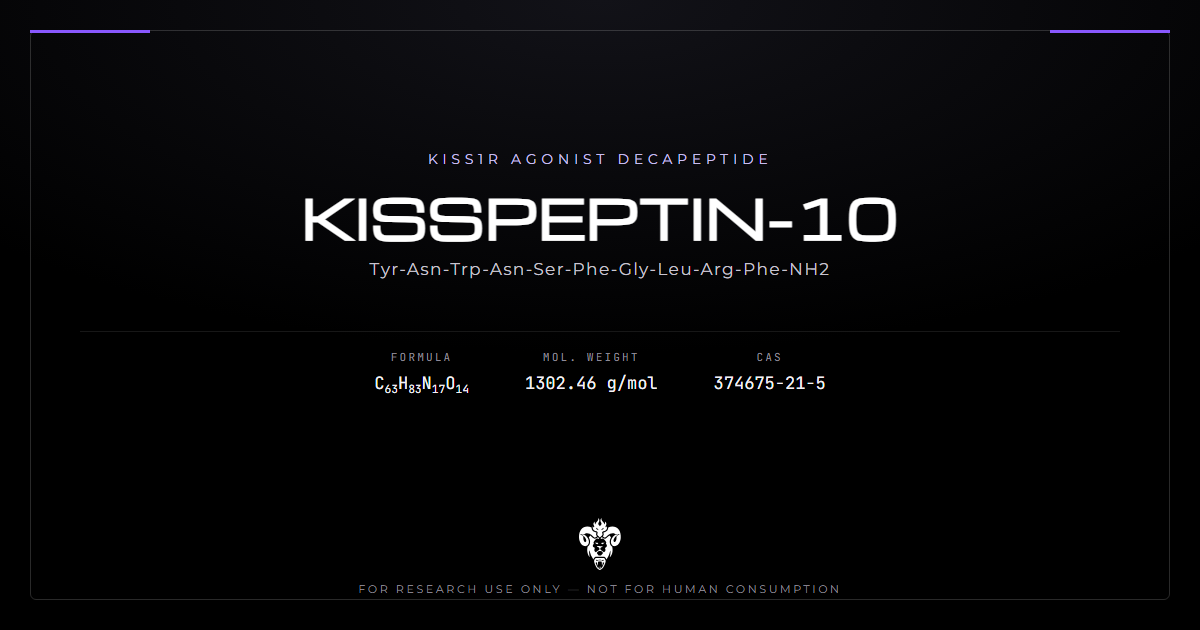
| Sequence | Tyr-Asn-Trp-Asn-Ser-Phe-Gly-Leu-Arg-Phe-NH2 |
| Common names | Kisspeptin-10, KP-10, metastin 45-54, kisspeptin 112-121 |
| Molecular formula | C63H83N17O14 |
| Molecular weight | 1302.4 |
| CAS | 374675-21-5 |
| PubChem CID | 25240297 |
| InChIKey | RITKWYDZSSQNJI-INXYWQKQSA-N |
Kimera supplies the material as Kisspeptin-10.
The two numbering systems
The same molecule carries two positional names, and both appear in the literature. Metastin 45-54 numbers from the processed 54-residue peptide. Kisspeptin 112-121 numbers from the full KISS1 gene product.
Papers use them interchangeably without explanation. A search on one misses the other, which is the ordinary reason a literature review on this compound comes back thinner than it should.
The C-terminal amide is not optional
The RF-amide motif at the C-terminus defines the family and the receptor interaction. An unamidated peptide is a different compound with the same residue sequence.
That matters for verification, because the amide costs one dalton against the free acid. A synthesis that failed to amidate produces material 1 Da heavier that a low-resolution instrument will not flag.
The name records a hypothesis that turned out wrong
Kisspeptin-10 is a fossil of its own discovery, and the fossil is still in the synonym list.
Found as a metastasis suppressor
KISS1 entered the literature as a metastasis suppressor gene. Early work showed the peptide product, named metastin, suppressing motility and growth in cells transfected with its receptor [3].
That is why the compound’s PubChem synonyms still include “Human metastin 45-54” and why the CAS registry entry sits under that lineage.
Then found to run reproduction
The receptor, KISS1R and formerly GPR54, turned out to sit upstream of gonadotropin-releasing hormone. Loss-of-function mutations produce idiopathic hypogonadotropic hypogonadism, and the system is now understood as central to reproductive function [4].
The cancer thread did not disappear. Work on KISS1 and KISS1R in metastasis continues [5]. But the compound’s importance moved to a different organ system than the one it was named for.
Why this is worth knowing
Anyone reading across this literature will meet the same molecule under four names, in two fields, numbered two ways. The oncology papers and the reproductive endocrinology papers rarely cite each other.
That split has a practical cost. A search on “kisspeptin” returns the reproductive literature. A search on “metastin” returns the cancer literature. Neither returns both, and a review that used only one term will look complete while missing half the field.
The two roles are not obviously connected
It would be tidy if the reproductive and metastatic functions shared a mechanism. Published work does not make that case cleanly.
Reproduction runs through hypothalamic neurons and GnRH release [6]. The cancer literature concerns cell motility and invasion in peripheral tissue [3][5]. Same receptor, very different context, and the connection between them is an open question rather than a settled story.
Treat a paper that explains one role by reference to the other as making an argument, not reporting a finding.
The receptor and where it sits
KISS1R is a G-protein coupled receptor, and the neurons expressing it sit upstream of GnRH release [6].
KNDy neurons
The relevant population co-expresses kisspeptin, neurokinin B and dynorphin, and is known by the acronym KNDy. Reviews of human reproductive health treat this population as the pulse generator for GnRH [7].
Kisspeptin-10 acts at the top of that cascade. It does not release LH directly. It drives GnRH release, which drives LH, which is why an intact downstream network is a precondition for any response at all.
The receptor is not exclusive
At least one small molecule, RF9, acts as a KISS1R agonist both in vivo and in vitro [8]. The RF-amide family is broad, and cross-reactivity within it is a known complication rather than a curiosity.
What determines whether it works
Five variables change the response. All five have published human or large-animal evidence.
| Variable | Finding |
|---|---|
| Sex | LH and FSH rose in men at 0.3 and 1.0 nmol/kg; no gonadotropin change in follicular-phase women [1] |
| Cycle phase | LH pulses in all luteal and preovulatory women; only half of early-follicular women responded [2] |
| Dose | Increasing dose did not rescue non-responders in the early follicular phase [2] |
| Estradiol | Postmenopausal women resistant; on estradiol replacement, LH pulse amplitude rose in proportion to circulating estradiol [9] |
| Network integrity | All subjects with abiding hypogonadotropic hypogonadism failed to respond; one whose condition had reversed responded fully [10] |
Sex is the largest single difference
The dimorphism study administered intravenous bolus Kisspeptin-10 to healthy men and women, with subcutaneous bolus and infusion arms in women as well [1]. Group sizes were four to five.
Men responded at low doses. Follicular-phase women did not respond to the intravenous bolus. That is a categorical difference rather than a shift in magnitude.
Cycle phase explains part of the rest
The follow-up dosed ten women in the early follicular phase, three in the late follicular phase and fourteen in the midluteal phase [2]. Every luteal and preovulatory woman showed LH pulses immediately after administration.
In the early follicular phase, only half did. A higher dose in an additional group did not change that.
Estradiol looks like the mediating variable
Eight postmenopausal women received a 24-hour continuous infusion [9]. They were resistant. On estradiol replacement they remained resistant initially, then showed LH pulse amplitude rising in proportion to both estradiol concentration and infusion duration.
Read alongside the cycle-phase data, the coherent reading is that circulating estradiol gates responsiveness. The low-estradiol early follicular phase and the postmenopausal state both produce poor responses.
What it is actually good for
The variability that makes Kisspeptin-10 unreliable as an intervention makes it valuable as a diagnostic probe.
Reading GnRH network function
Investigators administered it to twelve subjects with congenital hypogonadotropic hypogonadism, six with an identified genetic cause, alongside exogenous GnRH before and after six days of pulsatile GnRH treatment [10].
Every subject with abiding disease failed to mount a GnRH-induced LH response to Kisspeptin-10. The single subject whose hypogonadotropism had reversed showed a clear response.
That is the compound doing what a probe should. The readout distinguished a functioning neuronal network from a non-functioning one, in a way a downstream hormone measurement would not.
A genetic counter-example worth knowing
A child with a homozygous KISS1R missense variant presented with microphallus and cryptorchidism, and had low neonatal testosterone [11]. The variant reduces but does not abolish signalling.
By 17 years he had 20 mL testicular volume and adult gonadotropin and testosterone levels. The case associates biallelic KISS1R loss of function with normal adolescent puberty, which means kisspeptin dependence differs between mini-puberty and adolescent puberty.
Where it fails
Two published failures are worth carrying, because both were reasonable expectations.
Ovulation in the mare
Equine Kisspeptin-10 was given to Welsh pony mares by bolus and by short and long perfusion, in anestrus and at several cycle stages [12]. Gonadotropins rose reliably every time.
The rise was rapid and essentially transient, even under continuous perfusion, and ovulation was not triggered. In sheep the same approach had controlled ovulation. Species did not transfer.
The transience is the mechanism
That the response fades under continued exposure is the most practically important property in this article. A single bolus and a continuous infusion do not produce proportionally different results.
Anyone designing an experiment on the assumption that more exposure means more effect is designing against the published behaviour.
The postmenopausal infusion study complicates this in a useful direction [9]. There, 24 hours of continuous exposure produced no response without estradiol, and a growing response with it. So transience is not a fixed property of the peptide. It depends on the hormonal background, like everything else here.
Why a pulse generator resists constant input
The underlying reason is structural rather than pharmacological. GnRH release is pulsatile, and the KNDy population generates that rhythm [7]. A system built to produce pulses does not respond to a flat signal the way a simple dose-response would predict.
This is well established for the downstream receptor. Continuous GnRH agonism suppresses the axis rather than stimulating it, which is the basis of how GnRH agonists are used clinically. Kisspeptin-10 sits one step above that, and the published behaviour is consistent with a system that reads rhythm rather than level.
What this means for experimental design
Three consequences follow from the evidence above, and they are unusual enough to state directly.
A dose is not a specification
For most compounds, reporting the dose and the route describes the exposure. Here it describes only half of it. The other half is the recipient’s endocrine state, and it can move the result from a full response to none at all [1][2].
An experiment that does not record sex, cycle phase and estradiol has an uncontrolled variable larger than the one under study.
Non-response is data
In most contexts a null result invites a dose increase. Here it does not: the dose escalation was run and it did not rescue non-responders [2].
Non-response instead says something about the preparation. That is the property the hypogonadotropic hypogonadism work exploits [10], and it is what makes the compound useful.
Matched controls matter more than usual
Comparing two groups that differ in hormonal background will produce a difference whether or not the intervention did anything. Given the size of the effects described here, that is a large risk in a small study, and the published group sizes are four to fourteen.
How to read a Kisspeptin-10 study
Five questions, and the first three are unusual to need at all.
Who received it?
Sex, cycle phase, menopausal status and estradiol concentration all change the result [1][2][9]. A paper that reports a dose without reporting these has not reported the experiment.
Bolus or infusion?
Transience under continuous exposure is documented in the mare [12] and the postmenopausal infusion study shows a time-dependent interaction with estradiol [9].
Which numbering?
Metastin 45-54 and kisspeptin 112-121 are the same molecule. Confirm rather than assume.
Which species?
Sheep and horses diverged on ovulation induction under comparable protocols [12].
Was the downstream network intact?
Without functioning GnRH neurons there is no response to measure [10]. In a disease model this is the variable under study rather than a nuisance.
A note on group sizes
Every human study cited here is small. Four to five per group in the dimorphism work [1], ten and three and fourteen across cycle phases [2], eight postmenopausal women [9], twelve subjects with hypogonadotropic hypogonadism [10].
That is normal for studies requiring ten-minute serial blood sampling over many hours. It also means single findings deserve caution, and the confidence here comes from agreement between independent studies rather than from any one of them.
The agreement is the strong part. Four groups, different populations, different protocols, and a consistent story about estradiol gating the response.
Verifying research material
Kisspeptin-10 is a defined chemical entity with published identifiers, so verification is arithmetic rather than judgement. Batch documentation sits on the certificates of analysis page.
Identity
Formula C63H83N17O14, molecular weight 1302.4, InChIKey RITKWYDZSSQNJI-INXYWQKQSA-N. At ten residues, tandem mass spectrometry sequences the peptide readily.
The amidation check
Confirm the C-terminal amide. The free acid weighs one dalton more and is a plausible synthesis failure, and the RF-amide motif is what the receptor recognises.
High-resolution mass spectrometry resolves one dalton at 1302 without difficulty. A nominal-mass instrument does not, which makes the instrument specification on a certificate worth reading.
Asparagine deamidation is the other one-dalton trap, and it runs in the opposite direction on the sequence. Two asparagines sit at positions two and four. Deamidation converts each to aspartate, adding one dalton per event.
So a sample reading 1303 has two plausible explanations: a failed amidation, or a deamidated asparagine. They are different defects with different causes, and mass alone cannot separate them. Peptide mapping locates which residue changed.
Why the sequence is worth reading before ordering
Four of the ten residues carry liabilities. Tryptophan and tyrosine photodegrade, and the two asparagines deamidate. That is a high proportion for a short peptide.
None of it makes the compound difficult to work with. It does mean a vial that has sat reconstituted for a month is not the same material as a fresh one, and a purity figure from the date of manufacture says little about the state on the bench.
Handling
Tryptophan at position three and tyrosine at position one both absorb ultraviolet light and photodegrade, the same liability that affects the melanocortin peptides. Arginine and asparagine add deamidation routes.
Lyophilised, cold and dark is the standard. Compare with the shorter Gonadorelin, which acts one step downstream at the GnRH receptor and carries its own stability profile.
Common questions about Kisspeptin-10
Identity and naming
Is Kisspeptin-10 the same as metastin? It is the C-terminal decapeptide of it. Metastin is the 54-residue peptide; this is residues 45 to 54, also numbered 112 to 121 from the full gene product.
Why is it named after metastasis? KISS1 was characterised first as a metastasis suppressor gene, and early work showed the peptide suppressing cell motility and growth [3]. Its reproductive role was established later.
What is GPR54? The former name for KISS1R, its receptor. Older papers use it.
Effects and evidence
Does it work in women? It depends on cycle phase and estradiol. Follicular-phase women showed no gonadotropin response to an intravenous bolus that worked in men [1], and only half of early-follicular women responded in a larger study [2].
Does a higher dose overcome non-response? No, not in the early follicular phase [2].
Does it induce ovulation? Not in mares, despite reliably raising gonadotropins [12]. It did in sheep, so the result is species-dependent.
Why is it used in hypogonadotropic hypogonadism research? As a probe. Subjects with abiding disease do not respond; one whose condition reversed did [10].
Does more exposure give more effect? No. Gonadotropin rises were transient in mares even under continuous perfusion [12]. In postmenopausal women a 24-hour infusion did nothing without estradiol [9].
Why would a pulse generator ignore a constant signal? Because GnRH release is rhythmic and the KNDy population produces that rhythm [7]. Systems built on pulses respond to pattern, not level.
Does biallelic KISS1R loss of function always block puberty? Not always. One case with a partial-loss variant had absent mini-puberty and normal adolescent puberty [11], so the dependence differs between developmental windows.
Handling and verification
What is the main identity risk? A missing C-terminal amide. The free acid is one dalton heavier and needs high-resolution mass spectrometry to catch.
Why does it photodegrade? Tryptophan at position three and tyrosine at position one both absorb ultraviolet light. Asparagine and arginine add deamidation routes.
Is it related to Gonadorelin? They act one step apart. Kisspeptin-10 drives GnRH release; Gonadorelin is GnRH and acts at the pituitary receptor below it.
Summary of the evidence
Strongest evidence: the human administration studies, small but consistent and mutually reinforcing. Sexual dimorphism at matched doses [1], cycle-phase dependence with a dose-escalation control [2], estradiol-proportional responses in postmenopausal women [9], and a clean diagnostic result in hypogonadotropic hypogonadism [10].
Weakest evidence: anything that treats the compound as having a characteristic effect size. Group sizes are four to fourteen, and the variable that most changes the outcome is the recipient rather than the dose.
Read plainly, Kisspeptin-10 measures whether a reproductive axis can respond. It is a well-characterised probe of GnRH neuronal function with an unusually clear failure mode, and it carries a name from a field it turned out not to belong to.
The failure mode is worth restating, because it inverts the usual advice. With most compounds, a null result prompts a dose increase or a longer exposure. Here both were tried and neither worked [2][12]. Non-response means the axis could not respond, which for a probe is a successful measurement rather than a failed one.
The rest of this class sits in the endocrine category, alongside Enclomiphene.
Status: supplied for laboratory research use only.
References
- Jayasena CN, Nijher GM, Comninos AN, Abbara A, Januszewki A, Vaal ML, Sriskandarajah L, Murphy KG, et al.. The effects of kisspeptin-10 on reproductive hormone release show sexual dimorphism in humans. J Clin Endocrinol Metab. 2011;96(12):E1963-72. PMID 21976724. DOI
- Chan YM, Butler JP, Sidhoum VF, Pinnell NE, Seminara SB. Kisspeptin administration to women: a window into endogenous kisspeptin secretion and GnRH responsiveness across the menstrual cycle. J Clin Endocrinol Metab. 2012;97(8):E1458-67. PMID 22577171. DOI
- Hori A, Honda S, Asada M, Ohtaki T, Oda K, Watanabe T, Shintani Y, Yamada T, et al.. Metastin suppresses the motility and growth of CHO cells transfected with its receptor. Biochem Biophys Res Commun. 2001;286(5):958-63. PMID 11527393. DOI
- Dhillo WS, Murphy KG, Bloom SR. The neuroendocrine physiology of kisspeptin in the human. Rev Endocr Metab Disord. 2007;8(1):41-6. PMID 17323132. DOI
- Li Z, Liu J, Inuzuka H, Wei W. Functional analysis of the emerging roles for the KISS1/KISS1R signaling pathway in cancer metastasis. J Genet Genomics. 2022;49(3):181-184. PMID 34767970. DOI
- Joy KP, Chaube R. Kisspeptin control of hypothalamus-pituitary-ovarian functions. Vitam Horm. 2025;127:153-206. PMID 39864941. DOI
- Oride A, Kanasaki H. The role of KNDy neurons in human reproductive health. Endocr J. 2024;71(8):733-743. PMID 38866494. DOI
- Min L, Leon S, Li H, Pinilla L, Carroll RS, Tena-Sempere M, Kaiser UB. RF9 Acts as a KISS1R Agonist In Vivo and In Vitro. Endocrinology. 2015;156(12):4639-48. PMID 26418326. DOI
- Lippincott MF, Chan YM, Rivera Morales D, Seminara SB. Continuous Kisspeptin Administration in Postmenopausal Women: Impact of Estradiol on Luteinizing Hormone Secretion. J Clin Endocrinol Metab. 2017;102(6):2091-2099. PMID 28368443. DOI
- Chan YM, Lippincott MF, Butler JP, Sidhoum VF, Li CX, Plummer L, Seminara SB. Exogenous kisspeptin administration as a probe of GnRH neuronal function in patients with idiopathic hypogonadotropic hypogonadism. J Clin Endocrinol Metab. 2014;99(12):E2762-71. PMID 25226293. DOI
- Shahab M, Lippincott M, Chan YM, Davies A, Merino PM, Plummer L, Mericq V, Seminara S. Discordance in the Dependence on Kisspeptin Signaling in Mini Puberty vs Adolescent Puberty: Human Genetic Evidence. J Clin Endocrinol Metab. 2018;103(4):1273-1276. PMID 29452377. DOI
- Decourt C, Caraty A, Briant C, Guillaume D, Lomet D, Chesneau D, Lardic L, Duchamp G, et al.. Acute injection and chronic perfusion of kisspeptin elicit gonadotropins release but fail to trigger ovulation in the mare. Biol Reprod. 2014;90(2):36. PMID 24429215. DOI
Kisspeptin-10 is sold for laboratory research use only. Not for human consumption, nor medical, veterinary, or household uses.