
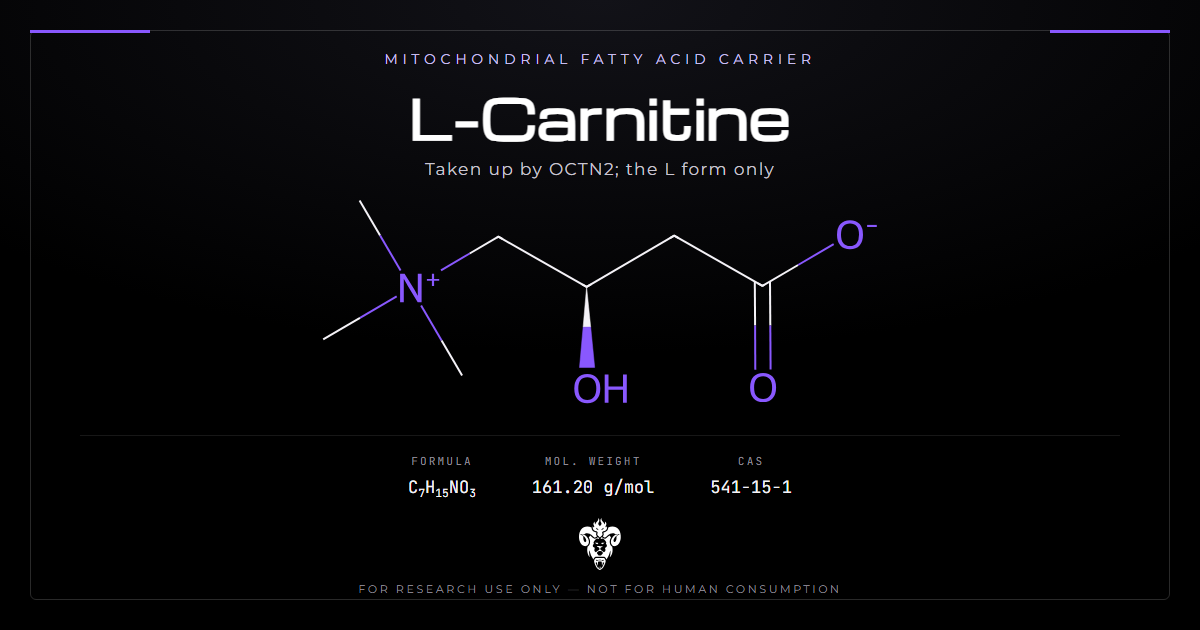
Most compounds in this catalogue need several separate explanations. Carnitine needs one.
A transporter called OCTN2 moves it out of blood and into tissue. Mutations in the gene encoding that transporter cause a rare inherited disease. Saturating it is why raising muscle carnitine takes months rather than days. And whatever the gut fails to absorb becomes food for intestinal bacteria, which is where the cardiovascular question comes from.
Four apparently unrelated facts, one mechanism. That is the frame worth carrying through the rest of this article.
Chemical identity
Small, charged, and water-soluble, which is the root of the delivery problem.
| Property | Value |
|---|---|
| Systematic name | (R)-3-hydroxy-4-(trimethylazaniumyl)butanoate |
| Molecular formula | C7H15NO3 |
| Molecular weight | 161.20 |
| CAS | 541-15-1 |
| PubChem CID | 10917 |
| InChIKey | PHIQHXFUZVPYII-ZCFIWIBFSA-N |
| Form | Zwitterion, quaternary ammonium and carboxylate |
The stereochemistry is not optional
That InChIKey carries a defined stereocentre. Only the L form, also written R, is biologically active. The D form is not simply inert: it competes for the same handling machinery.
So “carnitine” and “L-carnitine” are not interchangeable terms on a label. A racemic preparation is a different material from the one every study here used.
What carnitine actually does
Long-chain fatty acids cannot cross the inner mitochondrial membrane on their own. Carnitine carries them. An acyl group transfers onto carnitine, the acylcarnitine crosses, and the acyl group transfers back off inside.
No carnitine, no long-chain fatty acid oxidation. That is why deficiency is a serious clinical problem rather than a subtle one.
The quaternary ammonium group is the source of everything else
A permanently charged nitrogen makes this molecule water-soluble and membrane-impermeant. It cannot diffuse into cells, so it needs a transporter. It also carries the trimethylamine group that intestinal bacteria will later strip off.
One structural feature, two consequences, and both of them run through the rest of this article.
OCTN2 is the whole story
OCTN2, the product of the SLC22A5 gene, is the high-affinity carnitine transporter. It moves carnitine into muscle, heart, kidney and other tissue against a concentration gradient.
A functional genomics study characterised OCTN2 variants systematically and used the results to build a protein-specific variant effect predictor [1]. That is the level of attention a transporter gets when it is the only route in.
When the transporter fails
Pathogenic variants in SLC22A5 cause primary carnitine deficiency, an autosomal recessive disorder of carnitine transport.
A 2025 analysis interrogated 807,162 individuals in the gnomAD database [2]. Classifying variants against ACMG standards produced 213 pathogenic or likely pathogenic ones. From those, the authors estimated carrier frequency and genetic prevalence across nine ancestry groups.
The disease phenotype is cardiac
A human stem cell model of primary carnitine deficiency cardiomyopathy identified ferroptosis as a mechanism of the cardiac phenotype [3].
The relevance here is not the disease itself. Losing carnitine transport produces a cardiomyopathy. That tells you how much cardiac muscle depends on fatty acid oxidation, and therefore on this one carrier.
Getting carnitine into muscle is hard
This is where the transporter stops being background and becomes the practical problem. Raising blood carnitine is easy. Raising muscle carnitine is not, because OCTN2 uptake into skeletal muscle needs insulin to stimulate it.
A randomised double-blind study had participants take L-carnitine with carbohydrate twice daily for 24 weeks [4]. Muscle total carnitine rose 21%. Every significant effect appeared only at 24 weeks.
What the loaded muscle then did
At 50% of maximal effort, the carnitine group used 55% less muscle glycogen and showed 31% less pyruvate dehydrogenase complex activation. At 80% the picture inverted. PDC activation ran 38% higher and muscle lactate came out 44% lower. The phosphocreatine to ATP ratio held up better, and work output in a performance trial rose 11% from baseline [4].
Different behaviour at low and high intensity, from the same intervention. That is a specific and coherent result, and it took six months of twice-daily dosing with carbohydrate to produce.
Co-ingestion changes the uptake
Because insulin drives the uptake, what else is eaten matters. Whey protein acutely inhibited insulin-stimulated muscle carnitine uptake in a forearm balance study [5]. Carbohydrate and carbohydrate-plus-protein had raised serum insulin similarly, so insulin alone does not explain it.
A separate line found caffeine ingestion stimulating plasma carnitine clearance, proposed as a possible loading strategy [6].
It works in older muscle too
Older participants supplemented while cycling twice weekly [7]. Muscle total carnitine rose 20%, and total fat oxidation rose 20%. Greater intramuscular lipid use drove most of it, alongside changes in fat metabolism gene expression. Insulin-stimulated glucose disposal did not change.
What the gut microbiota do with the rest
Here is the other side of poor absorption. It is also the most consequential finding about this molecule in fifteen years.
Intestinal bacteria strip the trimethylamine group from carnitine. The liver oxidises the resulting TMA into trimethylamine N-oxide. A 2013 study demonstrated that microbial metabolism of dietary L-carnitine produces TMAO and accelerates atherosclerosis in mice [8].
The pathway has an intermediate
Later work in humans used deuterium-labelled carnitine and labelled gamma-butyrobetaine, before and after oral antibiotics [9]. That established the route: L-carnitine to gamma-butyrobetaine to TMA to TMAO. Antibiotic exposure knocked out the first two steps, which confirms they are microbial rather than human.
Diet reshapes the bacteria that do it
In the same work, omnivores generated more than twenty times the labelled TMAO of vegans and vegetarians, at P=0.001 [9]. Same oral dose, same molecule. That direction matches the original 2013 study [8].
One compound, two populations, and a twentyfold difference in what comes out. The microbiome doing the metabolising is what changed. A 2024 review works through what that means for cardiovascular risk, and what dietary modulation might do about it [10]. Separate work examined TMAO and related microbe-derived metabolites against incident heart failure [11].
Why the route of administration is a real variable here
The microbial steps happen in the gut. A dose that never passes through the intestinal lumen does not meet the bacteria that perform them.
That is a pharmacokinetic statement rather than a recommendation. It is also the clearest case in this catalogue of a route changing which metabolites form at all.
Where the clinical evidence is strongest
Two settings, and both are deficiency states rather than enhancement.
Carnitine deficiency is common in chronic kidney disease and on haemodialysis. Both the pathophysiology and the supplementation literature carry recent reviews [12][13]. Primary carnitine deficiency is the genetic case [2][3].
The performance literature is weaker than the mechanism suggests
A Cochrane review examined propionyl-L-carnitine against placebo and other interventions for intermittent claudication, searching to July 2021 [14]. Cochrane reviews are the most demanding synthesis available. Reaching one is itself a marker that the question has had real trials.
A meta-analysis of supplementation in healthy subjects screened 6,404 articles and included 30. It found no significant difference in serum lactate, at rest or after exercise. Maximal oxygen consumption at rest did change [15]. A separate systematic review examined exercise-induced muscle damage [16].
So the mechanism is solid and the deficiency indications are solid. The enhancement literature in healthy people is mixed, with a mostly null result on the marker people expect to move.
What the studies actually used
Protocols vary more than the summaries suggest, and the duration is the part that gets dropped.
| Study | Population | Protocol |
|---|---|---|
| Muscle loading [4] | Healthy, randomised double-blind | L-carnitine with carbohydrate, twice daily, 24 weeks |
| Older adults [7] | Older individuals | Supplementation plus twice-weekly cycling, 1 h at 50% VO2 max |
| Uptake mechanism [5] | 7 healthy men | 4.5 g L-carnitine tartrate, then 80 g carbohydrate or 40 g carbohydrate plus 40 g protein |
| TMAO tracing [9] | Omnivores and vegans/vegetarians | Deuterium-labelled oral dose, before and after antibiotics |
The protocols are not interchangeable
Read down that table and the differences are structural rather than cosmetic. One study loaded with carbohydrate for six months. Another added exercise. A third measured a single uptake window over three hours. The fourth traced isotope through a microbial pathway.
Each answers a different question, and only the first two say anything about muscle content over time. Pooling them, as a casual summary does, produces a claim none of them made.
Twenty-four weeks is the number to remember
The loading study reported that all significant effects occurred at 24 weeks [4]. A shorter trial of the same intervention would have found nothing and reported a negative result honestly.
That makes duration the first thing to check in any null carnitine study. Treat a short trial as uninformative rather than as evidence of absence.
The esters are separate compounds
Three names circulate and get treated as one: L-carnitine, acetyl-L-carnitine and propionyl-L-carnitine. The last two carry an acyl group on the hydroxyl, and they are distinct chemical entities with distinct literature.
This matters more than a naming quibble, because it changes which evidence applies to what.
The Cochrane review is not about L-carnitine
That systematic review on intermittent claudication tested propionyl-L-carnitine [14]. It is the strongest piece of evidence discussed in this article, and it is evidence about a different molecule from the one in a plain L-carnitine vial.
Anyone citing “a Cochrane review supports carnitine” has moved a result across an ester bond. The same care applies to the acetyl form, which has its own separate body of work and its own distribution, since adding an acetyl group changes how the molecule crosses membranes.
Why the esters exist at all
The parent molecule is permanently charged and poorly absorbed. Acylating the hydroxyl changes solubility and tissue distribution, which is exactly why formulators made them. That is the same logic behind the acetyl group on TB-500 and the Pro-Gly-Pro tail on Semax: modify a molecule to fix a delivery problem, and accept that the result is a new compound needing its own evidence.
Two experiments that would settle the interpretation
Neither is a recommendation. They are the gaps a reader should notice.
Measure muscle carnitine and TMAO in the same trial
The loading literature and the TMAO literature do not overlap. One set of studies raises muscle carnitine over 24 weeks and reports fuel metabolism [4][7]. Another set traces the microbial pathway and reports atherogenic output [8][9].
Nobody has run both readouts in the same participants over the same period. Until somebody does, the benefit and the liability are being estimated from different people on different protocols, and the ratio between them is unknown.
Test the route difference directly
The microbial steps happen in the gut lumen, so a dose that bypasses it should not generate the same gamma-butyrobetaine and TMA [9]. That is a prediction rather than a finding.
Measuring plasma TMAO after matched oral and non-oral doses in the same subjects would test it in a single crossover. The prediction is straightforward, the experiment is straightforward, and the published record does not contain it.
How to read an L-Carnitine study
Four questions, and the first two separate most of the confusion.
Which carnitine?
Plain L-carnitine, the acetyl ester and the propionyl ester are three compounds. Check which one a paper used before carrying its result across [14].
Plasma or tissue?
Plasma carnitine rises easily. Muscle carnitine needs insulin and months [4]. A study measuring the first has not measured the second. Only the second sits downstream of the mechanism people care about.
Deficient or replete?
Restoring a deficiency and supplementing a normal person are different experiments. The strongest clinical evidence sits in kidney disease and in genetic deficiency [2][12][13]. Extrapolating from a repletion result to a healthy population crosses the line the evidence sits on.
What was co-ingested, and for how long?
Carbohydrate raises uptake, protein blunts it acutely [5], and effects took 24 weeks to appear [4]. A study omitting all three details cannot be compared with one that reports them.
Omnivore or vegetarian participants?
For anything involving TMAO, the answer changes the result by more than twentyfold [9].
Verifying research material
Two checks, and both come straight from the chemistry.
L or DL
Only the L enantiomer is active. Confirm that a certificate specifies L-carnitine rather than carnitine, and that the optical rotation or a chiral method backs it. The InChIKey for the active form ends -ZCFIWIBFSA-N; a flat key with no stereochemistry describes an unresolved or racemic material.
The acyl form, if any
A certificate for L-carnitine tartrate describes a salt of the parent compound. A certificate for acetyl-L-carnitine describes an ester, which is a different molecule with a different mass and its own separate evidence base. The distinction lives in the name, and it is easy to skim past.
Salt and counter-ion
Carnitine is commonly supplied as the free zwitterion, the tartrate, or the fumarate. Each carries a different mass and a different carnitine content by weight. The muscle uptake study used L-carnitine tartrate and stated carnitine content separately from salt weight [5]. That is the correct way to report it.
Every batch we supply carries a certificate of analysis recording the identity and purity data behind it.
Handling
The free base is hygroscopic and pulls water from air. Keep the container closed, and equilibrate it to room temperature before opening. Solutions in water hold up well enough for ordinary work. With no cysteine, no methionine and no aromatic ring, this compound lacks the oxidation liability that dominates the peptides in this catalogue.
Common questions about L-Carnitine
Mechanism
What does carnitine do? It carries long-chain fatty acids across the inner mitochondrial membrane so they can be oxidised.
Why does it need a transporter? The quaternary ammonium group keeps it permanently charged, so it cannot cross membranes by diffusion.
What is OCTN2? The high-affinity carnitine transporter, encoded by SLC22A5, and the route into tissue [1].
Why does the body need a carrier at all? Because the trimethylammonium group holds a permanent positive charge, so the molecule cannot diffuse through a lipid membrane the way an uncharged compound can.
Evidence
Where is the evidence strongest? Deficiency states: genetic primary carnitine deficiency, and the deficiency common in chronic kidney disease and dialysis [2][12][13].
Does it improve performance in healthy people? A meta-analysis of 30 studies found no significant change in serum lactate, though resting oxygen consumption did change [15]. The 24-week loading study did report an 11% work output increase from baseline [4].
How long does muscle loading take? All significant effects in the loading study appeared at 24 weeks [4]. That is the single most useful number for judging whether a null result means anything, because a shorter trial of the same protocol would have found nothing and reported it honestly.
TMAO
What is the TMAO concern? Gut bacteria convert unabsorbed carnitine to trimethylamine via gamma-butyrobetaine, and the liver oxidises that to TMAO, which accelerated atherosclerosis in mice [8][9].
Does everyone produce the same amount? No. Omnivores produced over twenty times more than vegans and vegetarians from an identical dose [9].
Does the route of administration matter? For the microbial steps, yes, because they happen in the gut lumen. Nobody has measured the difference directly, so the expectation rests on where the enzymes are rather than on a published comparison.
Is acetyl-L-carnitine the same thing? No. It is an ester of the parent compound, with its own distribution and its own literature, and results do not transfer between them [14].
Summary of the evidence
Carnitine carries long-chain fatty acids into mitochondria, and a permanently charged nitrogen means it needs OCTN2 to get anywhere. That one transporter accounts for most of what follows. Its failure causes an inherited cardiomyopathy. Its dependence on insulin is why muscle loading took 24 weeks of twice-daily dosing with carbohydrate to raise muscle content 21%. It is also why protein blunts uptake acutely.
The evidence is strongest where carnitine is missing: genetic deficiency, chronic kidney disease and dialysis. In healthy people the performance literature is mixed, with a 30-study meta-analysis finding no lactate effect. And the fraction the gut does not absorb feeds a microbial pathway to TMAO. There an identical dose produces more than twenty times the output in omnivores as in vegetarians.
Kimera Chems supplies L-Carnitine alongside related research compounds including CoQ10, NAD+ and Glutathione, with full analytical documentation. Our redox and cofactors research library covers more compounds in this class.
Research use only. Not for human or veterinary use. Nothing here describes a therapy or a dosing protocol.
References
- Koleske ML, McInnes G, Brown JEH, Thomas N, Hutchinson K, Chin MY, Koehl A, Arkin MR, et al. Functional genomics of OCTN2 variants informs protein-specific variant effect predictor for Carnitine Transporter Deficiency. Proc Natl Acad Sci U S A. 2022;119(46):e2210247119. PMID 36343260. DOI
- Sun L, Yao K, Wu HJ. The global prevalence and genetic spectrum of primary carnitine deficiency. BMC Genom Data. 2025;26(1):44. PMID 40624458. DOI
- Loos M, Klampe B, Schulze T, Yin X, Theofilatos K, Ulmer BM, Schulz C, Behrens CS, et al. Human model of primary carnitine deficiency cardiomyopathy reveals ferroptosis as a novel mechanism. Stem Cell Reports. 2023;18(11):2123-2137. PMID 37802072. DOI
- Wall BT, Stephens FB, Constantin-Teodosiu D, Marimuthu K, Macdonald IA, Greenhaff PL. Chronic oral ingestion of L-carnitine and carbohydrate increases muscle carnitine content and alters muscle fuel metabolism during exercise in humans. J Physiol. 2011;589(Pt 4):963-73. PMID 21224234. DOI
- Shannon CE, Nixon AV, Greenhaff PL, Stephens FB. Protein ingestion acutely inhibits insulin-stimulated muscle carnitine uptake in healthy young men. Am J Clin Nutr. 2016;103(1):276-82. PMID 26675771. DOI
- Wall BT, Machin D, Dunlop MV, Stephens FB. Caffeine ingestion stimulates plasma carnitine clearance in humans. Physiol Rep. 2023;11(4):e15615. PMID 36806708. DOI
- Chee C, Shannon CE, Burns A, Selby AL, Wilkinson D, Smith K, Greenhaff PL, Stephens FB. Increasing skeletal muscle carnitine content in older individuals increases whole-body fat oxidation during moderate-intensity exercise. Aging Cell. 2021;20(2):e13303. PMID 33464721. DOI
- Koeth RA, Wang Z, Levison BS, Buffa JA, Org E, Sheehy BT, Britt EB, Fu X, et al. Intestinal microbiota metabolism of L-carnitine, a nutrient in red meat, promotes atherosclerosis. Nat Med. 2013;19(5):576-85. PMID 23563705. DOI
- Koeth RA, Lam-Galvez BR, Kirsop J, Wang Z, Levison BS, Gu X, Copeland MF, Bartlett D, et al. l-Carnitine in omnivorous diets induces an atherogenic gut microbial pathway in humans. J Clin Invest. 2019;129(1):373-387. PMID 30530985. DOI
- Demarquoy J. Revisiting the Role of Carnitine in Heart Disease Through the Lens of the Gut Microbiota. Nutrients. 2024;16(23). PMID 39683637. DOI
- Tang WHW, Lemaitre RN, Jensen PN, Wang M, Wang Z, Li XS, Nemet I, Lee Y, et al. Trimethylamine N-Oxide and Related Gut Microbe-Derived Metabolites and Incident Heart Failure Development in Community-Based Populations. Circ Heart Fail. 2024;17(8):e011569. PMID 39119698. DOI
- Kaida Y, Taguchi K, Fukami K. Carnitine Deficiency in Chronic Kidney Disease: Pathophysiology, Clinical Implications, and Therapeutic Perspectives. Nutrients. 2025;17(13). PMID 40647189. DOI
- Kljajić M, Katalinić L, Krajina L, Kovačić A, Kovačić M, Bašić-Jukić N. Carnitine Supplementation in Chronic Hemodialysis Patients-A Literature Review. J Clin Med. 2025;14(14). PMID 40725745. DOI
- Kamoen V, Vander Stichele R, Campens L, De Bacquer D, Van Bortel L, de Backer TL. Propionyl-L-carnitine for intermittent claudication. Cochrane Database Syst Rev. 2021;12(12):CD010117. PMID 34954832. DOI
- Vecchio M, Chiaramonte R, Testa G, Pavone V. Clinical Effects of L-Carnitine Supplementation on Physical Performance in Healthy Subjects, the Key to Success in Rehabilitation: A Systematic Review and Meta-Analysis from the Rehabilitation Point of View. J Funct Morphol Kinesiol. 2021;6(4). PMID 34842765. DOI
- Yarizadh H, Shab-Bidar S, Zamani B, Vanani AN, Baharlooi H, Djafarian K. The Effect of L-Carnitine Supplementation on Exercise-Induced Muscle Damage: A Systematic Review and Meta-Analysis of Randomized Clinical Trials. J Am Coll Nutr. 2020;39(5):457-468. PMID 32154768. DOI
Research use only. Not for human or veterinary use. Nothing here describes a therapy or a dosing protocol.