
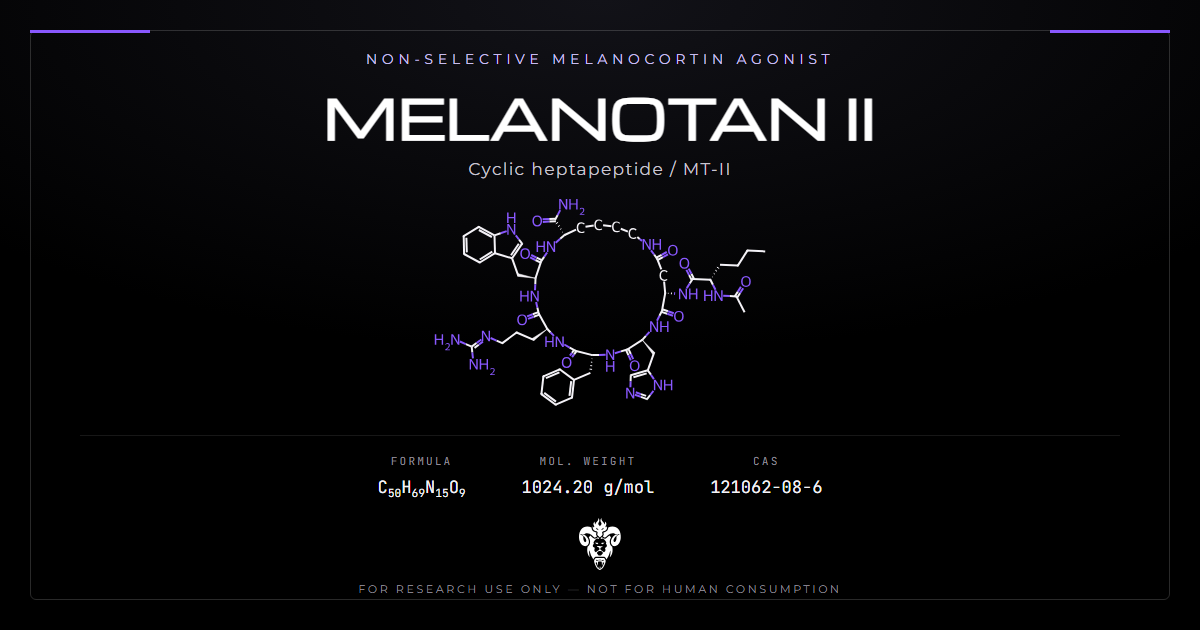
Three peptides came out of the same melanocortin programme. Two of them are approved medicines. Melanotan II is the one that is not, and the reason is chemistry rather than bad luck.
Its linear relative was engineered for one receptor and became a treatment for a rare light-sensitivity disorder. Its deamidated relative was narrowed toward another receptor and reached approval for a sexual desire indication [8].
Melanotan II hits all four melanocortin receptors at once. That is what makes it interesting pharmacologically, and it is exactly why it stopped.
Chemical identity
A cyclic heptapeptide built from alpha-melanocyte-stimulating hormone, closed by a lactam bridge between an aspartate and a lysine.
| Property | Value |
|---|---|
| Sequence | Ac-Nle-cyclo[Asp-His-D-Phe-Arg-Trp-Lys]-NH2 |
| Common names | Melanotan II, MT-II, MTII |
| Molecular formula | C50H69N15O9 |
| Molecular weight | 1,024.2 g/mol |
| Monoisotopic mass | 1,023.5403 Da |
| PubChem CID | 92432 |
| InChIKey | JDKLPDJLXHXHNV-MFVUMRCOSA-N |
| Residues | 7 |
| Ring | Lactam, Asp to Lys side chains |
| Parent hormone | Alpha-MSH |
| Targets | MC1R, MC3R, MC4R, MC5R |
| Regulatory status | Not approved in any jurisdiction |
Reading the macrocycle
The ring is the point, and so is one inverted residue.
Cyclisation joins an aspartate side chain to a lysine side chain, locking the backbone into a constrained loop. That rigidity holds the pharmacophore in the shape the receptor wants and resists the proteases that would linearise it.
D-phenylalanine at position 7 does the other half. Substituting the natural L-residue for its mirror image raised potency and stability together, and the same substitution appears in the linear sibling.
The family it belongs to
Three compounds share the alpha-MSH pharmacophore and differ in how far the engineering went.
Afamelanotide, sold as Melanotan I, is linear and biased toward MC1R. It reached approval for erythropoietic protoporphyria, an ultra-rare disorder in which protoporphyrin IX accumulates in erythrocytes [14]. Visible light then causes severe phototoxic pain.
Bremelanotide is the deamidated form of Melanotan II, carrying a free acid where the parent carries an amide. It reached approval for hypoactive sexual desire disorder [8].
Melanotan II sits between them, unmodified in the direction of selectivity, and unapproved.
Non-selectivity is the design problem
A single agonist at four related receptors produces four effect sets simultaneously. None of them can be dialled out.
What each receptor does
The receptors sit in different tissues and answer to the same ligand.
| Receptor | Principal location | Effect engaged |
|---|---|---|
| MC1R | Melanocytes | Eumelanin synthesis, pigmentation |
| MC3R | Hypothalamus, periphery | Energy homeostasis |
| MC4R | Hypothalamus, brainstem | Appetite suppression, erectile response |
| MC5R | Sebaceous glands, exocrine | Sebum, exocrine secretion |
Pigmentation is the effect people want from Melanotan II. Nausea, flushing, appetite loss and spontaneous erection arrive with it, because the same molecule is agonising the receptors that produce them.
Why that blocked development
A drug developer wants one axis and a clean margin around it. Melanotan II offers neither.
The path taken instead was to split the molecule’s activities across separate compounds. Afamelanotide narrowed toward MC1R and pigmentation; bremelanotide narrowed toward MC4R and sexual response [8][14].
That split is the clearest verdict available on the parent compound. Two development programmes concluded independently that the useful move was to take less of this pharmacology at a time.
How the pigmentation works
The effect people want from this compound is the one part of its pharmacology that behaves exactly as designed.
From receptor to eumelanin
MC1R is a Gs-coupled receptor sitting on melanocytes. Agonism raises intracellular cAMP, and that rise drives the transcriptional programme controlling melanin synthesis.
The programme shifts output from pheomelanin, the red-yellow pigment, toward eumelanin, the brown-black one. Eumelanin is the photoprotective form, so the pigment produced is the pigment the skin makes under sun exposure rather than a dye.
Nothing about that step is unusual. Melanotan II is asking a receptor to do its normal job.
Why it works without sun
Physiological pigmentation runs on the same receptor, reached by a longer route.
Ultraviolet damage triggers keratinocytes to release alpha-MSH, which then agonises MC1R on neighbouring melanocytes. The tan is a downstream response to injury, which is why it takes days and why it requires the injury first.
Melanotan II supplies the signal directly and skips the trigger. That is the entire commercial proposition. It also explains reports of pigment in people whose own alpha-MSH produces little.
The same receptor, on the tumour
One consequence of targeting melanocytes is that transformed melanocytes are also melanocytes.
Melanoma overexpresses MC1R, and that overexpression is exploitable. Zhou and colleagues used Melanotan II as a targeting moiety in ligand-drug conjugates for exactly that reason [11].
That cuts in two directions at once. A ligand seeking out melanocytes is useful when it carries a cytotoxic payload. It is harder to interpret when it carries nothing but agonism.
The controlled human data
One properly controlled trial exists, and it was not a tanning study.
Wessells and colleagues gave Melanotan II to 20 men with psychogenic and organic erectile dysfunction (PMID 11035391). The design was double-blind, placebo-controlled and crossover, with RigiScan monitoring over six hours.
Seventeen of 20 men developed penile erection in the absence of sexual stimulation. Mean tip rigidity above 80% lasted 41 minutes. Increased sexual desire followed 13 of 19 doses, 68%, against 4 of 21 placebo doses, 19%, at p below 0.01 [1].
The adverse events sit in the same paragraph and are not incidental. Nausea and yawning were frequent, and at 0.025 mg/kg severe nausea affected 12.9% of subjects [1].
What the animal work adds
Rodent studies map the central effects that the human trial reported as side effects.
Feeding, and where in the brain
Baird and colleagues injected Melanotan II into the third or fourth ventricle of rats. They then analysed licking microstructure rather than intake alone [2].
Both sites reduced sucrose intake at 0.1 and 1 nM. Forebrain injection also reduced the initial lick rate and mean burst duration, measures associated with taste evaluation, while hindbrain injection did not [2].
Read that as two mechanisms rather than one. The anorexia carries a postingestive component from both sites and a taste-evaluation component only from the forebrain.
Other central effects
The melanocortin system reaches further than appetite and pigment.
One study used an APP/PS1 mouse model of Alzheimer’s disease. Central administration of a Melanotan II derivative reduced amyloid-beta accumulation and astrocytic activation, particularly in hippocampus [12]. The A1 reactive astrocyte subtype fell specifically.
That result belongs to a transgenic mouse and a central injection route. It illustrates how wide melanocortin signalling reaches, and it establishes nothing about the compound in any other setting.
The naevus and melanoma question
This is the safety signal that dominates the dermatology literature, and the evidence runs in two directions.
The eruptive naevus review
Burian and Jemec compiled every published report of eruptive melanocytic naevi they could find: 93 articles, 179 patients (PMID 31119650).
Melanotan sits in the causal grouping alongside immunosuppressive agents and chemotherapy, which together accounted for 41% of cases [7]. Overall, 16% of cases had at least one histologically confirmed dysplastic naevus, and five associated melanomas were reported across the whole series.
Australian dermatologists raised the same concern as a public health matter, on the grounds that the compound is unregulated and widely available [5]. A Dutch review states plainly that previous work shows the drug supports development of new pigmented and dysplastic naevi [13].
The counter-evidence
Two papers cut against the simple reading, and neither is obscure.
Wu and colleagues tested topical Melanotan II against B16-F10 melanoma [10]. It did not change proliferation, and it did inhibit migration, invasion and colony formation. Topical application attenuated tumour progression in mice with established melanoma. The mechanism they report runs through raised PTEN protein, suppressed AKT and NF-kappaB signalling, and reduced COX-2 with lower prostaglandin E2 [10].
The second is a design decision rather than a result. Melanoma overexpresses MC1R, so the peptide serves as a targeting moiety in ligand-drug conjugates. A camptothecin conjugate inhibited A375 melanoma cells at an IC50 of 16 nM [11].
Hold both halves. Case reports link the compound to naevus eruption and a small number of melanomas in people. A mouse model reports it suppressing an established melanoma, and neither observation cancels the other.
Acute case reports
The remaining safety literature is case reports, and their consistency is the informative part.
| Report | Presentation | Detail |
|---|---|---|
| Nelson 2012 [3] | Rhabdomyolysis, sympathomimetic excess | 6 mg subcutaneous, six times the stated starting dose |
| Kaski 2013 [4] | Posterior reversible encephalopathy syndrome | Reported in Annals of Internal Medicine |
| Dreyer 2019 [6] | Low-flow priapism | Aspiration, irrigation, intracavernosal phenylephrine |
| Peters 2020 [9] | Renal infarction | Review plus case, thrombotic and direct toxicity considered |
| Eijmael 2022 [13] | Sympathomimetic toxicity | Lorazepam, potassium, intravenous fluids |
Sympathomimetic toxicity
Two of the reports describe the same acute picture and both followed self-administration.
A 39-year-old man injected 6 mg subcutaneously, by his own account six times the recommended starting dose. He reached the emergency department two hours later with diffuse body aches, sweating and anxiety, at a blood pressure of 151/85 [3]. Rhabdomyolysis followed.
A 27-year-old man with no relevant history presented two hours after self-administration with sympathomimetic symptoms and required lorazepam, potassium and fluid resuscitation [13].
Vascular and neurological
The more serious reports involve organs a long way from skin.
Priapism required cavernosal aspiration, irrigation and intracavernosal phenylephrine, and the patient had not recovered erectile function at four weeks [6]. The authors note that acute priapism had not previously been reported for this class.
Renal infarction was reported alongside a review of the compound’s renal effects, with the authors weighing thrombotic influence against direct parenchymal toxicity [9]. Posterior reversible encephalopathy syndrome appears in a separate report [4].
What the approved sibling shows
Bremelanotide reached approval, which makes its tolerability data the best available proxy for what narrowed melanocortin agonism costs.
In the RECONNECT open-label extension, 684 of 856 eligible women entered and 272 completed the 52 weeks [8]. The most common drug-related adverse events were nausea at 40.4%, flushing at 20.6% and headache at 12.0%.
Note what that implies for the parent. A compound narrowed toward one receptor, taken forward through phase 3 and approved, still produced nausea in two of every five participants. Melanotan II engages that receptor and three others.
The supply problem
Every human report in this literature shares a feature that is easy to skip past. The material came from an unregulated source.
Nelson’s patient bought it over the internet and injected what he understood to be six times the starting dose [3]. Eijmael and colleagues describe purchase over the internet and in gyms as the ordinary route [13]. Adler and colleagues raised exactly this with Australian dermatologists as a public health matter, on the grounds that the use is unregulated rather than that the pharmacology is novel [5].
That changes how a dose figure should be read. When a case report records 6 mg, the number describes what the patient believed they injected. No report in this series pairs its dose with a content assay on the material actually used.
It also separates two objects that get discussed as one. Melanotan II has a defined receptor profile and a defined mass. A vial bought from a gym has neither until somebody measures it, and nothing in the case literature does.
The practical consequence for anyone reading a harm report is narrow but real. A severe reaction tells you what happened after an injection of unverified material, which is a weaker claim than what happens after a known dose of a known compound, and the two get quoted interchangeably.
How to read a Melanotan II study
Four questions, and the first two account for most of the confusion in this literature.
Which melanotan?
Melanotan I and Melanotan II are different molecules with different receptor profiles and different regulatory status [14]. Papers and case reports sometimes write only “melanotan”, and the distinction changes the pharmacology entirely.
What route and what site?
Central ventricular injection in a rodent is not subcutaneous self-administration [2][12]. Forebrain and hindbrain injection of the same dose gave different effects in the same study [2].
Case report or controlled trial?
One controlled human trial exists, in 20 men, on an erectile endpoint [1]. Everything else in the human literature is a case report or a review of case reports [7][9].
Was the material assayed?
Laboratory studies use characterised compound and case reports mostly do not [3][13].
That distinction decides what a harm report can support. A study dosing verified peptide at a stated concentration describes the pharmacology of Melanotan II. A case report describes the consequence of injecting something a patient bought, and the two are not the same claim even when the outcome is identical.
Look for a content assay before treating a reported dose as a dose at all.
Which direction on melanoma?
A mouse xenograft reporting tumour suppression [10] and a case series reporting naevus eruption [7] are answering different questions in different species. Neither settles the other.
Verifying research material
A cyclic seven-residue peptide with a lactam bridge has one analytical question that a linear peptide does not.
Identity
Intact mass is 1,024.2 average and 1,023.540 monoisotopic. That separates it cleanly from bremelanotide, which differs by the amide-to-acid change, and from the linear Melanotan I at a different mass entirely.
The ring is the thing to confirm. A linear impurity with the same residues differs from the cyclised product by 18 Da, the water lost on ring closure. Incomplete cyclisation is therefore measurable rather than inferred.
Tandem mass spectrometry behaves differently on a macrocycle. Ring opening has to occur before sequence ions appear. A fragmentation spectrum from a cyclic peptide therefore reads unlike its linear equivalent, and the two do not compare directly.
Purity and stereochemistry
D-phenylalanine at position 7 is a stereochemical claim that chromatographic purity does not test.
The all-L epimer has the same mass and the same formula, and it is a different compound pharmacologically. Chiral analysis, or amino acid analysis after hydrolysis, is what answers that question.
Deletion sequences and the acetyl and amide caps are the other routine asks. A missing N-terminal acetyl shifts mass by 42 Da and a free C-terminal acid by 1 Da.
Handling
Store lyophilised, cold, dry and dark, and reconstitute close to use.
Tryptophan is the oxidation-prone residue here, adding 16 Da when it goes. Cyclisation makes the peptide more resistant to proteases than a linear equivalent. That is a stability advantage rather than a licence to leave stocks in solution.
Adsorption to plastic is the routine loss at low concentration. Aliquot on reconstitution rather than sampling one vial repeatedly.
Kimera publishes third-party certificates of analysis for every lot in its COA database. Laboratories source Melanotan II as a non-selective melanocortin receptor agonist reference. It appears alongside Melanotan I, the MC1R-biased linear relative, and PT-141, the deamidated form narrowed toward MC4R. Related work appears in the peptides category.
Common questions about Melanotan II
Why was it never approved? Non-selectivity. It agonises MC1R, MC3R, MC4R and MC5R together, and development split into two narrower compounds instead [8][14].
What controlled human evidence exists? One crossover trial in 20 men with erectile dysfunction. Erection followed in 17 of 20 without sexual stimulation, with severe nausea in 12.9% at 0.025 mg/kg [1].
How does it differ from PT-141? PT-141 is the deamidated form, carrying a free acid instead of an amide, and it reached approval for a sexual desire indication [8].
What does the melanoma literature say? Case series link it to eruptive naevi, with 16% showing a dysplastic naevus and five melanomas across 179 patients [7]. A mouse model reports the opposite, with topical application suppressing established melanoma [10].
What are the reported acute harms? Rhabdomyolysis, priapism, renal infarction, posterior reversible encephalopathy syndrome and sympathomimetic toxicity, all as individual case reports [3][4][6][9][13].
Is the tan the only effect? No. Pigmentation is one of four receptor effects, and the others arrive with it [1].
Summary of the evidence
Identity: Ac-Nle-cyclo[Asp-His-D-Phe-Arg-Trp-Lys]-NH2, C50H69N15O9, 1,024.2 g/mol. Cyclic heptapeptide, lactam bridge, D-Phe at position 7.
The family verdict: the linear MC1R-biased sibling and the deamidated MC4R-narrowed sibling both reached approval, and the non-selective parent did not [8][14].
Controlled human data: one crossover trial in 20 men. Erection followed in 17 of 20 without sexual stimulation, desire increased after 68% of doses against 19% on placebo, and severe nausea affected 12.9% at 0.025 mg/kg [1].
Central effects: ventricular injection reduces sucrose intake from forebrain and hindbrain sites, with a taste-evaluation component only from the forebrain [2].
Dermatological signal: melanotan grouped with immunosuppressives and chemotherapy in 41% of 179 eruptive naevus cases. Across the series, 16% had a confirmed dysplastic naevus and five melanomas were reported [7].
Counter-evidence: topical application suppressed migration, invasion and tumour progression in B16-F10 melanoma through PTEN and COX-2 [10]. The peptide also serves as an MC1R-targeting moiety for melanoma-directed conjugates [11].
Acute harms: rhabdomyolysis, priapism, renal infarction, posterior reversible encephalopathy and sympathomimetic toxicity, individually reported [3][4][6][9][13].
Limits: one controlled trial in 20 people and everything else uncontrolled. Australian dermatologists raised the unregulated supply chain itself as a public health concern [5].
Status: supplied for laboratory research use only.
References
- Wessells H, Levine N, Hadley ME, Dorr R, Hruby V. Melanocortin receptor agonists, penile erection, and sexual motivation: human studies with Melanotan II. Int J Impot Res. 2000;12 Suppl 4:S74-S79. PMID 11035391. DOI
- Baird JP, Palacios M, LaRiviere M, Grigg LA, Lim C, Matute E, Lord J. Anatomical dissociation of melanocortin receptor agonist effects on taste- and gut-sensitive feeding processes. Am J Physiol Regul Integr Comp Physiol. 2011;301(4):R1044-R1056. PMID 21734020. DOI
- Nelson ME, Bryant SM, Aks SE. Melanotan II injection resulting in systemic toxicity and rhabdomyolysis. Clin Toxicol (Phila). 2012;50(10):1169-1173. PMID 23121206. DOI
- Kaski D, Stafford N, Mehta A, Jenkins IH, Malhotra P. Melanotan and the posterior reversible encephalopathy syndrome. Ann Intern Med. 2013;158(9):707-708. PMID 23648958. DOI
- Adler NR, Dowling JP, Pan Y. The unregulated use of melanotan-II is of public health interest to Australian dermatologists. Australas J Dermatol. 2017;58(4):327-329. PMID 28905366. DOI
- Dreyer BA, Amer T, Fraser M. Melanotan-induced priapism: a hard-earned tan. BMJ Case Rep. 2019;12(2):e227644. PMID 30796078. DOI
- Burian EA, Jemec GBE. Eruptive melanocytic nevi: a review. Am J Clin Dermatol. 2019;20(5):669-682. PMID 31119650. DOI
- Simon JA, Kingsberg SA, Portman D, Williams LA, Krop J, Jordan R, Lucas J, Clayton AH. Long-term safety and efficacy of bremelanotide for hypoactive sexual desire disorder. Obstet Gynecol. 2019;134(5):909-917. PMID 31599847. DOI
- Peters B, Hadimeri H, Wahlberg R, Afghahi H. Melanotan II: a possible cause of renal infarction, review of the literature and case report. CEN Case Rep. 2020;9(2):159-161. PMID 31953620. DOI
- Wu JC, Tsai HE, Hsiao YH, Wu JS, Wu CS, Tai MH. Topical MTII therapy suppresses melanoma through PTEN upregulation and cyclooxygenase II inhibition. Int J Mol Sci. 2020;21(2):681. PMID 31968661. DOI
- Zhou Y, Mowlazadeh Haghighi S, Liu Z, Wang L, Hruby VJ, Cai M. Development of ligand-drug conjugates targeting melanoma through the overexpressed melanocortin 1 receptor. ACS Pharmacol Transl Sci. 2020;3(5):921-930. PMID 33073191. DOI
- Lau JKY, Tian M, Shen Y, Lau SF, Fu WY, Fu AKY, Ip NY. Melanocortin receptor activation alleviates amyloid pathology and glial reactivity in an Alzheimer’s disease transgenic mouse model. Sci Rep. 2021;11(1):4359. PMID 33623128. DOI
- Eijmael MJPM, Janmaat CJ, Briët-Schipper EMN. The risks of tanning with the Barbie drug. Ned Tijdschr Geneeskd. 2022;166:D6578. PMID 35736369.
- Minder AE, Kluijver LG, Barman-Aksözen J, Minder EI, Langendonk JG. Erythropoietic protoporphyrias: pathogenesis, diagnosis and management. Liver Int. 2025;45(1):e16027. PMID 39011756. DOI
Melanotan II is sold for laboratory research use only. Not for human consumption, nor medical, veterinary, or household uses.
Literature retrieved from PubMed.