Skip to content

Melanotan I (Afamelanotide) Research Standard
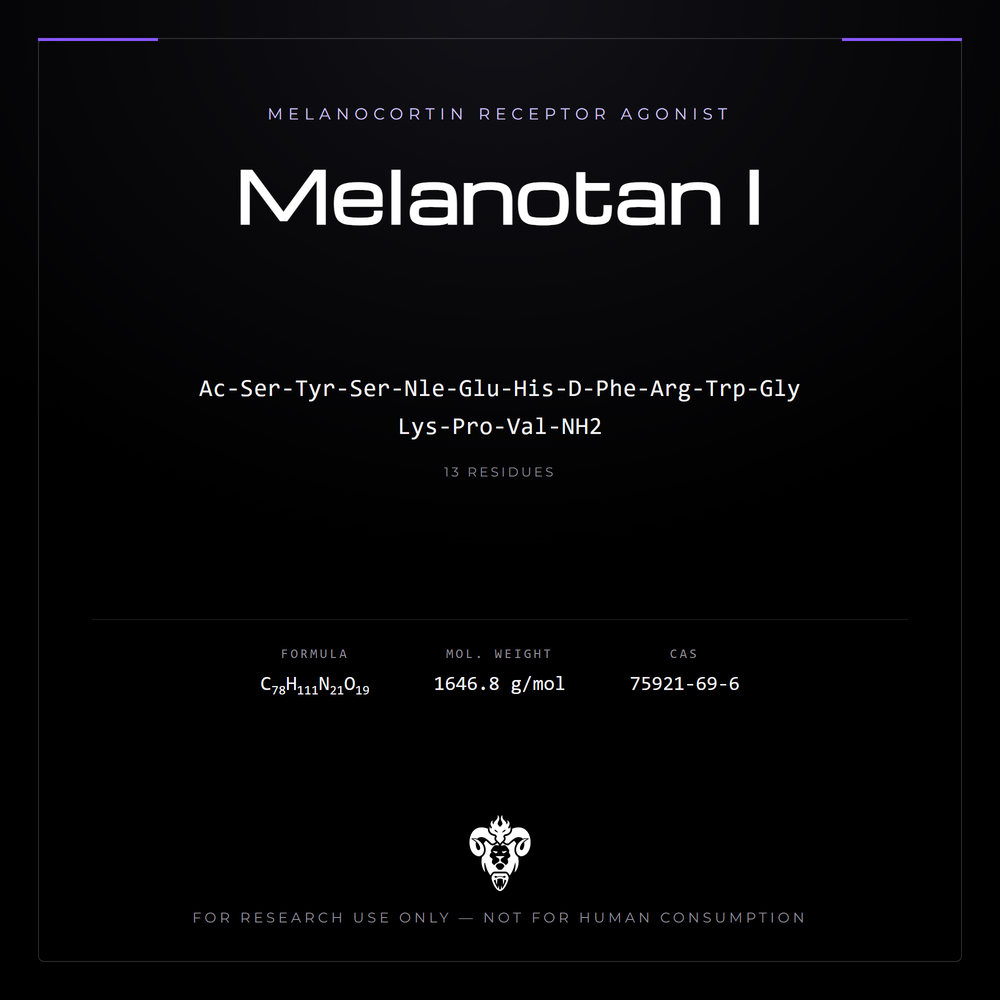
Melanotan I (CAS 75921-69-6), also indexed as afamelanotide and NDP-α-MSH, is the linear α-MSH analogue [Nle4, D-Phe7]-α-MSH. Supplied as a 10 mg lyophilized powder in a 3 mL vial, it is the compound the melanocortin field uses as its high-potency linear reference — the analogue against which subtype-selective candidates are benchmarked.[1]
Mechanism of Action & Research Context
The molecular targets are the melanocortin receptors, five class A GPCRs signalling through Gs and cyclic AMP.
Potent at nearly every subtype. NDP-α-MSH possesses nanomolar efficacies at all melanocortin receptor subtypes except MC2R — the ACTH receptor, which the melanocortin peptides do not engage. That near-universal potency is precisely what makes it a reference rather than a selective tool.[1]
Two substitutions, both deliberate. Norleucine at position 4 removes the oxidation-prone methionine of native α-MSH; D-phenylalanine at position 7 inverts a stereocentre in the message sequence. Together they give a linear peptide with markedly greater potency and stability than the parent hormone.
Linear, where MT-II is cyclic. Melanotan I has no macrocycle. Comparing it against cyclic analogues such as MT-II isolates what conformational constraint contributes, separately from residue substitution.[4]
Five receptors, not one. The melanocortin family comprises MC1R–MC5R, class A GPCRs coupling to Gs, adenylyl cyclase and cyclic AMP. cAMP accumulation is the standard functional readout, and real-time luminescent cAMP reporters in receptor-expressing HEK293 lines are an established platform for quantifying it.[5]
The message sequence engages subtypes differently. Systematic truncation of NDP-α-MSH established that the conserved His-Phe-Arg-Trp core does not bind and stimulate each subtype in the same fashion, overturning the earlier assumption of a shared binding mode.[1]
Residue chemistry drives selectivity. In α-MSH/γ-MSH hybrid series, increasing hydrophobicity and substituting bulkier aromatic residues at positions 6 and 8 separates MC1R-preferring from MC3R-preferring analogues.[3]
Research Applications
Primary fields of in vitro and preclinical laboratory investigation include:
Receptor binding panels across MC1R–MC5R with a high-potency linear anchor.[2]
cAMP functional assays benchmarking Gs-coupled output.[5]
Structure-activity relationship work comparing linear against cyclic scaffolds.[3,4]
Comparative pharmacology against native α-MSH, ACTH and the endogenous antagonist AgRP.[2]
Analytical Documentation
Purity and identity vary by manufacturing lot. Kimera Chems does not publish a single fixed purity figure for this item; refer to the batch-specific Certificate of Analysis (COA) issued for the lot received, which reflects third-party analytical testing for that lot.
References
- Haskell-Luevano C, Hendrata S, North C, et al. Discovery of prototype peptidomimetic agonists at the human melanocortin receptors MC1R and MC4R. J Med Chem. 1997;40(14):2133–2139. doi:10.1021/jm960840h
- Schiöth HB, Muceniece R, Wikberg JE. Characterization of the binding of MSH-B, HB-228, GHRP-6 and 153N-6 to the human melanocortin receptor subtypes. Neuropeptides. 1997;31(6):565–571. doi:10.1016/s0143-4179(97)90002-0
- Cai M, Mayorov AV, Cabello C, et al. Novel 3D pharmacophore of alpha-MSH/gamma-MSH hybrids leads to selective human MC1R and MC3R analogues. J Med Chem. 2005;48(6):1839–1848. doi:10.1021/jm049579s
- Bednarek MA, MacNeil T, Tang R, et al. Potent and selective agonists of human melanocortin receptor 5: cyclic analogues of alpha-melanocyte-stimulating hormone. J Med Chem. 2007;50(10):2520–2526. doi:10.1021/jm0614275
- Pantel J, Williams SY, Mi D, et al. Development of a high throughput screen for allosteric modulators of melanocortin-4 receptor signaling using a real time cAMP assay. Eur J Pharmacol. 2011;660(1):139–147. doi:10.1016/j.ejphar.2011.01.031
Storage & Handling
Store at controlled room temperature, sealed and protected from light.
Storage guidance is a house recommendation. Analytical documentation is per-lot release testing.