
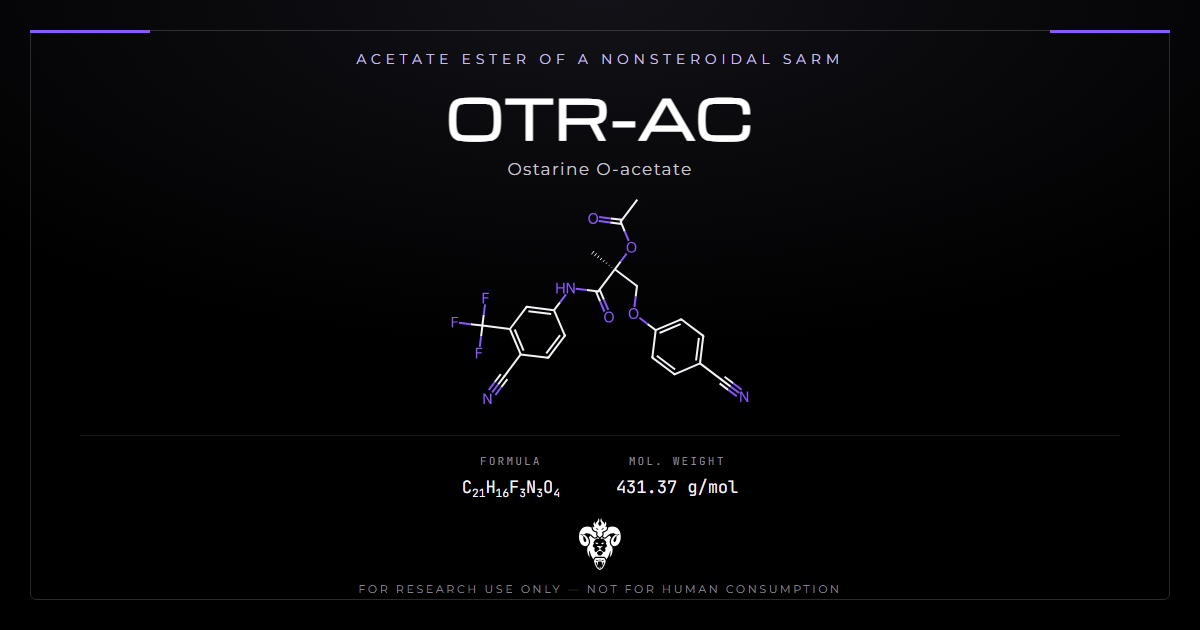
Three routes identify most compounds in this catalogue: the name, the CAS number, the structure. Run all three on this one and you get three different outcomes, and none of them is a clean confirmation.
The name resolves to nothing in PubChem. The CAS number widely printed for it resolves to a molecule that is not ostarine acetate. And the correct structure does sit in PubChem, with no name and no CAS attached to it at all.
That would be a footnote if the wrong answer looked wrong. It does not. The molecule the CAS number returns has the identical molecular formula and the same molecular weight, so formula and mass both agree while the structure does not. OTR-AC is worth an article mostly for that, and the ester pharmacology comes second.
Chemical identity
| Property | Value |
|---|---|
| Common names | OTR-AC, ostarine O-acetate |
| Molecular formula | C21H16F3N3O4 |
| Molecular weight | 431.37 g/mol |
| PubChem CID | 144891019 |
| InChIKey | JCANFFLRQJHOHJ-FQEVSTJZSA-N |
| Class | Acetate ester of an arylpropionamide SARM |
| Configuration | (2S) |
| Parent on hydrolysis | Ostarine, C19H14F3N3O3, 389.33 |
| CAS | None assigned in PubChem |
The catalogue carries it as OTR-AC, alongside the parent MK-2866.
Three identifiers, three different answers
Take them one at a time, because each fails in a different way.
The name returns nothing. PubChem has no record under “OTR-AC” or under “ostarine acetate”. A search on the designation is an error, not a result, which is at least an honest failure.
The CAS number returns a different molecule. The number in circulation for this product is 1025658-44-9. PubChem maps it to CID 6260896, whose systematic name is [(E)-[amino-[4-[5-(trifluoromethyl)pyridin-2-yl]oxyphenyl]methylidene]amino] 3-methoxybenzoate. That is an amidoxime ester built on a trifluoromethylpyridinyloxy phenyl core. It contains no arylpropionamide, no cyanophenoxy group and no relationship to the androgen receptor.
The structure returns no name. Ostarine O-acetate does exist as CID 144891019. Its synonym list is empty: no CAS, no trade code, nothing. It is a deposited structure and no more.
The isomer that passes every cheap check
Here is why the middle failure is the dangerous one. Both molecules are C21H16F3N3O4 at 431.4 daltons. They are constitutional isomers.
So a certificate reporting molecular formula agrees. High-resolution mass spectrometry agrees, because exact mass is a property of the formula. Elemental analysis agrees. Every check that reduces a molecule to its atom count returns a pass on the wrong compound.
Only connectivity separates them, and only the InChIKey encodes connectivity. For OTR-AC that is JCANFFLRQJHOHJ-FQEVSTJZSA-N. This is the cleanest illustration in the catalogue of why the house rule names the InChIKey rather than the formula.
The one cheap check that does work
Tandem mass spectrometry is the exception, and it is worth stating positively because the rest of this section is negative.
An acetate ester fragments by losing the acetyl group as ketene, a neutral loss of 42 daltons. The isomer has no acetate. Its acyl group is 3-methoxybenzoyl, and losing it costs 135 daltons rather than 42.
So the two molecules share a precursor ion at m/z 431 and diverge immediately on fragmentation. A single MS/MS experiment separates them, and the diagnostic transition is the one already quoted in trade documentation for this product. The check is sound; the point is that it has to be run and reported rather than assumed. A certificate stating formula, mass and purity has done none of this.
Why identity checks are a base rate, not pedantry
Van Wagoner and colleagues bought 44 products marketed as SARMs and analysed them under chain of custody [1]. Only 23 contained a SARM at all, which is 52%. Four contained no active compound whatsoever. Eleven carried substances absent from the label, and 17 contained a different unapproved drug entirely.
Label accuracy was worse than presence. The stated amount matched the analysis in 18 of 44 products, or 41%.
Jendrzejewska and colleagues repeated the exercise in a different market eight years later [2]. Of 16 unregistered supplements bought online in Slovakia, seven did not reliably contain the SARM named on the label.
Two studies, two countries, one conclusion. Roughly half the material sold under these names is not what the name says.
That base rate shifts where the burden sits. Where half the labels fail, an identifier mismatch is the expected signal rather than a clerical curiosity. The person holding the vial is the one who has to resolve it.
Neither study tested an ester. Both bought products named after well-known parents, so OTR-AC sits outside even that thin evidence base, and nothing published describes what a vial of it usually contains.
The acetyl group sits where the parent clears
One hydroxyl, one major metabolite
Ostarine carries a single hydroxyl group, the tertiary alcohol at position 2 of the propanamide. Acetylation of that hydroxyl is what makes OTR-AC.
That same oxygen carries the parent’s main clearance route. Coss and colleagues ran a set of drug interaction studies and identified the glucuronide as ostarine’s major metabolite [6]. Probenecid, a pan-UGT inhibitor, raised parent exposure by 50% and glucuronide exposure by 112%. A CYP3A4 inhibitor did nothing at all.
So the parent clears mainly by glucuronidation, at the only hydroxyl it has. Rifampin, a CYP3A4 inducer, cut exposure by 43%, which places a secondary oxidative route alongside the dominant conjugative one.
What blocking it would and would not do
An acetyl group occupies that oxygen. A UGT enzyme cannot conjugate a position that already carries an acyl group, so while the acetate stays on, that route is shut.
Read carefully, that says less than it appears to. Blocking a clearance route extends exposure only if the blocked molecule is the active one, and the product literature presents OTR-AC as inactive until hydrolysed. On its own account the acetyl comes off first, and the parent’s normal clearance then resumes.
The interesting version of the question compares two rates. How fast does an esterase cleave the acetate, and how fast does a UGT conjugate the hydroxyl it exposes? If cleavage is slow relative to conjugation, the compound behaves as a slow-release parent. If it is fast, the acetate is a synthetic detail with no pharmacological consequence.
Nobody has measured either rate for this molecule. The site is a hindered tertiary alcohol on a quaternary carbon, and no carboxylesterase study cited here covers that geometry.
The parent has a real clinical record
Ostarine is the best-documented compound in the class, which raises rather than lowers the standard of proof for an ester of it. The full account sits in the ostarine article; three points matter here.
The cachexia programme
The POWER trials ran two identical phase 3 studies, 150 placebo and 150 on 3 mg daily in each [3]. Co-primary endpoints were lean body mass and stair climb power at day 84, both as responder analyses at the regulator’s request.
The bars were not symmetric. A lean mass responder needed no loss; a physical function responder needed at least 10% improvement. Kinsey and colleagues later reported from the placebo arm that 53% lost lean mass and 49% lost stair climb power [4]. So roughly 47% of placebo patients cleared the mass bar by not losing.
The breast cancer trial
Palmieri and colleagues ran a phase 2 in 136 women with androgen receptor positive, ER-positive, HER2-negative advanced breast cancer [5]. Clinical benefit at 24 weeks reached 32% at 9 mg and 29% at 18 mg, with the lower dose matching the higher.
Grade 3 or 4 drug-related events affected 8% at 9 mg and 16% at 18 mg. Raised hepatic transaminases were the commonest of them.
Liver injury
Koller and colleagues describe two young men who developed cholestatic liver injury after ligandrol or ostarine followed by post-cycle therapy [9]. Biopsies showed canalicular bile plugs and ductopenia, and recovery took three months.
The authors confound their own cases honestly, noting the post-cycle compounds as an untested variable. That caveat is the reason the report is worth citing rather than the reason to discard it.
An ester of ostarine cannot help with detection
Whatever OTR-AC is for, it cannot be evasion, and the arithmetic of the parent’s detection literature is the reason.
One microgram, nine days
Walpurgis and colleagues dosed volunteers with 1, 10 and 50 micrograms to mimic contaminated supplements [7]. A single oral dose of one microgram stayed detectable for up to nine days by monitoring the parent, and five days by its glucuronide.
Hydrolysing an ester yields exactly that analyte. Every doping control laboratory screens for it, and ostarine ranks among the most frequently reported findings in the class [10]. Gheddar and colleagues quantify it in hair down to single picograms per milligram [12].
Transfer without ingestion
Kintz and colleagues documented the extreme end [8]. A volunteer took 17.3 mg and oral fluid peaked at 468 ng/mL after 15 minutes, still reading 1 to 2 ng/mL past four hours. The study supported an athlete’s claim that her finding came from kissing her partner.
Korsmeier and colleagues showed the skin route for related compounds at 10 and 50 micrograms [16]. A more lipophilic ester of a compound with that sensitivity profile raises a contamination question rather than solving one.
What acetate changes, and how little
Acetate is the smallest ester in common use. It adds 42 daltons to a 389 dalton parent, so OTR-AC is 90.3% ostarine by mass, and the structural change touches one oxygen.
Compare the benzoate on RAD-150, which adds 104 daltons and roughly a quarter of the finished molecule. Two esters, two very different magnitudes of change, and neither measured.
The relevant point is proportional. A small acyl group makes a small change to lipophilicity and a correspondingly small claim, and the claim still needs a partition coefficient and a hydrolysis rate to become a number. Neither exists for this compound.
There is a manufacturing consequence too, and it points at the certificate rather than the pharmacology. Acylating a hindered tertiary alcohol runs slower than acylating a primary one, so incomplete conversion during synthesis leaves unreacted parent behind. That impurity is ostarine itself.
Two failure modes therefore produce the same contaminant. Incomplete acetylation at manufacture, and hydrolysis in storage afterwards, both leave parent alongside ester. A method that separates the two answers both questions at once, which is a good argument for asking whether the certificate reports them separately.
Ester read-across, briefly
Nishimuta and colleagues put 11 prodrugs through hepatocytes, liver, intestinal and kidney fractions and plasma from four species [13]. Plasma hydrolysis of carboxylesterase substrates appeared in rat and in no other species tested.
Fu and colleagues found one ester behaving three different ways across human, dog and rat, differing in where it converted and into what [14]. Conversion is a property of a specific ester in a specific system, not of esters as a category.
The gap does not reflect a general shortage of effort in this field. Cutler and colleagues mapped equine metabolites for seven class members in one study [11], and the parent’s excretion profile now reaches microgram doses [7]. No metabolite map of any SARM ester has appeared. The tools exist and nobody has pointed them here.
Where OTR-AC sits among the thin literatures
The rest of this shelf is thin for a reason that does not apply here. S-23 has a single preclinical characterisation. GSK-2881078 and LGD-2226 were developed and set aside, and now appear mainly in metabolism and detection work [11].
Researchers studied each of those and then moved on, so their literature is small but real. OTR-AC has no literature to be thin. It derives from the best-documented compound in the class, and that inheritance does all the persuasive work.
The distinction changes how a claim reads. Anyone can check a statement about S-23 against one paper and find it wanting. Nobody can check a statement about OTR-AC at all, because the only thing standing behind it is a molecule it is assumed to become.
Even two arylpropionamides are not interchangeable
The assumption underneath every ester argument is that the released parent behaves predictably. A prior assumption sits beneath that one: that compounds sharing a scaffold behave alike. They do not.
Simitsidellis and colleagues gave ostarine and andarine to ovariectomised mice and measured uterine endpoints [15]. Ostarine raised uterine weight, stromal and epithelial area and epithelial cell proliferation, tracking dihydrotestosterone. Andarine did none of it. The two compounds also moved Wnt4 and Wnt7a expression in opposite directions.
Two arylpropionamide SARMs, one tissue, opposite answers. If the scaffold does not predict behaviour between two parents, an acetyl group on one of them is not a safe extrapolation either.
What a study of OTR-AC would have to measure
| Measurement | What it settles | Status |
|---|---|---|
| NMR against a characterised standard | Which of the two isomers is in the vial | Not published |
| Hydrolysis rate in human plasma and liver fractions | Whether it is a prodrug at all | Not measured |
| Measured logP against ostarine | Tests the lipophilicity claim | Not measured |
| Receptor binding of the intact ester | Prodrug or analogue | Not measured |
| Competition between hydrolysis and conjugation | Whether exposure actually changes | Not measured |
| A CAS registration for the real structure | Makes the compound orderable unambiguously | Absent |
The first line is the cheapest and the most important, and it is the one a purity figure never covers.
Verifying research material
Batch documentation sits on the certificates of analysis page. For OTR-AC the ordinary checks are unusually weak, so the order in which they run matters.
Identity
Formula C21H16F3N3O4, molecular weight 431.37, InChIKey JCANFFLRQJHOHJ-FQEVSTJZSA-N, PubChem CID 144891019.
Do not accept the formula as confirmation. The isomer described above matches it exactly, so a certificate reporting formula and mass has excluded nothing. Ask for the InChIKey, and ask what generated it.
Stereochemistry
The FQEVSTJZSA block encodes the (2S) configuration, inherited from the parent. Mass spectrometry does not resolve it and neither does NMR without a chiral method.
Chiral chromatography against a characterised standard answers the question. Ostarine itself is a single enantiomer and its acetate should be too.
The ester is the labile part
Acetate esters hydrolyse. Material stored warm or damp converts toward the parent over time. Ostarine is the compound every laboratory already screens for, so partial hydrolysis produces the analyte rather than an unknown peak.
Ask whether the analytical method separates ester from parent, and whether the certificate reports both. On a compound whose whole premise is a conversion, a single purity number is the least informative result a certificate can carry.
One practical consequence follows for anyone weighing material. A vial that has partly hydrolysed contains two compounds of different molecular weight, so the molar amount of ester no longer follows from the mass on the label.
Common questions about OTR-AC
What is it? The acetate ester of ostarine, formed at the compound’s single hydroxyl group.
Why does the CAS number return something else? PubChem maps 1025658-44-9 to CID 6260896, an unrelated molecule with the same molecular formula. Verify on InChIKey JCANFFLRQJHOHJ-FQEVSTJZSA-N.
Does it convert to ostarine? That is the design intention. No published study measures the rate for this ester, and hydrolysis rates are specific to the ester and the species [13][14].
Is it harder to detect? No. Hydrolysis yields the most heavily screened SARM in doping control, detectable from a one microgram dose for nine days [7].
What does the parent’s record show? Two phase 3 cachexia trials with asymmetric responder definitions, a positive phase 2 in breast cancer, and case reports of cholestatic liver injury [3][4][5][9].
How much of it is ostarine? 90.3% by mass, if conversion is complete.
Summary of the evidence
Nothing in the indexed literature describes this ester. Everything above is either the parent’s record, the general behaviour of esters, or a fact about databases.
The finding specific to OTR-AC is an identity failure with an unusually sharp edge. Its name resolves to nothing, its circulating CAS number resolves to a constitutional isomer, and its actual structure carries no identifier of its own. Formula, exact mass and elemental analysis all pass on the wrong molecule, which leaves connectivity as the only discriminator.
Set that beside the class base rate. Roughly half of products sold under SARM names contain something other than the label says [1][2]. An identifier that disagrees with itself is exactly the signal those studies would predict.
The transferable rule is one line. A molecular formula identifies a composition, not a compound. Where isomers exist, and for a molecule this size they always do, only connectivity settles the question. More of this literature sits in the SARMs category.
Status: supplied for laboratory research use only.
References
- Van Wagoner RM, Eichner A, Bhasin S, Deuster PA, Eichner D. Chemical composition and labeling of substances marketed as selective androgen receptor modulators and sold via the internet. JAMA. 2017;318(20):2004-2010. PMID 29183075. DOI
- Jendrzejewska I, Cehlarik L, Goryczka T, Pietrasik E, Pawlik N, Jampilek J. Rapid detection of illegal selective androgen receptor modulators in unregistered supplements using a combination of selected solid-state analytical methods. ADMET DMPK. 2025;13(3):2685. PMID 40585415. DOI
- Crawford J, Prado CMM, Johnston MA, Gralla RJ, Taylor RP, Hancock ML, Dalton JT. Study design and rationale for the phase 3 clinical development program of enobosarm, a selective androgen receptor modulator, for the prevention and treatment of muscle wasting in cancer patients (POWER trials). Curr Oncol Rep. 2016;18(6):37. PMID 27138015. DOI
- Kinsey E, Ajazi E, Wang X, Johnston MAM, Crawford J. Predictors of physical and functional loss in advanced-stage lung cancer patients receiving platinum chemotherapy. J Thorac Oncol. 2018;13(9):1294-1301. PMID 29981438. DOI
- Palmieri C, Linden H, Birrell SN, Wheelwright S, Lim E, Schwartzberg LS, Dwyer AR, Hickey TE, Rugo HS, Cobb P, O’Shaughnessy JA, Johnston S, Brufsky A, Tilley WD, Overmoyer B. Activity and safety of enobosarm, a novel, oral, selective androgen receptor modulator, in androgen receptor-positive, oestrogen receptor-positive, and HER2-negative advanced breast cancer (Study G200802): a randomised, open-label, multicentre, multinational, parallel design, phase 2 trial. Lancet Oncol. 2024;25(3):317-325. PMID 38342115. DOI
- Coss CC, Jones A, Dalton JT. Pharmacokinetic drug interactions of the selective androgen receptor modulator GTx-024 (enobosarm) with itraconazole, rifampin, probenecid, celecoxib and rosuvastatin. Invest New Drugs. 2016;34(4):458-467. PMID 27105861. DOI
- Walpurgis K, Rubio A, Wagener F, Krug O, Knoop A, Görgens C, Guddat S, Thevis M. Elimination profiles of microdosed ostarine mimicking contaminated products ingestion. Drug Test Anal. 2020;12(11-12):1570-1580. PMID 32959982. DOI
- Kintz P, Gheddar L, Garnier D. Evidence of ostarine excretion in oral fluid after a single controlled oral administration. Clin Chim Acta. 2024;557:117879. PMID 38499138. DOI
- Koller T, Vrbova P, Meciarova I, Molcan P, Smitka M, Adamcova Selcanova S, Skladany L. Liver injury associated with the use of selective androgen receptor modulators and post-cycle therapy: two case reports and literature review. World J Clin Cases. 2021;9(16):4062-4071. PMID 34141767. DOI
- Thevis M, Schänzer W. Detection of SARMs in doping control analysis. Mol Cell Endocrinol. 2017;464:34-45. PMID 28137616. DOI
- Cutler C, Viljanto M, Taylor P, Hincks P, Biddle S, Van Eenoo P. Identification of equine in vitro metabolites of seven non-steroidal selective androgen receptor modulators for doping control purposes. Drug Test Anal. 2022;14(2):349-370. PMID 34714606. DOI
- Gheddar L, Raul JS, Kintz P. Development and validation of SARMs and metabolic modulators screening in hair using UHPLC-MS/MS: application to a doping case and first identification of S23 in authentic human hair. J Chromatogr B. 2021;1187:123048. PMID 34814052. DOI
- Nishimuta H, Houston JB, Galetin A. Hepatic, intestinal, renal, and plasma hydrolysis of prodrugs in human, cynomolgus monkey, dog, and rat: implications for in vitro-in vivo extrapolation of clearance of prodrugs. Drug Metab Dispos. 2014;42(9):1522-1531. PMID 24994071. DOI
- Fu J, Pacyniak E, Leed MGD, Sadgrove MP, Marson L, Jay M. Interspecies differences in the metabolism of a multiester prodrug by carboxylesterases. J Pharm Sci. 2016;105(2):989-995. PMID 26344572. DOI
- Simitsidellis I, Esnal-Zuffiaure A, Kelepouri O, O’Flaherty E, Gibson DA, Saunders PTK. Selective androgen receptor modulators (SARMs) have specific impacts on the mouse uterus. J Endocrinol. 2019;242(3):227-239. PMID 31319382. DOI
- Korsmeier L, Krombholz S, Alhalabi H, Thomas A, Thevis M. Exploring transdermal SARMs exposure: analysis of the elimination profiles and metabolism for doping control purposes. J Anal Toxicol. 2025;49(9):681-690. PMID 40632609. DOI
OTR-AC is sold for laboratory research use only. Not for human consumption, nor medical, veterinary, or household uses.
Literature retrieved from PubMed.