
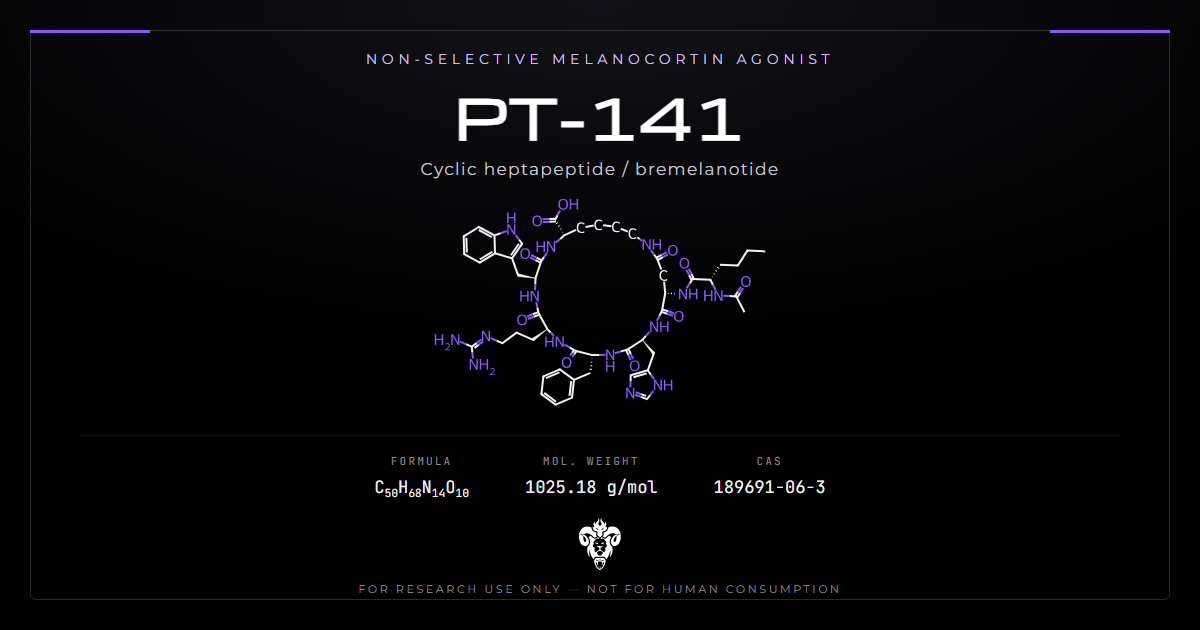
Few research peptides sit in a published receptor structure. PT-141 does. A 2021 cryo-electron microscopy study captured the full-length human melanocortin-4 receptor coupled to its G protein, with bremelanotide occupying the orthosteric pocket [1]. The binding pose is resolved at atomic scale.
The behavioural mechanism is not. A 2025 study built specifically to trace how the peptide acts on the mesolimbic dopamine system found no change in melanocortin receptor expression and no enhancement of the reward measure it used [2].
That gap defines the compound. Chemistry and receptor engagement are settled. The circuit-level account remains an active question, which is what makes PT-141 useful as a reference agonist rather than a finished story.
Chemical identity
A cyclic heptapeptide built on the alpha-melanocyte-stimulating hormone core, closed by a lactam bridge between two side chains.
| Property | Value |
|---|---|
| Sequence | Ac-Nle-cyclo[Asp-His-D-Phe-Arg-Trp-Lys]-OH |
| Common names | PT-141, bremelanotide, PT-14 |
| Molecular formula | C50H68N14O10 |
| Molecular weight | 1025.2 |
| CAS | 189691-06-3 |
| PubChem CID | 9941379 |
| InChIKey | FFHBJDQSGDNCIV-MFVUMRCOSA-N |
Kimera supplies the material as PT-141 (Bremelanotide), 10 mg of lyophilised powder in a 3 mL vial.
Reading the sequence
Four residues carry the pharmacology: His, D-Phe, Arg, Trp. That His-Phe-Arg-Trp motif runs through every melanocortin ligand, endogenous or synthetic, and the D-configuration at position 7 blocks the proteolysis that clears the native hormone.
The lactam bridge
An amide links the Asp side chain to the Lys side chain, closing a 23-membered ring. Cyclisation fixes the pharmacophore in the bound conformation rather than leaving it to find that shape by chance.
PT-141 is melanotan II minus one nitrogen
The relationship is exact and worth stating in atoms. Melanotan II carries the formula C50H69N15O9. PT-141 carries C50H68N14O10. One NH becomes one O.
That single swap converts the C-terminal amide into a free carboxylic acid. Nothing else moves. Both compounds share the InChIKey stereochemical block MFVUMRCOSA, so every stereocentre matches.
Why the lineage matters
Melanotan II entered a 1996 pilot trial as a tanning agent in three volunteers [3]. Pigmentation appeared, and so did an unplanned observation: spontaneous erections, preceded by stretching and yawning, lasting one to five hours. Nausea appeared at most dose levels.
The acid metabolite became its own development programme. Reviews of that programme trace melanotan I, melanotan II and bremelanotide as one lineage of melanocortin receptor agonists [4]. Kimera carries the two parent compounds as Melanotan II and Melanotan I.
The tell for anyone assaying it
Mass spectrometry separates the pair by one unit, and the direction runs opposite to intuition. PT-141 is heavier at 1025.2 against 1024.2, because the substitution trades NH for the heavier O. A supplier confusing the two ships a compound one dalton light, not one dalton heavy.
PT-141 against the rest of the melanocortin family
Five ligands cover most of the published work, and their identity data separate them cleanly.
| Compound | Core | Formula | MW | Status |
|---|---|---|---|---|
| alpha-MSH | Linear tridecapeptide | C77H109N21O19S | 1664.9 | Endogenous ligand |
| Melanotan I | Linear tridecapeptide | C78H111N21O19 | 1646.8 | Approved as afamelanotide |
| Melanotan II | Cyclic heptapeptide amide | C50H69N15O9 | 1024.2 | Discontinued programme |
| PT-141 | Cyclic heptapeptide acid | C50H68N14O10 | 1025.2 | Approved as bremelanotide |
| Setmelanotide | Cyclic octapeptide | C49H68N18O9S2 | 1117.3 | Approved, MC4R-selective |
Two different design strategies
Melanotan I keeps the full 13-residue chain and substitutes two positions. PT-141 throws the chain away and keeps only the pharmacophore, held in a ring. Both approaches beat the native hormone on stability, and they arrive there by opposite routes.
Setmelanotide shows the third route. It reaches genuine MC4R selectivity through a disulfide-closed octapeptide, which is why it, rather than PT-141, became the metabolic agent [19].
What this means for a comparison experiment
Any panel comparing these compounds needs matched conditions. The cyclic pair sits near 1025 daltons and the linear pair near 1650, so a single chromatographic method rarely resolves all four well. Calcium dependence adds a second variable [6].
The receptor and where PT-141 binds
Five melanocortin receptors exist. MC1R governs pigmentation, MC2R responds to adrenocorticotropin, and MC3R with MC4R sit mainly in the central nervous system [5]. PT-141 activates several subtypes rather than one.
A solved structure
The 2021 cryo-EM work resolved four MC4R complexes: with the endogenous ligand alpha-MSH, with afamelanotide, with a small-molecule agonist, and with bremelanotide [1]. Peptide agonists share a conserved binding mode. Small molecules do not, which explains why subtype selectivity has been so hard to engineer.
A companion structure of MC4R with setmelanotide added a mechanistic detail with practical consequences: calcium is necessary for agonist efficacy but not for antagonist binding [6]. Assay buffers therefore change the answer.
Selectivity is a matter of degree
Reviews of melanocortin pharmacology describe the whole ligand class as poorly selective, with the shared pharmacophore as the reason [5]. MC4R is treated as the subtype most relevant to the observed effects at the doses studied [7], not as the only receptor engaged.
Medicinal chemistry continues to attack this. A 2026 series of 14 mid-size macrocycles, built on melanotan II and related scaffolds, produced two selective MC4R antagonists and one selective agonist [8]. Selectivity is achievable, and the older peptides do not have it.
What the registration trials measured
Three trial generations sit behind the compound. Reading them in order shows what the evidence covers and what it does not.
The dose-finding trial
A randomised placebo-controlled trial ran three dose levels against placebo over 12 weeks in premenopausal women, with efficacy data from 327 participants [9]. The primary endpoint was change in satisfying sexual events per month.
Pooled active arms gave +0.7 events per month against +0.2 for placebo. Female Sexual Function Index total score moved +3.6 against +1.9. Distress scores fell 11.1 points against 6.8. Adverse events were nausea, flushing and headache.
RECONNECT
Two identical phase 3 trials randomised 1,267 women, with 1,202 in the efficacy population [10]. Coprimary endpoints covered desire and distress over 24 weeks.
Both reached statistical significance. Desire scores rose 0.30 in one study and 0.42 in the other, integrated at 0.35. Distress scores fell. Mean participant age was 39 and 85.6% of participants were white, which bounds the population the result describes.
The open-label extension
Of 856 eligible completers, 684 continued into a 52-week extension and 272 finished it [11]. That completion rate is itself a finding. Nausea affected 40.4%, flushing 20.6%, headache 12.0%.
A prespecified subgroup analysis across age, weight, body mass index and bioavailable testosterone found the effect held across strata [12].
The effect sizes are small and the trials say so
Desire domain scores moved by roughly a third of a point. Satisfying events moved by half an event per month. Both differences cleared their significance thresholds in populations above 1,000.
Statistical significance and effect magnitude are separate readings, and a large trial resolves small differences well. Regulatory reviews of the programme describe the compound as approved on those endpoints [13][14], with commentary noting the modest scale of the change [15].
The endpoints are subjective instruments
Both coprimary measures are questionnaires. The Female Sexual Function Index desire domain and the Female Sexual Distress Scale item 13 record self-reported states, validated for that purpose and unavoidably noisy.
Nothing about that invalidates the result. It does mean the trials measured reported experience rather than a physiological readout, so anyone looking for a biomarker will not find one in this literature.
What the completion rates add
Of 684 participants entering the 52-week extension, 272 finished [11]. Nausea affected 40% of the treated group across the programme and was the most common reason for stopping [17]. A tolerability profile at that level shapes how much of the efficacy signal survives outside a trial setting.
The cardiovascular signal is real and quantified
Melanocortin agonism at MC4R raises blood pressure. That is a class property rather than an off-target surprise, and one trial was built to measure it.
Ambulatory monitoring
A randomised placebo-controlled parallel-arm study put 397 premenopausal women on ambulatory blood pressure monitoring across three dose levels [16]. Systolic pressure rose 2.4 to 3.2 mmHg above placebo in the four hours after dosing, and diastolic pressure tracked it.
Peak increases typically lasted under 15 minutes. Heart rate fell 4.6 to 4.7 beats per minute at the highest dose. The safety review across 43 completed studies and 3,500 subjects records the same pattern as small, transient and statistically significant [17].
Pigmentation at repeated exposure
That same safety review reports focal hyperpigmentation as rare under labelled use, then records it in more than a third of subjects after up to 16 consecutive daily doses [17]. MC1R activity drove the original tanning programme, and it does not disappear in the acid analogue.
Frequency therefore tracks exposure pattern rather than the molecule alone. A study reporting no pigmentation on intermittent exposure and a study reporting it on daily exposure are both accurate.
What the 2025 hamster study did not find
A female Syrian hamster study set out to locate the mechanism in the mesolimbic dopamine system [2]. Its results run against the expected account, which is why it deserves reading in full rather than in summary.
Where the receptors sit
Most MC3R and MC4R mRNA appeared in dopamine neurons of the ventral tegmental area. In the nucleus accumbens and dorsal striatum, fewer neurons carried MC4R, and those rarely overlapped with D1 or D2 receptor neurons. Accumbens MC4R sat in interneurons instead.
The two negative results
Neither the low nor the high dose changed melanocortin receptor mRNA expression anywhere in that system. Sexual experience produced a conditioned place preference in these animals, and the peptide failed to enhance it.
The proposed mechanism holds that the compound acts on presynaptic MC4R in the medial preoptic area, raising dopamine release [7]. The hamster data do not contradict that anatomy. They fail to reproduce the downstream reward signal in the model tested, and the authors present the result as discrepant.
Why a negative result carries weight here
Two features make this study hard to set aside. It looked in the right place, finding MC3R and MC4R message concentrated in ventral tegmental dopamine neurons exactly as the model predicts. And it tested two dose levels rather than one, so a simple exposure explanation does not cover the outcome.
The anatomical finding also complicates the account in its own right. Accumbens MC4R sat on interneurons and rarely on D1 or D2 neurons, so any dopaminergic effect in that region runs through an extra synapse. A mechanism written as direct action on reward neurons does not match the expression map.
Read together with the receptor structure [1], the picture is a compound whose molecular target is certain and whose behavioural pathway is inferred. Reference agonists are useful in precisely that state, because the open question is answerable with the reagent in hand.
PT-141 outside sexual behaviour
Two lines of work use the same receptor engagement for unrelated endpoints. Both are early, and neither transfers to the clinical population above.
Caloric intake and body weight
MC4R agonism promotes satiety, so two phase 1 trials examined the effect in women with a body mass index above 30 [18]. In the first, 27 of 30 participants completed 16 days, and body weight fell 1.3 kg relative to placebo. Mean caloric intake dropped by roughly 400 kcal per day.
That result sits alongside the wider case for the central melanocortin system as a metabolic target [19]. Setmelanotide, not this compound, is the approved agent in that space.
Glioblastoma cell lines
A 2024 study applied bremelanotide to human glioblastoma cell lines [20]. It reduced survivin expression and induced cell death at concentrations that spared normal human cells. An MC3R and MC4R antagonist abolished both effects, and forced survivin overexpression prevented the cell death.
This is in vitro work in cell lines. It identifies the receptors as candidate targets and says nothing about any intact organism.
How to read a PT-141 study
Four questions separate a usable paper from a misleading one.
Which melanocortin peptide?
Melanotan I, melanotan II and PT-141 appear in overlapping literature and share a pharmacophore. Check the formula rather than the name. Reviews covering all three exist precisely because the field conflates them [4].
Which receptor subtype?
A paper reporting an MC4R effect in a system expressing several subtypes has attributed rather than isolated. Antagonist controls, as in the glioblastoma work [20], are what convert attribution into evidence.
Which model?
Cell line, hamster, and a 1,200-participant trial answer different questions. The hamster result [2] and the RECONNECT result [10] are both sound and do not settle each other.
Was calcium controlled?
Agonist efficacy at MC4R depends on it [6]. A binding number produced without that control is not comparable to one produced with it.
Verifying research material
PT-141 is a defined chemical entity with published identifiers, so verification is arithmetic rather than judgement. Batch documentation sits on the certificates of analysis page.
Identity
Formula C50H68N14O10 and InChIKey FFHBJDQSGDNCIV-MFVUMRCOSA-N. Mass spectrometry should return a molecular weight near 1025.2, and the doubly charged ion is the practical precursor. A result near 1024.2 indicates melanotan II.
Purity and stereochemistry
The D-phenylalanine at position 7 defines the molecule, and mass spectrometry cannot see it. An epimer carries the same formula and the same mass. Chiral amino acid analysis after hydrolysis answers the question, and nothing cheaper does.
The lactam bridge needs its own check. A linear impurity with an unformed ring shares the elemental composition of the hydrolysed product, so ring closure needs chromatographic confirmation rather than mass alone.
Handling
Tryptophan and histidine both absorb ultraviolet light and degrade under it. Suppliers ship the material lyophilised for that reason. A reconstituted unformulated peptide carries none of the stabilisation a finished drug product provides.
Two degradation routes matter for assay work. Tryptophan oxidises, which shifts mass by 16 daltons and shows up as a late-eluting shoulder. The lactam bridge hydrolyses under acid, opening the ring and adding 18 daltons. Both products retain enough of the parent signal to pass a careless identity check.
Store lyophilised material cold and dark, and treat aliquot count as a real variable. Freeze-thaw cycling degrades cyclic peptides faster than the storage interval alone predicts, so a vial opened weekly and a vial opened once are not equivalent starting material even at the same nominal age.
Common questions about PT-141
Is PT-141 the same thing as bremelanotide? Yes. One compound, two names, plus the development code PT-14.
How does it differ from melanotan II? By one atom. The C-terminal amide becomes a carboxylic acid, taking the formula from C50H69N15O9 to C50H68N14O10 [3][4].
Is it selective for MC4R? No. It activates several melanocortin subtypes, and MC4R is treated as the most relevant one at studied doses [7]. Genuinely selective macrocycles came later [8].
Does it still cause pigmentation? Yes, at repeated exposure. More than a third of subjects showed focal hyperpigmentation after up to 16 consecutive daily doses [17].
Why does blood pressure appear in every safety discussion? Because MC4R agonism raises it, and one trial quantified the rise at 2.4 to 3.2 mmHg systolic with peaks under 15 minutes [16].
What is the strongest evidence for a mechanism? The receptor structure [1]. The behavioural mechanism has weaker support and one recent negative result [2].
Why does calcium appear in binding protocols? Agonist efficacy at MC4R requires it, while antagonist binding does not, so buffer composition changes the measured potency [6].
Which melanocortin peptide is actually MC4R-selective? Setmelanotide, a disulfide-closed octapeptide, rather than any compound in the melanotan lineage [19]. Selective macrocycles reported in 2026 came from a separate design effort [8].
Summary of the evidence
Strongest evidence: a solved cryo-EM structure with the compound in the MC4R pocket [1], two phase 3 trials above 1,200 participants [10] with a 52-week extension [11], a dedicated ambulatory blood pressure trial in 397 participants [16], and a safety review spanning 43 studies [17].
Weakest evidence: the circuit-level mechanism. The leading account rests on preoptic dopamine release [7], and the study built to test it in hamsters returned two negative results [2]. Metabolic [18] and oncology [20] applications are phase 1 and in vitro respectively.
Read plainly, PT-141 is a well-characterised, poorly selective melanocortin agonist with a resolved binding pose, a quantified cardiovascular profile, and an unfinished mechanistic account. That combination is what a reference agonist looks like.
The rest of the melanocortin family sits in the peptides category.
Status: supplied for laboratory research use only.
References
- Zhang H, Chen LN, Yang D, Mao C, Shen Q, Feng W, Shen DD, Dai A, et al. Structural insights into ligand recognition and activation of the melanocortin-4 receptor. Cell Res. 2021;31(11):1163-1175. PMID 34433901. DOI
- Borland JM, Kohut-Jackson AL, Peyla AC, Hall MA, Mermelstein PG, Meisel RL. Female Syrian hamster analyses of bremelanotide, a US FDA approved drug for the treatment of female hypoactive sexual desire disorder. Neuropharmacology. 2025;267:110299. PMID 39793696. DOI
- Dorr RT, Lines R, Levine N, Brooks C, Xiang L, Hruby VJ, Hadley ME. Evaluation of melanotan-II, a superpotent cyclic melanotropic peptide in a pilot phase-I clinical study. Life Sci. 1996;58(20):1777-1784. PMID 8637402. DOI
- Ückert S, Bannowsky A, Albrecht K, Kuczyk MA. Melanocortin receptor agonists in the treatment of male and female sexual dysfunctions: results from basic research and clinical studies. Expert Opin Investig Drugs. 2014;23(11):1477-1483. PMID 25096243. DOI
- Yuan XC, Tao YX. Ligands for melanocortin receptors: beyond melanocyte-stimulating hormones and adrenocorticotropin. Biomolecules. 2022;12(10):1407. PMID 36291616. DOI
- Israeli H, Degtjarik O, Fierro F, Chunilal V, Gill AK, Roth NJ, Botta J, Prabahar V, et al. Structure reveals the activation mechanism of the MC4 receptor to initiate satiation signaling. Science. 2021;372(6544):808-814. PMID 33858992. DOI
- Pfaus JG, Sadiq A, Spana C, Clayton AH. The neurobiology of bremelanotide for the treatment of hypoactive sexual desire disorder in premenopausal women. CNS Spectr. 2022;27(3):281-289. PMID 33455598. DOI
- Merlino F, Jia L, Boccino I, Carotenuto A, Tammaro F, Santoro F, Thompson PE, Grieco P. Goldilocks-inspired design of mid-size macrocycles for selective targeting of human melanocortin receptors. J Med Chem. 2026;69(15):18800-18812. PMID 42340853. DOI
- Clayton AH, Althof SE, Kingsberg S, DeRogatis LR, Kroll R, Goldstein I, Kaminetsky J, Spana C, et al. Bremelanotide for female sexual dysfunctions in premenopausal women: a randomized, placebo-controlled dose-finding trial. Womens Health (Lond). 2016;12(3):325-337. PMID 27181790. DOI
- Kingsberg SA, Clayton AH, Portman D, Williams LA, Krop J, Jordan R, Lucas J, Simon JA. Bremelanotide for the treatment of hypoactive sexual desire disorder: two randomized phase 3 trials. Obstet Gynecol. 2019;134(5):899-908. PMID 31599840. DOI
- Simon JA, Kingsberg SA, Portman D, Williams LA, Krop J, Jordan R, Lucas J, Clayton AH. Long-term safety and efficacy of bremelanotide for hypoactive sexual desire disorder. Obstet Gynecol. 2019;134(5):909-917. PMID 31599847. DOI
- Simon JA, Kingsberg SA, Portman D, Jordan R, Lucas J, Sadiq A, Krop J, Clayton AH. Prespecified and integrated subgroup analyses from the RECONNECT phase 3 studies of bremelanotide. J Womens Health (Larchmt). 2022;31(3):391-400. PMID 35230162. DOI
- Dhillon S, Keam SJ. Bremelanotide: first approval. Drugs. 2019;79(14):1599-1606. PMID 31429064. DOI
- Mayer D, Lynch SE. Bremelanotide: new drug approved for treating hypoactive sexual desire disorder. Ann Pharmacother. 2020;54(7):684-690. PMID 31893927. DOI
- Cipriani S, Alfaroli C, Maseroli E, Vignozzi L. An evaluation of bremelanotide injection for the treatment of hypoactive sexual desire disorder. Expert Opin Pharmacother. 2023;24(1):15-21. PMID 36242769. DOI
- White WB, Myers MG, Jordan R, Lucas J. Usefulness of ambulatory blood pressure monitoring to assess the melanocortin receptor agonist bremelanotide. J Hypertens. 2017;35(4):761-768. PMID 27977473. DOI
- Clayton AH, Kingsberg SA, Portman D, Sadiq A, Krop J, Jordan R, Lucas J, Simon JA. Safety profile of bremelanotide across the clinical development program. J Womens Health (Larchmt). 2022;31(2):171-182. PMID 35147466. DOI
- Spana C, Jordan R, Fischkoff S. Effect of bremelanotide on body weight of obese women: data from two phase 1 randomized controlled trials. Diabetes Obes Metab. 2022;24(6):1084-1093. PMID 35170192. DOI
- Sweeney P, Gimenez LE, Hernandez CC, Cone RD. Targeting the central melanocortin system for the treatment of metabolic disorders. Nat Rev Endocrinol. 2023;19(9):507-519. PMID 37365323. DOI
- Suzuki S, Kitanaka C, Okada M. Melanocortin receptor agonist bremelanotide induces cell death and growth inhibition in glioblastoma cells via suppression of survivin expression. Anticancer Res. 2024;44(9):3875-3883. PMID 39197897. DOI
PT-141 (Bremelanotide) is sold for laboratory research use only. Not for human consumption, nor medical, veterinary, or household uses.